About the Report
Base Year 2024Global Advanced Metering Infrastructure Market Overview
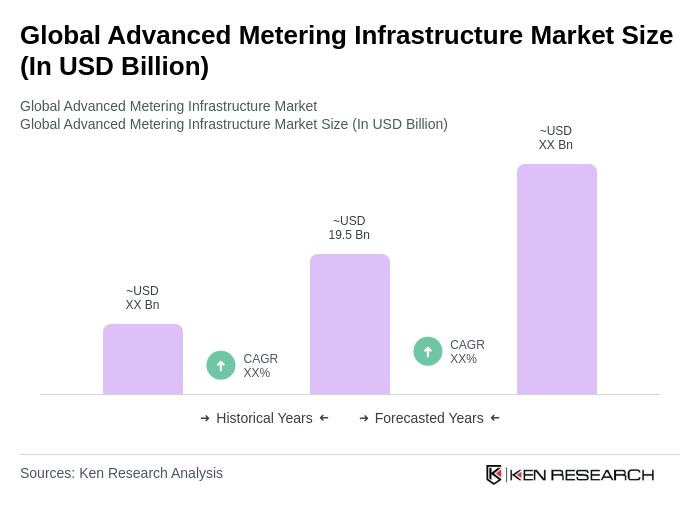
- The Global Advanced Metering Infrastructure Market is valued at USD 19.5 billion, based on a five-year historical analysis. Growth is driven by government mandates for smart metering, large-scale smart grid programs, and accelerated digitalization of utilities, with corroborated market sizes in the same range reported by multiple industry trackers.
- Key players in this market include the United States, Germany, and China, supported by extensive smart grid investment, policy mandates, and utility-scale rollouts. North America has historically held a major share due to federally supported AMI programs, while Europe and China continue nationwide metering initiatives and grid modernization.
- In 2023, the European Union updated the Energy Efficiency Directive; however, there is no EU-wide mandate for at least 80% of consumers to be equipped with smart meters by 2024. EU policy includes provisions for smart metering deployment under the Electricity Directive and related country-specific targets, with many member states aiming for high-penetration rollouts by mid-2020s to early 2030s, but not a uniform 80% by 2024 requirement.
Global Advanced Metering Infrastructure Market Segmentation
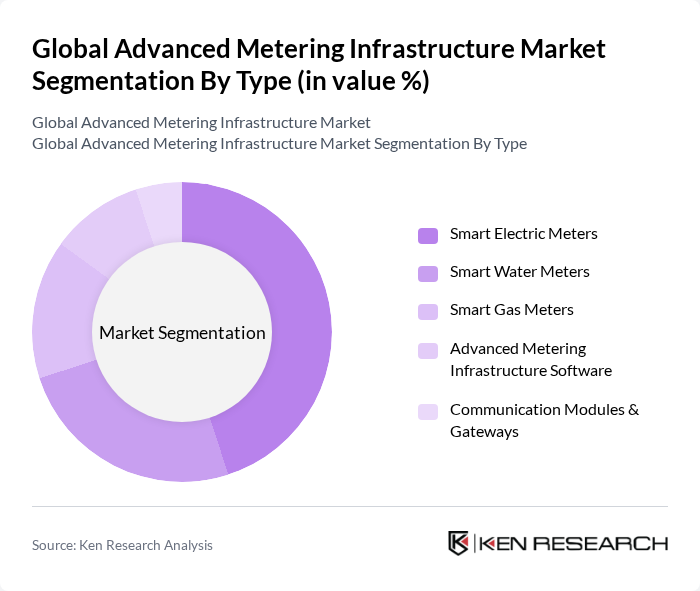
By Type:The market is segmented into various types, including Smart Electric Meters, Smart Water Meters, Smart Gas Meters, Advanced Metering Infrastructure Software, and Communication Modules & Gateways. Among these, Smart Electric Meters are leading the market due to widespread national rollouts and utility regulatory drivers; water and gas smart metering are growing as utilities target non-revenue water reduction, leak detection, and safety improvements.
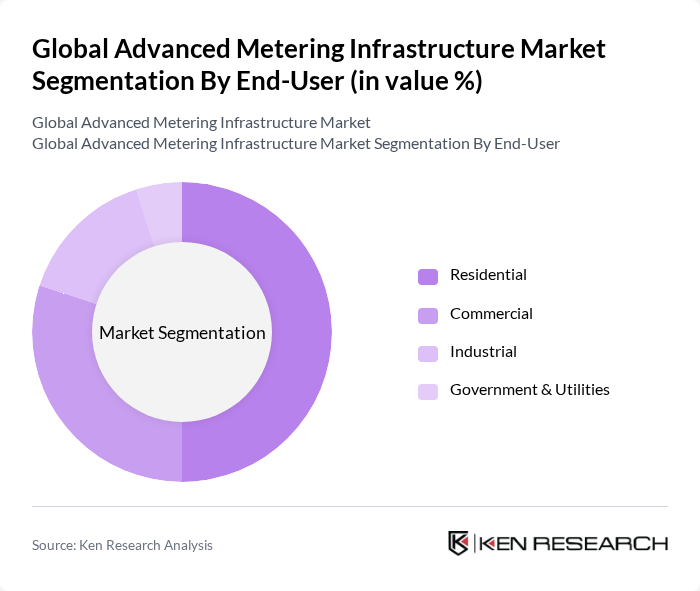
By End-User:The end-user segmentation includes Residential, Commercial, Industrial, and Government & Utilities. The Residential segment is the largest, reflecting the focus of most large-scale AMI deployments on mass-market households under national and utility programs; commercial and industrial users adopt AMI for interval data, power quality monitoring, and demand optimization; government and utilities segments are supported by smart grid mandates and modernization funding.
Global Advanced Metering Infrastructure Market Competitive Landscape
The Global Advanced Metering Infrastructure Market is characterized by a dynamic mix of regional and international players. Leading participants such as Itron, Inc., Landis+Gyr AG, Siemens AG, Schneider Electric SE, Honeywell International Inc., Sensus (Xylem Inc.), Aclara Technologies LLC (a Hubbell company), Elster Group GmbH (Elster, a Honeywell company), Kamstrup A/S, Trilliant Holdings, Inc., Oracle Corporation (Utilities & Opower), Cisco Systems, Inc., ABB Ltd., GE Vernova (Grid Solutions & Digital), Enel Grids (including e-distribuzione, Italy), Sagemcom Energy & Telecom, Hexing Electrical Co., Ltd., Ningbo Sanxing Electric Co., Ltd. (Sansion), Wasion Holdings Limited, Holley Technology Ltd., EDMI Limited (a TTCL company), Iskraemeco, d.d., ZIV Automation (Arteche Group), S&T Smart Energy (formerly Addnergie/Networked Energy Services), Vodafone Group Plc (IoT/NB-IoT for AMI), Telefonica Tech (IoT & Big Data for AMI), L&T Electrical & Automation (Schneider Electric India), Genus Power Infrastructures Ltd., Secure Meters Limited, CyanConnode Holdings plc contribute to innovation, geographic expansion, and service delivery in this space.
Global Advanced Metering Infrastructure Market Industry Analysis
Growth Drivers
- Increasing Demand for Energy Efficiency:The global push for energy efficiency is driving the adoption of advanced metering infrastructure (AMI). In future, energy consumption is projected to reach 6,500 terawatt-hours (TWh), with a significant portion attributed to residential and commercial sectors. Governments are targeting a 25% reduction in energy waste by 2030, which translates to approximately 1,625 TWh. This demand for efficiency is propelling investments in AMI technologies, as utilities seek to optimize energy distribution and reduce operational costs.
- Government Initiatives for Smart Grids:Governments worldwide are increasingly investing in smart grid initiatives, with an estimated $120 billion allocated for smart grid projects in future. This funding aims to enhance grid reliability and integrate renewable energy sources. For instance, the U.S. Department of Energy has committed $8 billion to support smart grid technologies, which includes advanced metering solutions. Such initiatives are crucial for modernizing infrastructure and improving energy management, thereby driving AMI market growth.
- Technological Advancements in Metering Solutions:The AMI market is experiencing rapid technological advancements, particularly in IoT and AI integration. In future, the global IoT market is expected to reach $1.5 trillion, with smart metering solutions playing a pivotal role. Innovations such as real-time data analytics and predictive maintenance are enhancing operational efficiency. For example, AI-driven analytics can reduce meter reading errors by up to 35%, significantly improving service delivery and customer satisfaction, thus fueling AMI adoption.
Market Challenges
- High Initial Investment Costs:One of the primary challenges facing the AMI market is the high initial investment required for deployment. The average cost of installing smart meters ranges from $250 to $350 per unit, with utilities needing to invest billions for widespread implementation. For instance, a utility serving 1.5 million customers may face upfront costs exceeding $400 million. This financial burden can deter smaller utilities from adopting AMI, limiting market growth potential.
- Data Privacy and Security Concerns:As AMI systems collect vast amounts of consumer data, concerns regarding data privacy and security are escalating. In future, cyberattacks on utility infrastructure are projected to increase by 30%, with potential breaches leading to significant financial losses. Utilities must invest in robust cybersecurity measures, which can add an additional 20-25% to overall project costs. This challenge poses a significant barrier to AMI adoption, as consumer trust is paramount for successful implementation.
Global Advanced Metering Infrastructure Market Future Outlook
The future of the AMI market appears promising, driven by ongoing technological advancements and increasing regulatory support. As utilities continue to modernize their infrastructure, the integration of AI and machine learning will enhance operational efficiencies and customer engagement. Additionally, the growing emphasis on sustainability will further accelerate the adoption of renewable energy sources, necessitating advanced metering solutions. This evolving landscape presents significant opportunities for innovation and collaboration among stakeholders in the energy sector.
Market Opportunities
- Expansion in Emerging Markets:Emerging markets present substantial growth opportunities for AMI deployment. Countries like India and Brazil are investing heavily in smart grid technologies, with projected investments of $20 billion and $15 billion, respectively, in future. This expansion is driven by the need for improved energy access and efficiency, creating a favorable environment for AMI solutions.
- Development of IoT-Enabled Solutions:The rise of IoT-enabled solutions offers significant market potential. In future, the global IoT-enabled smart meter market is expected to reach $7 billion. This growth is fueled by the demand for real-time data analytics and enhanced customer engagement, allowing utilities to optimize energy distribution and improve service delivery, thus creating a competitive edge in the AMI landscape.
Scope of the Report
| Segment | Sub-Segments |
|---|---|
| By Type | Smart Electric Meters Smart Water Meters Smart Gas Meters Advanced Metering Infrastructure Software Communication Modules & Gateways |
| By End-User | Residential Commercial Industrial Government & Utilities |
| By Region | North America Europe Asia-Pacific Latin America Middle East & Africa |
| By Technology | Cellular (2G/3G/4G LTE/5G) RF Mesh Power Line Communication (PLC) NB-IoT & LPWAN |
| By Application | Advanced Metering (AMI) & Meter Data Management Billing and Revenue Management Demand Response & Load Management Outage Management & Remote Connect/Disconnect |
| By Investment Source | Private Investments Public Funding Public-Private Partnerships (PPP) & Joint Ventures Multilateral & Development Finance |
| By Policy Support | Government Subsidies Tax Incentives Regulatory Mandates & Standards Data Privacy & Cybersecurity Compliance |
Key Target Audience
Investors and Venture Capitalist Firms
Government and Regulatory Bodies (e.g., Federal Energy Regulatory Commission, Department of Energy)
Utility Companies
Smart Grid Technology Providers
Energy Management Firms
Telecommunications Companies
Infrastructure Development Agencies
Energy Policy Advocacy Groups
Players Mentioned in the Report:
Itron, Inc.
Landis+Gyr AG
Siemens AG
Schneider Electric SE
Honeywell International Inc.
Sensus (Xylem Inc.)
Aclara Technologies LLC (a Hubbell company)
Elster Group GmbH (Elster, a Honeywell company)
Kamstrup A/S
Trilliant Holdings, Inc.
Oracle Corporation (Utilities & Opower)
Cisco Systems, Inc.
ABB Ltd.
GE Vernova (Grid Solutions & Digital)
Enel Grids (including e-distribuzione, Italy)
Sagemcom Energy & Telecom
Hexing Electrical Co., Ltd.
Ningbo Sanxing Electric Co., Ltd. (Sansion)
Wasion Holdings Limited
Holley Technology Ltd.
EDMI Limited (a TTCL company)
Iskraemeco, d.d.
ZIV Automation (Arteche Group)
S&T Smart Energy (formerly Addnergie/Networked Energy Services)
Vodafone Group Plc (IoT/NB-IoT for AMI)
Telefonica Tech (IoT & Big Data for AMI)
L&T Electrical & Automation (Schneider Electric India)
Genus Power Infrastructures Ltd.
Secure Meters Limited
CyanConnode Holdings plc
Table of Contents
Market Assessment Phase
1. Executive Summary and Approach
2. Global Advanced Metering Infrastructure Market Overview
2.1 Key Insights and Strategic Recommendations
2.2 Global Advanced Metering Infrastructure Market Overview
2.3 Definition and Scope
2.4 Evolution of Market Ecosystem
2.5 Timeline of Key Regulatory Milestones
2.6 Value Chain & Stakeholder Mapping
2.7 Business Cycle Analysis
2.8 Policy & Incentive Landscape
3. Global Advanced Metering Infrastructure Market Analysis
3.1 Growth Drivers
3.1.1 Increasing Demand for Energy Efficiency
3.1.2 Government Initiatives for Smart Grids
3.1.3 Technological Advancements in Metering Solutions
3.1.4 Rising Consumer Awareness on Energy Consumption
3.2 Market Challenges
3.2.1 High Initial Investment Costs
3.2.2 Data Privacy and Security Concerns
3.2.3 Integration with Legacy Systems
3.2.4 Regulatory Compliance Issues
3.3 Market Opportunities
3.3.1 Expansion in Emerging Markets
3.3.2 Development of IoT-Enabled Solutions
3.3.3 Partnerships with Utility Companies
3.3.4 Adoption of Renewable Energy Sources
3.4 Market Trends
3.4.1 Shift Towards Cloud-Based Solutions
3.4.2 Increasing Use of AI and Machine Learning
3.4.3 Focus on Customer-Centric Services
3.4.4 Growth of Decentralized Energy Systems
3.5 Government Regulation
3.5.1 Energy Efficiency Standards
3.5.2 Smart Metering Mandates
3.5.3 Data Protection Regulations
3.5.4 Incentives for Renewable Energy Integration
4. SWOT Analysis
5. Stakeholder Analysis
6. Porter's Five Forces Analysis
7. Global Advanced Metering Infrastructure Market Market Size, 2019-2024
7.1 By Value
7.2 By Volume
7.3 By Average Selling Price
8. Global Advanced Metering Infrastructure Market Segmentation
8.1 By Type
8.1.1 Smart Electric Meters
8.1.2 Smart Water Meters
8.1.3 Smart Gas Meters
8.1.4 Advanced Metering Infrastructure Software
8.1.5 Communication Modules & Gateways
8.2 By End-User
8.2.1 Residential
8.2.2 Commercial
8.2.3 Industrial
8.2.4 Government & Utilities
8.3 By Region
8.3.1 North America
8.3.2 Europe
8.3.3 Asia-Pacific
8.3.4 Latin America
8.3.5 Middle East & Africa
8.4 By Technology
8.4.1 Cellular (2G/3G/4G LTE/5G)
8.4.2 RF Mesh
8.4.3 Power Line Communication (PLC)
8.4.4 NB-IoT & LPWAN
8.5 By Application
8.5.1 Advanced Metering (AMI) & Meter Data Management
8.5.2 Billing and Revenue Management
8.5.3 Demand Response & Load Management
8.5.4 Outage Management & Remote Connect/Disconnect
8.6 By Investment Source
8.6.1 Private Investments
8.6.2 Public Funding
8.6.3 Public-Private Partnerships (PPP) & Joint Ventures
8.6.4 Multilateral & Development Finance
8.7 By Policy Support
8.7.1 Government Subsidies
8.7.2 Tax Incentives
8.7.3 Regulatory Mandates & Standards
8.7.4 Data Privacy & Cybersecurity Compliance
9. Global Advanced Metering Infrastructure Market Competitive Analysis
9.1 Market Share of Key Players
9.2 Cross Comparison of Key Players
9.2.1 Company Name
9.2.2 Group Size (Large, Medium, or Small as per industry convention)
9.2.3 AMI/Smart Meter Revenue (latest fiscal year, USD)
9.2.4 Global AMI Installed Base (cumulative meters)
9.2.5 Annual Meter Shipments (units)
9.2.6 Win Rate in Utility Tenders (%)
9.2.7 Geographic Reach (countries/regions served)
9.2.8 R&D Intensity (% of revenue)
9.2.9 Communications Technology Portfolio (RF mesh, PLC, Cellular, NB-IoT)
9.2.10 Interoperability/Standards Support (DLMS/COSEM, IEEE 802.15.4g, PRIME/G3-PLC)
9.2.11 Cybersecurity Certifications (e.g., ISO/IEC 27001, Common Criteria)
9.2.12 Utility Customer Retention/Contract Renewal Rate (%)
9.2.13 SaaS/MDMS Subscribers or ARR (USD)
9.2.14 Average Selling Price (meter, comms module)
9.2.15 Gross Margin (%)
9.2.16 Market Share Percentage
9.3 SWOT Analysis of Top Players
9.4 Pricing Analysis
9.5 Detailed Profile of Major Companies
9.5.1 Itron, Inc.
9.5.2 Landis+Gyr AG
9.5.3 Siemens AG
9.5.4 Schneider Electric SE
9.5.5 Honeywell International Inc.
9.5.6 Sensus (Xylem Inc.)
9.5.7 Aclara Technologies LLC (a Hubbell company)
9.5.8 Elster Group GmbH (Elster, a Honeywell company)
9.5.9 Kamstrup A/S
9.5.10 Trilliant Holdings, Inc.
9.5.11 Oracle Corporation (Utilities & Opower)
9.5.12 Cisco Systems, Inc.
9.5.13 ABB Ltd.
9.5.14 GE Vernova (Grid Solutions & Digital)
9.5.15 Enel Grids (including e-distribuzione, Italy)
9.5.16 Sagemcom Energy & Telecom
9.5.17 Hexing Electrical Co., Ltd.
9.5.18 Ningbo Sanxing Electric Co., Ltd. (Sansion)
9.5.19 Wasion Holdings Limited
9.5.20 Holley Technology Ltd.
9.5.21 EDMI Limited (a TTCL company)
9.5.22 Iskraemeco, d.d.
9.5.23 ZIV Automation (Arteche Group)
9.5.24 S&T Smart Energy (formerly Addnergie/Networked Energy Services)
9.5.25 Vodafone Group Plc (IoT/NB-IoT for AMI)
9.5.26 Telefonica Tech (IoT & Big Data for AMI)
9.5.27 L&T Electrical & Automation (Schneider Electric India)
9.5.28 Genus Power Infrastructures Ltd.
9.5.29 Secure Meters Limited
9.5.30 CyanConnode Holdings plc
10. Global Advanced Metering Infrastructure Market End-User Analysis
10.1 Procurement Behavior of Key Ministries
10.1.1 Budget Allocation Trends
10.1.2 Decision-Making Processes
10.1.3 Procurement Cycles
10.2 Corporate Spend on Infrastructure & Energy
10.2.1 Investment Priorities
10.2.2 Spending Patterns
10.2.3 Cost-Benefit Analysis
10.3 Pain Point Analysis by End-User Category
10.3.1 Common Challenges Faced
10.3.2 Service Gaps
10.3.3 Technology Adoption Barriers
10.4 User Readiness for Adoption
10.4.1 Awareness Levels
10.4.2 Training Needs
10.4.3 Infrastructure Readiness
10.5 Post-Deployment ROI and Use Case Expansion
10.5.1 Performance Metrics
10.5.2 Case Studies
10.5.3 Future Use Cases
11. Global Advanced Metering Infrastructure Market Future Size, 2025-2030
11.1 By Value
11.2 By Volume
11.3 By Average Selling Price
Go-To-Market Strategy Phase
1. Whitespace Analysis + Business Model Canvas
1.1 Market Gaps Identification
1.2 Business Model Framework
2. Marketing and Positioning Recommendations
2.1 Branding Strategies
2.2 Product USPs
3. Distribution Plan
3.1 Urban Retail Strategies
3.2 Rural NGO Tie-Ups
4. Channel & Pricing Gaps
4.1 Underserved Routes
4.2 Pricing Bands
5. Unmet Demand & Latent Needs
5.1 Category Gaps
5.2 Consumer Segments
6. Customer Relationship
6.1 Loyalty Programs
6.2 After-Sales Service
7. Value Proposition
7.1 Sustainability Initiatives
7.2 Integrated Supply Chains
8. Key Activities
8.1 Regulatory Compliance
8.2 Branding Efforts
8.3 Distribution Setup
9. Entry Strategy Evaluation
9.1 Domestic Market Entry Strategy
9.1.1 Product Mix Considerations
9.1.2 Pricing Band Strategies
9.1.3 Packaging Options
9.2 Export Entry Strategy
9.2.1 Target Countries
9.2.2 Compliance Roadmap
10. Entry Mode Assessment
10.1 Joint Ventures
10.2 Greenfield Investments
10.3 Mergers & Acquisitions
10.4 Distributor Model
11. Capital and Timeline Estimation
11.1 Capital Requirements
11.2 Timelines for Implementation
12. Control vs Risk Trade-Off
12.1 Ownership Considerations
12.2 Partnerships Evaluation
13. Profitability Outlook
13.1 Breakeven Analysis
13.2 Long-Term Sustainability
14. Potential Partner List
14.1 Distributors
14.2 Joint Ventures
14.3 Acquisition Targets
15. Execution Roadmap
15.1 Phased Plan for Market Entry
15.1.1 Market Setup
15.1.2 Market Entry
15.1.3 Growth Acceleration
15.1.4 Scale & Stabilize
15.2 Key Activities and Milestones
15.2.1 Milestone Planning
15.2.2 Activity Tracking
Research Methodology
Phase 1: Approach1
Desk Research
- Industry reports from global energy and utility associations
- Market analysis publications from research firms specializing in smart grid technologies
- Government publications and white papers on energy efficiency and metering regulations
Primary Research
- Interviews with utility executives and smart metering project managers
- Surveys with technology providers and system integrators in the metering space
- Field interviews with end-users, including residential and commercial customers
Validation & Triangulation
- Cross-validation of findings through multiple data sources, including market reports and expert opinions
- Triangulation of data from utility companies, technology vendors, and regulatory bodies
- Sanity checks through expert panel discussions and feedback sessions
Phase 2: Market Size Estimation1
Top-down Assessment
- Analysis of global energy consumption trends and their impact on metering infrastructure
- Segmentation of the market by technology type (AMR, AMI) and application (residential, commercial, industrial)
- Incorporation of government initiatives promoting smart grid technologies and renewable energy integration
Bottom-up Modeling
- Estimation of unit sales based on historical data from leading metering manufacturers
- Operational cost analysis derived from installation and maintenance expenses of metering systems
- Volume x pricing model for different metering technologies and service contracts
Forecasting & Scenario Analysis
- Multi-variable regression analysis incorporating factors such as energy prices, regulatory changes, and technological advancements
- Scenario modeling based on varying rates of adoption of smart metering technologies across regions
- Development of baseline, optimistic, and pessimistic forecasts through 2030
Phase 3: CATI Sample Composition1
| Scope Item/Segment | Sample Size | Target Respondent Profiles |
|---|---|---|
| Residential Smart Meter Adoption | 150 | Homeowners, Utility Customer Service Representatives |
| Commercial Metering Solutions | 100 | Facility Managers, Energy Efficiency Consultants |
| Industrial Metering Systems | 80 | Plant Managers, Energy Managers |
| Utility Infrastructure Investments | 120 | Utility Executives, Project Managers |
| Smart Grid Technology Providers | 90 | Product Development Managers, Sales Directors |
Frequently Asked Questions
What is the current value of the Global Advanced Metering Infrastructure Market?
The Global Advanced Metering Infrastructure Market is valued at approximately USD 19.5 billion, based on a five-year historical analysis. This valuation reflects the increasing demand for smart metering solutions driven by government mandates and digitalization in utilities.
What factors are driving the growth of the Advanced Metering Infrastructure Market?
Which regions are leading in the Advanced Metering Infrastructure Market?
What types of smart meters are included in the Advanced Metering Infrastructure?
Other Regional/Country Reports
Indonesia Advanced Metering Infrastructure Market
Malaysia Advanced Metering Infrastructure Market
APAC Advanced Metering Infrastructure Market
SEA Advanced Metering Infrastructure Market
Why Buy From Us?

What makes us stand out is that our consultants follow Robust, Refine and Result (RRR) methodology. Robust for clear definitions, approaches and sanity checking, Refine for differentiating respondents' facts and opinions, and Result for presenting data with story.

We have set a benchmark in the industry by offering our clients with syndicated and customized market research reports featuring coverage of entire market as well as meticulous research and analyst insights.

While we don't replace traditional research, we flip the method upside down. Our dual approach of Top Bottom & Bottom Top ensures quality deliverable by not just verifying company fundamentals but also looking at the sector and macroeconomic factors.

With one step in the future, our research team constantly tries to show you the bigger picture. We help with some of the tough questions you may encounter along the way: How is the industry positioned? Best marketing channel? KPI's of competitors? By aligning every element, we help maximize success.

Our report gives you instant access to the answers and sources that other companies might choose to hide. We elaborate each steps of research methodology we have used and showcase you the sample size to earn your trust.

If you need any support, we are here! We pride ourselves on universe strength, data quality, and quick, friendly, and professional service.