About the Report
Base Year 2024Global Aerial Imaging Market Overview
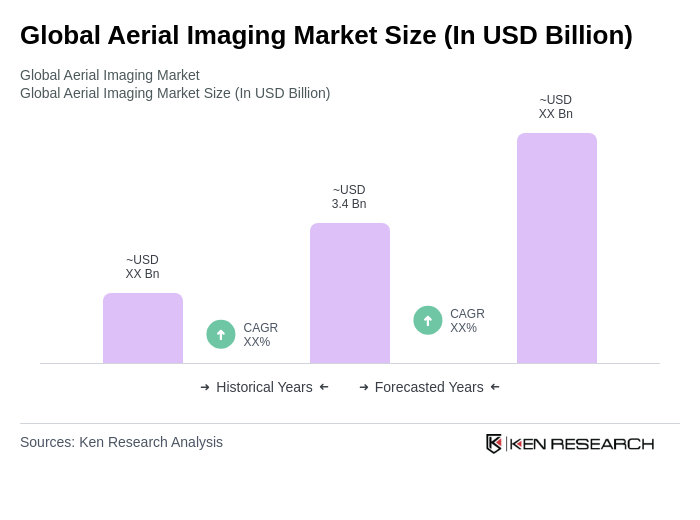
- The Global Aerial Imaging Market is valued at USD 3.4 billion, based on a five-year historical analysis. This growth is primarily driven by advancements in drone and UAV technologies, high-resolution sensors, and improved data processing/analytics that enhance the quality and accessibility of aerial imagery.
- Key players in this market include the United States, Canada, and China, which dominate due to strong technological infrastructure, robust investment in drones and geospatial capabilities, and widespread demand across sectors including construction, agriculture, and defense; North America holds a leading share and continues to adopt aerial imaging broadly in public and private applications.
- In 2023, the U.S. government advanced rules enabling broader commercial drone operations in populated areas through Remote ID requirements and expanded waivers for operations such as flights over people and beyond visual line of sight, intended to enhance safety and facilitate commercial use cases including urban aerial imaging.
Global Aerial Imaging Market Segmentation
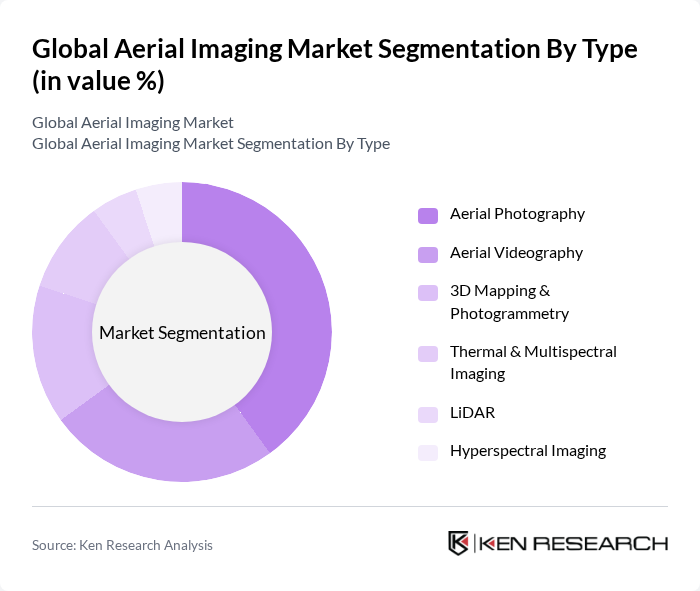
By Type:The aerial imaging market is segmented into various types, including Aerial Photography, Aerial Videography, 3D Mapping & Photogrammetry, Thermal & Multispectral Imaging, LiDAR, and Hyperspectral Imaging. Among these,Aerial Photographyis the most dominant segment, supported by extensive use in real estate listings, infrastructure documentation, and environmental monitoring; the proliferation of consumer and professional drones with high-resolution cameras has accelerated adoption.Aerial Videographyfollows closely, gaining traction in media and entertainment as well as marketing and inspections where high-quality stabilized video is essential; improving gimbals and onboard processing have supported growth.3D Mapping & Photogrammetrycontinues to expand with surveying, construction progress monitoring, and digital twin initiatives, whileThermal & Multispectral Imagingis increasingly used in energy inspections and precision agriculture for vegetation and asset health assessment;LiDARadoption is rising for corridor mapping and detailed elevation models, andHyperspectral Imagingis emerging for specialized applications such as mineral exploration and advanced environmental analysis.
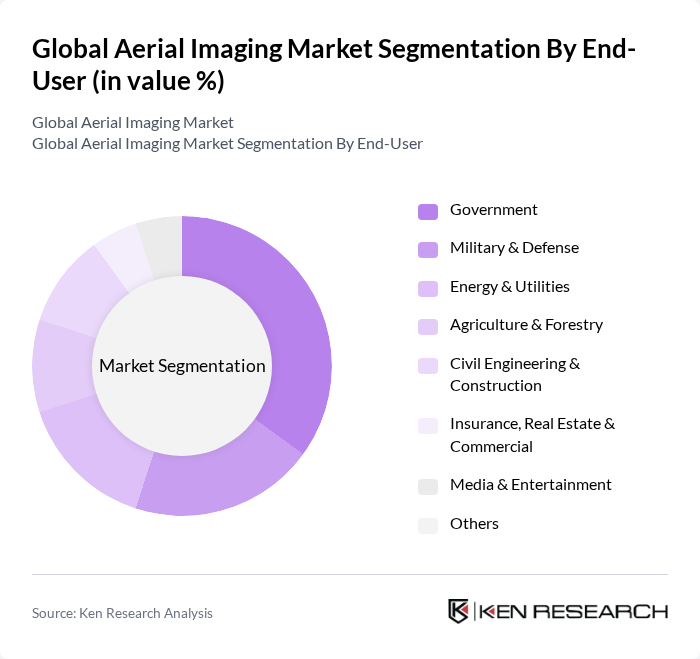
By End-User:The end-user segmentation of the aerial imaging market includes Government, Military & Defense, Energy & Utilities, Agriculture & Forestry, Civil Engineering & Construction, Insurance, Real Estate & Commercial, Media & Entertainment, and Others. TheGovernmentsector is a leading end-user, leveraging aerial imaging for geospatial mapping, disaster response, permitting, and urban planning; public agencies increasingly use aerial data to support land use, infrastructure, and environmental assessments.Military & Defenseremains significant for reconnaissance, situational awareness, and training.Agriculture & Forestryis growing with precision agriculture and vegetation health monitoring using multispectral and thermal sensors;Energy & Utilitiesrely on aerial imaging for transmission line, pipeline, and solar/wind asset inspections that reduce costs and improve safety;Civil Engineering & Constructionuse cases include surveying, progress tracking, and 3D modeling for digital twins and BIM workflows.
Global Aerial Imaging Market Competitive Landscape
The Global Aerial Imaging Market is characterized by a dynamic mix of regional and international players. Leading participants such as DJI Technology Co., Ltd., senseFly SA (AgEagle Aerial Systems Inc.), Nearmap Ltd, Delair SAS, EagleView Technologies, Inc., Pix4D SA, Trimble Inc., Parrot Drones SAS, Skydio, Inc., Quantum-Systems GmbH, Vexcel Imaging GmbH, Aerodata International Surveys, DroneDeploy, Inc., Hexagon AB (Leica Geosystems), Teledyne FLIR LLC contribute to innovation, geographic expansion, and service delivery in this space.
Global Aerial Imaging Market Industry Analysis
Growth Drivers
- Increasing Demand for Geographic Information Systems:The global GIS market is projected to reach USD 14.2 billion, driven by the need for spatial data analysis across various sectors. This demand is fueled by urbanization, with over 56% of the world's population living in urban areas, necessitating advanced mapping solutions. Aerial imaging plays a crucial role in providing accurate geographic data, enhancing decision-making processes in urban planning and resource management.
- Advancements in Drone Technology:The drone market is expected to grow to USD 43 billion. Innovations such as enhanced battery life and high-resolution cameras are making drones more efficient for aerial imaging applications. In the U.S., more than 1.5 million recreational and commercial drones are registered with the FAA, indicating significant adoption for various purposes, including surveying and mapping.
- Rising Applications in Agriculture and Environmental Monitoring:The agricultural sector is increasingly utilizing aerial imaging for precision farming, with the global precision agriculture market projected to reach USD 12.9 billion. Aerial imaging helps farmers monitor crop health, optimize resource use, and increase yields. Additionally, environmental monitoring applications are expanding, with over 75% of environmental agencies adopting aerial imaging for data collection and analysis, enhancing conservation efforts.
Market Challenges
- High Initial Investment Costs:The cost of acquiring advanced aerial imaging technology, including drones and software, can exceed USD 100,000 for comprehensive systems. This high initial investment poses a barrier for small and medium-sized enterprises (SMEs) looking to enter the market. Furthermore, ongoing maintenance and operational costs can deter potential users, limiting the overall growth of the aerial imaging sector in various regions.
- Regulatory Restrictions on Drone Usage:Regulatory frameworks governing drone operations are becoming increasingly stringent. In the U.S., the FAA has implemented regulations that require commercial drone operators to obtain specific certifications, impacting operational flexibility. As of now, over 30% of drone operators reported challenges in compliance with local regulations, which can hinder the growth of aerial imaging applications across different industries.
Global Aerial Imaging Market Future Outlook
The future of the aerial imaging market appears promising, driven by technological advancements and increasing integration with AI. As industries seek real-time data for decision-making, the demand for aerial imaging solutions is expected to rise. Additionally, the collaboration between tech companies and government agencies will likely enhance regulatory frameworks, fostering innovation. The market is poised for growth as businesses recognize the value of aerial imaging in improving operational efficiency and data accuracy across various sectors.
Market Opportunities
- Expansion in Emerging Markets:Emerging markets, particularly in Asia-Pacific and Africa, present significant growth opportunities for aerial imaging. With urbanization rates exceeding 45% in these regions, the demand for mapping and surveying services is increasing. Investments in infrastructure development are expected to drive the adoption of aerial imaging technologies, creating a favorable environment for market players.
- Integration with AI and Machine Learning:The integration of AI and machine learning into aerial imaging solutions is set to revolutionize data analysis. By 2024, the AI market in the aerial imaging sector is projected to reach USD 2.5 billion. This integration will enhance image processing capabilities, enabling faster and more accurate insights, thus attracting a broader range of industries seeking data-driven solutions.
Scope of the Report
| Segment | Sub-Segments |
|---|---|
| By Type | Aerial Photography Aerial Videography D Mapping & Photogrammetry Thermal & Multispectral Imaging LiDAR Hyperspectral Imaging |
| By End-User | Government Military & Defense Energy & Utilities Agriculture & Forestry Civil Engineering & Construction Insurance, Real Estate & Commercial Media & Entertainment Others |
| By Application | Geospatial Mapping Disaster Management & Emergency Response Surveillance & Monitoring Energy and Resource Management Urban Planning & Land Use Infrastructure Inspection Others |
| By Distribution Channel | Direct Enterprise Sales Online Platforms & Marketplaces Value-Added Resellers (VARs) & System Integrators Others |
| By Region | North America Europe Asia-Pacific Latin America Middle East & Africa |
| By Pricing Model | Subscription-Based (SaaS) Project-Based / Pay-Per-Use License + Maintenance Others |
| By Data Type | Raw Imagery (RGB, Thermal, Multispectral) Processed Orthomosaics & Point Clouds Analytical Reports & Dashboards D Models & Digital Twins |
Key Target Audience
Investors and Venture Capitalist Firms
Government and Regulatory Bodies (e.g., Federal Aviation Administration, National Oceanic and Atmospheric Administration)
Aerial Imaging Service Providers
Geospatial Technology Companies
Real Estate Developers and Property Management Firms
Environmental and Conservation Organizations
Insurance Companies
Construction and Infrastructure Firms
Players Mentioned in the Report:
DJI Technology Co., Ltd.
senseFly SA (AgEagle Aerial Systems Inc.)
Nearmap Ltd
Delair SAS
EagleView Technologies, Inc.
Pix4D SA
Trimble Inc.
Parrot Drones SAS
Skydio, Inc.
Quantum-Systems GmbH
Vexcel Imaging GmbH
Aerodata International Surveys
DroneDeploy, Inc.
Hexagon AB (Leica Geosystems)
Teledyne FLIR LLC
Table of Contents
Market Assessment Phase
1. Executive Summary and Approach
2. Global Aerial Imaging Market Overview
2.1 Key Insights and Strategic Recommendations
2.2 Global Aerial Imaging Market Overview
2.3 Definition and Scope
2.4 Evolution of Market Ecosystem
2.5 Timeline of Key Regulatory Milestones
2.6 Value Chain & Stakeholder Mapping
2.7 Business Cycle Analysis
2.8 Policy & Incentive Landscape
3. Global Aerial Imaging Market Analysis
3.1 Growth Drivers
3.1.1 Increasing Demand for Geographic Information Systems
3.1.2 Advancements in Drone Technology
3.1.3 Rising Applications in Agriculture and Environmental Monitoring
3.1.4 Growth in Construction and Infrastructure Development
3.2 Market Challenges
3.2.1 High Initial Investment Costs
3.2.2 Regulatory Restrictions on Drone Usage
3.2.3 Data Privacy Concerns
3.2.4 Competition from Traditional Imaging Methods
3.3 Market Opportunities
3.3.1 Expansion in Emerging Markets
3.3.2 Integration with AI and Machine Learning
3.3.3 Increasing Use in Disaster Management
3.3.4 Development of Customized Aerial Imaging Solutions
3.4 Market Trends
3.4.1 Growing Adoption of 3D Mapping Technologies
3.4.2 Shift Towards Real-Time Data Processing
3.4.3 Increasing Collaboration Between Tech Companies and Governments
3.4.4 Rise of Subscription-Based Aerial Imaging Services
3.5 Government Regulation
3.5.1 FAA Regulations on Drone Operations
3.5.2 GDPR Compliance for Data Collection
3.5.3 National Security Regulations Impacting Drone Usage
3.5.4 Environmental Regulations Affecting Aerial Surveys
4. SWOT Analysis
5. Stakeholder Analysis
6. Porter's Five Forces Analysis
7. Global Aerial Imaging Market Market Size, 2019-2024
7.1 By Value
7.2 By Volume
7.3 By Average Selling Price
8. Global Aerial Imaging Market Segmentation
8.1 By Type
8.1.1 Aerial Photography
8.1.2 Aerial Videography
8.1.3 3D Mapping & Photogrammetry
8.1.4 Thermal & Multispectral Imaging
8.1.5 LiDAR
8.1.6 Hyperspectral Imaging
8.2 By End-User
8.2.1 Government
8.2.2 Military & Defense
8.2.3 Energy & Utilities
8.2.4 Agriculture & Forestry
8.2.5 Civil Engineering & Construction
8.2.6 Insurance, Real Estate & Commercial
8.2.7 Media & Entertainment
8.2.8 Others
8.3 By Application
8.3.1 Geospatial Mapping
8.3.2 Disaster Management & Emergency Response
8.3.3 Surveillance & Monitoring
8.3.4 Energy and Resource Management
8.3.5 Urban Planning & Land Use
8.3.6 Infrastructure Inspection
8.3.7 Others
8.4 By Distribution Channel
8.4.1 Direct Enterprise Sales
8.4.2 Online Platforms & Marketplaces
8.4.3 Value-Added Resellers (VARs) & System Integrators
8.4.4 Others
8.5 By Region
8.5.1 North America
8.5.2 Europe
8.5.3 Asia-Pacific
8.5.4 Latin America
8.5.5 Middle East & Africa
8.6 By Pricing Model
8.6.1 Subscription-Based (SaaS)
8.6.2 Project-Based / Pay-Per-Use
8.6.3 License + Maintenance
8.6.4 Others
8.7 By Data Type
8.7.1 Raw Imagery (RGB, Thermal, Multispectral)
8.7.2 Processed Orthomosaics & Point Clouds
8.7.3 Analytical Reports & Dashboards
8.7.4 3D Models & Digital Twins
9. Global Aerial Imaging Market Competitive Analysis
9.1 Market Share of Key Players
9.2 Cross Comparison of Key Players
9.2.1 Company Name
9.2.2 Group Size (Large, Medium, or Small as per industry convention)
9.2.3 Annual Revenue (Aerial imaging-related)
9.2.4 YoY Revenue Growth (%)
9.2.5 Geographic Footprint (No. of countries served)
9.2.6 Installed Fleet/Platform Base (UAVs/aircraft or sensors deployed)
9.2.7 Data Coverage Scale (km² captured per year)
9.2.8 Customer Segments Mix (% revenue by Gov/Defense vs. Commercial)
9.2.9 Key Technology Capabilities (LiDAR, multispectral, thermal, hyperspectral, 3D)
9.2.10 Average Project Ticket Size (USD)
9.2.11 Pricing Model (SaaS, project-based, licensing)
9.2.12 Customer Acquisition Cost (CAC)
9.2.13 Gross Margin (%)
9.2.14 Backlog / Recurring Revenue (% of total)
9.2.15 Turnaround Time (collection-to-delivery, hours/days)
9.2.16 Data Accuracy/Resolution (GSD cm/pixel; vertical accuracy cm)
9.2.17 Compliance & Certifications (FAA/EASA waivers, ISO, SOC 2)
9.2.18 Partnership Ecosystem (OEMs, software, integrators)
9.3 SWOT Analysis of Top Players
9.4 Pricing Analysis
9.5 Detailed Profile of Major Companies
9.5.1 DJI Technology Co., Ltd.
9.5.2 senseFly SA (AgEagle Aerial Systems Inc.)
9.5.3 Nearmap Ltd
9.5.4 Delair SAS
9.5.5 EagleView Technologies, Inc.
9.5.6 Pix4D SA
9.5.7 Trimble Inc.
9.5.8 Parrot Drones SAS
9.5.9 Skydio, Inc.
9.5.10 Quantum-Systems GmbH
9.5.11 Vexcel Imaging GmbH
9.5.12 Aerodata International Surveys
9.5.13 DroneDeploy, Inc.
9.5.14 Hexagon AB (Leica Geosystems)
9.5.15 Teledyne FLIR LLC
10. Global Aerial Imaging Market End-User Analysis
10.1 Procurement Behavior of Key Ministries
10.1.1 Government Contracts for Aerial Surveys
10.1.2 Budget Allocations for Environmental Monitoring
10.1.3 Collaboration with Private Sector for Data Acquisition
10.2 Corporate Spend on Infrastructure & Energy
10.2.1 Investment in Smart City Projects
10.2.2 Funding for Renewable Energy Assessments
10.2.3 Expenditure on Urban Development Initiatives
10.3 Pain Point Analysis by End-User Category
10.3.1 Challenges in Data Accuracy
10.3.2 Limitations in Real-Time Data Access
10.3.3 High Costs of Aerial Imaging Services
10.4 User Readiness for Adoption
10.4.1 Awareness of Aerial Imaging Benefits
10.4.2 Training and Skill Development Needs
10.4.3 Infrastructure Readiness for Aerial Data Integration
10.5 Post-Deployment ROI and Use Case Expansion
10.5.1 Evaluation of Cost Savings
10.5.2 Expansion into New Use Cases
10.5.3 Long-Term Benefits of Aerial Imaging
11. Global Aerial Imaging Market Future Size, 2025-2030
11.1 By Value
11.2 By Volume
11.3 By Average Selling Price
Go-To-Market Strategy Phase
1. Whitespace Analysis + Business Model Canvas
1.1
2. Marketing and Positioning Recommendations
2.1
3. Distribution Plan
3.1
4. Channel & Pricing Gaps
4.1
5. Unmet Demand & Latent Needs
5.1
6. Customer Relationship
7.1
7. Value Proposition
8.1
8. Key Activities
9.1
9. Entry Strategy Evaluation
9.1 Domestic Market Entry Strategy
10.1.1
9.2 Export Entry Strategy
10.2.1
10. Entry Mode Assessment
11.1
11. Capital and Timeline Estimation
12.1
12. Control vs Risk Trade-Off
13.1
13. Profitability Outlook
14.1
14. Potential Partner List
15.1
15. Execution Roadmap
15.1 Phased Plan for Market Entry
16.1.1
15.2 Key Activities and Milestones
16.2.1
Research Methodology
Phase 1: Approach1
Desk Research
- Industry reports from leading market research firms focusing on aerial imaging technologies
- Government publications and regulations related to drone usage and aerial data collection
- Academic journals and white papers discussing advancements in imaging technologies and applications
Primary Research
- Interviews with industry experts, including drone manufacturers and aerial imaging service providers
- Surveys targeting end-users in sectors such as agriculture, construction, and environmental monitoring
- Field interviews with professionals utilizing aerial imaging for mapping and surveying purposes
Validation & Triangulation
- Cross-validation of findings through multiple data sources, including market reports and expert opinions
- Triangulation of data from primary interviews and secondary research to ensure consistency
- Sanity checks through expert panel reviews to validate market trends and projections
Phase 2: Market Size Estimation1
Top-down Assessment
- Analysis of global spending on aerial imaging technologies and services
- Segmentation of the market by application areas such as agriculture, construction, and environmental monitoring
- Incorporation of growth trends in drone technology and regulatory impacts on market expansion
Bottom-up Modeling
- Estimation of market size based on sales data from leading aerial imaging companies
- Operational cost analysis for aerial imaging services across different sectors
- Volume and pricing analysis based on service offerings and customer demand
Forecasting & Scenario Analysis
- Multi-factor regression analysis incorporating technological advancements and market adoption rates
- Scenario modeling based on potential regulatory changes and market disruptions
- Development of baseline, optimistic, and pessimistic forecasts through 2030
Phase 3: CATI Sample Composition1
| Scope Item/Segment | Sample Size | Target Respondent Profiles |
|---|---|---|
| Aerial Imaging in Agriculture | 120 | Agronomists, Farm Managers |
| Construction Site Monitoring | 100 | Project Managers, Site Supervisors |
| Environmental Impact Assessments | 80 | Environmental Scientists, Policy Makers |
| Real Estate and Property Management | 60 | Real Estate Agents, Property Developers |
| Infrastructure Inspection Services | 90 | Infrastructure Engineers, Safety Inspectors |
Frequently Asked Questions
What is the current value of the Global Aerial Imaging Market?
The Global Aerial Imaging Market is valued at approximately USD 3.4 billion, driven by advancements in drone technology, high-resolution sensors, and improved data processing capabilities that enhance the quality and accessibility of aerial imagery.
Which regions dominate the Global Aerial Imaging Market?
What are the key segments of the Global Aerial Imaging Market?
How is the U.S. government influencing the aerial imaging market?
Other Regional/Country Reports
Indonesia Aerial Imaging Market
Malaysia Aerial Imaging Market
APAC Aerial Imaging Market
Why Buy From Us?

What makes us stand out is that our consultants follow Robust, Refine and Result (RRR) methodology. Robust for clear definitions, approaches and sanity checking, Refine for differentiating respondents' facts and opinions, and Result for presenting data with story.

We have set a benchmark in the industry by offering our clients with syndicated and customized market research reports featuring coverage of entire market as well as meticulous research and analyst insights.

While we don't replace traditional research, we flip the method upside down. Our dual approach of Top Bottom & Bottom Top ensures quality deliverable by not just verifying company fundamentals but also looking at the sector and macroeconomic factors.

With one step in the future, our research team constantly tries to show you the bigger picture. We help with some of the tough questions you may encounter along the way: How is the industry positioned? Best marketing channel? KPI's of competitors? By aligning every element, we help maximize success.

Our report gives you instant access to the answers and sources that other companies might choose to hide. We elaborate each steps of research methodology we have used and showcase you the sample size to earn your trust.

If you need any support, we are here! We pride ourselves on universe strength, data quality, and quick, friendly, and professional service.