Region:Global
Author(s):Geetanshi
Product Code:KRAD1223
Pages:97
Published On:November 2025
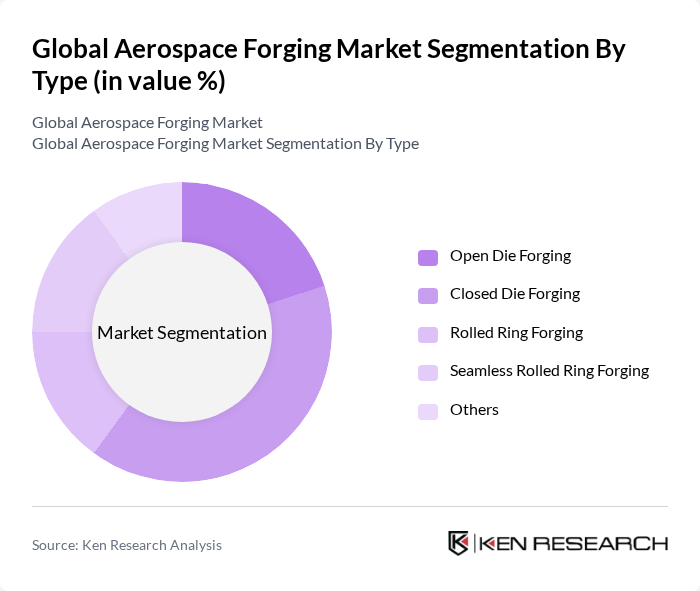
By Type:The aerospace forging market is segmented into various types, including Open Die Forging, Closed Die Forging, Rolled Ring Forging, Seamless Rolled Ring Forging, and Others. Among these, Closed Die Forging is the most dominant due to its ability to produce complex shapes with high precision, which is essential for aerospace components. The demand for lightweight and durable parts has led to an increased preference for this method, particularly in the production of critical engine and structural components. The market is further driven by the adoption of advanced alloys and the need for high-performance forged parts in next-generation aircraft .
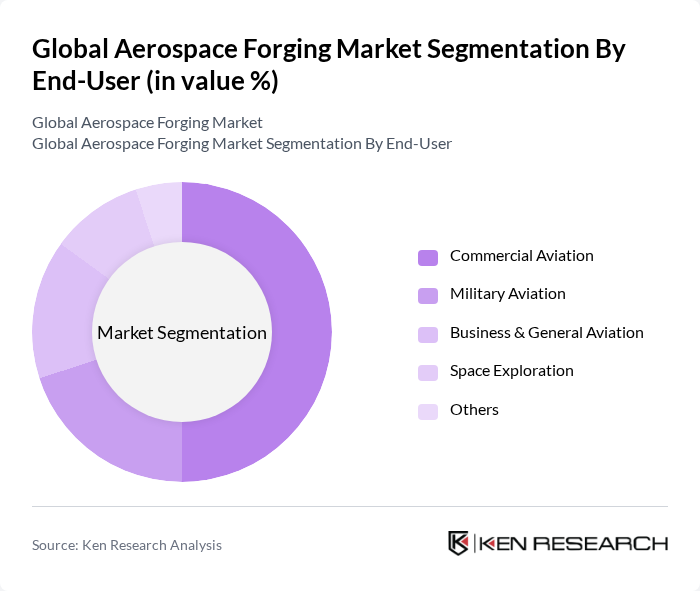
By End-User:The market is further segmented by end-users, including Commercial Aviation, Military Aviation, Business & General Aviation, Space Exploration, and Others. The Commercial Aviation segment holds the largest share, driven by the increasing demand for passenger aircraft and the expansion of airline fleets worldwide. The growth in air travel and the need for more efficient aircraft have led to a surge in demand for forged components in this sector. Military aviation and space exploration are also significant contributors, supported by rising defense budgets and investments in space programs .
The Global Aerospace Forging Market is characterized by a dynamic mix of regional and international players. Leading participants such as Precision Castparts Corp., Alcoa Corporation, Forged Solutions Group, ATI (Allegheny Technologies Incorporated), thyssenkrupp AG, Arconic Corporation, Boeing Company, Airbus S.A.S., Rolls-Royce Holdings plc, Safran S.A., Spirit AeroSystems Holdings, Inc., GKN Aerospace, Magellan Aerospace Corporation, Doncasters Group Ltd., Firth Rixson, Larsen & Toubro Limited, Jiangyin Hengrun Heavy Industries Co., Ltd., WLLEOOD Group Inc., Curtiss-Wright Corporation, Honeywell International Inc., Raytheon Technologies Corporation, CAV Systems Ltd., Aernnova Aerospace S.A. contribute to innovation, geographic expansion, and service delivery in this space.
The aerospace forging market is poised for transformative growth, driven by technological advancements and increasing demand for sustainable practices. As manufacturers adopt innovative forging techniques and advanced materials, the industry is likely to witness enhanced efficiency and reduced environmental impact. Furthermore, the expansion of aerospace applications, particularly in emerging markets, will create new opportunities for growth. Collaborations between industry players will also foster innovation, ensuring that the market remains competitive and responsive to evolving consumer needs in the coming years.
| Segment | Sub-Segments |
|---|---|
| By Type | Open Die Forging Closed Die Forging Rolled Ring Forging Seamless Rolled Ring Forging Others |
| By End-User | Commercial Aviation Military Aviation Business & General Aviation Space Exploration Others |
| By Material | Aluminum Alloys Titanium Alloys Steel Alloys Nickel Alloys Others |
| By Application | Engine Components Airframe Components Structural Components Landing Gear Transmission & Rotor Components Control Surfaces Others |
| By Process | Hot Forging Cold Forging Warm Forging Others |
| By Geography | North America Europe Asia-Pacific Latin America Middle East & Africa Others |
| By Technology | Traditional Forging Computer Numerical Control (CNC) Forging Automated Forging Others |
| Scope Item/Segment | Sample Size | Target Respondent Profiles |
|---|---|---|
| Commercial Aircraft Forging | 100 | Manufacturing Managers, Aerospace Engineers |
| Military Aircraft Components | 70 | Procurement Managers, Defense Contractors |
| General Aviation Parts | 50 | Product Development Managers, Quality Assurance Leads |
| Aerospace Material Suppliers | 40 | Supply Chain Managers, Materials Scientists |
| Forging Technology Innovators | 40 | R&D Directors, Technology Managers |
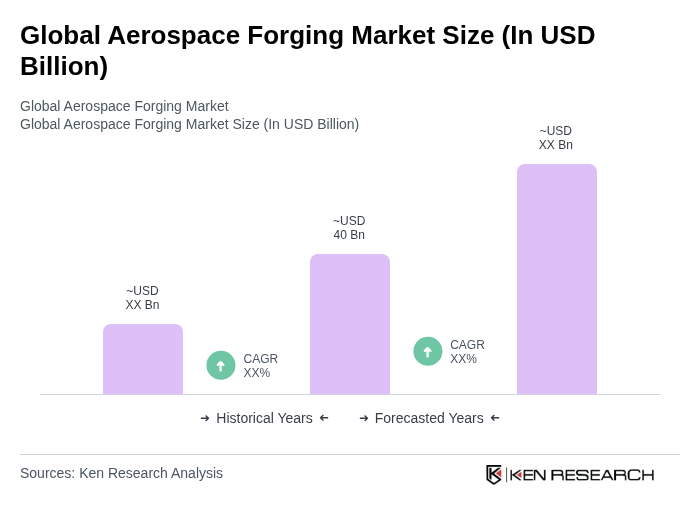
The Global Aerospace Forging Market is valued at approximately USD 40 billion, reflecting a significant growth trend driven by the increasing demand for lightweight and high-strength materials in aircraft manufacturing and the expansion of the aerospace sector globally.

What makes us stand out is that our consultants follow Robust, Refine and Result (RRR) methodology. Robust for clear definitions, approaches and sanity checking, Refine for differentiating respondents' facts and opinions, and Result for presenting data with story.

We have set a benchmark in the industry by offering our clients with syndicated and customized market research reports featuring coverage of entire market as well as meticulous research and analyst insights.

While we don't replace traditional research, we flip the method upside down. Our dual approach of Top Bottom & Bottom Top ensures quality deliverable by not just verifying company fundamentals but also looking at the sector and macroeconomic factors.

With one step in the future, our research team constantly tries to show you the bigger picture. We help with some of the tough questions you may encounter along the way: How is the industry positioned? Best marketing channel? KPI's of competitors? By aligning every element, we help maximize success.

Our report gives you instant access to the answers and sources that other companies might choose to hide. We elaborate each steps of research methodology we have used and showcase you the sample size to earn your trust.

If you need any support, we are here! We pride ourselves on universe strength, data quality, and quick, friendly, and professional service.













