About the Report
Base Year 2024Listen to the audio summary
Global Air Deflector Market Overview
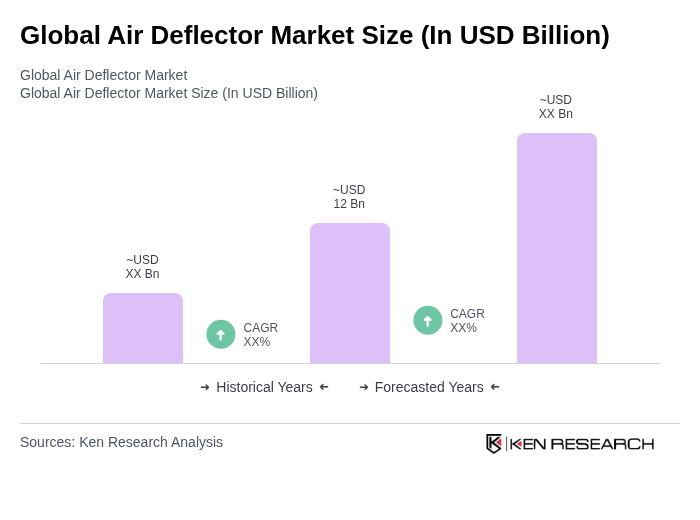
- The Global Air Deflector Market is valued at approximately USD 12 billion, based on a five-year historical analysis. This growth is primarily driven by the increasing demand for vehicle customization and enhanced aerodynamics, which improve fuel efficiency and reduce wind noise, as highlighted by multiple industry studies. The rising awareness of vehicle aesthetics, driving comfort, and functionality among consumers has further propelled the market, with strong uptake in both OEM fitments and the automotive aftermarket across passenger and commercial vehicle segments.
- Key country-level demand centers in this market include the United States, Germany, and Japan, supported by their advanced automotive industries, high vehicle ownership, and strong spending on vehicle accessories and aftermarket components. The presence of major automotive manufacturers and tier-1 suppliers, together with well-developed aftermarket distribution networks in these countries, contributes to their leadership in the air deflector market, fostering continuous innovation, product differentiation, and competitive pricing.
- In the European Union, aerodynamic and fuel-efficiency performance of vehicles is indirectly driven by binding carbon dioxide emission and eco-design requirements, which have encouraged wider integration of aerodynamic devices, including air deflectors, in new vehicles. A key framework is Regulation (EU) 2019/631 of the European Parliament and of the Council setting CO? emission performance standards for new passenger cars and new light commercial vehicles, which requires manufacturers to meet fleet-average CO? targets and drives the use of aerodynamic improvements to reduce drag and fuel consumption. For heavy-duty vehicles, Commission Regulation (EU) 2017/2400 on the determination of CO? emissions and fuel consumption of heavy-duty vehicles introduced standardized methods (including aerodynamic drag inputs) that incentivize OEMs to deploy cab roof fairings and side deflectors to meet efficiency benchmarks. These regulatory frameworks have spurred demand for aerodynamic components such as air deflectors, as manufacturers seek to enhance vehicle performance and reduce emissions while complying with EU standards.
Global Air Deflector Market Segmentation
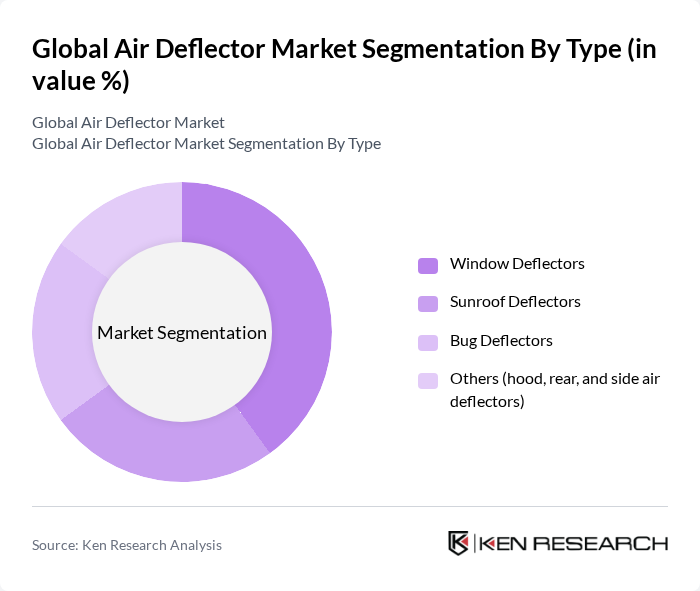
By Type:The air deflector market is segmented into various types, including window deflectors, sunroof deflectors, bug deflectors, and others such as hood, rear, and side air deflectors. This aligns with industry categorizations that highlight window/side deflectors, hood/bonnet deflectors, and roof deflectors as key product groups. Among these, window deflectors are the most popular due to their ability to enhance ventilation while minimizing wind noise and rain intrusion, and they are consistently reported as the leading type segment by share. Sunroof deflectors are also gaining traction as they provide an added layer of comfort for passengers by reducing buffeting and noise when the roof is open. Bug deflectors are favored for their protective features against debris and insects, particularly in pickup trucks and SUVs in North America, while the 'others' category includes specialized hood, rear, and side air deflectors tailored for specific models, commercial fleets, and performance applications.
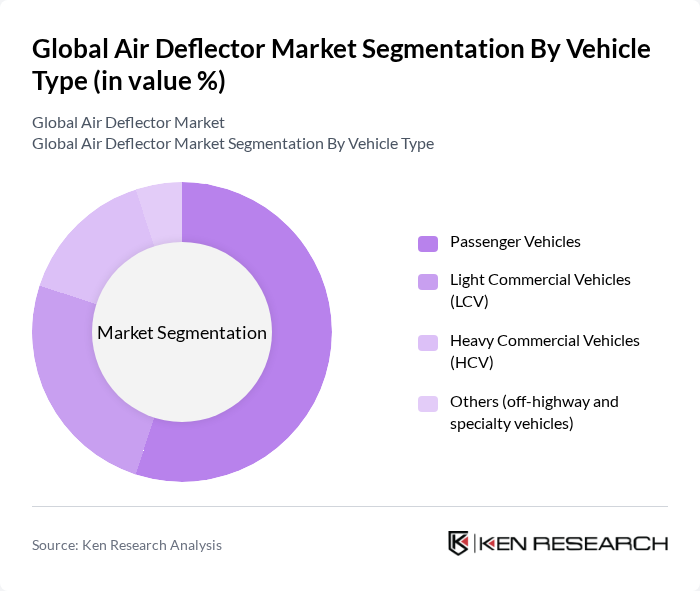
By Vehicle Type:The market is further segmented by vehicle type, including passenger vehicles, light commercial vehicles (LCV), heavy commercial vehicles (HCV), and others such as off-highway and specialty vehicles. Major syndicated studies similarly segment the market by passenger cars, light commercial vehicles, and heavy commercial vehicles, with passenger vehicles consistently accounting for the largest share due to their high global parc and consumer preference for comfort and customization. The LCV segment is also significant, driven by the growing demand for last?mile delivery and logistics services and the use of roof fairings and side deflectors to improve fuel efficiency in vans and small trucks. HCVs are increasingly adopting air deflectors, such as cab roof and side fairings, to reduce drag and achieve lower fuel consumption and CO? emissions in long?haul operations, while the 'others' category caters to off?highway, recreational, and specialty vehicles that require tailored aerodynamic solutions and protective deflectors.
Global Air Deflector Market Competitive Landscape
The Global Air Deflector Market is characterized by a dynamic mix of regional and international players. Leading participants such as Lund International, Heko Sp. z o.o., ClimAir Plava Kunststoffe GmbH, DGA Srl, ELLEDI Srl, P.I. e C.F. Srl, Hatcher Components Ltd, Piedmont Plastics, LLC, Spoiler Factory, Farad Group, Team HEKO USA, Inc., WeatherTech (MacNeil IP LLC), Rugged Ridge / Omix-ADA, Inc., AVS – Auto Ventshade (a Lund International brand), EGR Group contribute to innovation, geographic expansion, and service delivery in this space, alongside larger automotive component suppliers and material specialists that support aerodynamic solutions for OEMs and the aftermarket.
Global Air Deflector Market Industry Analysis
Growth Drivers
- Increasing Demand for Energy-Efficient Solutions:The global push for energy efficiency is driving the air deflector market, with energy consumption in buildings projected to reach 1,300 terawatt-hours (TWh) in future. This demand is fueled by rising energy costs, which have increased by 20% over the past three years. As consumers and businesses seek to reduce energy expenses, air deflectors are becoming essential for optimizing HVAC systems, leading to a projected increase in adoption rates across various sectors.
- Technological Advancements in Air Deflector Design:Innovations in air deflector technology are enhancing performance and efficiency. For instance, the introduction of aerodynamic designs has improved airflow management, resulting in energy savings of up to 35% in HVAC systems. Additionally, the integration of smart technologies, such as IoT sensors, is expected to increase system efficiency, with the smart building market projected to grow to $120 billion in future, further driving demand for advanced air deflectors.
- Rising Awareness of Environmental Sustainability:Growing environmental concerns are prompting consumers and businesses to adopt sustainable practices. In future, global investments in renewable energy are expected to exceed $600 billion, with air deflectors playing a crucial role in reducing carbon footprints. This shift towards sustainability is supported by a 25% increase in consumer preference for eco-friendly products, driving manufacturers to innovate and promote energy-efficient air deflector solutions that align with these values.
Market Challenges
- High Initial Investment Costs:The adoption of air deflectors often requires significant upfront investments, which can deter potential buyers. For instance, the average installation cost for energy-efficient HVAC systems, including air deflectors, can range from $6,000 to $16,000. This financial barrier is particularly pronounced in emerging markets, where budget constraints limit the ability of consumers and businesses to invest in advanced technologies, hindering market growth.
- Regulatory Compliance Complexities:Navigating the regulatory landscape can pose challenges for air deflector manufacturers. Compliance with emission reduction targets and safety standards requires substantial resources and expertise. In future, it is estimated that compliance costs could account for up to 12% of total operational expenses for manufacturers. This complexity can slow down product development and market entry, impacting overall competitiveness in the air deflector market.
Global Air Deflector Market Future Outlook
The future of the air deflector market appears promising, driven by technological advancements and increasing environmental awareness. As smart technologies become more integrated into building systems, the demand for innovative air deflector solutions is expected to rise. Additionally, the focus on sustainability will likely lead to more stringent regulations, pushing manufacturers to develop compliant, energy-efficient products. This evolving landscape presents opportunities for growth, particularly in emerging markets where energy efficiency is becoming a priority.
Market Opportunities
- Expansion into Emerging Markets:Emerging markets present significant growth opportunities for air deflector manufacturers. With urbanization rates projected to reach 65% in future, there is an increasing demand for energy-efficient solutions in residential and commercial buildings. This trend is expected to drive investments in HVAC systems, creating a favorable environment for air deflector adoption.
- Development of Innovative Product Features:The market for air deflectors can benefit from the development of innovative features, such as smart controls and enhanced materials. By incorporating advanced technologies, manufacturers can improve product performance and appeal to environmentally conscious consumers. This innovation is crucial as the demand for customizable and efficient solutions continues to grow, potentially increasing market share for forward-thinking companies.
Scope of the Report
| Segment | Sub-Segments |
|---|---|
| By Type | Window Deflectors Sunroof Deflectors Bug Deflectors Others (hood, rear, and side air deflectors) |
| By Vehicle Type | Passenger Vehicles Light Commercial Vehicles (LCV) Heavy Commercial Vehicles (HCV) Others (off-highway and specialty vehicles) |
| By Mounting Method | Tape-on Deflectors In-channel Deflectors Bolt-on / Clamp-on Deflectors Others |
| By Material | Acrylic / Polycarbonate ABS Plastic Metal Composite & Other Advanced Materials |
| By Sales Channel | OEM Aftermarket – Offline Aftermarket – Online Others |
| By Region | North America Europe Asia-Pacific Latin America Middle East & Africa |
| By End-Use Industry | Automotive OEMs Automotive Aftermarket Specialty & Customization Workshops Others |
Key Target Audience
Investors and Venture Capitalist Firms
Government and Regulatory Bodies (e.g., Federal Aviation Administration, European Union Aviation Safety Agency)
Manufacturers and Producers
Distributors and Retailers
Aerospace and Defense Contractors
Airline Operators
Environmental Agencies (e.g., Environmental Protection Agency)
Industry Associations (e.g., Aerospace Industries Association)
Players Mentioned in the Report:
Lund International
Heko Sp. z o.o.
ClimAir Plava Kunststoffe GmbH
DGA Srl
ELLEDI Srl
P.I. e C.F. Srl
Hatcher Components Ltd
Piedmont Plastics, LLC
Spoiler Factory
Farad Group
Team HEKO USA, Inc.
WeatherTech (MacNeil IP LLC)
Rugged Ridge / Omix-ADA, Inc.
AVS Auto Ventshade (a Lund International brand)
EGR Group
Table of Contents
Market Assessment Phase
1. Executive Summary and Approach
2. Global Air Deflector Market Overview
2.1 Key Insights and Strategic Recommendations
2.2 Global Air Deflector Market Overview
2.3 Definition and Scope
2.4 Evolution of Market Ecosystem
2.5 Timeline of Key Regulatory Milestones
2.6 Value Chain & Stakeholder Mapping
2.7 Business Cycle Analysis
2.8 Policy & Incentive Landscape
3. Global Air Deflector Market Analysis
3.1 Growth Drivers
3.1.1 Increasing demand for energy-efficient solutions
3.1.2 Technological advancements in air deflector design
3.1.3 Rising awareness of environmental sustainability
3.1.4 Government incentives for renewable energy adoption
3.2 Market Challenges
3.2.1 High initial investment costs
3.2.2 Regulatory compliance complexities
3.2.3 Competition from alternative technologies
3.2.4 Limited consumer awareness and education
3.3 Market Opportunities
3.3.1 Expansion into emerging markets
3.3.2 Development of innovative product features
3.3.3 Strategic partnerships with technology providers
3.3.4 Increasing investment in renewable energy projects
3.4 Market Trends
3.4.1 Growing integration of smart technologies
3.4.2 Shift towards modular and customizable solutions
3.4.3 Emphasis on lifecycle sustainability
3.4.4 Rise of consumer-centric product designs
3.5 Government Regulation
3.5.1 Emission reduction targets
3.5.2 Renewable energy mandates
3.5.3 Safety and performance standards
3.5.4 Incentives for energy-efficient technologies
4. SWOT Analysis
5. Stakeholder Analysis
6. Porter's Five Forces Analysis
7. Global Air Deflector Market Market Size, 2019-2024
7.1 By Value
7.2 By Volume
7.3 By Average Selling Price
8. Global Air Deflector Market Segmentation
8.1 By Type
8.1.1 Window Deflectors
8.1.2 Sunroof Deflectors
8.1.3 Bug Deflectors
8.1.4 Others (hood, rear, and side air deflectors)
8.2 By Vehicle Type
8.2.1 Passenger Vehicles
8.2.2 Light Commercial Vehicles (LCV)
8.2.3 Heavy Commercial Vehicles (HCV)
8.2.4 Others (off-highway and specialty vehicles)
8.3 By Mounting Method
8.3.1 Tape-on Deflectors
8.3.2 In-channel Deflectors
8.3.3 Bolt-on / Clamp-on Deflectors
8.3.4 Others
8.4 By Material
8.4.1 Acrylic / Polycarbonate
8.4.2 ABS Plastic
8.4.3 Metal
8.4.4 Composite & Other Advanced Materials
8.5 By Sales Channel
8.5.1 OEM
8.5.2 Aftermarket – Offline
8.5.3 Aftermarket – Online
8.5.4 Others
8.6 By Region
8.6.1 North America
8.6.2 Europe
8.6.3 Asia-Pacific
8.6.4 Latin America
8.6.5 Middle East & Africa
8.7 By End-Use Industry
8.7.1 Automotive OEMs
8.7.2 Automotive Aftermarket
8.7.3 Specialty & Customization Workshops
8.7.4 Others
9. Global Air Deflector Market Competitive Analysis
9.1 Market Share of Key Players
9.2 Cross Comparison of Key Players
9.2.1 Company Name
9.2.2 Company Size (global headcount / revenue band)
9.2.3 Air Deflector Segment Revenue
9.2.4 Air Deflector Revenue Growth Rate
9.2.5 Air Deflector Market Share (by region/segment)
9.2.6 OEM vs Aftermarket Revenue Mix
9.2.7 Average Selling Price (ASP) by Product Type
9.2.8 Product Portfolio Breadth (type, vehicle, material coverage)
9.2.9 New Product Launches / Innovation Intensity
9.2.10 Geographic Footprint (manufacturing & distribution)
9.2.11 Key OEM Relationships / Platform Wins
9.2.12 EBITDA Margin for Air Deflector Business (where available)
9.3 SWOT Analysis of Top Players
9.4 Pricing Analysis
9.5 Detailed Profile of Major Companies
9.5.1 Lund International
9.5.2 Heko Sp. z o.o.
9.5.3 ClimAir Plava Kunststoffe GmbH
9.5.4 DGA Srl
9.5.5 ELLEDI Srl
9.5.6 P.I. e C.F. Srl
9.5.7 Hatcher Components Ltd
9.5.8 Piedmont Plastics, LLC
9.5.9 Spoiler Factory
9.5.10 Farad Group
9.5.11 Team HEKO USA, Inc.
9.5.12 WeatherTech (MacNeil IP LLC)
9.5.13 Rugged Ridge / Omix-ADA, Inc.
9.5.14 AVS – Auto Ventshade (a Lund International brand)
9.5.15 EGR Group
10. Global Air Deflector Market End-User Analysis
10.1 Procurement Behavior of Key Ministries
10.1.1 Budget Allocation Trends
10.1.2 Decision-Making Processes
10.1.3 Supplier Selection Criteria
10.1.4 Contracting Practices
10.2 Corporate Spend on Infrastructure & Energy
10.2.1 Investment Priorities
10.2.2 Spending Patterns
10.2.3 Long-term Contracts
10.2.4 Budgeting Cycles
10.3 Pain Point Analysis by End-User Category
10.3.1 Common Challenges Faced
10.3.2 Performance Expectations
10.3.3 Cost Management Issues
10.3.4 Regulatory Compliance Concerns
10.4 User Readiness for Adoption
10.4.1 Awareness Levels
10.4.2 Training and Support Needs
10.4.3 Adoption Barriers
10.4.4 Feedback Mechanisms
10.5 Post-Deployment ROI and Use Case Expansion
10.5.1 Measurement of Success
10.5.2 Case Studies of Successful Implementations
10.5.3 Future Expansion Plans
10.5.4 User Satisfaction Levels
11. Global Air Deflector Market Future Size, 2025-2030
11.1 By Value
11.2 By Volume
11.3 By Average Selling Price
Go-To-Market Strategy Phase
1. Whitespace Analysis + Business Model Canvas
1.1 Market Gaps Identification
1.2 Value Proposition Development
1.3 Revenue Streams Analysis
1.4 Cost Structure Evaluation
1.5 Key Partnerships Exploration
1.6 Customer Segmentation
1.7 Channels of Distribution
2. Marketing and Positioning Recommendations
2.1 Branding Strategies
2.2 Product USPs
2.3 Target Market Identification
2.4 Communication Strategies
2.5 Digital Marketing Approaches
3. Distribution Plan
3.1 Urban Retail Strategies
3.2 Rural NGO Tie-ups
3.3 E-commerce Integration
3.4 Logistics and Supply Chain Management
4. Channel & Pricing Gaps
4.1 Underserved Routes
4.2 Pricing Bands Analysis
4.3 Competitor Pricing Strategies
5. Unmet Demand & Latent Needs
5.1 Category Gaps Identification
5.2 Consumer Segments Analysis
5.3 Product Development Opportunities
6. Customer Relationship
6.1 Loyalty Programs
6.2 After-sales Service
6.3 Customer Feedback Mechanisms
7. Value Proposition
7.1 Sustainability Initiatives
7.2 Integrated Supply Chains
7.3 Competitive Advantages
8. Key Activities
8.1 Regulatory Compliance
8.2 Branding Efforts
8.3 Distribution Setup
9. Entry Strategy Evaluation
9.1 Domestic Market Entry Strategy
9.1.1 Product Mix Considerations
9.1.2 Pricing Band Strategies
9.1.3 Packaging Innovations
9.2 Export Entry Strategy
9.2.1 Target Countries Analysis
9.2.2 Compliance Roadmap Development
10. Entry Mode Assessment
10.1 Joint Ventures
10.2 Greenfield Investments
10.3 Mergers & Acquisitions
10.4 Distributor Model Evaluation
11. Capital and Timeline Estimation
11.1 Capital Requirements
11.2 Timelines for Implementation
12. Control vs Risk Trade-Off
12.1 Ownership Considerations
12.2 Partnerships Evaluation
13. Profitability Outlook
13.1 Breakeven Analysis
13.2 Long-term Sustainability Strategies
14. Potential Partner List
14.1 Distributors
14.2 Joint Ventures
14.3 Acquisition Targets
15. Execution Roadmap
15.1 Phased Plan for Market Entry
15.1.1 Market Setup
15.1.2 Market Entry
15.1.3 Growth Acceleration
15.1.4 Scale & Stabilize
15.2 Key Activities and Milestones
15.2.1 Milestone Planning
15.2.2 Activity Tracking
Research Methodology
Phase 1: Approach1
Desk Research
- Industry reports from aviation and automotive associations
- Market analysis publications focusing on air deflector technologies
- Government and regulatory documents related to air quality and vehicle standards
Primary Research
- Interviews with product managers at leading automotive manufacturers
- Surveys with engineers specializing in aerodynamic design
- Field interviews with installers and distributors of air deflector products
Validation & Triangulation
- Cross-validation of data from multiple industry sources and reports
- Triangulation of insights from primary interviews and secondary data
- Sanity checks through expert panels comprising industry veterans
Phase 2: Market Size Estimation1
Top-down Assessment
- Analysis of global automotive market size and growth trends
- Segmentation by vehicle type and geographical region
- Incorporation of emerging trends in fuel efficiency and aerodynamics
Bottom-up Modeling
- Volume estimates based on production data from major automotive manufacturers
- Cost analysis of air deflector production and installation
- Estimation of market share based on sales data from key players
Forecasting & Scenario Analysis
- Multi-variable regression analysis considering fuel prices and environmental regulations
- Scenario modeling based on technological advancements and consumer preferences
- Baseline, optimistic, and pessimistic forecasts through 2030
Phase 3: CATI Sample Composition1
| Scope Item/Segment | Sample Size | Target Respondent Profiles |
|---|---|---|
| Passenger Vehicle Manufacturers | 45 | Product Development Managers, Design Engineers |
| Commercial Vehicle Sector | 40 | Fleet Managers, Procurement Specialists |
| Aftermarket Suppliers | 35 | Sales Directors, Marketing Managers |
| Regulatory Bodies | 30 | Policy Analysts, Environmental Compliance Officers |
| Automotive Research Institutions | 40 | Research Scientists, Aerodynamics Experts |
Frequently Asked Questions
What is the current value of the Global Air Deflector Market?
The Global Air Deflector Market is valued at approximately USD 12 billion, driven by increasing demand for vehicle customization, enhanced aerodynamics, and improved fuel efficiency. This growth reflects a five-year historical analysis of market trends and consumer preferences.
What factors are driving the growth of the Air Deflector Market?
Which countries are the largest markets for air deflectors?
What types of air deflectors are available in the market?
Other Regional/Country Reports
Indonesia Air Deflector Market
Malaysia Air Deflector Market
KSA Air Deflector Market
APAC Air Deflector Market
SEA Air Deflector Market
Vietnam Air Deflector Market
Other Adjacent Reports
South Korea Automotive Spoiler Market
South Korea Vehicle Accessories Market
South Korea Automotive Aftermarket Market
Oman Fuel Efficiency Technology Market
South Korea Commercial Vehicle Parts Market
Japan Passenger Car Accessories Market
Mexico Aerodynamic Components Market
Qatar Vehicle Customization Market
Japan Automotive Plastics Market
Thailand Emissions Reduction Technology Market
Why Buy From Us?

What makes us stand out is that our consultants follow Robust, Refine and Result (RRR) methodology. Robust for clear definitions, approaches and sanity checking, Refine for differentiating respondents' facts and opinions, and Result for presenting data with story.

We have set a benchmark in the industry by offering our clients with syndicated and customized market research reports featuring coverage of entire market as well as meticulous research and analyst insights.

While we don't replace traditional research, we flip the method upside down. Our dual approach of Top Bottom & Bottom Top ensures quality deliverable by not just verifying company fundamentals but also looking at the sector and macroeconomic factors.

With one step in the future, our research team constantly tries to show you the bigger picture. We help with some of the tough questions you may encounter along the way: How is the industry positioned? Best marketing channel? KPI's of competitors? By aligning every element, we help maximize success.

Our report gives you instant access to the answers and sources that other companies might choose to hide. We elaborate each steps of research methodology we have used and showcase you the sample size to earn your trust.

If you need any support, we are here! We pride ourselves on universe strength, data quality, and quick, friendly, and professional service.