About the Report
Base Year 2024Global Air Freshener Market Overview
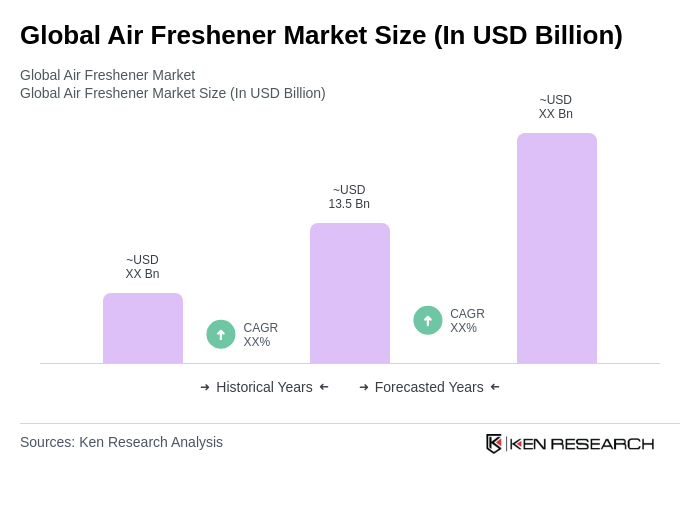
- The Global Air Freshener Market is valued at USD 13.5 billion, based on a five-year historical analysis. This growth is primarily driven by increasing consumer awareness regarding hygiene and the rising demand for pleasant indoor environments. The market has seen a surge in product innovation, with manufacturers focusing on eco-friendly and long-lasting air freshening solutions, including natural ingredients, smart dispensers, and automated fragrance delivery systems to cater to evolving consumer preferences.
- Key players in this market include the United States, Germany, and China, which dominate due to their large consumer bases and high disposable incomes. Europe currently holds the largest regional share, driven by high individual awareness about indoor air quality, preference for premium and eco-friendly products, and widespread adoption in commercial spaces. The presence of established brands and a growing trend towards home improvement and wellness further contribute to the market's strength in these regions.
- The European Union’s Regulation (EC) No 1272/2008 on Classification, Labelling and Packaging of Substances and Mixtures (CLP), enforced by the European Chemicals Agency, sets binding limits on volatile organic compounds (VOCs) in air fresheners. This regulation mandates that products must not exceed specific VOC thresholds, requires clear labelling of hazardous substances, and promotes the development of safer and more environmentally friendly air freshening products.
Global Air Freshener Market Segmentation
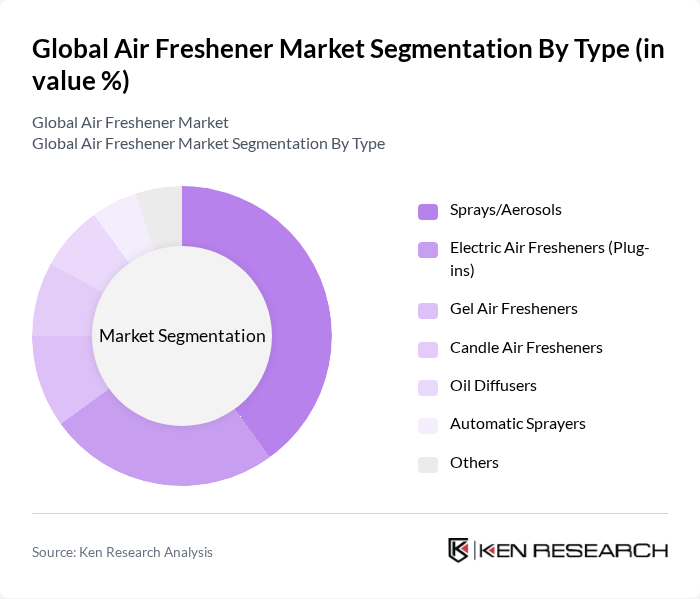
By Type:The air freshener market is segmented into various types, including sprays/aerosols, electric air fresheners (plug-ins), gel air fresheners, candle air fresheners, oil diffusers, automatic sprayers, and others. Among these, sprays/aerosols dominate the market due to their convenience and immediate effect, appealing to consumers looking for quick solutions to unpleasant odors. Electric air fresheners are also gaining traction, particularly in residential and commercial spaces, as they offer continuous fragrance release and are often perceived as more effective. Recent product launches feature natural and essential oil-based formulations, rechargeable plug-ins, and smart sensors for automated dispensing.
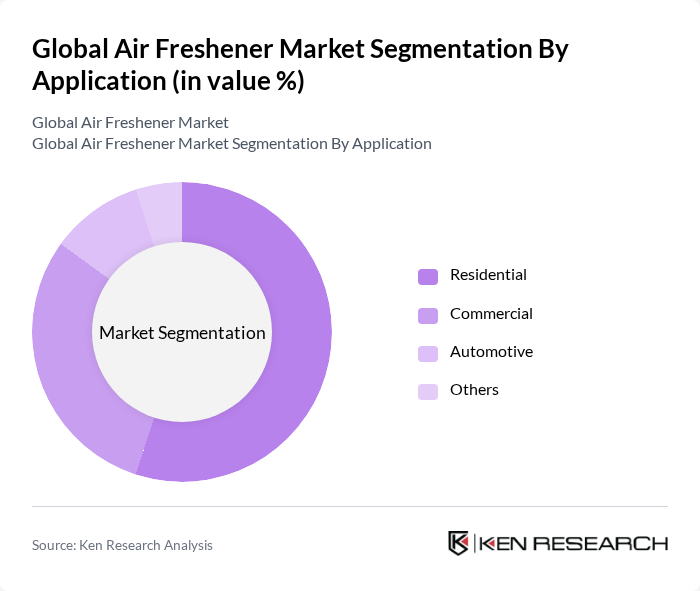
By Application:The air freshener market is segmented by application into residential, commercial, automotive, and others. The residential segment holds the largest share, driven by increasing consumer spending on home care products and a growing focus on creating pleasant living environments. The commercial segment is also significant, as businesses seek to enhance customer experiences and maintain a fresh atmosphere in their establishments. Automotive air fresheners are gaining popularity due to heightened awareness of vehicle interior air quality and personalization trends.
Global Air Freshener Market Competitive Landscape
The Global Air Freshener Market is characterized by a dynamic mix of regional and international players. Leading participants such as Procter & Gamble Co., SC Johnson & Son, Inc., Reckitt Benckiser Group plc, Henkel AG & Co. KGaA, Church & Dwight Co., Inc., Air Wick (Reckitt Benckiser), Glade (SC Johnson), Yankee Candle Company, Poo~Pourri, LLC, Caldrea, Inc., Febreze (Procter & Gamble), Mrs. Meyer's Clean Day (S.C. Johnson), The Honest Company, Inc., ScentAir Technologies, LLC, Godrej Consumer Products Limited contribute to innovation, geographic expansion, and service delivery in this space.
Global Air Freshener Market Industry Analysis
Growth Drivers
- Increasing Consumer Awareness of Air Quality:The global air quality index has shown alarming levels, with over 90% of the world's population living in areas exceeding WHO guidelines. This has led to a surge in consumer demand for air fresheners, as individuals seek to improve indoor air quality. In future, the air quality monitoring market is projected to reach $4.8 billion, indicating a growing awareness that directly influences air freshener purchases, particularly in urban areas.
- Rising Demand for Eco-Friendly Products:The eco-friendly product market is expected to reach $160 billion by future, driven by consumer preferences for sustainable options. This trend is reflected in the air freshener sector, where brands are increasingly offering natural and organic products. In future, sales of eco-friendly air fresheners grew by 27%, highlighting a significant shift towards environmentally responsible purchasing decisions among consumers, particularly in developed markets.
- Growth in the Hospitality and Tourism Sectors:The global tourism industry is projected to generate $12 trillion in revenue in future, with a significant portion allocated to enhancing guest experiences. Hotels and resorts are increasingly using air fresheners to create inviting atmospheres, leading to a 17% increase in air freshener sales within the hospitality sector. This growth is particularly evident in regions with booming tourism, such as Southeast Asia and the Middle East.
Market Challenges
- Stringent Regulations on Chemical Usage:Regulatory bodies worldwide are imposing stricter guidelines on volatile organic compounds (VOCs) in consumer products. In the EU, regulations limit VOC emissions to 0.1% in air fresheners, impacting product formulations. Companies must invest in compliance, which can increase production costs by up to 22%, posing a challenge for manufacturers aiming to maintain competitive pricing while adhering to these regulations.
- Competition from Alternative Air Purification Solutions:The rise of air purifiers, which are projected to reach a market size of $14 billion by future, presents a significant challenge to air freshener sales. Consumers increasingly prefer air purifiers for their ability to remove pollutants rather than just masking odors. This shift has led to a 12% decline in traditional air freshener sales in regions with high air quality concerns, forcing brands to innovate or risk losing market share.
Global Air Freshener Market Future Outlook
The air freshener market is poised for transformation as consumer preferences shift towards sustainability and health-conscious products. Innovations in fragrance technology and the integration of smart home systems are expected to redefine product offerings. Additionally, the increasing focus on indoor air quality will drive demand for natural and organic air fresheners. Companies that adapt to these trends and invest in eco-friendly solutions will likely capture a larger market share, ensuring long-term growth and relevance in a competitive landscape.
Market Opportunities
- Expansion into Emerging Markets:Emerging markets, particularly in Asia and Africa, are experiencing rapid urbanization, leading to increased demand for air fresheners. With a projected population growth of 1.3 billion in these regions in future, companies have a significant opportunity to introduce affordable and effective air freshening solutions tailored to local preferences, potentially increasing market penetration by 32%.
- Development of Subscription-Based Models:Subscription services for air fresheners are gaining traction, with a projected market value of $12 billion by future. This model offers convenience and personalized scent options, appealing to busy consumers. Companies that implement subscription services can enhance customer loyalty and predict revenue streams, potentially increasing customer retention rates by 27% in the first year of implementation.
Scope of the Report
| Segment | Sub-Segments |
|---|---|
| By Type | Sprays/Aerosols Electric Air Fresheners (Plug-ins) Gel Air Fresheners Candle Air Fresheners Oil Diffusers Automatic Sprayers Others |
| By Application | Residential Commercial Automotive Others |
| By Distribution Channel | Supermarkets/Hypermarkets Online Retail Convenience Stores Specialty Stores Others |
| By Fragrance Type | Floral Citrus Fresh Spicy Others |
| By Packaging Type | Bottles Cans Jars Sachets Others |
| By Price Range | Economy Mid-range Premium |
| By Region | North America Europe Asia-Pacific Latin America Middle East & Africa |
Key Target Audience
Investors and Venture Capitalist Firms
Government and Regulatory Bodies (e.g., Environmental Protection Agency, Food and Drug Administration)
Manufacturers and Producers
Distributors and Retailers
Raw Material Suppliers
Marketing and Advertising Agencies
Industry Associations (e.g., American Cleaning Institute)
Financial Institutions
Players Mentioned in the Report:
Procter & Gamble Co.
SC Johnson & Son, Inc.
Reckitt Benckiser Group plc
Henkel AG & Co. KGaA
Church & Dwight Co., Inc.
Air Wick (Reckitt Benckiser)
Glade (SC Johnson)
Yankee Candle Company
Poo~Pourri, LLC
Caldrea, Inc.
Febreze (Procter & Gamble)
Mrs. Meyer's Clean Day (S.C. Johnson)
The Honest Company, Inc.
ScentAir Technologies, LLC
Godrej Consumer Products Limited
Table of Contents
Market Assessment Phase
1. Executive Summary and Approach
2. Global Air Freshener Market Overview
2.1 Key Insights and Strategic Recommendations
2.2 Global Air Freshener Market Overview
2.3 Definition and Scope
2.4 Evolution of Market Ecosystem
2.5 Timeline of Key Regulatory Milestones
2.6 Value Chain & Stakeholder Mapping
2.7 Business Cycle Analysis
2.8 Policy & Incentive Landscape
3. Global Air Freshener Market Analysis
3.1 Growth Drivers
3.1.1 Increasing consumer awareness of air quality
3.1.2 Rising demand for eco-friendly products
3.1.3 Growth in the hospitality and tourism sectors
3.1.4 Innovations in fragrance technology
3.2 Market Challenges
3.2.1 Stringent regulations on chemical usage
3.2.2 Competition from alternative air purification solutions
3.2.3 Fluctuating raw material prices
3.2.4 Consumer skepticism towards synthetic fragrances
3.3 Market Opportunities
3.3.1 Expansion into emerging markets
3.3.2 Development of subscription-based models
3.3.3 Collaborations with smart home technology
3.3.4 Customization of scents for personal branding
3.4 Market Trends
3.4.1 Shift towards natural and organic air fresheners
3.4.2 Increasing popularity of multi-functional products
3.4.3 Growth of online sales channels
3.4.4 Rising interest in sustainable packaging solutions
3.5 Government Regulation
3.5.1 Regulations on VOC emissions
3.5.2 Labeling requirements for ingredients
3.5.3 Safety standards for consumer products
3.5.4 Incentives for eco-friendly product development
4. SWOT Analysis
5. Stakeholder Analysis
6. Porter's Five Forces Analysis
7. Global Air Freshener Market Market Size, 2019-2024
7.1 By Value
7.2 By Volume
7.3 By Average Selling Price
8. Global Air Freshener Market Segmentation
8.1 By Type
8.1.1 Sprays/Aerosols
8.1.2 Electric Air Fresheners (Plug-ins)
8.1.3 Gel Air Fresheners
8.1.4 Candle Air Fresheners
8.1.5 Oil Diffusers
8.1.6 Automatic Sprayers
8.1.7 Others
8.2 By Application
8.2.1 Residential
8.2.2 Commercial
8.2.3 Automotive
8.2.4 Others
8.3 By Distribution Channel
8.3.1 Supermarkets/Hypermarkets
8.3.2 Online Retail
8.3.3 Convenience Stores
8.3.4 Specialty Stores
8.3.5 Others
8.4 By Fragrance Type
8.4.1 Floral
8.4.2 Citrus
8.4.3 Fresh
8.4.4 Spicy
8.4.5 Others
8.5 By Packaging Type
8.5.1 Bottles
8.5.2 Cans
8.5.3 Jars
8.5.4 Sachets
8.5.5 Others
8.6 By Price Range
8.6.1 Economy
8.6.2 Mid-range
8.6.3 Premium
8.7 By Region
8.7.1 North America
8.7.2 Europe
8.7.3 Asia-Pacific
8.7.4 Latin America
8.7.5 Middle East & Africa
9. Global Air Freshener Market Competitive Analysis
9.1 Market Share of Key Players
9.2 Cross Comparison of Key Players
9.2.1 Company Name
9.2.2 Group Size (Large, Medium, or Small as per industry convention)
9.2.3 Global Air Freshener Revenue (USD, latest fiscal year)
9.2.4 Revenue Growth Rate (CAGR %)
9.2.5 Market Share (%)
9.2.6 Geographic Presence (No. of countries/regions)
9.2.7 Product Portfolio Breadth (No. of SKUs/brands)
9.2.8 R&D/Innovation Spend (% of revenue)
9.2.9 Distribution Channel Strength (weighted score)
9.2.10 Sustainability/ESG Initiatives (qualitative/quantitative)
9.2.11 Brand Equity Score
9.2.12 Customer Retention Rate (%)
9.3 SWOT Analysis of Top Players
9.4 Pricing Analysis
9.5 Detailed Profile of Major Companies
9.5.1 Procter & Gamble Co.
9.5.2 SC Johnson & Son, Inc.
9.5.3 Reckitt Benckiser Group plc
9.5.4 Henkel AG & Co. KGaA
9.5.5 Church & Dwight Co., Inc.
9.5.6 Air Wick (Reckitt Benckiser)
9.5.7 Glade (SC Johnson)
9.5.8 Yankee Candle Company
9.5.9 Poo~Pourri, LLC
9.5.10 Caldrea, Inc.
9.5.11 Febreze (Procter & Gamble)
9.5.12 Mrs. Meyer's Clean Day (S.C. Johnson)
9.5.13 The Honest Company, Inc.
9.5.14 ScentAir Technologies, LLC
9.5.15 Godrej Consumer Products Limited
10. Global Air Freshener Market End-User Analysis
10.1 Procurement Behavior of Key Ministries
10.1.1 Government contracts for public spaces
10.1.2 Budget allocation for environmental health
10.1.3 Preference for sustainable products
10.2 Corporate Spend on Infrastructure & Energy
10.2.1 Investment in air quality improvement
10.2.2 Budget for employee wellness programs
10.2.3 Spending on eco-friendly office supplies
10.3 Pain Point Analysis by End-User Category
10.3.1 Residential concerns about allergens
10.3.2 Commercial needs for odor control
10.3.3 Industrial requirements for compliance
10.4 User Readiness for Adoption
10.4.1 Awareness of air quality issues
10.4.2 Acceptance of new fragrance technologies
10.4.3 Willingness to pay for premium products
10.5 Post-Deployment ROI and Use Case Expansion
10.5.1 Measurement of customer satisfaction
10.5.2 Analysis of repeat purchase rates
10.5.3 Expansion into new market segments
11. Global Air Freshener Market Future Size, 2025-2030
11.1 By Value
11.2 By Volume
11.3 By Average Selling Price
Go-To-Market Strategy Phase
1. Whitespace Analysis + Business Model Canvas
1.1 Identification of market gaps
1.2 Value proposition development
1.3 Revenue stream analysis
1.4 Customer segment targeting
1.5 Key resource allocation
1.6 Cost structure evaluation
1.7 Partnership opportunities
2. Marketing and Positioning Recommendations
2.1 Branding strategies
2.2 Product USPs
2.3 Target audience engagement
2.4 Digital marketing tactics
2.5 Influencer partnerships
3. Distribution Plan
3.1 Urban retail strategies
3.2 Rural NGO tie-ups
3.3 E-commerce platform integration
3.4 Direct-to-consumer models
4. Channel & Pricing Gaps
4.1 Underserved routes
4.2 Pricing bands analysis
4.3 Competitor pricing strategies
5. Unmet Demand & Latent Needs
5.1 Category gaps identification
5.2 Consumer segments analysis
5.3 Product development opportunities
6. Customer Relationship
6.1 Loyalty programs
6.2 After-sales service enhancements
6.3 Customer feedback mechanisms
7. Value Proposition
7.1 Sustainability initiatives
7.2 Integrated supply chains
7.3 Community engagement strategies
8. Key Activities
8.1 Regulatory compliance measures
8.2 Branding efforts
8.3 Distribution setup processes
9. Entry Strategy Evaluation
9.1 Domestic Market Entry Strategy
9.1.1 Product mix considerations
9.1.2 Pricing band strategies
9.1.3 Packaging innovations
9.2 Export Entry Strategy
9.2.1 Target countries analysis
9.2.2 Compliance roadmap development
10. Entry Mode Assessment
10.1 JV opportunities
10.2 Greenfield investments
10.3 M&A considerations
10.4 Distributor model evaluation
11. Capital and Timeline Estimation
11.1 Capital requirements analysis
11.2 Timelines for market entry
12. Control vs Risk Trade-Off
12.1 Ownership considerations
12.2 Partnerships evaluation
13. Profitability Outlook
13.1 Breakeven analysis
13.2 Long-term sustainability strategies
14. Potential Partner List
14.1 Distributors identification
14.2 JVs opportunities
14.3 Acquisition targets
15. Execution Roadmap
15.1 Phased Plan for Market Entry
15.1.1 Market Setup
15.1.2 Market Entry
15.1.3 Growth Acceleration
15.1.4 Scale & Stabilize
15.2 Key Activities and Milestones
15.2.1 Activity timelines
15.2.2 Milestone tracking
Research Methodology
Phase 1: Approach1
Desk Research
- Market reports from industry associations such as the International Fragrance Association
- Analysis of consumer behavior studies published in journals focusing on home and lifestyle products
- Review of sales data from major air freshener brands and retailers through trade publications
Primary Research
- Interviews with product development managers at leading air freshener manufacturers
- Surveys targeting consumers to understand preferences and purchasing behavior
- Focus groups with retail buyers to gauge market trends and product reception
Validation & Triangulation
- Cross-validation of findings with historical sales data and market growth rates
- Triangulation of insights from consumer surveys and expert interviews
- Sanity checks through feedback from industry experts and market analysts
Phase 2: Market Size Estimation1
Top-down Assessment
- Estimation of market size based on overall household product spending trends
- Segmentation of the market by product type (sprays, gels, plug-ins, etc.) and distribution channels
- Incorporation of demographic data to assess potential market growth in emerging regions
Bottom-up Modeling
- Volume estimates derived from sales data of top air freshener brands
- Cost analysis based on production and marketing expenditures of key players
- Calculation of market size using unit sales multiplied by average selling prices
Forecasting & Scenario Analysis
- Utilization of time-series analysis to project future market trends based on historical data
- Scenario modeling based on economic indicators and consumer sentiment shifts
- Development of multiple forecasts (pessimistic, realistic, optimistic) through 2030
Phase 3: CATI Sample Composition1
| Scope Item/Segment | Sample Size | Target Respondent Profiles |
|---|---|---|
| Household Air Freshener Usage | 120 | Homeowners, Renters |
| Commercial Air Freshener Applications | 60 | Facility Managers, Office Managers |
| Retail Distribution Insights | 50 | Retail Buyers, Category Managers |
| Consumer Preferences and Trends | 100 | General Consumers, Brand Loyalists |
| Environmental Impact Awareness | 40 | Sustainability Advocates, Eco-conscious Consumers |
Frequently Asked Questions
What is the current value of the Global Air Freshener Market?
The Global Air Freshener Market is valued at approximately USD 13.5 billion, reflecting a significant growth trend driven by consumer awareness of hygiene and the demand for pleasant indoor environments.
What factors are driving the growth of the air freshener market?
Which regions dominate the Global Air Freshener Market?
What types of air fresheners are available in the market?
Other Regional/Country Reports
Indonesia Air Freshener Market
Malaysia Air Freshener Market
APAC Air Freshener Market
SEA Air Freshener Market
Why Buy From Us?

What makes us stand out is that our consultants follow Robust, Refine and Result (RRR) methodology. Robust for clear definitions, approaches and sanity checking, Refine for differentiating respondents' facts and opinions, and Result for presenting data with story.

We have set a benchmark in the industry by offering our clients with syndicated and customized market research reports featuring coverage of entire market as well as meticulous research and analyst insights.

While we don't replace traditional research, we flip the method upside down. Our dual approach of Top Bottom & Bottom Top ensures quality deliverable by not just verifying company fundamentals but also looking at the sector and macroeconomic factors.

With one step in the future, our research team constantly tries to show you the bigger picture. We help with some of the tough questions you may encounter along the way: How is the industry positioned? Best marketing channel? KPI's of competitors? By aligning every element, we help maximize success.

Our report gives you instant access to the answers and sources that other companies might choose to hide. We elaborate each steps of research methodology we have used and showcase you the sample size to earn your trust.

If you need any support, we are here! We pride ourselves on universe strength, data quality, and quick, friendly, and professional service.