Global Aircraft De Icing Market

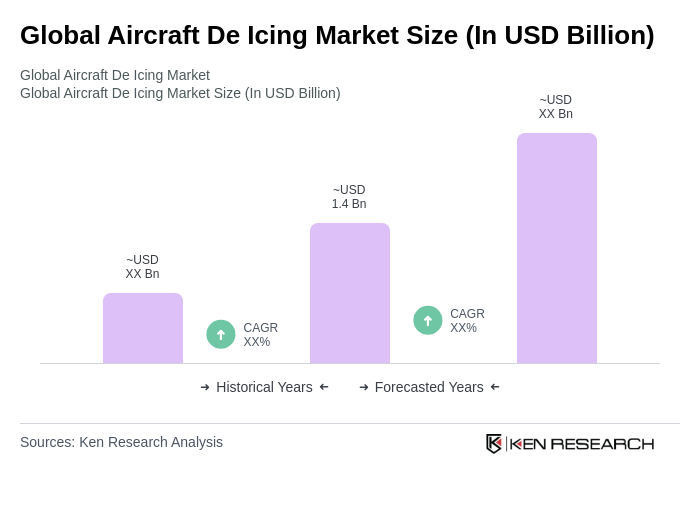
The Global Aircraft De-Icing Market, worth USD 1.4 Bn, grows due to increasing air traffic, stringent safety rules, and innovations in sustainable de-icing solutions.

Region:Global

Author(s):Dev

Product Code:KRAC0435

Pages:95

Published On:August 2025
About the Report

Base Year 2024

Global Aircraft De Icing Market Overview

  • The Global Aircraft De Icing Market is valued at approximately USD 1.4 billion, based on a five-year historical analysis. This growth is primarily driven by the increasing air traffic and the need for safe operations during winter months. The demand for de-icing solutions is further propelled by the rise in commercial aviation and the expansion of airport infrastructure in regions prone to severe weather conditions.
  • Key players in this market include North America and Europe, which dominate due to their extensive aviation networks and harsh winter climates. The presence of major airlines and airports in these regions necessitates advanced de-icing solutions to ensure operational efficiency and safety, making them critical markets for de-icing products and services.
  • In 2023, the U.S. government implemented regulations mandating the use of environmentally friendly de-icing fluids at major airports. This regulation aims to reduce the environmental impact of traditional de-icing agents, promoting the adoption of bio-based and biodegradable alternatives in the aviation sector.
Global Aircraft De Icing Market Size

Global Aircraft De Icing Market Segmentation

By Type:The market is segmented into various types of de-icing fluids and systems, including Type I Fluids (EG-based, PG-based), Type II Fluids, Type III Fluids, Type IV Fluids, De-icing Trucks and Spraying Systems, Electro-thermal/Electric De-icing Systems, Infrared/Hot Air De-icing Systems, and Others. Among these, Type I Fluids dominate the market due to their widespread use in commercial aviation for effective ice removal and anti-icing properties. The increasing focus on safety and operational efficiency in the aviation industry drives the demand for these fluids, making them a preferred choice for airlines and airport operators.
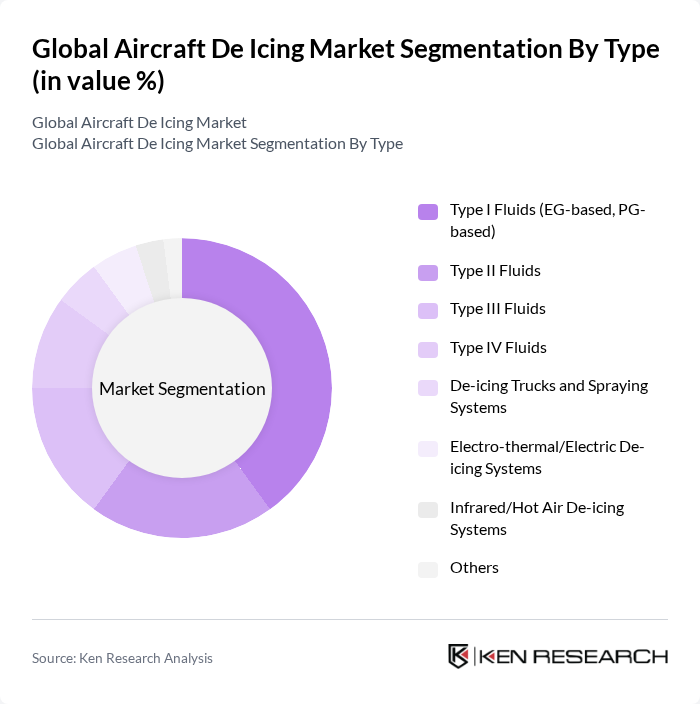
Global Aircraft De Icing Market segmentation by Type.

By End-User:The market is segmented by end-users, including Commercial Airlines, Cargo Airlines, Business & General Aviation (Private Jets), Military Aviation, Airport Operators & Ground Handling Companies, and Others. The Commercial Airlines segment holds the largest share due to the high volume of passenger flights and the stringent safety regulations that necessitate effective de-icing solutions. The increasing number of flights and the expansion of airline networks globally contribute to the growth of this segment, making it a key driver in the aircraft de-icing market.
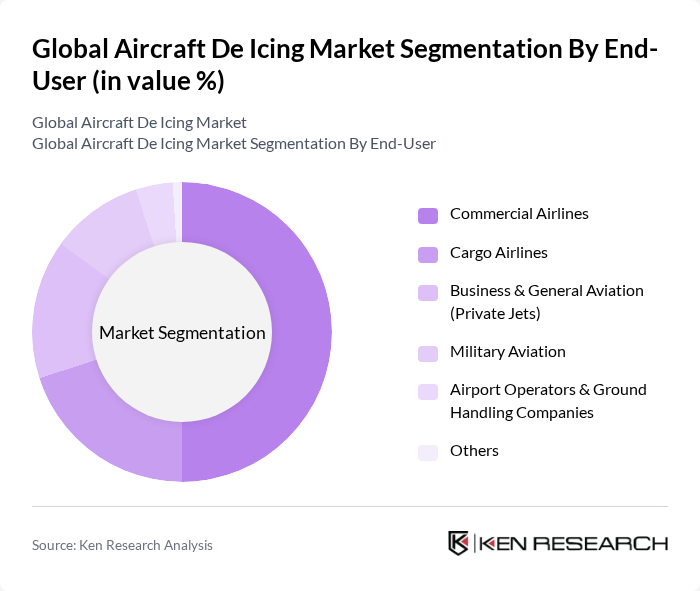
Global Aircraft De Icing Market segmentation by End-User.

Global Aircraft De Icing Market Competitive Landscape

The Global Aircraft De Icing Market is characterized by a dynamic mix of regional and international players. Leading participants such as Clariant AG (Aviation De-/Anti-icing Fluids), Dow Inc. (Formerly The Dow Chemical Company), BASF SE, Chevron Phillips Chemical Company LLC, Kilfrost Limited, LNT Solutions Limited, Cryotech Deicing Technology (a division of General Atomics), Vestergaard Company A/S (Elephant de-icing trucks), JBT Corporation (AeroTech), Global Ground Support, LLC, Textron Ground Support Equipment (Textron GSE), Safeaero AB, Øveraasen AS, Aebi Schmidt Group, Menzies Aviation plc, Swissport International AG, Integrated Deicing Services, LLC (IDS), Aero Mag 2000 Inc. (Aéro Mag), Servisair Ground Services ? now part of Swissport International AG, Aircraft De-icing Services (ADS), Inc. contribute to innovation, geographic expansion, and service delivery in this space.

Clariant AG

1995

Muttenz, Switzerland

Dow Inc.

1897

Midland, Michigan, USA

BASF SE

1865

Ludwigshafen, Germany

Kilfrost Limited

1939

Haltwhistle, UK

JBT Corporation

1884

Chicago, Illinois, USA

Company

Establishment Year

Headquarters

Segment Focus Mix (% revenue: Fluids vs Equipment vs Services)

Aircraft De-icing Revenue (latest FY) and 3-year CAGR

Regional Footprint (number of de-icing stations/depots, countries served)

Installed Base (de-icing trucks/systems delivered)

Contract Wins with Major Airports/Airlines (active multi-year contracts)

Product Portfolio Breadth (Type I–IV, EG/PG, electric/infrared systems)

Global Aircraft De Icing Market Industry Analysis

Growth Drivers

  • Increasing Air Traffic:The global air traffic is projected to reach 4.8 billion passengers in future, according to the International Air Transport Association (IATA). This surge in air travel necessitates efficient aircraft operations, including effective de-icing solutions. As airlines expand their fleets to accommodate rising passenger numbers, the demand for de-icing services will increase significantly, driving market growth. The need for timely departures during winter months further emphasizes the importance of reliable de-icing methods.
  • Stringent Safety Regulations:Regulatory bodies such as the Federal Aviation Administration (FAA) and the European Union Aviation Safety Agency (EASA) enforce strict safety standards for aircraft operations. In future, compliance with these regulations will require airlines to invest in advanced de-icing technologies to ensure passenger safety and operational efficiency. The FAA's guidelines mandate that airlines maintain safe operations during winter weather, thus propelling the demand for effective de-icing solutions across the industry.
  • Technological Advancements in De Icing Solutions:The development of innovative de-icing technologies, such as heated de-icing systems and eco-friendly fluids, is transforming the market landscape. In future, the introduction of these advanced solutions is expected to enhance operational efficiency and reduce environmental impact. For instance, glycol-based de-icing fluids are being optimized for better performance, leading to increased adoption among airlines. This technological evolution is a key driver for market growth as airlines seek to improve their de-icing processes.

Market Challenges

  • High Operational Costs:The operational costs associated with de-icing can be substantial, particularly for smaller airlines. In future, the average cost of de-icing an aircraft is estimated to be around $1,800 per operation, which can significantly impact profit margins. These high costs may deter smaller carriers from investing in necessary de-icing technologies, limiting their operational capabilities during winter months. Consequently, this challenge could hinder overall market growth as airlines strive to balance safety and cost-efficiency.
  • Environmental Concerns:The use of traditional de-icing fluids raises environmental concerns due to their chemical composition. In future, regulatory scrutiny regarding the environmental impact of these fluids is expected to intensify, prompting airlines to seek alternative solutions. The potential for groundwater contamination and adverse ecological effects poses a significant challenge for the industry. As airlines face pressure to adopt greener practices, the transition to eco-friendly de-icing products may be slow, impacting market dynamics.

Global Aircraft De Icing Market Future Outlook

The future of the aircraft de-icing market appears promising, driven by increasing air traffic and evolving safety regulations. As airlines prioritize operational efficiency and sustainability, the adoption of automated de-icing systems and eco-friendly solutions is expected to rise. Furthermore, partnerships between airlines and airports for integrated de-icing services will likely enhance operational capabilities. The focus on technological innovations will continue to shape the market, ensuring that de-icing processes are both effective and environmentally responsible in the coming years.

Market Opportunities

  • Expansion in Emerging Markets:Emerging markets, particularly in Asia and Africa, are witnessing rapid growth in air travel. In future, these regions are expected to see a 12% increase in passenger traffic, creating significant opportunities for de-icing service providers. Airlines in these markets will require efficient de-icing solutions to meet safety standards, presenting a lucrative opportunity for companies to expand their operations and offerings.
  • Development of Eco-Friendly De Icing Products:The demand for sustainable de-icing solutions is on the rise, driven by regulatory pressures and consumer preferences. In future, the market for eco-friendly de-icing products is projected to grow as airlines seek to minimize their environmental footprint. Companies that invest in research and development of biodegradable de-icing fluids will find substantial market opportunities, aligning with global sustainability goals and enhancing their competitive edge.

Scope of the Report

SegmentSub-Segments
By Type

Type I Fluids (EG-based, PG-based)

Type II Fluids

Type III Fluids

Type IV Fluids

De-icing Trucks and Spraying Systems

Electro-thermal/Electric De-icing Systems

Infrared/Hot Air De-icing Systems

Others

By End-User

Commercial Airlines

Cargo Airlines

Business & General Aviation (Private Jets)

Military Aviation

Airport Operators & Ground Handling Companies

Others

By Application

Airport Ground De-icing/Anti-icing Operations

Aircraft In-service & Line Maintenance

Hangar/MRO De-icing

Remote/Pad De-icing Operations

Others

By Distribution Channel

Direct Sales to Airlines/Airports

Distributors & Ground Support Integrators

OEM Supply (Aircraft/GSE OEMs)

Online Procurement Platforms

Others

By Region

North America

Europe

Asia-Pacific

Latin America

Middle East & Africa

By Product Formulation

Ethylene Glycol (EG)-based Fluids

Propylene Glycol (PG)-based Fluids

Thickened/Anti-icing Fluids (With Additives)

Bio-based/Biodegradable Fluids

Others

By Service Type

On-Stand/At-Gate De-icing Services

Remote Pad/Off-Stand De-icing Services

Full Turnkey Winter Operations (Outsourced)

Emergency/On-Demand De-icing Services

Others

Key Target Audience

Investors and Venture Capitalist Firms

Government and Regulatory Bodies (e.g., Federal Aviation Administration, European Union Aviation Safety Agency)

Manufacturers and Producers of De Icing Solutions

Airlines and Aviation Operators

Aerospace and Defense Contractors

Airport Authorities and Management

Maintenance, Repair, and Overhaul (MRO) Service Providers

Environmental Agencies and Organizations

Players Mentioned in the Report:

Clariant AG (Aviation De-/Anti-icing Fluids)

Dow Inc. (Formerly The Dow Chemical Company)

BASF SE

Chevron Phillips Chemical Company LLC

Kilfrost Limited

LNT Solutions Limited

Cryotech Deicing Technology (a division of General Atomics)

Vestergaard Company A/S (Elephant de-icing trucks)

JBT Corporation (AeroTech)

Global Ground Support, LLC

Textron Ground Support Equipment (Textron GSE)

Safeaero AB

veraasen AS

Aebi Schmidt Group

Menzies Aviation plc

Swissport International AG

Integrated Deicing Services, LLC (IDS)

Aero Mag 2000 Inc. (Aero Mag)

Servisair Ground Services now part of Swissport International AG

Aircraft De-icing Services (ADS), Inc.

Table of Contents

Market Assessment Phase

1. Executive Summary and Approach


2. Global Aircraft De Icing Market Overview

2.1 Key Insights and Strategic Recommendations

2.2 Global Aircraft De Icing Market Overview

2.3 Definition and Scope

2.4 Evolution of Market Ecosystem

2.5 Timeline of Key Regulatory Milestones

2.6 Value Chain & Stakeholder Mapping

2.7 Business Cycle Analysis

2.8 Policy & Incentive Landscape


3. Global Aircraft De Icing Market Analysis

3.1 Growth Drivers

3.1.1 Increasing Air Traffic
3.1.2 Stringent Safety Regulations
3.1.3 Technological Advancements in De Icing Solutions
3.1.4 Climate Change Impact on Weather Patterns

3.2 Market Challenges

3.2.1 High Operational Costs
3.2.2 Environmental Concerns
3.2.3 Limited Awareness Among Smaller Airlines
3.2.4 Seasonal Demand Fluctuations

3.3 Market Opportunities

3.3.1 Expansion in Emerging Markets
3.3.2 Development of Eco-Friendly De Icing Products
3.3.3 Partnerships with Airports for Integrated Solutions
3.3.4 Innovations in De Icing Technologies

3.4 Market Trends

3.4.1 Increasing Use of Glycol-Based De Icing Fluids
3.4.2 Adoption of Automated De Icing Systems
3.4.3 Focus on Sustainability and Green Solutions
3.4.4 Growth of On-Demand De Icing Services

3.5 Government Regulation

3.5.1 Compliance with FAA and EASA Standards
3.5.2 Regulations on Chemical Usage in De Icing
3.5.3 Environmental Protection Agency (EPA) Guidelines
3.5.4 Local Government Policies on Airport Operations

4. SWOT Analysis


5. Stakeholder Analysis


6. Porter's Five Forces Analysis


7. Global Aircraft De Icing Market Market Size, 2019-2024

7.1 By Value

7.2 By Volume

7.3 By Average Selling Price


8. Global Aircraft De Icing Market Segmentation

8.1 By Type

8.1.1 Type I Fluids (EG-based, PG-based)
8.1.2 Type II Fluids
8.1.3 Type III Fluids
8.1.4 Type IV Fluids
8.1.5 De-icing Trucks and Spraying Systems
8.1.6 Electro-thermal/Electric De-icing Systems
8.1.7 Infrared/Hot Air De-icing Systems
8.1.8 Others

8.2 By End-User

8.2.1 Commercial Airlines
8.2.2 Cargo Airlines
8.2.3 Business & General Aviation (Private Jets)
8.2.4 Military Aviation
8.2.5 Airport Operators & Ground Handling Companies
8.2.6 Others

8.3 By Application

8.3.1 Airport Ground De-icing/Anti-icing Operations
8.3.2 Aircraft In-service & Line Maintenance
8.3.3 Hangar/MRO De-icing
8.3.4 Remote/Pad De-icing Operations
8.3.5 Others

8.4 By Distribution Channel

8.4.1 Direct Sales to Airlines/Airports
8.4.2 Distributors & Ground Support Integrators
8.4.3 OEM Supply (Aircraft/GSE OEMs)
8.4.4 Online Procurement Platforms
8.4.5 Others

8.5 By Region

8.5.1 North America
8.5.2 Europe
8.5.3 Asia-Pacific
8.5.4 Latin America
8.5.5 Middle East & Africa

8.6 By Product Formulation

8.6.1 Ethylene Glycol (EG)-based Fluids
8.6.2 Propylene Glycol (PG)-based Fluids
8.6.3 Thickened/Anti-icing Fluids (With Additives)
8.6.4 Bio-based/Biodegradable Fluids
8.6.5 Others

8.7 By Service Type

8.7.1 On-Stand/At-Gate De-icing Services
8.7.2 Remote Pad/Off-Stand De-icing Services
8.7.3 Full Turnkey Winter Operations (Outsourced)
8.7.4 Emergency/On-Demand De-icing Services
8.7.5 Others

9. Global Aircraft De Icing Market Competitive Analysis

9.1 Market Share of Key Players

9.2 Cross Comparison of Key Players

9.2.1 Company Name (Fluids/GSE/Service)
9.2.2 Segment Focus Mix (% revenue: Fluids vs Equipment vs Services)
9.2.3 Aircraft De-icing Revenue (latest FY) and 3-year CAGR
9.2.4 Regional Footprint (number of de-icing stations/depots, countries served)
9.2.5 Installed Base (de-icing trucks/systems delivered)
9.2.6 Contract Wins with Major Airports/Airlines (active multi-year contracts)
9.2.7 Product Portfolio Breadth (Type I–IV, EG/PG, electric/infrared systems)
9.2.8 Operational KPIs (turnaround time per aircraft, utilization rate, OTP impact)
9.2.9 Safety & Compliance (incident rate, ISO/ISAGO/ACI certifications)
9.2.10 Environmental Metrics (glycol recovery %, water use, CO2e/turn)
9.2.11 Pricing/Cost Position (fluid ASP per liter, cost per turn, service rate card)
9.2.12 Innovation Intensity (R&D spend %, patents, new tech pilots)

9.3 SWOT Analysis of Top Players

9.4 Pricing Analysis

9.5 Detailed Profile of Major Companies

9.5.1 Clariant AG (Aviation De-/Anti-icing Fluids)
9.5.2 Dow Inc. (Formerly The Dow Chemical Company)
9.5.3 BASF SE
9.5.4 Chevron Phillips Chemical Company LLC
9.5.5 Kilfrost Limited
9.5.6 LNT Solutions Limited
9.5.7 Cryotech Deicing Technology (a division of General Atomics)
9.5.8 Vestergaard Company A/S (Elephant de-icing trucks)
9.5.9 JBT Corporation (AeroTech)
9.5.10 Global Ground Support, LLC
9.5.11 Textron Ground Support Equipment (Textron GSE)
9.5.12 Safeaero AB
9.5.13 Øveraasen AS
9.5.14 Aebi Schmidt Group
9.5.15 Menzies Aviation plc
9.5.16 Swissport International AG
9.5.17 Integrated Deicing Services, LLC (IDS)
9.5.18 Aero Mag 2000 Inc. (Aéro Mag)
9.5.19 Servisair Ground Services ? now part of Swissport International AG
9.5.20 Aircraft De-icing Services (ADS), Inc.

10. Global Aircraft De Icing Market End-User Analysis

10.1 Procurement Behavior of Key Ministries

10.1.1 Government Contracts and Tenders
10.1.2 Budget Allocations for Aviation Safety
10.1.3 Compliance with National Safety Standards

10.2 Corporate Spend on Infrastructure & Energy

10.2.1 Investment in Airport Infrastructure
10.2.2 Funding for Safety Enhancements
10.2.3 Expenditure on De Icing Equipment

10.3 Pain Point Analysis by End-User Category

10.3.1 Cost Management Challenges
10.3.2 Operational Efficiency Issues
10.3.3 Regulatory Compliance Difficulties

10.4 User Readiness for Adoption

10.4.1 Awareness of De Icing Solutions
10.4.2 Training and Skill Development Needs
10.4.3 Infrastructure Readiness

10.5 Post-Deployment ROI and Use Case Expansion

10.5.1 Measurement of Cost Savings
10.5.2 Evaluation of Service Efficiency
10.5.3 Opportunities for Service Expansion

11. Global Aircraft De Icing Market Future Size, 2025-2030

11.1 By Value

11.2 By Volume

11.3 By Average Selling Price


Go-To-Market Strategy Phase

1. Whitespace Analysis + Business Model Canvas

1.1 Market Gaps Identification

1.2 Value Proposition Development

1.3 Revenue Model Structuring

1.4 Key Partnerships Identification

1.5 Customer Segmentation Analysis

1.6 Competitive Landscape Overview

1.7 Risk Assessment


2. Marketing and Positioning Recommendations

2.1 Branding Strategies

2.2 Product USPs

2.3 Target Market Identification

2.4 Communication Strategy

2.5 Digital Marketing Approach

2.6 Customer Engagement Tactics


3. Distribution Plan

3.1 Urban Retail Strategies

3.2 Rural NGO Tie-Ups

3.3 Online Distribution Channels

3.4 Partnerships with Airports

3.5 Logistics and Supply Chain Management


4. Channel & Pricing Gaps

4.1 Underserved Routes

4.2 Pricing Bands Analysis

4.3 Competitor Pricing Strategies

4.4 Customer Willingness to Pay


5. Unmet Demand & Latent Needs

5.1 Category Gaps Identification

5.2 Consumer Segments Analysis

5.3 Emerging Trends Exploration

5.4 Future Needs Assessment


6. Customer Relationship

6.1 Loyalty Programs

6.2 After-Sales Service

6.3 Customer Feedback Mechanisms

6.4 Relationship Management Strategies


7. Value Proposition

7.1 Sustainability Initiatives

7.2 Integrated Supply Chains

7.3 Customer-Centric Solutions

7.4 Competitive Differentiation


8. Key Activities

8.1 Regulatory Compliance

8.2 Branding Initiatives

8.3 Distribution Setup

8.4 Training and Development


9. Entry Strategy Evaluation

9.1 Domestic Market Entry Strategy

9.1.1 Product Mix Considerations
9.1.2 Pricing Band Strategy
9.1.3 Packaging Solutions

9.2 Export Entry Strategy

9.2.1 Target Countries Identification
9.2.2 Compliance Roadmap Development

10. Entry Mode Assessment

10.1 Joint Ventures

10.2 Greenfield Investments

10.3 Mergers & Acquisitions

10.4 Distributor Model Evaluation


11. Capital and Timeline Estimation

11.1 Capital Requirements Analysis

11.2 Timelines for Market Entry


12. Control vs Risk Trade-Off

12.1 Ownership vs Partnerships


13. Profitability Outlook

13.1 Breakeven Analysis

13.2 Long-Term Sustainability Assessment


14. Potential Partner List

14.1 Distributors

14.2 Joint Ventures

14.3 Acquisition Targets


15. Execution Roadmap

15.1 Phased Plan for Market Entry

15.1.1 Market Setup
15.1.2 Market Entry
15.1.3 Growth Acceleration
15.1.4 Scale & Stabilize

15.2 Key Activities and Milestones

15.2.1 Milestone Planning
15.2.2 Activity Tracking

Research Methodology

ApproachModellingSample

Phase 1: Approach1

Desk Research

  • Industry reports from aviation authorities and aerospace organizations
  • Market analysis publications from aviation consultancy firms
  • Regulatory documents and guidelines from aviation safety agencies

Primary Research

  • Interviews with maintenance managers at commercial airlines
  • Surveys with de-icing service providers and equipment manufacturers
  • Field interviews with airport operations personnel

Validation & Triangulation

  • Cross-validation of data from multiple industry sources and reports
  • Triangulation of insights from primary interviews and secondary data
  • Sanity checks through expert panels comprising aviation specialists

Phase 2: Market Size Estimation1

Top-down Assessment

  • Analysis of global air traffic growth and its impact on de-icing demand
  • Breakdown of market size by geographic regions and aircraft types
  • Incorporation of seasonal variations and climate impact on de-icing needs

Bottom-up Modeling

  • Volume estimates based on de-icing fluid consumption per aircraft
  • Cost analysis of de-icing services provided at major airports
  • Estimation of market share based on leading service providers' revenues

Forecasting & Scenario Analysis

  • Multi-factor regression analysis considering weather patterns and air travel trends
  • Scenario modeling based on regulatory changes and technological advancements
  • Baseline, optimistic, and pessimistic forecasts through 2030

Phase 3: CATI Sample Composition1

Scope Item/SegmentSample SizeTarget Respondent Profiles
Commercial Airlines De-Icing Operations120Maintenance Managers, Operations Directors
Airport Ground Handling Services90Ground Operations Managers, Safety Officers
De-Icing Equipment Manufacturers60Product Development Managers, Sales Directors
Regulatory Bodies and Aviation Authorities50Policy Makers, Safety Inspectors
Research and Development in De-Icing Technologies70R&D Managers, Technical Experts

Frequently Asked Questions

What is the current value of the Global Aircraft De Icing Market?

The Global Aircraft De Icing Market is valued at approximately USD 1.4 billion, driven by increasing air traffic and the need for safe operations during winter months. This market is expected to grow further due to the expansion of commercial aviation and airport infrastructure.

What factors are driving the growth of the Aircraft De Icing Market?

Which regions dominate the Aircraft De Icing Market?

What types of de-icing fluids are available in the market?

Other Regional/Country Reports

UAE Aircraft De Icing MarketKSA Aircraft De Icing Market

Indonesia Aircraft De Icing Market

Malaysia Aircraft De Icing Market

APAC Aircraft De Icing Market

SEA Aircraft De Icing Market

Why Buy From Us?

Refine Robust Result (RRR) Framework

What makes us stand out is that our consultants follow Robust, Refine and Result (RRR) methodology. Robust for clear definitions, approaches and sanity checking, Refine for differentiating respondents' facts and opinions, and Result for presenting data with story.

Our Reach Is Unmatched

We have set a benchmark in the industry by offering our clients with syndicated and customized market research reports featuring coverage of entire market as well as meticulous research and analyst insights.

Shifting the Research Paradigm

While we don't replace traditional research, we flip the method upside down. Our dual approach of Top Bottom & Bottom Top ensures quality deliverable by not just verifying company fundamentals but also looking at the sector and macroeconomic factors.

More Insights-Better Decisions

With one step in the future, our research team constantly tries to show you the bigger picture. We help with some of the tough questions you may encounter along the way: How is the industry positioned? Best marketing channel? KPI's of competitors? By aligning every element, we help maximize success.

Transparency and Trust

Our report gives you instant access to the answers and sources that other companies might choose to hide. We elaborate each steps of research methodology we have used and showcase you the sample size to earn your trust.

Round the Clock Support

If you need any support, we are here! We pride ourselves on universe strength, data quality, and quick, friendly, and professional service.

Why Clients Choose Us?

400000+
Reports in repository
150+
Consulting projects a year
100+
Analysts
8000+
Client Queries in 2022








