About the Report
Base Year 2024Global Aircraft Landing Gear Systems Market Overview
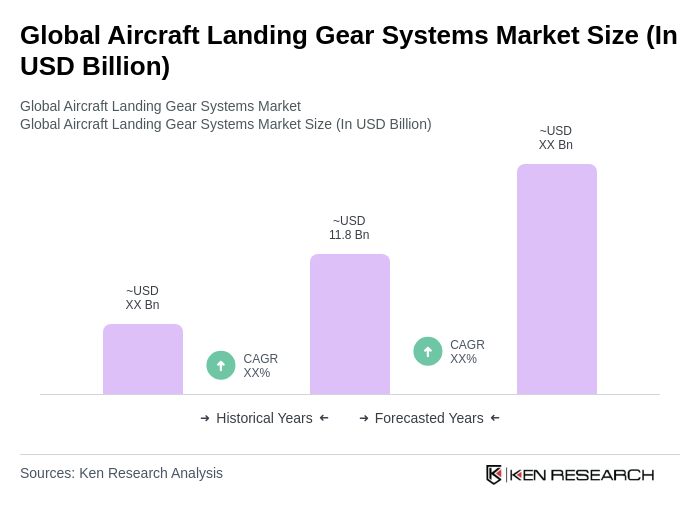
- The Global Aircraft Landing Gear Systems Market is valued at USD 11.8 billion, based on a five-year historical analysis. This growth is primarily driven by the increasing demand for air travel, expanding commercial aircraft fleets, ongoing military modernization programs, and the need for enhanced safety features in aviation. The market is also influenced by the rising number of aircraft deliveries, modernization initiatives, and consistent maintenance and replacement cycles for aging fleets. Manufacturers are increasingly integrating advanced materials such as composites and titanium alloys to reduce weight and improve durability, while innovations in electric and retractable landing gear systems are gaining momentum .
- Key players in this market include the United States, Germany, and China. The United States dominates due to its extensive aerospace industry, advanced technology, and significant investments in research and development. Germany is recognized for manufacturing and engineering excellence, while China is rapidly expanding its aviation sector, contributing to the global demand for landing gear systems .
- In recent years, regulatory bodies such as the Federal Aviation Administration (FAA) have continued to update safety and performance standards for landing gear systems, emphasizing the adoption of advanced materials and technologies. These regulations ensure that new aircraft models meet stringent safety requirements, driving innovation and investment in the landing gear sector .
Global Aircraft Landing Gear Systems Market Segmentation
By Type:The market is segmented into various types of landing gear systems, including Main Landing Gear, Nose Landing Gear, Tailwheel Landing Gear, Multi-Bogey Landing Gear, and Others. Among these, the Main Landing Gear is the most significant segment, primarily due to its critical role in supporting the aircraft's weight during landing and takeoff. The demand for advanced materials and designs in Main Landing Gear is driven by the need for enhanced safety, performance, and operational efficiency, making it a focal point for manufacturers .

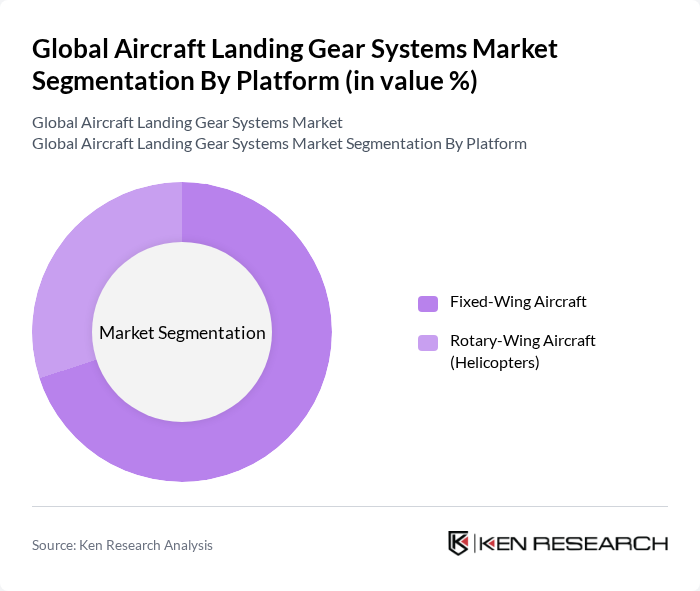
By Platform:The market is categorized into Fixed-Wing Aircraft and Rotary-Wing Aircraft (Helicopters). The Fixed-Wing Aircraft segment holds a dominant position due to the higher volume of commercial and military aircraft in operation. The increasing demand for passenger and cargo transport, fleet modernization, and the need for robust landing gear systems to ensure safety and reliability during operations are key factors driving the growth of this segment .
Global Aircraft Landing Gear Systems Market Competitive Landscape
The Global Aircraft Landing Gear Systems Market is characterized by a dynamic mix of regional and international players. Leading participants such as Safran Landing Systems, Collins Aerospace, Liebherr-Aerospace Lindenberg GmbH, Triumph Group, Heroux-Devtek Inc., CIRCOR Aerospace, Inc., Magellan Aerospace Corporation, Parker Hannifin Corporation, GKN Aerospace, UTC Aerospace Systems (now part of Collins Aerospace), SPP Canada Aircraft, Inc., AAR Corp, Honeywell Aerospace, Boeing, Airbus, Bombardier, Embraer contribute to innovation, geographic expansion, and service delivery in this space.
Global Aircraft Landing Gear Systems Market Industry Analysis
Growth Drivers
- Increasing Air Traffic Demand:The global air traffic is projected to reach 4.8 billion passengers in future, up from 4.5 billion in future, according to the International Air Transport Association (IATA). This surge in passenger numbers drives the need for more aircraft, subsequently increasing the demand for landing gear systems. Additionally, the World Bank forecasts a 4.0% growth in global GDP, further supporting the expansion of the aviation sector and the associated landing gear market.
- Technological Advancements in Landing Gear Systems:The integration of advanced technologies, such as composite materials and smart sensors, is revolutionizing landing gear systems. The global market for aerospace composites is expected to reach $45 billion by future, as reported by MarketsandMarkets. These innovations enhance performance, reduce weight, and improve fuel efficiency, making modern aircraft more competitive and driving the demand for upgraded landing gear systems in the aviation industry.
- Rising Focus on Aircraft Safety and Performance:With increasing regulatory scrutiny, the aviation industry is prioritizing safety and performance enhancements. The Federal Aviation Administration (FAA) reported a 20% increase in safety inspections in future, reflecting this trend. As airlines invest in safety upgrades, the demand for high-performance landing gear systems is expected to rise, ensuring compliance with stringent safety standards and improving overall operational efficiency.
Market Challenges
- High Maintenance and Replacement Costs:The maintenance costs for landing gear systems can reach up to $1.2 million annually for large commercial aircraft, according to industry estimates. This financial burden can deter airlines from upgrading their systems, especially in a post-pandemic recovery phase where operational budgets are tight. Consequently, the high costs associated with maintenance and replacement pose a significant challenge to market growth.
- Stringent Regulatory Compliance Requirements:Compliance with international aviation safety standards, such as those set by the FAA and EASA, requires significant investment in quality assurance and testing. The cost of compliance can exceed $600,000 per aircraft, according to industry reports. These stringent regulations can slow down the introduction of new landing gear technologies, creating a barrier for manufacturers looking to innovate and expand their market presence.
Global Aircraft Landing Gear Systems Market Future Outlook
The future of the aircraft landing gear systems market is poised for significant transformation, driven by technological advancements and a growing emphasis on sustainability. As electric and hybrid aircraft gain traction, the demand for innovative landing gear solutions will increase. Furthermore, the adoption of predictive maintenance technologies is expected to enhance operational efficiency, reducing downtime and costs. These trends indicate a dynamic market landscape, where adaptability and innovation will be crucial for stakeholders to thrive in the evolving aviation sector.
Market Opportunities
- Expansion in Emerging Markets:Emerging markets, particularly in Asia-Pacific and Africa, are witnessing rapid growth in air travel. The International Air Transport Association (IATA) predicts that Asia-Pacific will account for 45% of global air traffic in future. This expansion presents significant opportunities for landing gear manufacturers to establish a foothold in these regions, catering to the increasing demand for new aircraft and associated systems.
- Development of Lightweight Materials:The shift towards lightweight materials, such as carbon fiber composites, is creating new opportunities in the landing gear sector. These materials can reduce the weight of landing gear systems by up to 35%, leading to improved fuel efficiency and lower operational costs. As manufacturers invest in R&D for these materials, the market is likely to see enhanced product offerings that meet the evolving needs of the aviation industry.
Scope of the Report
| Segment | Sub-Segments |
|---|---|
| By Type | Main Landing Gear Nose Landing Gear Tailwheel Landing Gear Multi-Bogey Landing Gear Others |
| By Platform | Fixed-Wing Aircraft Rotary-Wing Aircraft (Helicopters) |
| By End-User | Commercial Aviation Military Aviation General Aviation |
| By Component | Shock Absorbers (Struts) Wheels and Brakes Retraction Systems (Actuators) Control Electronics & Sensors Others |
| By Sales Channel | OEMs (Original Equipment Manufacturers) Aftermarket |
| By Application | Passenger Aircraft Cargo Aircraft Military Aircraft Regional Jets Helicopters Others |
Key Target Audience
Investors and Venture Capitalist Firms
Government and Regulatory Bodies (e.g., Federal Aviation Administration, European Union Aviation Safety Agency)
Aircraft Manufacturers
Aerospace Component Suppliers
Maintenance, Repair, and Overhaul (MRO) Service Providers
Airline Operators
Defense Contractors
Insurance Companies Specializing in Aviation
Players Mentioned in the Report:
Safran Landing Systems
Collins Aerospace
Liebherr-Aerospace Lindenberg GmbH
Triumph Group
Heroux-Devtek Inc.
CIRCOR Aerospace, Inc.
Magellan Aerospace Corporation
Parker Hannifin Corporation
GKN Aerospace
UTC Aerospace Systems (now part of Collins Aerospace)
SPP Canada Aircraft, Inc.
AAR Corp
Honeywell Aerospace
Boeing
Airbus
Bombardier
Embraer
Table of Contents
Market Assessment Phase
1. Executive Summary and Approach
2. Global Aircraft Landing Gear Systems Market Overview
2.1 Key Insights and Strategic Recommendations
2.2 Global Aircraft Landing Gear Systems Market Overview
2.3 Definition and Scope
2.4 Evolution of Market Ecosystem
2.5 Timeline of Key Regulatory Milestones
2.6 Value Chain & Stakeholder Mapping
2.7 Business Cycle Analysis
2.8 Policy & Incentive Landscape
3. Global Aircraft Landing Gear Systems Market Analysis
3.1 Growth Drivers
3.1.1 Increasing Air Traffic Demand
3.1.2 Technological Advancements in Landing Gear Systems
3.1.3 Rising Focus on Aircraft Safety and Performance
3.1.4 Growth in Military and Commercial Aviation Sectors
3.2 Market Challenges
3.2.1 High Maintenance and Replacement Costs
3.2.2 Stringent Regulatory Compliance Requirements
3.2.3 Supply Chain Disruptions
3.2.4 Limited Availability of Skilled Workforce
3.3 Market Opportunities
3.3.1 Expansion in Emerging Markets
3.3.2 Development of Lightweight Materials
3.3.3 Integration of Smart Technologies
3.3.4 Collaborations and Partnerships for Innovation
3.4 Market Trends
3.4.1 Shift Towards Electric and Hybrid Aircraft
3.4.2 Adoption of Predictive Maintenance Solutions
3.4.3 Increasing Investment in R&D
3.4.4 Focus on Sustainability and Eco-Friendly Solutions
3.5 Government Regulation
3.5.1 FAA Regulations on Aircraft Safety
3.5.2 EASA Standards for Landing Gear Systems
3.5.3 Environmental Regulations Impacting Manufacturing
3.5.4 Compliance with International Aviation Safety Standards
4. SWOT Analysis
5. Stakeholder Analysis
6. Porter's Five Forces Analysis
7. Global Aircraft Landing Gear Systems Market Market Size, 2019-2024
7.1 By Value
7.2 By Volume
7.3 By Average Selling Price
8. Global Aircraft Landing Gear Systems Market Segmentation
8.1 By Type
8.1.1 Main Landing Gear
8.1.2 Nose Landing Gear
8.1.3 Tailwheel Landing Gear
8.1.4 Multi-Bogey Landing Gear
8.1.5 Others
8.2 By Platform
8.2.1 Fixed-Wing Aircraft
8.2.2 Rotary-Wing Aircraft (Helicopters)
8.3 By End-User
8.3.1 Commercial Aviation
8.3.2 Military Aviation
8.3.3 General Aviation
8.4 By Component
8.4.1 Shock Absorbers (Struts)
8.4.2 Wheels and Brakes
8.4.3 Retraction Systems (Actuators)
8.4.4 Control Electronics & Sensors
8.4.5 Others
8.5 By Sales Channel
8.5.1 OEMs (Original Equipment Manufacturers)
8.5.2 Aftermarket
8.6 By Application
8.6.1 Passenger Aircraft
8.6.2 Cargo Aircraft
8.6.3 Military Aircraft
8.6.4 Regional Jets
8.6.5 Helicopters
8.6.6 Others
9. Global Aircraft Landing Gear Systems Market Competitive Analysis
9.1 Market Share of Key Players
9.2 Cross Comparison of Key Players
9.2.1 Company Name
9.2.2 Group Size (Large, Medium, or Small as per industry convention)
9.2.3 Revenue Growth Rate (YoY %)
9.2.4 Market Share (%)
9.2.5 Geographic Footprint (Number of Countries/Regions Served)
9.2.6 R&D Intensity (% of Revenue)
9.2.7 Product Portfolio Breadth (Number of Landing Gear Systems/Variants)
9.2.8 OEM vs Aftermarket Revenue Split (%)
9.2.9 Major Aircraft Programs Supported (e.g., Airbus A320, Boeing 737, etc.)
9.2.10 Strategic Partnerships/Joint Ventures
9.2.11 Supply Chain Responsiveness (Lead Time, On-Time Delivery %)
9.2.12 Certification & Compliance (FAA/EASA/Other)
9.2.13 Customer Satisfaction Index
9.3 SWOT Analysis of Top Players
9.4 Pricing Analysis
9.5 Detailed Profile of Major Companies
9.5.1 Safran Landing Systems
9.5.2 Collins Aerospace
9.5.3 Liebherr-Aerospace Lindenberg GmbH
9.5.4 Triumph Group
9.5.5 Heroux-Devtek Inc.
9.5.6 CIRCOR Aerospace, Inc.
9.5.7 Magellan Aerospace Corporation
9.5.8 Parker Hannifin Corporation
9.5.9 GKN Aerospace
9.5.10 UTC Aerospace Systems (now part of Collins Aerospace)
9.5.11 SPP Canada Aircraft, Inc.
9.5.12 AAR Corp
9.5.13 Honeywell Aerospace
9.5.14 Boeing
9.5.15 Airbus
9.5.16 Bombardier
9.5.17 Embraer
10. Global Aircraft Landing Gear Systems Market End-User Analysis
10.1 Procurement Behavior of Key Ministries
10.1.1 Defense Ministries
10.1.2 Transportation Ministries
10.1.3 Aviation Authorities
10.2 Corporate Spend on Infrastructure & Energy
10.2.1 Investment in Aircraft Maintenance
10.2.2 Budget Allocation for Safety Enhancements
10.2.3 Funding for Research and Development
10.3 Pain Point Analysis by End-User Category
10.3.1 Cost Management in Maintenance
10.3.2 Compliance with Safety Regulations
10.3.3 Need for Advanced Technology Integration
10.4 User Readiness for Adoption
10.4.1 Training and Skill Development
10.4.2 Infrastructure Readiness
10.4.3 Financial Preparedness
10.5 Post-Deployment ROI and Use Case Expansion
10.5.1 Performance Metrics Evaluation
10.5.2 Long-term Cost Savings
10.5.3 Opportunities for Upgrades
11. Global Aircraft Landing Gear Systems Market Future Size, 2025-2030
11.1 By Value
11.2 By Volume
11.3 By Average Selling Price
Go-To-Market Strategy Phase
1. Whitespace Analysis + Business Model Canvas
1.1 Market Gaps Identification
1.2 Value Proposition Development
1.3 Revenue Streams Analysis
1.4 Cost Structure Evaluation
1.5 Key Partnerships Exploration
1.6 Customer Segmentation
1.7 Channels and Customer Relationships
2. Marketing and Positioning Recommendations
2.1 Branding Strategies
2.2 Product USPs
3. Distribution Plan
3.1 Urban Retail vs Rural NGO Tie-ups
4. Channel & Pricing Gaps
4.1 Underserved Routes
4.2 Pricing Bands
5. Unmet Demand & Latent Needs
5.1 Category Gaps
5.2 Consumer Segments
6. Customer Relationship
6.1 Loyalty Programs
6.2 After-sales Service
7. Value Proposition
7.1 Sustainability
7.2 Integrated Supply Chains
8. Key Activities
8.1 Regulatory Compliance
8.2 Branding
8.3 Distribution Setup
9. Entry Strategy Evaluation
9.1 Domestic Market Entry Strategy
9.1.1 Product Mix
9.1.2 Pricing Band
9.1.3 Packaging
9.2 Export Entry Strategy
9.2.1 Target Countries
9.2.2 Compliance Roadmap
10. Entry Mode Assessment
10.1 JV
10.2 Greenfield
10.3 M&A
10.4 Distributor Model
11. Capital and Timeline Estimation
11.1 Capital Requirements
11.2 Timelines
12. Control vs Risk Trade-Off
12.1 Ownership vs Partnerships
13. Profitability Outlook
13.1 Breakeven Analysis
13.2 Long-term Sustainability
14. Potential Partner List
14.1 Distributors
14.2 JVs
14.3 Acquisition Targets
15. Execution Roadmap
15.1 Phased Plan for Market Entry
15.1.1 Market Setup
15.1.2 Market Entry
15.1.3 Growth Acceleration
15.1.4 Scale & Stabilize
15.2 Key Activities and Milestones
15.2.1 Activity Planning
15.2.2 Milestone Tracking
Research Methodology
Phase 1: Approach1
Desk Research
- Industry reports from aviation authorities and aerospace organizations
- Market analysis publications from leading aerospace research firms
- Technical specifications and standards from regulatory bodies like FAA and EASA
Primary Research
- Interviews with landing gear manufacturers and suppliers
- Surveys with airline fleet managers regarding landing gear usage and maintenance
- Field interviews with aerospace engineers specializing in landing gear systems
Validation & Triangulation
- Cross-validation of data from multiple industry sources and expert opinions
- Triangulation of market size estimates using historical data and growth trends
- Sanity checks through expert panel reviews and feedback sessions
Phase 2: Market Size Estimation1
Top-down Assessment
- Global aircraft fleet data to estimate landing gear system demand
- Breakdown of market size by aircraft type (commercial, military, cargo)
- Incorporation of trends in aircraft production and retirement rates
Bottom-up Modeling
- Volume estimates based on landing gear replacement cycles and maintenance schedules
- Cost analysis of landing gear systems from major manufacturers
- Estimation of aftermarket services and parts sales related to landing gear
Forecasting & Scenario Analysis
- Multi-factor regression analysis incorporating fuel prices, air travel demand, and technological advancements
- Scenario modeling based on regulatory changes and environmental considerations
- Baseline, optimistic, and pessimistic forecasts through 2035
Phase 3: CATI Sample Composition1
| Scope Item/Segment | Sample Size | Target Respondent Profiles |
|---|---|---|
| Commercial Aircraft Landing Gear | 120 | Fleet Managers, Maintenance Directors |
| Military Aircraft Landing Gear | 90 | Procurement Officers, Defense Contractors |
| Cargo Aircraft Landing Gear | 60 | Operations Managers, Logistics Coordinators |
| Aftermarket Services for Landing Gear | 50 | Service Managers, Parts Distribution Managers |
| Landing Gear Technology Innovations | 40 | Aerospace Engineers, R&D Managers |
Frequently Asked Questions
What is the current value of the Global Aircraft Landing Gear Systems Market?
The Global Aircraft Landing Gear Systems Market is valued at approximately USD 11.8 billion, driven by increasing air travel demand, military modernization, and the need for enhanced safety features in aviation.
What factors are driving the growth of the Aircraft Landing Gear Systems Market?
Which countries are leading in the Aircraft Landing Gear Systems Market?
What are the main types of landing gear systems in the market?
Other Regional/Country Reports
Indonesia Aircraft Landing Gear Systems Market
Malaysia Aircraft Landing Gear Systems Market
APAC Aircraft Landing Gear Systems Market
SEA Aircraft Landing Gear Systems Market
Why Buy From Us?

What makes us stand out is that our consultants follow Robust, Refine and Result (RRR) methodology. Robust for clear definitions, approaches and sanity checking, Refine for differentiating respondents' facts and opinions, and Result for presenting data with story.

We have set a benchmark in the industry by offering our clients with syndicated and customized market research reports featuring coverage of entire market as well as meticulous research and analyst insights.

While we don't replace traditional research, we flip the method upside down. Our dual approach of Top Bottom & Bottom Top ensures quality deliverable by not just verifying company fundamentals but also looking at the sector and macroeconomic factors.

With one step in the future, our research team constantly tries to show you the bigger picture. We help with some of the tough questions you may encounter along the way: How is the industry positioned? Best marketing channel? KPI's of competitors? By aligning every element, we help maximize success.

Our report gives you instant access to the answers and sources that other companies might choose to hide. We elaborate each steps of research methodology we have used and showcase you the sample size to earn your trust.

If you need any support, we are here! We pride ourselves on universe strength, data quality, and quick, friendly, and professional service.