Global Aircraft Radome Market

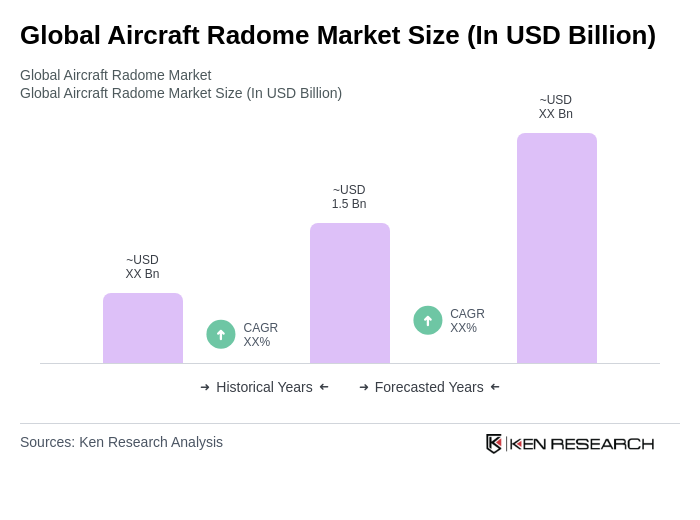
The Global Aircraft Radome Market, valued at USD 1.5 billion, is growing due to rising air travel, advanced materials, and regulations like FAA standards, with key segments in conformal radomes and commercial aviation.

Region:Global

Author(s):Shubham

Product Code:KRAB0712

Pages:90

Published On:August 2025
About the Report

Base Year 2024

Global Aircraft Radome Market Overview

  • The Global Aircraft Radome Market is valued at USD 1.5 billion, based on a five-year historical analysis. This growth is primarily driven by the increasing demand for advanced radar and communication systems in both commercial and military aviation sectors. The rise in air travel, expansion of airline fleets, and the need for enhanced safety and navigation systems have further propelled the market's expansion. The adoption of lightweight composite materials and integration of next-generation communication technologies, such as 5G and advanced satellite connectivity, are also accelerating market growth .
  • Key players in this market are predominantly located in North America and Europe, with the United States and Germany being the most significant contributors. The dominance of these regions is attributed to their advanced aerospace industries, substantial investments in R&D, and the presence of major aircraft manufacturers and defense contractors. North America leads the market, supported by strong defense spending and a concentration of key aerospace manufacturers .
  • In 2023, the Federal Aviation Administration (FAA) issued the “Advisory Circular AC 43-16A: Aviation Maintenance Alerts” and updated material standards under the “FAA Technical Standard Order (TSO) C148b – Aircraft Antenna and Radome” to mandate the use of advanced composite materials in aircraft radomes. These regulations are designed to improve radome performance, reduce weight, and ensure compliance with safety and electromagnetic transparency standards, thereby driving innovation and competitiveness in the aircraft radome market .
Global Aircraft Radome Market Size

Global Aircraft Radome Market Segmentation

By Type:

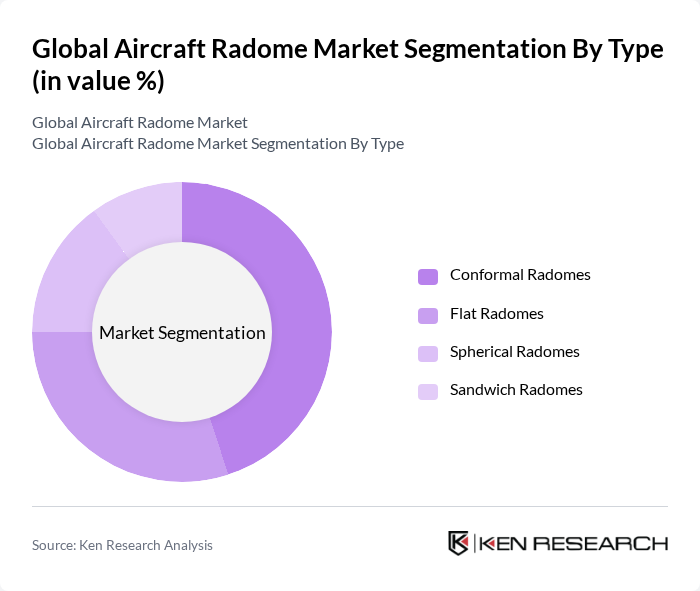
Global Aircraft Radome Market segmentation by Type.

The segmentation by type includes Conformal Radomes, Flat Radomes, Spherical Radomes, and Sandwich Radomes. Among these, Conformal Radomes are leading the market due to their aerodynamic advantages and lightweight properties, making them ideal for modern aircraft designs. The increasing focus on fuel efficiency, performance optimization, and stealth capabilities in aviation has led to a growing preference for these radomes. Flat Radomes are also gaining traction, particularly in military and UAV applications, due to their robust design and ease of integration with advanced radar and communication systems .

By End-User:
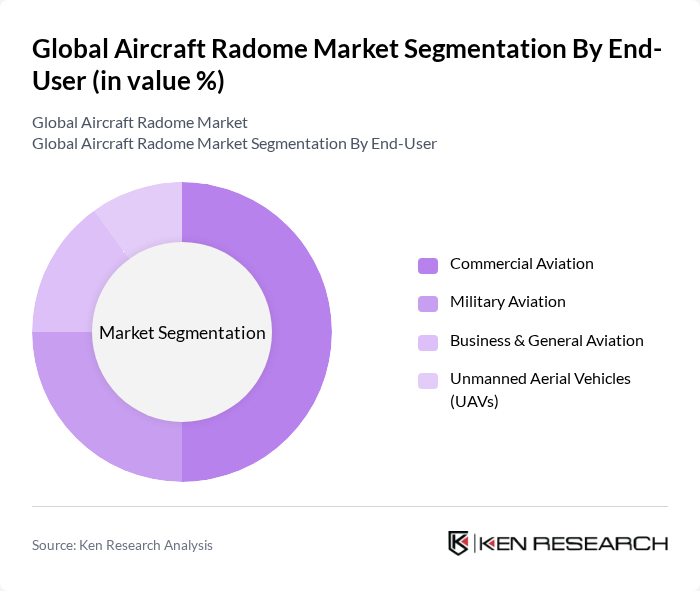
Global Aircraft Radome Market segmentation by End-User.

This segmentation includes Commercial Aviation, Military Aviation, Business & General Aviation, and Unmanned Aerial Vehicles (UAVs). The Commercial Aviation segment holds the largest share, driven by the increasing number of air travelers, expansion of airline fleets, and the need for advanced in-flight connectivity and navigation systems. Military Aviation is also significant, as defense budgets are being allocated towards upgrading existing aircraft with advanced radar and communication systems. The UAV segment is witnessing rapid growth due to the rising adoption of drones for surveillance, intelligence, and cargo transport applications .

Global Aircraft Radome Market Competitive Landscape

The Global Aircraft Radome Market is characterized by a dynamic mix of regional and international players. Leading participants such as Northrop Grumman Corporation, RTX Corporation (formerly Raytheon Technologies Corporation), Honeywell International Inc., L3Harris Technologies, Inc., Safran Electronics & Defense, GKN Aerospace Services Limited, RUAG AG, AMETEK, Inc., Ducommun Incorporated, Cobham Limited, Spirit AeroSystems Holdings, Inc., FACC AG, Aernnova Aerospace S.A., Triumph Group, Inc., Trelleborg AB, General Dynamics Corporation, Airbus SE, The NORDAM Group LLC, Saint-Gobain Performance Plastics, Starwin Industries, Meggitt PLC, Kitsap Composites, Vermont Composites Inc., Jenoptik AG, Royal Engineered Composites, Aviation Industry Corporation of China (AVIC), CPI Aerostructures, Inc., Leonardo S.p.A., Pacific Radomes, Orbital ATK (now part of Northrop Grumman), Kelvin Hughes Limited contribute to innovation, geographic expansion, and service delivery in this space.

Northrop Grumman Corporation

1939

Falls Church, Virginia, USA

RTX Corporation

2020

Arlington, Virginia, USA

Honeywell International Inc.

1906

Charlotte, North Carolina, USA

L3Harris Technologies, Inc.

2019

Melbourne, Florida, USA

Safran Electronics & Defense

2005

Paris, France

Company

Establishment Year

Headquarters

Group Size (Large, Medium, or Small as per industry convention)

Revenue (USD Millions)

Revenue Growth Rate (%)

Market Share (%)

Geographic Presence (No. of Countries/Regions)

R&D Investment (% of Revenue)

Global Aircraft Radome Market Industry Analysis

Growth Drivers

  • Increasing Demand for Advanced Avionics:The global avionics market is projected to reach $82.5 billion in future, driven by the need for enhanced navigation and communication systems. This surge in demand for advanced avionics directly influences the aircraft radome market, as radomes are essential for housing and protecting these sophisticated systems. The integration of advanced avionics in commercial and military aircraft is expected to increase radome production, with a notable rise in orders from manufacturers like Boeing and Airbus, which collectively delivered over 1,400 aircraft in recent periods.
  • Growth in Commercial Aviation Sector:The International Air Transport Association (IATA) forecasts that global passenger numbers will reach 4.3 billion in future, up from 4 billion in recent periods. This growth in commercial aviation is a significant driver for the aircraft radome market, as airlines invest in new aircraft to meet rising demand. With airlines expected to spend approximately $170 billion on new aircraft in future, the need for reliable and efficient radomes becomes critical to support advanced communication and navigation systems.
  • Technological Advancements in Materials:The development of advanced materials, such as composites and lightweight polymers, is revolutionizing the aircraft radome market. For instance, the global composite materials market is projected to reach $38.5 billion in future, driven by their superior performance characteristics. These materials not only enhance the durability and performance of radomes but also contribute to fuel efficiency in aircraft. As airlines and manufacturers prioritize weight reduction, the adoption of these innovative materials in radome production is expected to increase significantly.

Market Challenges

  • High Manufacturing Costs:The production of aircraft radomes involves significant investment in advanced materials and technologies, leading to high manufacturing costs. For example, the cost of composite materials can be up to 30% higher than traditional materials. This financial burden can deter smaller manufacturers from entering the market, limiting competition and innovation. Additionally, the high costs associated with research and development for new radome technologies can further strain budgets, particularly for companies operating on thin margins.
  • Stringent Regulatory Requirements:The aircraft industry is subject to rigorous safety and quality regulations imposed by authorities such as the FAA and EASA. Compliance with these regulations often requires extensive testing and certification processes, which can be time-consuming and costly. For instance, the FAA mandates that all aircraft components, including radomes, undergo thorough testing to ensure they meet safety standards. This regulatory landscape can pose significant challenges for manufacturers, particularly new entrants who may lack the resources to navigate complex compliance requirements.

Global Aircraft Radome Market Future Outlook

The future of the aircraft radome market appears promising, driven by ongoing advancements in technology and increasing demand for efficient aviation solutions. As the commercial aviation sector continues to expand, manufacturers are likely to focus on developing innovative radome designs that enhance performance while reducing weight. Additionally, the integration of IoT technologies in aircraft systems is expected to create new opportunities for radome applications, further driving market growth. The emphasis on sustainability will also push manufacturers to explore eco-friendly materials and production methods.

Market Opportunities

  • Expansion in Emerging Markets:Emerging markets, particularly in Asia-Pacific and Latin America, present significant growth opportunities for the aircraft radome market. With increasing air travel demand and investments in aviation infrastructure, these regions are expected to see a rise in aircraft orders. For instance, Asia-Pacific is projected to account for 40% of global aircraft deliveries in future, creating a robust market for radome manufacturers to capitalize on.
  • Development of Lightweight Materials:The ongoing research into lightweight materials, such as advanced composites, offers substantial opportunities for innovation in the radome market. These materials not only improve fuel efficiency but also enhance the overall performance of aircraft. As manufacturers increasingly prioritize weight reduction to meet environmental regulations, the demand for lightweight radomes is expected to grow, providing a competitive edge for companies that invest in this technology.

Scope of the Report

SegmentSub-Segments
By Type

Conformal Radomes

Flat Radomes

Spherical Radomes

Sandwich Radomes

By End-User

Commercial Aviation

Military Aviation

Business & General Aviation

Unmanned Aerial Vehicles (UAVs)

By Material

Composite Materials (e.g., fiberglass, quartz, carbon fiber)

Metal Radomes (e.g., aluminum alloys)

Plastic Radomes (e.g., polycarbonate, ABS)

Advanced Ceramics & Others

By Application

Communication Systems

Radar Systems

Navigation & Weather Systems

Electronic Warfare & Surveillance

By Distribution Channel

Direct Sales (OEMs & Tier-1 Suppliers)

Distributors & Integrators

Aftermarket/Replacement Sales

Online Sales

By Region

North America (U.S., Canada, Mexico)

Europe (U.K., Germany, France, Rest of Europe)

Asia-Pacific (China, India, Japan, South Korea, Rest of APAC)

Latin America

Middle East & Africa

By Price Range

Low Price Range

Mid Price Range

High Price Range

Custom/Project-Based Pricing

Key Target Audience

Investors and Venture Capitalist Firms

Government and Regulatory Bodies (e.g., Federal Aviation Administration, European Union Aviation Safety Agency)

Manufacturers and Producers

Distributors and Retailers

Aerospace and Defense Contractors

Airline Operators and Fleet Managers

Military Procurement Agencies

Aircraft Maintenance, Repair, and Overhaul (MRO) Providers

Players Mentioned in the Report:

Northrop Grumman Corporation

RTX Corporation (formerly Raytheon Technologies Corporation)

Honeywell International Inc.

L3Harris Technologies, Inc.

Safran Electronics & Defense

GKN Aerospace Services Limited

RUAG AG

AMETEK, Inc.

Ducommun Incorporated

Cobham Limited

Spirit AeroSystems Holdings, Inc.

FACC AG

Aernnova Aerospace S.A.

Triumph Group, Inc.

Trelleborg AB

General Dynamics Corporation

Airbus SE

The NORDAM Group LLC

Saint-Gobain Performance Plastics

Starwin Industries

Meggitt PLC

Kitsap Composites

Vermont Composites Inc.

Jenoptik AG

Royal Engineered Composites

Aviation Industry Corporation of China (AVIC)

CPI Aerostructures, Inc.

Leonardo S.p.A.

Pacific Radomes

Orbital ATK (now part of Northrop Grumman)

Kelvin Hughes Limited

Table of Contents

Market Assessment Phase

1. Executive Summary and Approach


2. Global Aircraft Radome Market Overview

2.1 Key Insights and Strategic Recommendations

2.2 Global Aircraft Radome Market Overview

2.3 Definition and Scope

2.4 Evolution of Market Ecosystem

2.5 Timeline of Key Regulatory Milestones

2.6 Value Chain & Stakeholder Mapping

2.7 Business Cycle Analysis

2.8 Policy & Incentive Landscape


3. Global Aircraft Radome Market Analysis

3.1 Growth Drivers

3.1.1 Increasing demand for advanced avionics
3.1.2 Growth in commercial aviation sector
3.1.3 Technological advancements in materials
3.1.4 Rising defense budgets globally

3.2 Market Challenges

3.2.1 High manufacturing costs
3.2.2 Stringent regulatory requirements
3.2.3 Supply chain disruptions
3.2.4 Competition from alternative technologies

3.3 Market Opportunities

3.3.1 Expansion in emerging markets
3.3.2 Development of lightweight materials
3.3.3 Increasing demand for unmanned aerial vehicles (UAVs)
3.3.4 Collaborations with aerospace manufacturers

3.4 Market Trends

3.4.1 Shift towards composite materials
3.4.2 Integration of IoT in aircraft systems
3.4.3 Focus on sustainability and eco-friendly products
3.4.4 Customization of radome designs

3.5 Government Regulation

3.5.1 FAA regulations on aircraft safety
3.5.2 EASA standards for aircraft components
3.5.3 Environmental regulations on manufacturing
3.5.4 Export control regulations for defense-related products

4. SWOT Analysis


5. Stakeholder Analysis


6. Porter's Five Forces Analysis


7. Global Aircraft Radome Market Market Size, 2019-2024

7.1 By Value

7.2 By Volume

7.3 By Average Selling Price


8. Global Aircraft Radome Market Segmentation

8.1 By Type

8.1.1 Conformal Radomes
8.1.2 Flat Radomes
8.1.3 Spherical Radomes
8.1.4 Sandwich Radomes

8.2 By End-User

8.2.1 Commercial Aviation
8.2.2 Military Aviation
8.2.3 Business & General Aviation
8.2.4 Unmanned Aerial Vehicles (UAVs)

8.3 By Material

8.3.1 Composite Materials (e.g., fiberglass, quartz, carbon fiber)
8.3.2 Metal Radomes (e.g., aluminum alloys)
8.3.3 Plastic Radomes (e.g., polycarbonate, ABS)
8.3.4 Advanced Ceramics & Others

8.4 By Application

8.4.1 Communication Systems
8.4.2 Radar Systems
8.4.3 Navigation & Weather Systems
8.4.4 Electronic Warfare & Surveillance

8.5 By Distribution Channel

8.5.1 Direct Sales (OEMs & Tier-1 Suppliers)
8.5.2 Distributors & Integrators
8.5.3 Aftermarket/Replacement Sales
8.5.4 Online Sales

8.6 By Region

8.6.1 North America (U.S., Canada, Mexico)
8.6.2 Europe (U.K., Germany, France, Rest of Europe)
8.6.3 Asia-Pacific (China, India, Japan, South Korea, Rest of APAC)
8.6.4 Latin America
8.6.5 Middle East & Africa

8.7 By Price Range

8.7.1 Low Price Range
8.7.2 Mid Price Range
8.7.3 High Price Range
8.7.4 Custom/Project-Based Pricing

9. Global Aircraft Radome Market Competitive Analysis

9.1 Market Share of Key Players

9.2 Cross Comparison of Key Players

9.2.1 Company Name
9.2.2 Group Size (Large, Medium, or Small as per industry convention)
9.2.3 Revenue (USD Millions)
9.2.4 Revenue Growth Rate (%)
9.2.5 Market Share (%)
9.2.6 Geographic Presence (No. of Countries/Regions)
9.2.7 R&D Investment (% of Revenue)
9.2.8 Product Portfolio Breadth (No. of Radome Types/Applications)
9.2.9 Major End-User Segments Served
9.2.10 Key Strategic Partnerships/Alliances
9.2.11 Patent Portfolio (No. of Radome-Related Patents)
9.2.12 Customer Base (Major OEMs/Defense Agencies)

9.3 SWOT Analysis of Top Players

9.4 Pricing Analysis

9.5 Detailed Profile of Major Companies

9.5.1 Northrop Grumman Corporation
9.5.2 RTX Corporation (formerly Raytheon Technologies Corporation)
9.5.3 Honeywell International Inc.
9.5.4 L3Harris Technologies, Inc.
9.5.5 Safran Electronics & Defense
9.5.6 GKN Aerospace Services Limited
9.5.7 RUAG AG
9.5.8 AMETEK, Inc.
9.5.9 Ducommun Incorporated
9.5.10 Cobham Limited
9.5.11 Spirit AeroSystems Holdings, Inc.
9.5.12 FACC AG
9.5.13 Aernnova Aerospace S.A.
9.5.14 Triumph Group, Inc.
9.5.15 Trelleborg AB
9.5.16 General Dynamics Corporation
9.5.17 Airbus SE
9.5.18 The NORDAM Group LLC
9.5.19 Saint-Gobain Performance Plastics
9.5.20 Starwin Industries
9.5.21 Meggitt PLC
9.5.22 Kitsap Composites
9.5.23 Vermont Composites Inc.
9.5.24 Jenoptik AG
9.5.25 Royal Engineered Composites
9.5.26 Aviation Industry Corporation of China (AVIC)
9.5.27 CPI Aerostructures, Inc.
9.5.28 Leonardo S.p.A.
9.5.29 Pacific Radomes
9.5.30 Orbital ATK (now part of Northrop Grumman)
9.5.31 Kelvin Hughes Limited

10. Global Aircraft Radome Market End-User Analysis

10.1 Procurement Behavior of Key Ministries

10.1.1 Defense Procurement Trends
10.1.2 Civil Aviation Authority Guidelines
10.1.3 Budget Allocation for Aviation Projects

10.2 Corporate Spend on Infrastructure & Energy

10.2.1 Investment in Aircraft Upgrades
10.2.2 Spending on Research and Development
10.2.3 Infrastructure Development Budgets

10.3 Pain Point Analysis by End-User Category

10.3.1 Cost Management Challenges
10.3.2 Supply Chain Reliability Issues
10.3.3 Compliance with Regulatory Standards

10.4 User Readiness for Adoption

10.4.1 Training and Skill Development Needs
10.4.2 Technology Adoption Barriers
10.4.3 Awareness of New Technologies

10.5 Post-Deployment ROI and Use Case Expansion

10.5.1 Measurement of Performance Metrics
10.5.2 Case Studies of Successful Implementations
10.5.3 Future Use Case Scenarios

11. Global Aircraft Radome Market Future Size, 2025-2030

11.1 By Value

11.2 By Volume

11.3 By Average Selling Price


Go-To-Market Strategy Phase

1. Whitespace Analysis + Business Model Canvas

1.1 Market Gaps Identification

1.2 Business Model Framework


2. Marketing and Positioning Recommendations

2.1 Branding Strategies

2.2 Product USPs


3. Distribution Plan

3.1 Urban Retail Strategies

3.2 Rural NGO Tie-ups


4. Channel & Pricing Gaps

4.1 Underserved Routes

4.2 Pricing Bands Analysis


5. Unmet Demand & Latent Needs

5.1 Category Gaps

5.2 Consumer Segments


6. Customer Relationship

6.1 Loyalty Programs

6.2 After-sales Service


7. Value Proposition

7.1 Sustainability Initiatives

7.2 Integrated Supply Chains


8. Key Activities

8.1 Regulatory Compliance

8.2 Branding Efforts

8.3 Distribution Setup


9. Entry Strategy Evaluation

9.1 Domestic Market Entry Strategy

9.1.1 Product Mix Considerations
9.1.2 Pricing Band Strategy
9.1.3 Packaging Solutions

9.2 Export Entry Strategy

9.2.1 Target Countries Identification
9.2.2 Compliance Roadmap Development

10. Entry Mode Assessment

10.1 Joint Ventures

10.2 Greenfield Investments

10.3 Mergers & Acquisitions

10.4 Distributor Model Evaluation


11. Capital and Timeline Estimation

11.1 Capital Requirements Analysis

11.2 Timelines for Implementation


12. Control vs Risk Trade-Off

12.1 Ownership Considerations

12.2 Partnerships Evaluation


13. Profitability Outlook

13.1 Breakeven Analysis

13.2 Long-term Sustainability Strategies


14. Potential Partner List

14.1 Distributors Identification

14.2 Joint Ventures Opportunities

14.3 Acquisition Targets


15. Execution Roadmap

15.1 Phased Plan for Market Entry

15.1.1 Market Setup
15.1.2 Market Entry
15.1.3 Growth Acceleration
15.1.4 Scale & Stabilize

15.2 Key Activities and Milestones

15.2.1 Milestone Planning
15.2.2 Activity Tracking

Research Methodology

ApproachModellingSample

Phase 1: Approach1

Desk Research

  • Industry reports from aviation authorities and aerospace organizations
  • Market analysis publications from leading aerospace research firms
  • Technical papers and white papers on radome technology advancements

Primary Research

  • Interviews with aerospace engineers specializing in radome design
  • Surveys with procurement managers at aircraft manufacturers
  • Field interviews with maintenance and repair organizations (MROs) focusing on radome applications

Validation & Triangulation

  • Cross-validation of data through multiple industry sources and expert opinions
  • Triangulation of market size estimates from production, sales, and regulatory data
  • Sanity checks through expert panel reviews and feedback loops

Phase 2: Market Size Estimation1

Top-down Assessment

  • Analysis of global aircraft production rates and forecasted growth
  • Segmentation of radome applications by aircraft type and region
  • Incorporation of defense and commercial aviation market trends

Bottom-up Modeling

  • Volume estimates based on radome production capacities of leading manufacturers
  • Cost analysis derived from material and manufacturing processes
  • Estimation of market share based on historical sales data and growth rates

Forecasting & Scenario Analysis

  • Multi-variable regression analysis considering technological advancements and market demand
  • Scenario modeling based on geopolitical factors affecting defense spending
  • Baseline, optimistic, and pessimistic forecasts through 2030

Phase 3: CATI Sample Composition1

Scope Item/SegmentSample SizeTarget Respondent Profiles
Commercial Aircraft Manufacturers100Design Engineers, Procurement Managers
Defense Contractors80Program Managers, Technical Directors
MRO Service Providers70Maintenance Managers, Quality Assurance Officers
Radome Material Suppliers60Product Development Managers, Sales Directors
Aerospace Regulatory Bodies40Policy Analysts, Compliance Officers

Frequently Asked Questions

What is the current value of the Global Aircraft Radome Market?

The Global Aircraft Radome Market is valued at approximately USD 1.5 billion, driven by the increasing demand for advanced radar and communication systems in both commercial and military aviation sectors.

What factors are driving the growth of the Aircraft Radome Market?

Which regions are leading in the Aircraft Radome Market?

What types of radomes are available in the market?

Other Regional/Country Reports

UAE Aircraft Radome MarketKSA Aircraft Radome Market

Indonesia Aircraft Radome Market

Malaysia Aircraft Radome Market

APAC Aircraft Radome Market

SEA Aircraft Radome Market

Why Buy From Us?

Refine Robust Result (RRR) Framework

What makes us stand out is that our consultants follow Robust, Refine and Result (RRR) methodology. Robust for clear definitions, approaches and sanity checking, Refine for differentiating respondents' facts and opinions, and Result for presenting data with story.

Our Reach Is Unmatched

We have set a benchmark in the industry by offering our clients with syndicated and customized market research reports featuring coverage of entire market as well as meticulous research and analyst insights.

Shifting the Research Paradigm

While we don't replace traditional research, we flip the method upside down. Our dual approach of Top Bottom & Bottom Top ensures quality deliverable by not just verifying company fundamentals but also looking at the sector and macroeconomic factors.

More Insights-Better Decisions

With one step in the future, our research team constantly tries to show you the bigger picture. We help with some of the tough questions you may encounter along the way: How is the industry positioned? Best marketing channel? KPI's of competitors? By aligning every element, we help maximize success.

Transparency and Trust

Our report gives you instant access to the answers and sources that other companies might choose to hide. We elaborate each steps of research methodology we have used and showcase you the sample size to earn your trust.

Round the Clock Support

If you need any support, we are here! We pride ourselves on universe strength, data quality, and quick, friendly, and professional service.

Why Clients Choose Us?

400000+
Reports in repository
150+
Consulting projects a year
100+
Analysts
8000+
Client Queries in 2022