About the Report
Base Year 2024Global Airport Security Screening Systems Market Overview
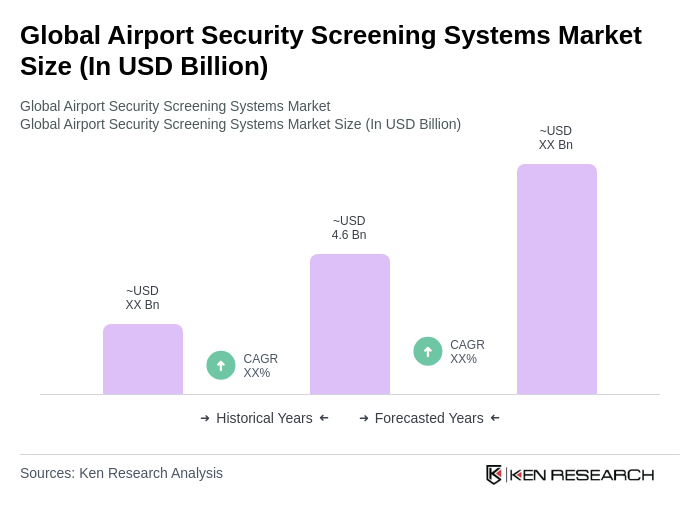
- The Global Airport Security Screening Systems Market is valued at USD 4.6 billion, based on a five-year historical analysis, aligning with recent industry assessments of the screening systems segment within the broader airport security market . This growth is primarily driven by increasing passenger traffic, heightened security concerns, and advancements in technology, including AI-enabled automated detection and computed tomography for baggage and checkpoint screening . The demand for efficient and effective screening solutions has surged amid the recovery of global air travel and evolving threats, reinforcing investment in next-generation systems .
- Key players in this market include the United States, China, and Germany, which dominate due to their extensive airport infrastructure and significant investments in security technologies. The U.S. leads with high passenger volume and advanced security programs; China continues large-scale airport expansion; and Germany’s hub role in Europe supports strong deployments of ECAC-compliant screening solutions .
- In 2023, the European Union advanced implementation of harmonized aviation security measures under EU and ECAC frameworks that mandate enhanced screening performance (including ECAC EDS CB C3 standards for CT and LEDS requirements), accelerating adoption of advanced screening technologies across member states .
Global Airport Security Screening Systems Market Segmentation
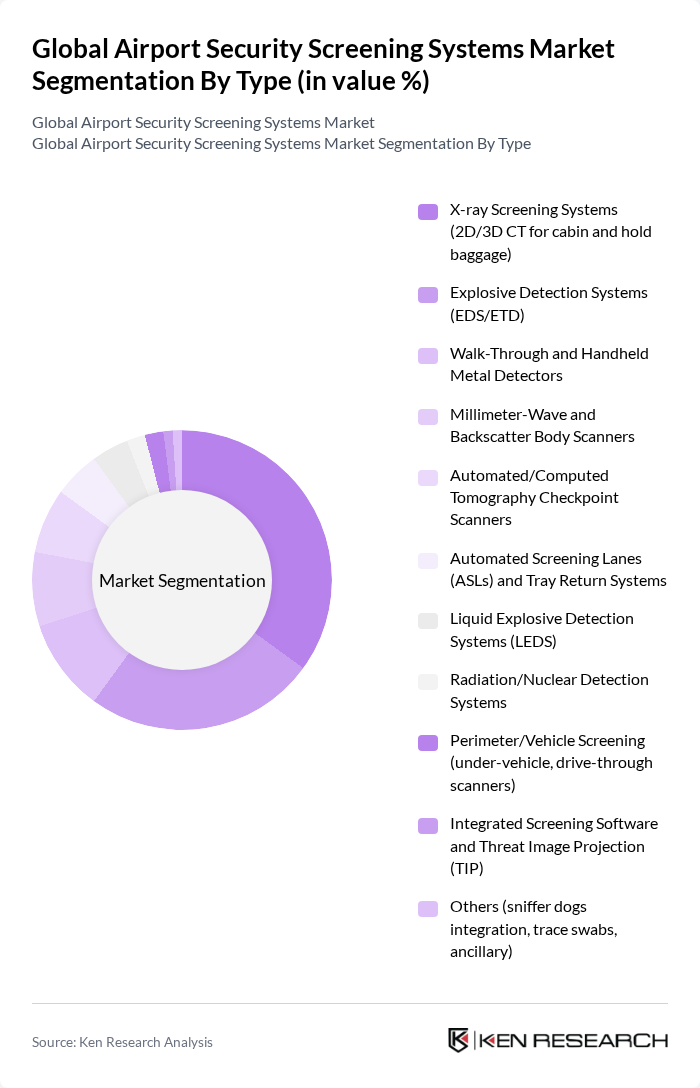
By Type:The market is segmented into various types of screening systems, each catering to specific security needs. The dominant sub-segment isX-ray Screening Systems(including 2D and CT for cabin and hold baggage), widely deployed for baggage inspection and increasingly upgraded to CT meeting ECAC EDS CB C3 performance levels.Explosive Detection Systems (EDS/ETD)remain critical for baggage and trace screening in high-security environments. The increasing adoption ofautomated systems—such as automated screening lanes, AI-enabled auto-detection, and high-throughput CT—is driven by the need for efficiency and faster processing at checkpoints while maintaining stringent detection performance .
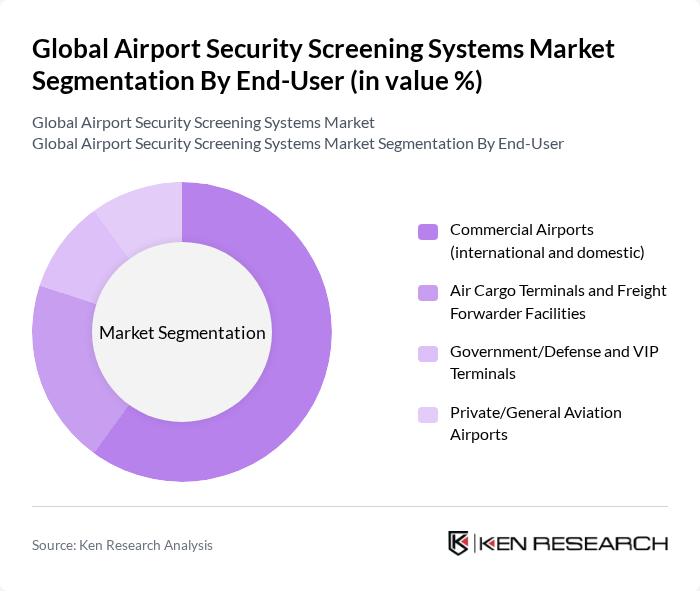
By End-User:The end-user segmentation includes various categories such as commercial airports, air cargo terminals, government/defense, and private aviation.Commercial airportsdominate due to high passenger throughput and mandatory compliance with TSA/ECAC/ICAO-aligned screening requirements.Air cargo terminalsshow rising adoption of certified EDS and ETD solutions driven by e-commerce growth and regulated air cargo security programs .
Global Airport Security Screening Systems Market Competitive Landscape
The Global Airport Security Screening Systems Market is characterized by a dynamic mix of regional and international players. Leading participants such as Smiths Detection, Leidos, Rapiscan Systems (OSI Systems), Analogic Corporation, Nuctech Company Limited, CEIA S.p.A., Astrophysics Inc., Leidos Security Detection & Automation, VOTI Detection, Gilardoni S.p.A., L3Harris Security & Detection Systems (legacy installed base), Evolv Technology, Adani Systems, Inc. (ADANI), Garrett Metal Detectors, Teledyne ICM (Teledyne Technologies) contribute to innovation, geographic expansion, and service delivery in this space.
Global Airport Security Screening Systems Market Industry Analysis
Growth Drivers
- Increasing Global Air Travel Demand:The International Air Transport Association (IATA) reported that global air passenger numbers are projected to reach 4.5 billion in future, up from 4.2 billion in future. This surge in air travel necessitates enhanced security measures at airports, driving demand for advanced screening systems. As more travelers pass through airports, the need for efficient and effective security solutions becomes paramount, prompting investments in state-of-the-art technologies to ensure safety and streamline operations.
- Heightened Security Concerns Post-9/11:Following the September 11 attacks, airport security protocols underwent significant changes, leading to increased investments in screening technologies. The U.S. Transportation Security Administration (TSA) allocated approximately $8.0 billion in future for security enhancements, reflecting ongoing concerns about terrorism and safety. This sustained focus on security has created a robust market for advanced screening systems, as airports strive to meet regulatory requirements and reassure passengers about their safety.
- Technological Advancements in Screening Systems:The global airport security screening systems market is witnessing rapid technological advancements, particularly in areas such as artificial intelligence and machine learning. In future, the market for AI-driven security solutions is expected to exceed $1.5 billion, driven by the need for faster and more accurate threat detection. These innovations not only enhance security but also improve operational efficiency, making them attractive investments for airports looking to modernize their screening processes.
Market Challenges
- High Initial Investment Costs:The implementation of advanced airport security screening systems often requires substantial upfront investments. For instance, the cost of installing a comprehensive screening system can range from $1.2 million to over $12 million, depending on the technology and airport size. This financial burden can deter smaller airports from upgrading their systems, leading to disparities in security capabilities across different regions and potentially compromising overall safety.
- Integration Complexities with Existing Systems:Many airports face challenges when integrating new screening technologies with their existing infrastructure. For example, legacy systems may not be compatible with modern solutions, leading to increased costs and extended implementation timelines. In future, it is estimated that 35% of airports will struggle with integration issues, which can hinder the effectiveness of new security measures and create operational inefficiencies that affect passenger experience.
Global Airport Security Screening Systems Market Future Outlook
The future of airport security screening systems is poised for significant transformation, driven by technological advancements and evolving security needs. As airports increasingly adopt biometric and contactless screening technologies, operational efficiency and passenger experience will improve. Additionally, the integration of data analytics for threat detection will enhance security measures. These trends indicate a shift towards more automated and intelligent systems, ensuring that airports can effectively manage growing passenger volumes while maintaining high safety standards.
Market Opportunities
- Growth in Emerging Markets:Emerging markets, particularly in Asia and Africa, are experiencing rapid growth in air travel. In future, the Asia-Pacific region is expected to see a 7% increase in passenger traffic, creating opportunities for airports to invest in modern security screening systems. This growth presents a significant opportunity for technology providers to expand their market presence and cater to the unique security needs of these regions.
- Development of AI and Machine Learning in Screening:The increasing adoption of AI and machine learning technologies in security screening presents a lucrative opportunity. By future, the market for AI-driven screening solutions is projected to grow significantly, driven by the demand for enhanced threat detection capabilities. This trend will enable airports to implement smarter, more efficient systems that can adapt to evolving security challenges, ultimately improving passenger safety and operational efficiency.
Scope of the Report
| Segment | Sub-Segments |
|---|---|
| By Type | X-ray Screening Systems (2D/3D CT for cabin and hold baggage) Explosive Detection Systems (EDS/ETD) Walk-Through and Handheld Metal Detectors Millimeter-Wave and Backscatter Body Scanners Automated/Computed Tomography Checkpoint Scanners Automated Screening Lanes (ASLs) and Tray Return Systems Liquid Explosive Detection Systems (LEDS) Radiation/Nuclear Detection Systems Perimeter/Vehicle Screening (under-vehicle, drive-through scanners) Integrated Screening Software and Threat Image Projection (TIP) Others (sniffer dogs integration, trace swabs, ancillary) |
| By End-User | Commercial Airports (international and domestic) Air Cargo Terminals and Freight Forwarder Facilities Government/Defense and VIP Terminals Private/General Aviation Airports |
| By Application | Passenger Screening Checkpoints Cabin Baggage Screening Hold/Checked Baggage Screening Air Cargo and Mail Screening Landside/Perimeter and Access Control Screening |
| By Component | Hardware (scanners, detectors, conveyors) Software/Algorithms (AI/ML, auto-detection, integration) Services (installation, MRO, calibration, training) |
| By Sales Channel | Direct Sales to Airport Authorities System Integrators and Distributors Government Procurement Frameworks/Tenders |
| By Distribution Mode | Air Transport Land Transport Sea Transport |
| By Price Range | Entry-Level Systems Mid-Range Systems Premium/High-Capacity Systems |
Key Target Audience
Investors and Venture Capitalist Firms
Government and Regulatory Bodies (e.g., Transportation Security Administration, European Union Aviation Safety Agency)
Airport Authorities and Operators
Security Equipment Manufacturers
Airline Companies
Customs and Border Protection Agencies
Airport Infrastructure Developers
Public Safety and Security Agencies
Players Mentioned in the Report:
Smiths Detection
Leidos
Rapiscan Systems (OSI Systems)
Analogic Corporation
Nuctech Company Limited
CEIA S.p.A.
Astrophysics Inc.
Leidos Security Detection & Automation
VOTI Detection
Gilardoni S.p.A.
L3Harris Security & Detection Systems (legacy installed base)
Evolv Technology
Adani Systems, Inc. (ADANI)
Garrett Metal Detectors
Teledyne ICM (Teledyne Technologies)
Table of Contents
Market Assessment Phase
1. Executive Summary and Approach
2. Global Airport Security Screening Systems Market Overview
2.1 Key Insights and Strategic Recommendations
2.2 Global Airport Security Screening Systems Market Overview
2.3 Definition and Scope
2.4 Evolution of Market Ecosystem
2.5 Timeline of Key Regulatory Milestones
2.6 Value Chain & Stakeholder Mapping
2.7 Business Cycle Analysis
2.8 Policy & Incentive Landscape
3. Global Airport Security Screening Systems Market Analysis
3.1 Growth Drivers
3.1.1 Increasing global air travel demand
3.1.2 Heightened security concerns post-9/11
3.1.3 Technological advancements in screening systems
3.1.4 Government regulations mandating enhanced security measures
3.2 Market Challenges
3.2.1 High initial investment costs
3.2.2 Integration complexities with existing systems
3.2.3 Evolving nature of security threats
3.2.4 Regulatory compliance hurdles
3.3 Market Opportunities
3.3.1 Growth in emerging markets
3.3.2 Development of AI and machine learning in screening
3.3.3 Expansion of public-private partnerships
3.3.4 Increasing demand for automated systems
3.4 Market Trends
3.4.1 Shift towards biometric screening technologies
3.4.2 Adoption of contactless screening solutions
3.4.3 Focus on sustainability in security operations
3.4.4 Integration of data analytics for threat detection
3.5 Government Regulation
3.5.1 TSA regulations in the United States
3.5.2 ICAO standards for international airports
3.5.3 EU regulations on airport security
3.5.4 National security policies in various countries
4. SWOT Analysis
5. Stakeholder Analysis
6. Porter's Five Forces Analysis
7. Global Airport Security Screening Systems Market Market Size, 2019-2024
7.1 By Value
7.2 By Volume
7.3 By Average Selling Price
8. Global Airport Security Screening Systems Market Segmentation
8.1 By Type
8.1.1 X-ray Screening Systems (2D/3D CT for cabin and hold baggage)
8.1.2 Explosive Detection Systems (EDS/ETD)
8.1.3 Walk-Through and Handheld Metal Detectors
8.1.4 Millimeter-Wave and Backscatter Body Scanners
8.1.5 Automated/Computed Tomography Checkpoint Scanners
8.1.6 Automated Screening Lanes (ASLs) and Tray Return Systems
8.1.7 Liquid Explosive Detection Systems (LEDS)
8.1.8 Radiation/Nuclear Detection Systems
8.1.9 Perimeter/Vehicle Screening (under-vehicle, drive-through scanners)
8.1.10 Integrated Screening Software and Threat Image Projection (TIP)
8.1.11 Others (sniffer dogs integration, trace swabs, ancillary)
8.2 By End-User
8.2.1 Commercial Airports (international and domestic)
8.2.2 Air Cargo Terminals and Freight Forwarder Facilities
8.2.3 Government/Defense and VIP Terminals
8.2.4 Private/General Aviation Airports
8.3 By Application
8.3.1 Passenger Screening Checkpoints
8.3.2 Cabin Baggage Screening
8.3.3 Hold/Checked Baggage Screening
8.3.4 Air Cargo and Mail Screening
8.3.5 Landside/Perimeter and Access Control Screening
8.4 By Component
8.4.1 Hardware (scanners, detectors, conveyors)
8.4.2 Software/Algorithms (AI/ML, auto-detection, integration)
8.4.3 Services (installation, MRO, calibration, training)
8.5 By Sales Channel
8.5.1 Direct Sales to Airport Authorities
8.5.2 System Integrators and Distributors
8.5.3 Government Procurement Frameworks/Tenders
8.6 By Distribution Mode
8.6.1 Air Transport
8.6.2 Land Transport
8.6.3 Sea Transport
8.7 By Price Range
8.7.1 Entry-Level Systems
8.7.2 Mid-Range Systems
8.7.3 Premium/High-Capacity Systems
9. Global Airport Security Screening Systems Market Competitive Analysis
9.1 Market Share of Key Players
9.2 Cross Comparison of Key Players
9.2.1 Company Name (e.g., Smiths Detection, Leidos, Rapiscan Systems, Nuctech, Analogic, CEIA)
9.2.2 Group Size (Large, Medium, Small by airport screening revenue)
9.2.3 Revenue Growth Rate (YoY, airport screening segment)
9.2.4 Installed Base at Airports (number of deployed units/airports)
9.2.5 TSA/ECAC/ICAO Certification Coverage (e.g., TSA AT-2, ECAC EDS CB C3)
9.2.6 Throughput Capacity (passengers or trays per hour, bags per hour)
9.2.7 Detection Performance (PD/false alarm rates per certification tests)
9.2.8 Product Innovation Velocity (new models, AI features, CT upgrades per year)
9.2.9 Service Network Uptime (SLA, mean time to repair/maintainability)
9.2.10 Average Selling Price Band (checkpoint CT, EDS, body scanners)
9.2.11 Cybersecurity and Data Compliance (FedRAMP/ISO 27001, data handling)
9.2.12 Global Market Share (%) in Airport Screening
9.2.13 Customer References (top airport programs, e.g., TSA, Heathrow, Changi)
9.3 SWOT Analysis of Top Players
9.4 Pricing Analysis
9.5 Detailed Profile of Major Companies
9.5.1 Smiths Detection
9.5.2 Leidos
9.5.3 Rapiscan Systems (OSI Systems)
9.5.4 Analogic Corporation
9.5.5 Nuctech Company Limited
9.5.6 CEIA S.p.A.
9.5.7 Astrophysics Inc.
9.5.8 Leidos Security Detection & Automation
9.5.9 VOTI Detection
9.5.10 Gilardoni S.p.A.
9.5.11 L3Harris Security & Detection Systems (legacy installed base)
9.5.12 Evolv Technology
9.5.13 Adani Systems, Inc. (ADANI)
9.5.14 Garrett Metal Detectors
9.5.15 Teledyne ICM (Teledyne Technologies)
10. Global Airport Security Screening Systems Market End-User Analysis
10.1 Procurement Behavior of Key Ministries
10.1.1 Government procurement policies
10.1.2 Budget allocation for security systems
10.1.3 Decision-making processes
10.2 Corporate Spend on Infrastructure & Energy
10.2.1 Investment trends in airport security
10.2.2 Budgeting for upgrades and maintenance
10.2.3 Long-term contracts with suppliers
10.3 Pain Point Analysis by End-User Category
10.3.1 Delays in security processing
10.3.2 High operational costs
10.3.3 Compliance with evolving regulations
10.4 User Readiness for Adoption
10.4.1 Training and skill development needs
10.4.2 Technology acceptance levels
10.4.3 Infrastructure readiness
10.5 Post-Deployment ROI and Use Case Expansion
10.5.1 Measurement of security effectiveness
10.5.2 Cost savings analysis
10.5.3 Opportunities for system upgrades
11. Global Airport Security Screening Systems Market Future Size, 2025-2030
11.1 By Value
11.2 By Volume
11.3 By Average Selling Price
Go-To-Market Strategy Phase
1. Whitespace Analysis + Business Model Canvas
1.1 Market gaps identification
1.2 Value proposition development
1.3 Revenue model exploration
1.4 Customer segmentation analysis
1.5 Competitive landscape overview
1.6 Key partnerships and alliances
1.7 Risk assessment and mitigation
2. Marketing and Positioning Recommendations
2.1 Branding strategies
2.2 Product USPs
2.3 Target audience identification
2.4 Communication strategies
2.5 Digital marketing initiatives
3. Distribution Plan
3.1 Urban retail vs rural NGO tie-ups
3.2 Direct sales strategies
3.3 Online distribution channels
3.4 Partnerships with logistics providers
4. Channel & Pricing Gaps
4.1 Underserved routes
4.2 Pricing bands
4.3 Competitor pricing analysis
4.4 Value-based pricing strategies
5. Unmet Demand & Latent Needs
5.1 Category gaps
5.2 Consumer segments
5.3 Emerging trends analysis
5.4 Future demand forecasting
6. Customer Relationship
6.1 Loyalty programs
6.2 After-sales service
6.3 Customer feedback mechanisms
6.4 Relationship management strategies
7. Value Proposition
7.1 Sustainability
7.2 Integrated supply chains
7.3 Cost-effectiveness
7.4 Enhanced security features
8. Key Activities
8.1 Regulatory compliance
8.2 Branding
8.3 Distribution setup
8.4 Training and development
9. Entry Strategy Evaluation
9.1 Domestic Market Entry Strategy
9.1.1 Product mix
9.1.2 Pricing band
9.1.3 Packaging
9.2 Export Entry Strategy
9.2.1 Target countries
9.2.2 Compliance roadmap
10. Entry Mode Assessment
10.1 JV
10.2 Greenfield
10.3 M&A
10.4 Distributor Model
11. Capital and Timeline Estimation
11.1 Capital requirements
11.2 Timelines
12. Control vs Risk Trade-Off
12.1 Ownership vs Partnerships
13. Profitability Outlook
13.1 Breakeven analysis
13.2 Long-term sustainability
14. Potential Partner List
14.1 Distributors
14.2 JVs
14.3 Acquisition targets
15. Execution Roadmap
15.1 Phased Plan for Market Entry
15.1.1 Market Setup
15.1.2 Market Entry
15.1.3 Growth Acceleration
15.1.4 Scale & Stabilize
15.2 Key Activities and Milestones
15.2.1 Activity timelines
15.2.2 Milestone tracking
Research Methodology
Phase 1: Approach1
Desk Research
- Analysis of global airport security regulations and compliance standards from ICAO and TSA
- Review of market reports and white papers from aviation security organizations
- Examination of technological advancements in screening systems through industry publications
Primary Research
- Interviews with airport security managers and operations directors
- Surveys with technology providers specializing in screening solutions
- Field interviews with security personnel at major international airports
Validation & Triangulation
- Cross-validation of findings through multiple data sources including government reports and industry insights
- Triangulation of qualitative insights from interviews with quantitative data from market reports
- Sanity checks conducted through expert panel reviews comprising industry veterans
Phase 2: Market Size Estimation1
Top-down Assessment
- Estimation of market size based on global airport traffic and security spending trends
- Segmentation by technology type (e.g., X-ray, CT scanners, metal detectors) and geographical region
- Incorporation of government budgets allocated for airport security enhancements
Bottom-up Modeling
- Volume estimates derived from the number of airports and their respective security screening needs
- Cost analysis based on pricing models of leading security technology providers
- Calculation of market size using unit sales multiplied by average selling prices of screening systems
Forecasting & Scenario Analysis
- Multi-factor regression analysis incorporating passenger growth, security threats, and technology adoption rates
- Scenario modeling based on potential regulatory changes and advancements in screening technology
- Development of baseline, optimistic, and pessimistic forecasts through 2030
Phase 3: CATI Sample Composition1
| Scope Item/Segment | Sample Size | Target Respondent Profiles |
|---|---|---|
| Airport Security Management | 100 | Security Managers, Operations Directors |
| Technology Providers for Screening Systems | 80 | Product Managers, Sales Directors |
| Regulatory Compliance Experts | 60 | Compliance Officers, Legal Advisors |
| Airport Operations and Logistics | 70 | Logistics Managers, Facility Managers |
| Passenger Experience and Feedback | 90 | Customer Service Managers, Passenger Experience Officers |
Frequently Asked Questions
What is the current value of the Global Airport Security Screening Systems Market?
The Global Airport Security Screening Systems Market is valued at approximately USD 4.6 billion, reflecting a significant growth trend driven by increasing passenger traffic, security concerns, and technological advancements in screening systems.
What factors are driving the growth of the airport security screening systems market?
Which countries are leading in the airport security screening systems market?
What are the main types of airport security screening systems?
Other Regional/Country Reports
Indonesia Airport Security Screening Systems Market
Malaysia Airport Security Screening Systems Market
APAC Airport Security Screening Systems Market
SEA Airport Security Screening Systems Market
Why Buy From Us?

What makes us stand out is that our consultants follow Robust, Refine and Result (RRR) methodology. Robust for clear definitions, approaches and sanity checking, Refine for differentiating respondents' facts and opinions, and Result for presenting data with story.

We have set a benchmark in the industry by offering our clients with syndicated and customized market research reports featuring coverage of entire market as well as meticulous research and analyst insights.

While we don't replace traditional research, we flip the method upside down. Our dual approach of Top Bottom & Bottom Top ensures quality deliverable by not just verifying company fundamentals but also looking at the sector and macroeconomic factors.

With one step in the future, our research team constantly tries to show you the bigger picture. We help with some of the tough questions you may encounter along the way: How is the industry positioned? Best marketing channel? KPI's of competitors? By aligning every element, we help maximize success.

Our report gives you instant access to the answers and sources that other companies might choose to hide. We elaborate each steps of research methodology we have used and showcase you the sample size to earn your trust.

If you need any support, we are here! We pride ourselves on universe strength, data quality, and quick, friendly, and professional service.