About the Report
Base Year 2024Global Airport Sleeping Pods Market Overview
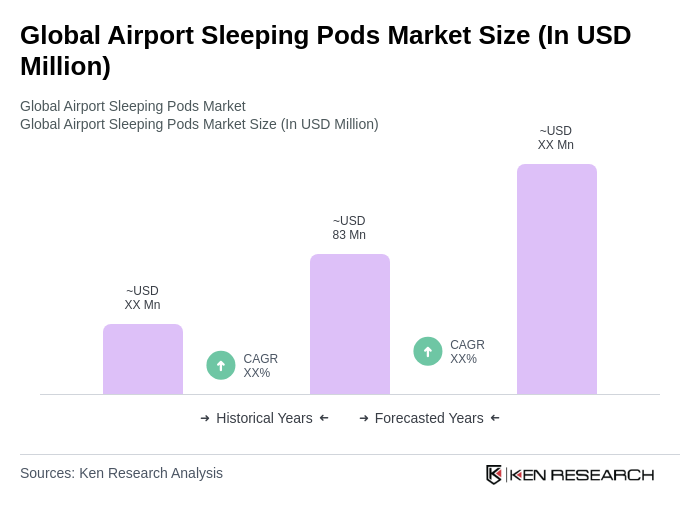
- The Global Airport Sleeping Pods Market is valued at USD 83 million, based on a five-year historical analysis. This growth is primarily driven by the increasing number of air travelers, longer average layover times, and the rising demand for comfort and convenience during layovers. The market is further propelled by the expansion of international airports, modernization initiatives, and the adoption of smart sleeping pod technology, including IoT-based booking systems and contactless payment solutions. The trend toward enhancing passenger experience has led to a surge in sleeping pod installations, catering to the needs of weary travelers and supporting airports’ non-aeronautical revenue streams.
- Key players in this market include major cities and countries such as the United States, Japan, and Germany, which dominate due to their high passenger traffic and advanced airport infrastructure. The presence of international airports in these regions, coupled with a focus on improving traveler amenities and experiential micro-accommodation, has significantly contributed to the market's growth and acceptance of sleeping pods as a viable solution for rest and relaxation.
- In 2023, the European Union implemented Regulation (EU) 2023/987 issued by the European Commission, mandating that all major airports within member states provide adequate passenger resting facilities, including sleeping pods, as part of the broader initiative to enhance airport infrastructure and traveler comfort. The regulation requires airports handling over 5 million passengers annually to ensure compliance by installing designated rest areas equipped with privacy features, climate control, and accessibility standards.
Global Airport Sleeping Pods Market Segmentation
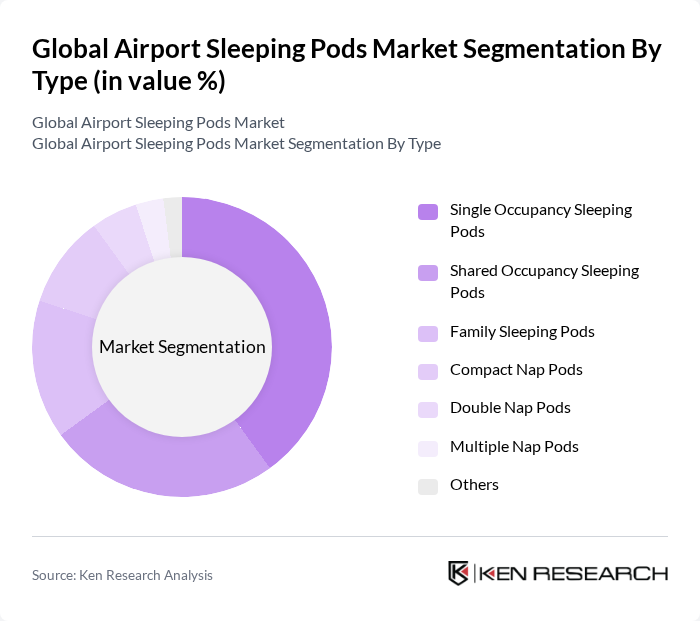
By Type:The market is segmented into Single Occupancy Sleeping Pods, Shared Occupancy Sleeping Pods, Family Sleeping Pods, Compact Nap Pods, Double Nap Pods, Multiple Nap Pods, and Others. Single Occupancy Sleeping Pods remain the most popular due to their privacy, comfort, and appeal to business travelers and solo passengers seeking a quiet space to rest. Shared Occupancy Sleeping Pods are gaining traction in budget-conscious markets, offering a more economical option for travelers. Family Sleeping Pods are increasingly in demand as airports invest in family-friendly amenities. Compact Nap Pods and Double Nap Pods are preferred for short-term rest and space optimization, while Multiple Nap Pods and other variants cater to group travelers and flexible usage scenarios.
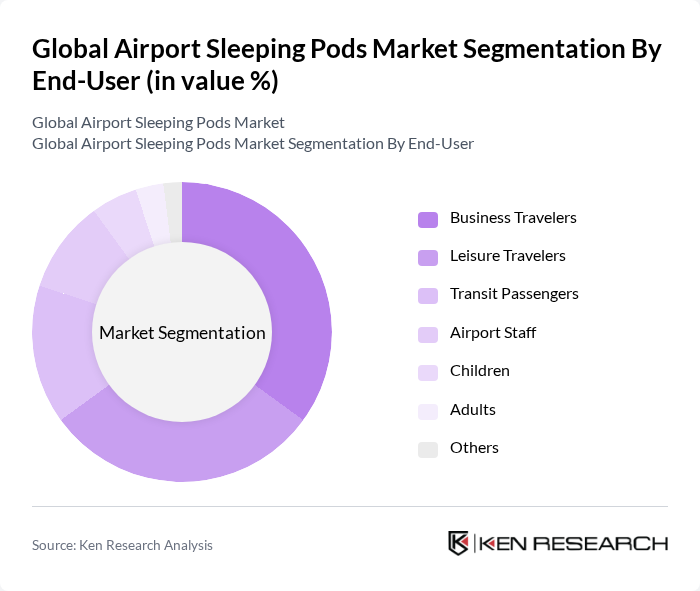
By End-User:The end-user segmentation includes Business Travelers, Leisure Travelers, Transit Passengers, Airport Staff, Children, Adults, and Others. Business Travelers continue to dominate the market, driven by their need for quick rest during layovers and tight schedules. Leisure Travelers are significant users, seeking comfort and convenience during travel. The adoption of sleeping pods by airport staff is rising, particularly for long shifts and overnight duties. The increasing number of families traveling with children is driving demand for family-oriented sleeping solutions, while adults and children benefit from dedicated pods designed for their specific needs.
Global Airport Sleeping Pods Market Competitive Landscape
The Global Airport Sleeping Pods Market is characterized by a dynamic mix of regional and international players. Leading participants such as Sleepbox, Minute Suites, YOTEL, SnoozeCube, GoSleep, Podtime, ZzzleepandGo, Restworks, Dream and Fly, Napcabs GmbH, 9hours (Nine Hours), AirPod Smart Sleeping Pods, JetQuay, Sleep 'n Fly, Rest & Fly contribute to innovation, geographic expansion, and service delivery in this space.
Global Airport Sleeping Pods Market Industry Analysis
Growth Drivers
- Increasing Passenger Traffic at Airports:In future, global air passenger traffic is projected to reach approximately 4.4 billion travelers, according to the International Air Transport Association (IATA). This surge in passenger numbers directly correlates with the demand for airport amenities, including sleeping pods. As airports strive to enhance the traveler experience, the installation of sleeping pods becomes a strategic investment to accommodate the growing number of passengers seeking rest during layovers.
- Rising Demand for Comfort and Convenience During Layovers:A report by the Airports Council International (ACI) indicates that 62% of travelers express a desire for more comfortable layover options. With an average layover time of 2.4 hours, travelers increasingly seek facilities that provide relaxation and comfort. Sleeping pods offer a solution, catering to this demand by providing private, restful spaces that enhance the overall airport experience, thereby driving market growth.
- Expansion of Airport Infrastructure:According to the World Bank, global airport infrastructure investment is expected to exceed $110 billion in future. This expansion includes the development of new terminals and facilities that prioritize passenger comfort. As airports modernize, the integration of sleeping pods becomes essential to meet the expectations of contemporary travelers, further propelling the market for these innovative resting solutions.
Market Challenges
- High Initial Investment Costs:The installation of sleeping pods requires significant capital investment, often ranging from $55,000 to $95,000 per unit, depending on design and technology. This high upfront cost can deter airport authorities from adopting such solutions, especially in regions with budget constraints. Consequently, the financial barrier poses a challenge to the widespread implementation of sleeping pods in airports.
- Limited Awareness Among Travelers:Despite the growing trend, many travelers remain unaware of the availability of sleeping pods at airports. A survey by the Global Business Travel Association (GBTA) found that only 32% of frequent flyers are familiar with sleeping pod services. This lack of awareness can hinder demand, as potential users may not seek out these facilities during their travels, impacting market growth.
Global Airport Sleeping Pods Market Future Outlook
The future of the airport sleeping pods market appears promising, driven by increasing passenger traffic and a growing emphasis on traveler comfort. As airports continue to modernize and expand, the integration of innovative sleeping solutions will likely become a standard offering. Additionally, the trend towards sustainability and smart technology will shape the design and functionality of sleeping pods, enhancing their appeal to environmentally conscious travelers and tech-savvy consumers alike.
Market Opportunities
- Technological Advancements in Pod Design:Innovations in materials and design can enhance the comfort and functionality of sleeping pods. For instance, incorporating soundproofing and climate control features can significantly improve user experience, attracting more travelers. This technological evolution presents a lucrative opportunity for manufacturers to differentiate their products in a competitive market.
- Partnerships with Airlines and Airport Authorities:Collaborating with airlines and airport authorities can facilitate the integration of sleeping pods into existing airport infrastructure. Such partnerships can lead to bundled services, enhancing traveler convenience and increasing pod utilization rates. This strategic approach can create a win-win situation, benefiting both pod providers and airport operators.
Scope of the Report
| Segment | Sub-Segments |
|---|---|
| By Type | Single Occupancy Sleeping Pods Shared Occupancy Sleeping Pods Family Sleeping Pods Compact Nap Pods Double Nap Pods Multiple Nap Pods Others |
| By End-User | Business Travelers Leisure Travelers Transit Passengers Airport Staff Children Adults Others |
| By Location | International Airports Domestic Airports Regional Airports Others |
| By Service Model | Pay-per-use Subscription-based Membership Programs Others |
| By Amenities Offered | Basic Amenities (bed, lighting, ventilation) Premium Amenities (private bathroom, entertainment system) Tech-enabled Amenities (Wi-Fi, smart controls, charging ports) Eco-friendly Features (energy-efficient lighting, sustainable materials) Others |
| By Duration of Stay | Less than 2 hours 6 hours Overnight Stays Others |
| By Pricing Tier | Budget Tier Mid-range Tier Premium Tier Others |
Key Target Audience
Investors and Venture Capitalist Firms
Government and Regulatory Bodies (e.g., Federal Aviation Administration, International Civil Aviation Organization)
Manufacturers and Producers of Sleeping Pods
Airport Authorities and Operators
Real Estate Developers in Airport Infrastructure
Travel and Hospitality Service Providers
Airport Lounge Operators
Financial Institutions and Investment Banks
Players Mentioned in the Report:
Sleepbox
Minute Suites
YOTEL
SnoozeCube
GoSleep
Podtime
ZzzleepandGo
Restworks
Dream and Fly
Napcabs GmbH
9hours (Nine Hours)
AirPod Smart Sleeping Pods
JetQuay
Sleep 'n Fly
Rest & Fly
Table of Contents
Market Assessment Phase
1. Executive Summary and Approach
2. Global Airport Sleeping Pods Market Overview
2.1 Key Insights and Strategic Recommendations
2.2 Global Airport Sleeping Pods Market Overview
2.3 Definition and Scope
2.4 Evolution of Market Ecosystem
2.5 Timeline of Key Regulatory Milestones
2.6 Value Chain & Stakeholder Mapping
2.7 Business Cycle Analysis
2.8 Policy & Incentive Landscape
3. Global Airport Sleeping Pods Market Analysis
3.1 Growth Drivers
3.1.1 Increasing passenger traffic at airports
3.1.2 Rising demand for comfort and convenience during layovers
3.1.3 Expansion of airport infrastructure
3.1.4 Growth in the travel and tourism industry
3.2 Market Challenges
3.2.1 High initial investment costs
3.2.2 Limited awareness among travelers
3.2.3 Regulatory hurdles in airport operations
3.2.4 Competition from alternative accommodation options
3.3 Market Opportunities
3.3.1 Technological advancements in pod design
3.3.2 Partnerships with airlines and airport authorities
3.3.3 Expansion into emerging markets
3.3.4 Customization options for different traveler segments
3.4 Market Trends
3.4.1 Increasing focus on sustainability in design
3.4.2 Integration of smart technology in sleeping pods
3.4.3 Growth of on-demand services
3.4.4 Rise in health and wellness trends among travelers
3.5 Government Regulation
3.5.1 Safety and health regulations for airport facilities
3.5.2 Zoning laws affecting pod installations
3.5.3 Environmental regulations for construction
3.5.4 Compliance with international travel standards
4. SWOT Analysis
5. Stakeholder Analysis
6. Porter's Five Forces Analysis
7. Global Airport Sleeping Pods Market Market Size, 2019-2024
7.1 By Value
7.2 By Volume
7.3 By Average Selling Price
8. Global Airport Sleeping Pods Market Segmentation
8.1 By Type
8.1.1 Single Occupancy Sleeping Pods
8.1.2 Shared Occupancy Sleeping Pods
8.1.3 Family Sleeping Pods
8.1.4 Compact Nap Pods
8.1.5 Double Nap Pods
8.1.6 Multiple Nap Pods
8.1.7 Others
8.2 By End-User
8.2.1 Business Travelers
8.2.2 Leisure Travelers
8.2.3 Transit Passengers
8.2.4 Airport Staff
8.2.5 Children
8.2.6 Adults
8.2.7 Others
8.3 By Location
8.3.1 International Airports
8.3.2 Domestic Airports
8.3.3 Regional Airports
8.3.4 Others
8.4 By Service Model
8.4.1 Pay-per-use
8.4.2 Subscription-based
8.4.3 Membership Programs
8.4.4 Others
8.5 By Amenities Offered
8.5.1 Basic Amenities (bed, lighting, ventilation)
8.5.2 Premium Amenities (private bathroom, entertainment system)
8.5.3 Tech-enabled Amenities (Wi-Fi, smart controls, charging ports)
8.5.4 Eco-friendly Features (energy-efficient lighting, sustainable materials)
8.5.5 Others
8.6 By Duration of Stay
8.6.1 Less than 2 hours
8.6.2 2-6 hours
8.6.3 Overnight Stays
8.6.4 Others
8.7 By Pricing Tier
8.7.1 Budget Tier
8.7.2 Mid-range Tier
8.7.3 Premium Tier
8.7.4 Others
9. Global Airport Sleeping Pods Market Competitive Analysis
9.1 Market Share of Key Players
9.2 Cross Comparison of Key Players
9.2.1 Company Name
9.2.2 Company Size (Large, Medium, Small)
9.2.3 Global Revenue (USD, latest available year)
9.2.4 Number of Airport Installations
9.2.5 Geographic Presence (Number of Countries/Regions)
9.2.6 Market Penetration Rate (Share of airports served)
9.2.7 Average Occupancy Rate (%)
9.2.8 Customer Satisfaction Score (NPS or equivalent)
9.2.9 Product Innovation Index (patents, new features launched)
9.2.10 Pricing Strategy (per hour, per night, tiered)
9.2.11 Distribution Network Strength (direct, franchise, partnership)
9.2.12 Brand Recognition Index
9.3 SWOT Analysis of Top Players
9.4 Pricing Analysis
9.5 Detailed Profile of Major Companies
9.5.1 Sleepbox
9.5.2 Minute Suites
9.5.3 YOTEL
9.5.4 SnoozeCube
9.5.5 GoSleep
9.5.6 Podtime
9.5.7 ZzzleepandGo
9.5.8 Restworks
9.5.9 Dream and Fly
9.5.10 Napcabs GmbH
9.5.11 9hours (Nine Hours)
9.5.12 AirPod Smart Sleeping Pods
9.5.13 JetQuay
9.5.14 Sleep 'n Fly
9.5.15 Rest & Fly
10. Global Airport Sleeping Pods Market End-User Analysis
10.1 Procurement Behavior of Key Ministries
10.1.1 Government procurement policies
10.1.2 Budget allocation for airport facilities
10.1.3 Collaboration with private sector
10.1.4 Evaluation criteria for pod installations
10.2 Corporate Spend on Infrastructure & Energy
10.2.1 Investment in airport modernization
10.2.2 Funding for passenger comfort initiatives
10.2.3 Budgeting for technology upgrades
10.3 Pain Point Analysis by End-User Category
10.3.1 Lack of sleeping facilities
10.3.2 High costs of nearby accommodations
10.3.3 Inconvenience during layovers
10.4 User Readiness for Adoption
10.4.1 Awareness of sleeping pod availability
10.4.2 Willingness to pay for comfort
10.4.3 Acceptance of new technologies
10.5 Post-Deployment ROI and Use Case Expansion
10.5.1 Measurement of user satisfaction
10.5.2 Analysis of repeat usage rates
10.5.3 Expansion into additional airports
11. Global Airport Sleeping Pods Market Future Size, 2025-2030
11.1 By Value
11.2 By Volume
11.3 By Average Selling Price
Go-To-Market Strategy Phase
1. Whitespace Analysis + Business Model Canvas
1.1 Market gaps identification
1.2 Value proposition development
1.3 Revenue model exploration
1.4 Customer segment analysis
1.5 Key partnerships identification
1.6 Cost structure assessment
1.7 Competitive landscape overview
2. Marketing and Positioning Recommendations
2.1 Branding strategies
2.2 Product USPs
2.3 Target audience identification
2.4 Marketing channels selection
2.5 Promotional tactics
3. Distribution Plan
3.1 Urban retail vs rural NGO tie-ups
3.2 Direct sales strategies
3.3 Online distribution channels
3.4 Partnerships with travel agencies
4. Channel & Pricing Gaps
4.1 Underserved routes
4.2 Pricing bands
4.3 Competitor pricing analysis
4.4 Customer willingness to pay
5. Unmet Demand & Latent Needs
5.1 Category gaps
5.2 Consumer segments
5.3 Emerging trends analysis
5.4 Feedback from potential users
6. Customer Relationship
6.1 Loyalty programs
6.2 After-sales service
6.3 Customer feedback mechanisms
6.4 Community engagement strategies
7. Value Proposition
7.1 Sustainability
7.2 Integrated supply chains
7.3 Unique selling points
7.4 Customer-centric approach
8. Key Activities
8.1 Regulatory compliance
8.2 Branding
8.3 Distribution setup
8.4 Training and development
9. Entry Strategy Evaluation
9.1 Domestic Market Entry Strategy
9.1.1 Product mix
9.1.2 Pricing band
9.1.3 Packaging
9.2 Export Entry Strategy
9.2.1 Target countries
9.2.2 Compliance roadmap
10. Entry Mode Assessment
10.1 JV
10.2 Greenfield
10.3 M&A
10.4 Distributor Model
11. Capital and Timeline Estimation
11.1 Capital requirements
11.2 Timelines
12. Control vs Risk Trade-Off
12.1 Ownership vs Partnerships
13. Profitability Outlook
13.1 Breakeven analysis
13.2 Long-term sustainability
14. Potential Partner List
14.1 Distributors
14.2 JVs
14.3 Acquisition targets
15. Execution Roadmap
15.1 Phased Plan for Market Entry
15.1.1 Market Setup
15.1.2 Market Entry
15.1.3 Growth Acceleration
15.1.4 Scale & Stabilize
15.2 Key Activities and Milestones
15.2.1 Activity timelines
15.2.2 Milestone tracking
Research Methodology
Phase 1: Approach1
Desk Research
- Industry reports from aviation and travel organizations detailing market trends
- Government publications on airport infrastructure and passenger statistics
- Academic journals and white papers on sleep technology and consumer behavior
Primary Research
- Interviews with airport management and operations personnel regarding sleeping pod installations
- Surveys with travelers to assess demand and preferences for sleeping pods
- Focus groups with airport concessionaires and service providers to understand market dynamics
Validation & Triangulation
- Cross-validation of findings through multiple data sources including industry reports and expert opinions
- Triangulation of passenger data with airport revenue reports to ensure consistency
- Sanity checks through expert panel reviews comprising industry veterans and market analysts
Phase 2: Market Size Estimation1
Top-down Assessment
- Analysis of global airport passenger traffic trends to estimate potential sleeping pod usage
- Segmentation of the market by region, airport size, and passenger demographics
- Incorporation of growth rates from related sectors such as travel and hospitality
Bottom-up Modeling
- Estimation of the number of sleeping pods per airport based on size and passenger volume
- Operational cost analysis including installation, maintenance, and service pricing
- Revenue projections based on average occupancy rates and pricing models
Forecasting & Scenario Analysis
- Multi-factor regression analysis incorporating travel trends, economic indicators, and consumer preferences
- Scenario modeling based on potential regulatory changes and airport expansions
- Baseline, optimistic, and pessimistic forecasts through 2030 to account for market volatility
Phase 3: CATI Sample Composition1
| Scope Item/Segment | Sample Size | Target Respondent Profiles |
|---|---|---|
| Airport Management Insights | 60 | Airport Directors, Operations Managers |
| Traveler Preferences Survey | 120 | Frequent Flyers, Business Travelers |
| Service Provider Feedback | 50 | Concessionaires, Facility Managers |
| Market Trend Analysis | 40 | Travel Industry Analysts, Market Researchers |
| Consumer Behavior Study | 90 | Leisure Travelers, Airport Users |
Frequently Asked Questions
What is the current value of the Global Airport Sleeping Pods Market?
The Global Airport Sleeping Pods Market is valued at approximately USD 83 million, driven by increasing air traveler numbers, longer layover times, and a growing demand for comfort and convenience during airport stays.
What factors are driving the growth of the airport sleeping pods market?
Which regions dominate the Global Airport Sleeping Pods Market?
What types of sleeping pods are available in the market?
Other Regional/Country Reports
Indonesia Airport Sleeping Pods Market
Malaysia Airport Sleeping Pods Market
APAC Airport Sleeping Pods Market
SEA Airport Sleeping Pods Market
Why Buy From Us?

What makes us stand out is that our consultants follow Robust, Refine and Result (RRR) methodology. Robust for clear definitions, approaches and sanity checking, Refine for differentiating respondents' facts and opinions, and Result for presenting data with story.

We have set a benchmark in the industry by offering our clients with syndicated and customized market research reports featuring coverage of entire market as well as meticulous research and analyst insights.

While we don't replace traditional research, we flip the method upside down. Our dual approach of Top Bottom & Bottom Top ensures quality deliverable by not just verifying company fundamentals but also looking at the sector and macroeconomic factors.

With one step in the future, our research team constantly tries to show you the bigger picture. We help with some of the tough questions you may encounter along the way: How is the industry positioned? Best marketing channel? KPI's of competitors? By aligning every element, we help maximize success.

Our report gives you instant access to the answers and sources that other companies might choose to hide. We elaborate each steps of research methodology we have used and showcase you the sample size to earn your trust.

If you need any support, we are here! We pride ourselves on universe strength, data quality, and quick, friendly, and professional service.