About the Report
Base Year 2024Global Algae Products Market Overview
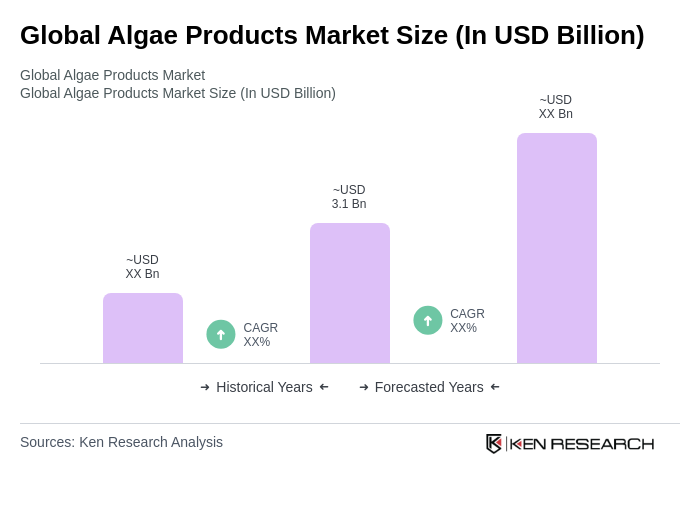
- The Global Algae Products Market is valued at USD 3.1 billion, based on a five-year historical analysis. This market size aligns with the rapid uptake of algae-derived ingredients in nutrition, cosmetics, and specialty ingredients, supported by rising consumer preference for natural, plant-based, and sustainable products; expanding applications of microalgae-derived omega-3s, pigments, and proteins; and improving cultivation and downstream processing technologies, including photobioreactors and precision fermentation. ,
- Countries such as the United States, China, and Japan are prominent in the Global Algae Products Market due to strong R&D ecosystems, established cultivation and processing capacity, and strategic investment in biotechnology. The U.S. leads in innovation and commercialization (notably in algal omega-3s, pigments, and functional ingredients), China holds substantial mass production capacity for spirulina, chlorella, and seaweed derivatives, and Japan has deep consumer adoption and product heritage in seaweed and microalgal applications. ,
- In 2023, the European Union advanced regulations and guidance promoting sustainable algae farming practices, including the EU Algae Initiative, harmonized standards work, and sustainability criteria to scale algae aquaculture while protecting the environment and food safety. This includes support for sustainable harvesting of wild stocks, streamlined permitting for aquaculture, and development of safety standards for algae ingredients, strengthening the industry’s competitiveness and sustainability. ,
Global Algae Products Market Segmentation
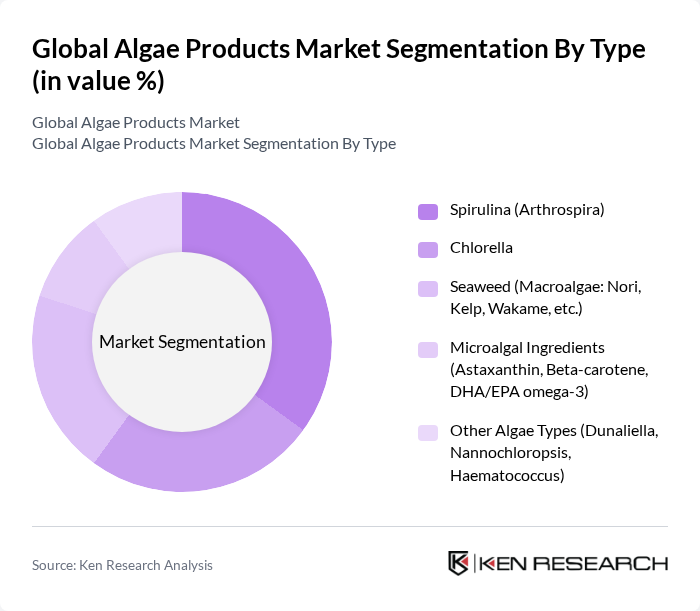
By Type:The market is segmented into various types of algae products, including Spirulina (Arthrospira), Chlorella, Seaweed (Macroalgae), Microalgal Ingredients, and Other Algae Types. Spirulina and Chlorella are widely used for protein, essential amino acids, vitamins, minerals, and antioxidant pigments (notably phycocyanin and chlorophyll), while seaweeds (nori, kelp, wakame, etc.) provide hydrocolloids and functional food uses. Microalgal ingredients such as astaxanthin, beta-carotene, and DHA/EPA omega-3 are gaining traction in nutraceuticals, dietary supplements, infant formula fortification, and specialty cosmetics due to clean-label positioning and sustainability advantages versus fish-derived inputs. ,
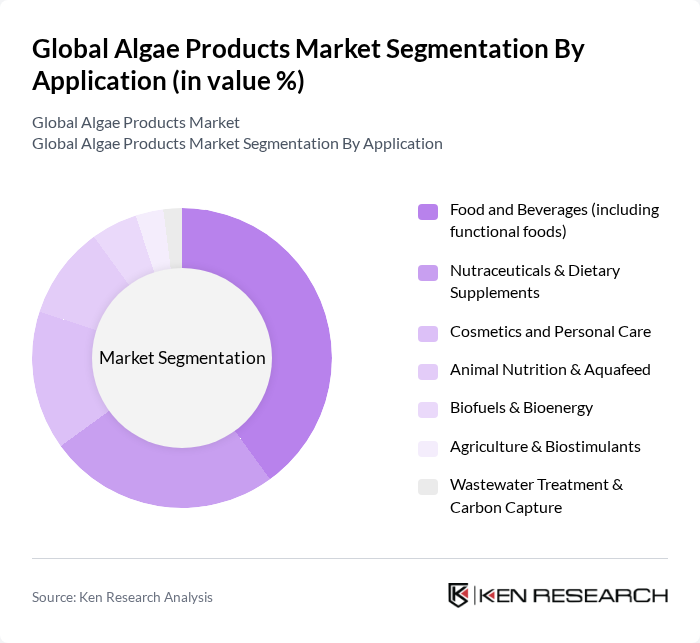
By Application:The applications of algae products span across various sectors, including Food and Beverages, Nutraceuticals & Dietary Supplements, Cosmetics and Personal Care, Animal Nutrition & Aquafeed, Biofuels & Bioenergy, Agriculture & Biostimulants, and Wastewater Treatment & Carbon Capture. The food and beverage sector remains the largest consumer, supported by growth in functional foods, plant-based proteins, natural colorants (phycocyanin, beta-carotene), and fortification with algal omega-3s; animal nutrition and aquafeed adopt algal DHA for fish-free formulation; and agriculture increasingly uses algae extracts as biostimulants for yield and stress tolerance. ,
Global Algae Products Market Competitive Landscape
The Global Algae Products Market is characterized by a dynamic mix of regional and international players. Leading participants such as Cyanotech Corporation, DIC Corporation (incl. Earthrise Nutritionals), Corbion N.V. (algal DHA, omega-3), Cargill, Incorporated (algae-based ingredients), AstaReal AB (astaxanthin), AlgaEnergy, S.A., Algenol Biotech LLC, Algama Foods, Algae Systems LLC, Allmicroalgae – Natural Products S.A., E.I. du Pont de Nemours and Company (DuPont) – alginates/biomaterials, DSM-Firmenich (algal omega-3 via Veramaris JV), Veramaris (DSM-Firmenich & Evonik JV), Evonik Industries AG (algal omega-3), Ocean Harvest Technology plc, Aker BioMarine ASA (krill and algal omega-3 initiatives), Alva (formerly TerraVia/Solazyme assets via Corbion), Phyco-Biotech (France), Fuqing King Dnarmsa Spirulina Co., Ltd., Tianjin Norland Biotech Co., Ltd. contribute to innovation, geographic expansion, and service delivery in this space.
Global Algae Products Market Industry Analysis
Growth Drivers
- Increasing Demand for Sustainable Products:The global shift towards sustainability is driving the algae products market, with the sustainable product market projected to reach $150 billion in future. This trend is fueled by consumers' growing preference for eco-friendly alternatives, as evidenced by a 30% increase in sales of sustainable goods in future. Algae, being a renewable resource, aligns perfectly with this demand, making it a key player in various industries, including food and cosmetics.
- Rising Health Consciousness Among Consumers:Health awareness is significantly influencing consumer choices, with the global health and wellness market expected to exceed $4.5 trillion in future. Algae products, rich in nutrients and antioxidants, are increasingly recognized for their health benefits. For instance, the demand for spirulina, a popular algae supplement, surged by 25% in future, reflecting consumers' shift towards natural health solutions and functional foods that promote well-being.
- Technological Advancements in Algae Cultivation:Innovations in algae cultivation technologies are enhancing production efficiency and reducing costs. For example, the introduction of photobioreactors has improved yield rates by up to 50% compared to traditional methods. Additionally, advancements in genetic engineering are enabling the development of high-yield algae strains, which are projected to increase global production capacity to 10 million tons in future, further supporting market growth.
Market Challenges
- High Production Costs:The algae products market faces significant challenges due to high production costs, which can reach up to $5,000 per ton for certain algae types. This is primarily due to the expensive infrastructure required for cultivation and processing. As a result, many producers struggle to compete with cheaper synthetic alternatives, which can hinder market growth and limit the accessibility of algae products to consumers.
- Regulatory Hurdles:Navigating the regulatory landscape poses a challenge for algae product manufacturers. In future, over 60% of companies reported difficulties in meeting food safety standards and environmental regulations. Compliance with these regulations often requires substantial investment in quality assurance and testing, which can deter new entrants and slow down innovation in the algae sector, ultimately impacting market expansion.
Global Algae Products Market Future Outlook
The future of the algae products market appears promising, driven by increasing consumer demand for sustainable and health-oriented products. As technological advancements continue to lower production costs and improve efficiency, the market is likely to see a surge in innovative applications across various sectors. Additionally, the growing interest in carbon sequestration technologies presents new avenues for algae utilization, potentially transforming waste management and energy production landscapes in future.
Market Opportunities
- Growth in Biofuel Applications:The biofuel sector is increasingly recognizing algae as a viable alternative energy source, with projections indicating that algae-based biofuels could supply up to 30% of global energy needs in future. This shift presents significant opportunities for algae producers to tap into the renewable energy market, driving demand and fostering innovation in sustainable energy solutions.
- Expansion in Nutraceuticals and Supplements:The nutraceuticals market is expected to reach $500 billion in future, with algae-based supplements gaining traction due to their health benefits. This growth is driven by rising consumer awareness of dietary supplements, particularly those derived from natural sources. Algae products, such as omega-3-rich oils, are well-positioned to capitalize on this trend, offering significant market potential.
Scope of the Report
| Segment | Sub-Segments |
|---|---|
| By Type | Spirulina (Arthrospira) Chlorella Seaweed (Macroalgae: Nori, Kelp, Wakame, etc.) Microalgal Ingredients (Astaxanthin, Beta-carotene, DHA/EPA omega-3) Other Algae Types (Dunaliella, Nannochloropsis, Haematococcus) |
| By Application | Food and Beverages (including functional foods) Nutraceuticals & Dietary Supplements Cosmetics and Personal Care Animal Nutrition & Aquafeed Biofuels & Bioenergy Agriculture & Biostimulants Wastewater Treatment & Carbon Capture |
| By End-User | Food & Beverage Manufacturers Nutraceutical & Pharmaceutical Companies Personal Care & Cosmetics Brands Aquaculture & Livestock Producers Biofuel Producers & Energy Companies Agriculture Input Providers |
| By Sales Channel | Direct B2B (contracts with manufacturers) Distributors/Wholesalers Online Retail (D2C supplements and ingredients) Specialty Retail & Health Stores |
| By Distribution Mode | B2B B2C E-commerce/Marketplace Others |
| By Price Range | Premium (e.g., astaxanthin, algal DHA) Mid-Range Budget/Commodity (e.g., bulk spirulina, seaweed) |
| By Others | Specialty Products (encapsulated omega-3, pigments) Organic & Non-GMO Algae Products Customized/Contract Manufacturing Solutions |
Key Target Audience
Investors and Venture Capitalist Firms
Government and Regulatory Bodies (e.g., Food and Drug Administration, Environmental Protection Agency)
Manufacturers and Producers
Distributors and Retailers
Biotechnology Companies
Pharmaceutical Companies
Food and Beverage Companies
Agricultural and Aquaculture Firms
Players Mentioned in the Report:
Cyanotech Corporation
DIC Corporation (incl. Earthrise Nutritionals)
Corbion N.V. (algal DHA, omega-3)
Cargill, Incorporated (algae-based ingredients)
AstaReal AB (astaxanthin)
AlgaEnergy, S.A.
Algenol Biotech LLC
Algama Foods
Algae Systems LLC
Allmicroalgae Natural Products S.A.
E.I. du Pont de Nemours and Company (DuPont) alginates/biomaterials
DSM-Firmenich (algal omega-3 via Veramaris JV)
Veramaris (DSM-Firmenich & Evonik JV)
Evonik Industries AG (algal omega-3)
Ocean Harvest Technology plc
Aker BioMarine ASA (krill and algal omega-3 initiatives)
Alva (formerly TerraVia/Solazyme assets via Corbion)
Phyco-Biotech (France)
Fuqing King Dnarmsa Spirulina Co., Ltd.
Tianjin Norland Biotech Co., Ltd.
Table of Contents
Market Assessment Phase
1. Executive Summary and Approach
2. Global Algae Products Market Overview
2.1 Key Insights and Strategic Recommendations
2.2 Global Algae Products Market Overview
2.3 Definition and Scope
2.4 Evolution of Market Ecosystem
2.5 Timeline of Key Regulatory Milestones
2.6 Value Chain & Stakeholder Mapping
2.7 Business Cycle Analysis
2.8 Policy & Incentive Landscape
3. Global Algae Products Market Analysis
3.1 Growth Drivers
3.1.1 Increasing Demand for Sustainable Products
3.1.2 Rising Health Consciousness Among Consumers
3.1.3 Technological Advancements in Algae Cultivation
3.1.4 Expanding Applications in Food and Cosmetics
3.2 Market Challenges
3.2.1 High Production Costs
3.2.2 Regulatory Hurdles
3.2.3 Limited Awareness Among Consumers
3.2.4 Competition from Synthetic Alternatives
3.3 Market Opportunities
3.3.1 Growth in Biofuel Applications
3.3.2 Expansion in Nutraceuticals and Supplements
3.3.3 Increasing Investment in R&D
3.3.4 Potential in Wastewater Treatment Solutions
3.4 Market Trends
3.4.1 Shift Towards Plant-Based Products
3.4.2 Innovations in Algae Processing Techniques
3.4.3 Rising Popularity of Algae-Based Food Products
3.4.4 Growing Interest in Carbon Sequestration Technologies
3.5 Government Regulation
3.5.1 Environmental Protection Regulations
3.5.2 Food Safety Standards
3.5.3 Subsidies for Renewable Energy Sources
3.5.4 Guidelines for Sustainable Harvesting Practices
4. SWOT Analysis
5. Stakeholder Analysis
6. Porter's Five Forces Analysis
7. Global Algae Products Market Market Size, 2019-2024
7.1 By Value
7.2 By Volume
7.3 By Average Selling Price
8. Global Algae Products Market Segmentation
8.1 By Type
8.1.1 Spirulina (Arthrospira)
8.1.2 Chlorella
8.1.3 Seaweed (Macroalgae: Nori, Kelp, Wakame, etc.)
8.1.4 Microalgal Ingredients (Astaxanthin, Beta-carotene, DHA/EPA omega-3)
8.1.5 Other Algae Types (Dunaliella, Nannochloropsis, Haematococcus)
8.2 By Application
8.2.1 Food and Beverages (including functional foods)
8.2.2 Nutraceuticals & Dietary Supplements
8.2.3 Cosmetics and Personal Care
8.2.4 Animal Nutrition & Aquafeed
8.2.5 Biofuels & Bioenergy
8.2.6 Agriculture & Biostimulants
8.2.7 Wastewater Treatment & Carbon Capture
8.3 By End-User
8.3.1 Food & Beverage Manufacturers
8.3.2 Nutraceutical & Pharmaceutical Companies
8.3.3 Personal Care & Cosmetics Brands
8.3.4 Aquaculture & Livestock Producers
8.3.5 Biofuel Producers & Energy Companies
8.3.6 Agriculture Input Providers
8.4 By Sales Channel
8.4.1 Direct B2B (contracts with manufacturers)
8.4.2 Distributors/Wholesalers
8.4.3 Online Retail (D2C supplements and ingredients)
8.4.4 Specialty Retail & Health Stores
8.5 By Distribution Mode
8.5.1 B2B
8.5.2 B2C
8.5.3 E-commerce/Marketplace
8.5.4 Others
8.6 By Price Range
8.6.1 Premium (e.g., astaxanthin, algal DHA)
8.6.2 Mid-Range
8.6.3 Budget/Commodity (e.g., bulk spirulina, seaweed)
8.7 Others
8.7.1 Specialty Products (encapsulated omega-3, pigments)
8.7.2 Organic & Non-GMO Algae Products
8.7.3 Customized/Contract Manufacturing Solutions
9. Global Algae Products Market Competitive Analysis
9.1 Market Share of Key Players
9.2 Cross Comparison of Key Players
9.2.1 Company Name
9.2.2 Scale Category (Large/Medium/Small; based on revenue/production)
9.2.3 Revenue Growth Rate (3-year CAGR, %)
9.2.4 Production Capacity (tons/year) and Capacity Utilization (%)
9.2.5 Market Coverage (regions served; number of countries)
9.2.6 Key Product Portfolio Mix (e.g., spirulina %, chlorella %, omega-3 %, pigments %)
9.2.7 Average Selling Price Index by Product (USD/kg or USD/L)
9.2.8 Gross Margin (%) and EBITDA Margin (%)
9.2.9 R&D Intensity (% of revenue) and Patent Count
9.2.10 Certification Footprint (e.g., USDA Organic, Non-GMO, ISO, FSSC, Novel Food, GRAS)
9.2.11 Supply Chain Model (photobioreactor vs. open pond; in-house vs. outsourced)
9.2.12 On-time Delivery Rate (%) and Lead Time (days)
9.2.13 Customer Concentration (top-5 customer share, %)
9.2.14 Strategic Partnerships & Long-term Contracts (count/value)
9.2.15 Sustainability KPIs (energy use/kg, water use/kg, carbon intensity, upcycling)
9.3 SWOT Analysis of Top Players
9.4 Pricing Analysis
9.5 Detailed Profile of Major Companies
9.5.1 Cyanotech Corporation
9.5.2 DIC Corporation (incl. Earthrise Nutritionals)
9.5.3 Corbion N.V. (algal DHA, omega-3)
9.5.4 Cargill, Incorporated (algae-based ingredients)
9.5.5 AstaReal AB (astaxanthin)
9.5.6 AlgaEnergy, S.A.
9.5.7 Algenol Biotech LLC
9.5.8 Algama Foods
9.5.9 Algae Systems LLC
9.5.10 Allmicroalgae – Natural Products S.A.
9.5.11 E.I. du Pont de Nemours and Company (DuPont) – alginates/biomaterials
9.5.12 DSM-Firmenich (algal omega-3 via Veramaris JV)
9.5.13 Veramaris (DSM-Firmenich & Evonik JV)
9.5.14 Evonik Industries AG (algal omega-3)
9.5.15 Ocean Harvest Technology plc
9.5.16 Aker BioMarine ASA (krill and algal omega-3 initiatives)
9.5.17 Alva (formerly TerraVia/Solazyme assets via Corbion)
9.5.18 Phyco-Biotech (France)
9.5.19 Fuqing King Dnarmsa Spirulina Co., Ltd.
9.5.20 Tianjin Norland Biotech Co., Ltd.
10. Global Algae Products Market End-User Analysis
10.1 Procurement Behavior of Key Ministries
10.1.1 Government Initiatives for Sustainable Products
10.1.2 Budget Allocations for Algae Research
10.1.3 Partnerships with Private Sector
10.2 Corporate Spend on Infrastructure & Energy
10.2.1 Investment in Renewable Energy Sources
10.2.2 Funding for Algae-Based Projects
10.2.3 Expenditure on Sustainable Practices
10.3 Pain Point Analysis by End-User Category
10.3.1 Cost Constraints
10.3.2 Quality Assurance Issues
10.3.3 Supply Chain Disruptions
10.4 User Readiness for Adoption
10.4.1 Awareness of Algae Benefits
10.4.2 Training and Support Needs
10.4.3 Infrastructure Readiness
10.5 Post-Deployment ROI and Use Case Expansion
10.5.1 Measurement of ROI
10.5.2 Case Studies of Successful Implementations
10.5.3 Future Use Cases in Different Sectors
11. Global Algae Products Market Future Size, 2025-2030
11.1 By Value
11.2 By Volume
11.3 By Average Selling Price
Go-To-Market Strategy Phase
1. Whitespace Analysis + Business Model Canvas
1.1 Market Gaps Identification
1.2 Value Proposition Development
1.3 Revenue Streams Analysis
1.4 Cost Structure Evaluation
1.5 Key Partnerships Exploration
1.6 Customer Segmentation
1.7 Channels of Distribution
2. Marketing and Positioning Recommendations
2.1 Branding Strategies
2.2 Product USPs
2.3 Target Market Identification
2.4 Communication Strategies
2.5 Digital Marketing Approaches
3. Distribution Plan
3.1 Urban Retail Strategies
3.2 Rural NGO Tie-Ups
3.3 E-commerce Platforms
3.4 Direct Sales Approaches
4. Channel & Pricing Gaps
4.1 Underserved Routes
4.2 Pricing Bands Analysis
4.3 Competitor Pricing Strategies
5. Unmet Demand & Latent Needs
5.1 Category Gaps
5.2 Consumer Segments Analysis
5.3 Emerging Trends Identification
6. Customer Relationship
6.1 Loyalty Programs
6.2 After-sales Service
6.3 Customer Feedback Mechanisms
7. Value Proposition
7.1 Sustainability Initiatives
7.2 Integrated Supply Chains
7.3 Competitive Advantages
8. Key Activities
8.1 Regulatory Compliance
8.2 Branding Efforts
8.3 Distribution Setup
9. Entry Strategy Evaluation
9.1 Domestic Market Entry Strategy
9.1.1 Product Mix Considerations
9.1.2 Pricing Band Strategy
9.1.3 Packaging Innovations
9.2 Export Entry Strategy
9.2.1 Target Countries Identification
9.2.2 Compliance Roadmap Development
10. Entry Mode Assessment
10.1 Joint Ventures
10.2 Greenfield Investments
10.3 Mergers & Acquisitions
10.4 Distributor Model Evaluation
11. Capital and Timeline Estimation
11.1 Capital Requirements
11.2 Timelines for Implementation
12. Control vs Risk Trade-Off
12.1 Ownership Considerations
12.2 Partnerships Evaluation
13. Profitability Outlook
13.1 Breakeven Analysis
13.2 Long-term Sustainability Strategies
14. Potential Partner List
14.1 Distributors
14.2 Joint Ventures
14.3 Acquisition Targets
15. Execution Roadmap
15.1 Phased Plan for Market Entry
15.1.1 Market Setup
15.1.2 Market Entry
15.1.3 Growth Acceleration
15.1.4 Scale & Stabilize
15.2 Key Activities and Milestones
15.2.1 Activity Planning
15.2.2 Milestone Tracking
Research Methodology
Phase 1: Approach1
Desk Research
- Industry reports from organizations such as the International Algae Association and Algae Biomass Organization
- Market analysis from trade publications and journals focusing on algae-based products
- Government publications and policy documents related to algae cultivation and usage
Primary Research
- Interviews with key stakeholders in the algae supply chain, including producers and distributors
- Surveys targeting end-users in sectors such as food, cosmetics, and biofuels
- Field interviews with researchers and scientists specializing in algal biotechnology
Validation & Triangulation
- Cross-validation of data from multiple sources, including academic studies and market reports
- Triangulation of findings from primary interviews with secondary data insights
- Sanity checks through expert panels comprising industry veterans and academic experts
Phase 2: Market Size Estimation1
Top-down Assessment
- Analysis of global algae production volumes and their applications across various industries
- Estimation of market size based on historical growth rates and future projections
- Incorporation of regional market dynamics and consumer trends influencing algae product demand
Bottom-up Modeling
- Collection of data on production capacities and sales figures from leading algae manufacturers
- Cost analysis of algae cultivation, processing, and distribution to determine pricing models
- Volume x price calculations to derive revenue estimates for different algae product segments
Forecasting & Scenario Analysis
- Multi-variable forecasting models incorporating factors such as climate change and sustainability trends
- Scenario analysis based on regulatory changes and technological advancements in algae processing
- Development of baseline, optimistic, and pessimistic market scenarios through 2030
Phase 3: CATI Sample Composition1
| Scope Item/Segment | Sample Size | Target Respondent Profiles |
|---|---|---|
| Food Industry Applications | 150 | Product Development Managers, Quality Assurance Specialists |
| Cosmetics and Personal Care | 100 | Formulation Chemists, Brand Managers |
| Biofuels and Renewable Energy | 80 | Energy Analysts, Project Managers |
| Pharmaceuticals and Nutraceuticals | 70 | Regulatory Affairs Specialists, Research Scientists |
| Animal Feed and Agriculture | 90 | Agronomists, Feed Formulation Experts |
Frequently Asked Questions
What is the current value of the Global Algae Products Market?
The Global Algae Products Market is valued at approximately USD 3.1 billion, reflecting a significant growth trend driven by the increasing demand for algae-derived ingredients in various sectors, including nutrition, cosmetics, and specialty ingredients.
Which countries are leading in the Global Algae Products Market?
What are the main types of algae products in the market?
What applications do algae products serve?
Other Regional/Country Reports
Indonesia Algae Products Market
Malaysia Algae Products Market
APAC Algae Products Market
SEA Algae Products Market
Why Buy From Us?

What makes us stand out is that our consultants follow Robust, Refine and Result (RRR) methodology. Robust for clear definitions, approaches and sanity checking, Refine for differentiating respondents' facts and opinions, and Result for presenting data with story.

We have set a benchmark in the industry by offering our clients with syndicated and customized market research reports featuring coverage of entire market as well as meticulous research and analyst insights.

While we don't replace traditional research, we flip the method upside down. Our dual approach of Top Bottom & Bottom Top ensures quality deliverable by not just verifying company fundamentals but also looking at the sector and macroeconomic factors.

With one step in the future, our research team constantly tries to show you the bigger picture. We help with some of the tough questions you may encounter along the way: How is the industry positioned? Best marketing channel? KPI's of competitors? By aligning every element, we help maximize success.

Our report gives you instant access to the answers and sources that other companies might choose to hide. We elaborate each steps of research methodology we have used and showcase you the sample size to earn your trust.

If you need any support, we are here! We pride ourselves on universe strength, data quality, and quick, friendly, and professional service.