Global Ambulance Stretchers Market

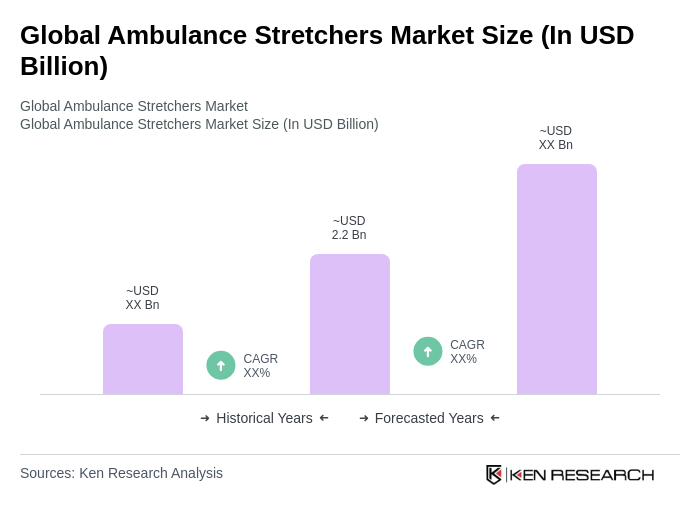
Global Ambulance Stretchers Market, valued at USD 2.2 billion, grows due to rising EMS demand, technological advancements in electric-powered and lightweight designs, and key players in US, Germany, China.

Region:Global

Author(s):Dev

Product Code:KRAA1597

Pages:94

Published On:August 2025
About the Report

Base Year 2024

Global Ambulance Stretchers Market Overview

  • The Global Ambulance Stretchers Market is valued at USD 2.2 billion, based on a five-year historical analysis. This growth is primarily driven by rising emergency medical demand from aging populations and chronic disease burden, the persistent incidence of road traffic injuries, and continuous product innovation focused on ergonomics, safety, and operator-assist features. The need for efficient patient transport solutions has accelerated advances in lightweight materials, powered lift/assist mechanisms, and compatibility with infection-control protocols, which enhance usability in prehospital and interfacility settings.
  • Key players in this market include the United States, Germany, and China, which are significant due to advanced healthcare infrastructure, substantial EMS investment, and the presence of leading manufacturers and suppliers. These countries also operate within mature regulatory environments that emphasize quality and safety standards (e.g., FDA 510(k), EN 1865 series, MDR in the EU), supporting the development and distribution of high-quality ambulance stretchers.
  • In 2023, the U.S. government did not issue a new, universal federal regulation specifically mandating NFPA compliance for all ambulance stretchers. In practice, U.S. market compliance is governed by a combination of FDA requirements and widely adopted consensus standards (e.g., EN 1865-1:2021 for stretchers and EN 1789/SAE/IEC standards for related safety and performance), as well as purchasing specifications by EMS agencies and states; NFPA documents primarily address fire/EMS operations but are not the core stretcher performance standard cited for market-wide mandatory compliance.
Global Ambulance Stretchers Market Size

Global Ambulance Stretchers Market Segmentation

By Type:The market is segmented into various types of stretchers, including Manual Stretchers, Electric-Powered Stretchers, Hydraulic/Pneumatic Stretchers, Bariatric Stretchers, Neonatal & Pediatric Transport Stretchers, Scoop & Basket Stretchers, Folding & Portable Stretchers, Automated Loading Systems (Cots & Power-Load), and Others. Among these, Electric-Powered Stretchers are gaining traction due to their ability to reduce lift-related injuries and physical strain on medical personnel, aligning with buyer preferences for powered cots and loading systems in high-volume EMS services.
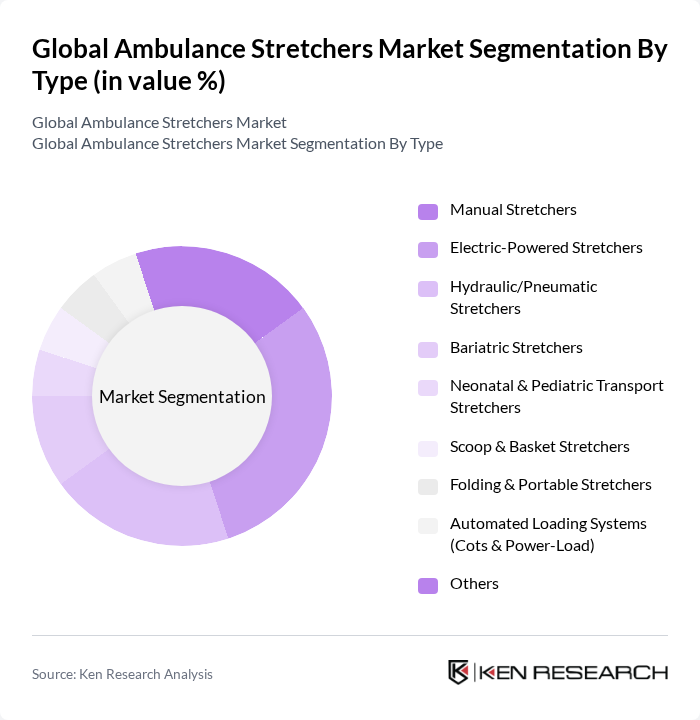
Global Ambulance Stretchers Market segmentation by Type.

By End-User:The end-user segmentation includes Hospitals & Trauma Centers, Emergency Medical Services (EMS) Providers, Fire & Rescue Departments, Military & Disaster-Relief Agencies, Ambulatory Surgical Centers & Private Clinics, and Others. Hospitals & Trauma Centers are leading end-users, supported by evidence that hospitals represent the largest revenue share among purchasing segments, followed by EMS providers.
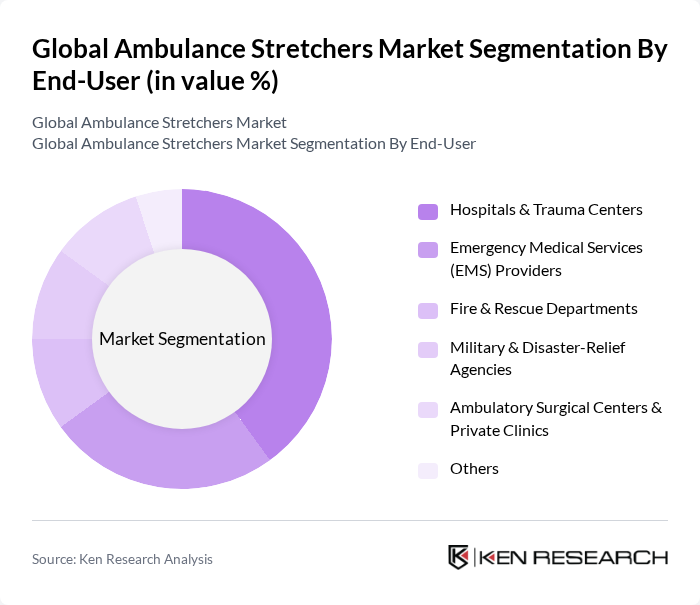
Global Ambulance Stretchers Market segmentation by End-User.

Global Ambulance Stretchers Market Competitive Landscape

The Global Ambulance Stretchers Market is characterized by a dynamic mix of regional and international players. Leading participants such as Stryker Corporation (Stryker Medical), Ferno-Washington, Inc., Hillrom/Welch Allyn (Baxter International Inc.), Spencer Italia S.r.l., Zhangjiagang New Fellow Med Co., Ltd., MeBer S.r.l., Medline Industries, LP, Gendron, Inc., MeBer China (MEBER China Co., Ltd.), Pensi Rescue Oy, PARAMED International FZCO, Dragon Industry (ZJG) Co., Ltd., Allied Healthcare Products, Inc., Arjo AB, Zhangjiagang Xiehe Medical Apparatus & Instruments Co., Ltd. (XIEHE) contribute to innovation, geographic expansion, and service delivery in this space.

Stryker Corporation

1941

Kalamazoo, Michigan, USA

Ferno-Washington, Inc.

1955

Wilmington, Ohio, USA

Hillrom/Welch Allyn

1915

Chicago, Illinois, USA

Spencer Italia S.r.l.

1989

Parma, Italy

Zhangjiagang New Fellow Med Co., Ltd.

2002

Zhangjiagang, Jiangsu, China

Company

Establishment Year

Headquarters

Company Scale (Global, Regional, Niche)

Ambulance Stretcher Revenue (USD, latest FY or estimate)

CAGR in Stretcher Segment (3–5 years)

Installed Base/Units in Service

Geographic Footprint (No. of countries served)

Product Portfolio Breadth (manual, powered, bariatric, neonatal, loading systems)

Global Ambulance Stretchers Market Industry Analysis

Growth Drivers

  • Increasing Demand for Emergency Medical Services:The global demand for emergency medical services is projected to reach $200 billion in future, driven by rising incidences of accidents and health emergencies. The World Health Organization reported that road traffic injuries alone account for approximately 1.19 million deaths annually. This surge in emergencies necessitates efficient medical transport solutions, including advanced ambulance stretchers, to ensure timely patient care and improve survival rates.
  • Technological Advancements in Stretcher Design:The integration of innovative technologies in stretcher design is enhancing functionality and safety. For instance, the introduction of smart stretchers equipped with monitoring systems is expected to increase by 30% in future. These advancements not only improve patient comfort but also facilitate real-time health monitoring, which is crucial during transport, thereby driving demand for modern ambulance stretchers in healthcare facilities.
  • Rising Healthcare Expenditure:Global healthcare expenditure is anticipated to exceed $10 trillion in future, according to the World Bank. This increase is largely attributed to aging populations and the growing prevalence of chronic diseases. As healthcare budgets expand, investments in emergency medical services, including the procurement of advanced ambulance stretchers, are prioritized to enhance patient care and operational efficiency in medical transport systems.

Market Challenges

  • High Cost of Advanced Stretchers:The cost of advanced ambulance stretchers can range from $5,000 to $15,000, which poses a significant barrier for many healthcare providers, especially in low-income regions. This high initial investment can deter hospitals and emergency services from upgrading their equipment, limiting access to the latest technologies that improve patient outcomes and operational efficiency in emergency medical services.
  • Regulatory Compliance Complexities:Navigating the regulatory landscape for medical equipment can be challenging, with compliance costs reaching up to $1 million for manufacturers. Stringent regulations imposed by health authorities, such as the FDA in the United States, require extensive testing and certification processes. These complexities can delay product launches and increase operational costs, hindering market growth for ambulance stretchers.

Global Ambulance Stretchers Market Future Outlook

The future of the ambulance stretchers market is poised for significant transformation, driven by technological innovations and evolving healthcare needs. As the demand for efficient emergency medical services continues to rise, manufacturers are likely to focus on developing lightweight, automated stretchers that enhance patient safety and comfort. Additionally, the integration of smart technologies will facilitate real-time monitoring, improving patient outcomes during transport. This evolution will create a more responsive and efficient emergency medical transport system, addressing the growing complexities of patient care.

Market Opportunities

  • Expansion in Developing Regions:Developing regions are experiencing rapid urbanization and healthcare infrastructure improvements, creating a significant opportunity for ambulance stretcher manufacturers. With healthcare spending projected to grow by 10% annually in these areas, there is a rising demand for modern medical transport solutions that can cater to increasing emergency service needs.
  • Integration of Smart Technologies:The integration of smart technologies into ambulance stretchers presents a lucrative opportunity for innovation. Features such as GPS tracking and health monitoring systems are gaining traction, with an expected market penetration increase of 25% in future. This trend not only enhances operational efficiency but also improves patient care during transport, making it a key area for investment.

Scope of the Report

SegmentSub-Segments
By Type

Manual Stretchers

Electric-Powered Stretchers

Hydraulic/Pneumatic Stretchers

Bariatric Stretchers

Neonatal & Pediatric Transport Stretchers

Scoop & Basket Stretchers

Folding & Portable Stretchers

Automated Loading Systems (Cots & Power-Load)

Others

By End-User

Hospitals & Trauma Centers

Emergency Medical Services (EMS) Providers

Fire & Rescue Departments

Military & Disaster-Relief Agencies

Ambulatory Surgical Centers & Private Clinics

Others

By Material

Aluminum Alloys

Stainless & High-Strength Steel

Composites & Carbon-Fiber

High-Impact Polymers

Others

By Weight Capacity

Up to 150 kg

kg to 250 kg

Above 250 kg (Bariatric)

By Distribution Channel

Direct Sales to EMS/Hospitals

Authorized Distributors

Medical Equipment Dealers

Online/B2B E-commerce

Others

By Region

North America

Europe

Asia-Pacific

Latin America

Middle East & Africa

Others

By Price Range

Low-End Stretchers

Mid-Range Stretchers

High-End Stretchers

Others

Key Target Audience

Investors and Venture Capitalist Firms

Government and Regulatory Bodies (e.g., Food and Drug Administration, National Highway Traffic Safety Administration)

Manufacturers and Producers

Distributors and Retailers

Emergency Medical Services (EMS) Providers

Healthcare Facilities and Hospitals

Industry Associations (e.g., National Association of Emergency Medical Technicians)

Financial Institutions

Players Mentioned in the Report:

Stryker Corporation (Stryker Medical)

Ferno-Washington, Inc.

Hillrom/Welch Allyn (Baxter International Inc.)

Spencer Italia S.r.l.

Zhangjiagang New Fellow Med Co., Ltd.

MeBer S.r.l.

Medline Industries, LP

Gendron, Inc.

MeBer China (MEBER China Co., Ltd.)

Pensi Rescue Oy

PARAMED International FZCO

Dragon Industry (ZJG) Co., Ltd.

Allied Healthcare Products, Inc.

Arjo AB

Zhangjiagang Xiehe Medical Apparatus & Instruments Co., Ltd. (XIEHE)

Table of Contents

Market Assessment Phase

1. Executive Summary and Approach


2. Global Ambulance Stretchers Market Overview

2.1 Key Insights and Strategic Recommendations

2.2 Global Ambulance Stretchers Market Overview

2.3 Definition and Scope

2.4 Evolution of Market Ecosystem

2.5 Timeline of Key Regulatory Milestones

2.6 Value Chain & Stakeholder Mapping

2.7 Business Cycle Analysis

2.8 Policy & Incentive Landscape


3. Global Ambulance Stretchers Market Analysis

3.1 Growth Drivers

3.1.1 Increasing demand for emergency medical services
3.1.2 Technological advancements in stretcher design
3.1.3 Rising healthcare expenditure
3.1.4 Growing aging population requiring medical transport

3.2 Market Challenges

3.2.1 High cost of advanced stretchers
3.2.2 Regulatory compliance complexities
3.2.3 Limited awareness in emerging markets
3.2.4 Competition from alternative transport solutions

3.3 Market Opportunities

3.3.1 Expansion in developing regions
3.3.2 Integration of smart technologies
3.3.3 Partnerships with healthcare providers
3.3.4 Customization for specific medical needs

3.4 Market Trends

3.4.1 Shift towards lightweight materials
3.4.2 Increased focus on patient safety features
3.4.3 Adoption of electric and automated stretchers
3.4.4 Growing emphasis on ergonomic designs

3.5 Government Regulation

3.5.1 Standards for medical equipment safety
3.5.2 Certification requirements for manufacturers
3.5.3 Guidelines for emergency medical services
3.5.4 Policies promoting healthcare accessibility

4. SWOT Analysis


5. Stakeholder Analysis


6. Porter's Five Forces Analysis


7. Global Ambulance Stretchers Market Market Size, 2019-2024

7.1 By Value

7.2 By Volume

7.3 By Average Selling Price


8. Global Ambulance Stretchers Market Segmentation

8.1 By Type

8.1.1 Manual Stretchers
8.1.2 Electric-Powered Stretchers
8.1.3 Hydraulic/Pneumatic Stretchers
8.1.4 Bariatric Stretchers
8.1.5 Neonatal & Pediatric Transport Stretchers
8.1.6 Scoop & Basket Stretchers
8.1.7 Folding & Portable Stretchers
8.1.8 Automated Loading Systems (Cots & Power-Load)
8.1.9 Others

8.2 By End-User

8.2.1 Hospitals & Trauma Centers
8.2.2 Emergency Medical Services (EMS) Providers
8.2.3 Fire & Rescue Departments
8.2.4 Military & Disaster-Relief Agencies
8.2.5 Ambulatory Surgical Centers & Private Clinics
8.2.6 Others

8.3 By Material

8.3.1 Aluminum Alloys
8.3.2 Stainless & High-Strength Steel
8.3.3 Composites & Carbon-Fiber
8.3.4 High-Impact Polymers
8.3.5 Others

8.4 By Weight Capacity

8.4.1 Up to 150 kg
8.4.2 150 kg to 250 kg
8.4.3 Above 250 kg (Bariatric)

8.5 By Distribution Channel

8.5.1 Direct Sales to EMS/Hospitals
8.5.2 Authorized Distributors
8.5.3 Medical Equipment Dealers
8.5.4 Online/B2B E-commerce
8.5.5 Others

8.6 By Region

8.6.1 North America
8.6.2 Europe
8.6.3 Asia-Pacific
8.6.4 Latin America
8.6.5 Middle East & Africa
8.6.6 Others

8.7 By Price Range

8.7.1 Low-End Stretchers
8.7.2 Mid-Range Stretchers
8.7.3 High-End Stretchers
8.7.4 Others

9. Global Ambulance Stretchers Market Competitive Analysis

9.1 Market Share of Key Players

9.2 Cross Comparison of Key Players

9.2.1 Company Name
9.2.2 Company Scale (Global, Regional, Niche)
9.2.3 Ambulance Stretcher Revenue (USD, latest FY or estimate)
9.2.4 CAGR in Stretcher Segment (3–5 years)
9.2.5 Installed Base/Units in Service
9.2.6 Geographic Footprint (No. of countries served)
9.2.7 Product Portfolio Breadth (manual, powered, bariatric, neonatal, loading systems)
9.2.8 Regulatory Approvals (FDA 510(k), CE MDR, EN 1865-1 compliance)
9.2.9 Average Selling Price Positioning (value, mid, premium)
9.2.10 Innovation Pipeline (new launches/patents past 24–36 months)
9.2.11 Distribution Model Strength (direct vs. channel coverage)
9.2.12 After-Sales Service Coverage (service centers/response SLAs)
9.2.13 Key EMS/Hospital Contracts or Framework Agreements
9.2.14 Warranty & Service Terms (years, battery/service inclusions)

9.3 SWOT Analysis of Top Players

9.4 Pricing Analysis

9.5 Detailed Profile of Major Companies

9.5.1 Stryker Corporation (Stryker Medical)
9.5.2 Ferno-Washington, Inc.
9.5.3 Hillrom/Welch Allyn (Baxter International Inc.)
9.5.4 Spencer Italia S.r.l.
9.5.5 Zhangjiagang New Fellow Med Co., Ltd.
9.5.6 MeBer S.r.l.
9.5.7 Medline Industries, LP
9.5.8 Gendron, Inc.
9.5.9 MeBer China (MEBER China Co., Ltd.)
9.5.10 Pensi Rescue Oy
9.5.11 PARAMED International FZCO
9.5.12 Dragon Industry (ZJG) Co., Ltd.
9.5.13 Allied Healthcare Products, Inc.
9.5.14 Arjo AB
9.5.15 Zhangjiagang Xiehe Medical Apparatus & Instruments Co., Ltd. (XIEHE)

10. Global Ambulance Stretchers Market End-User Analysis

10.1 Procurement Behavior of Key Ministries

10.1.1 Budget Allocation for Emergency Services
10.1.2 Decision-Making Processes
10.1.3 Evaluation Criteria for Equipment
10.1.4 Supplier Selection Preferences

10.2 Corporate Spend on Infrastructure & Energy

10.2.1 Investment in Emergency Medical Services
10.2.2 Funding for Equipment Upgrades
10.2.3 Budgeting for Training and Maintenance

10.3 Pain Point Analysis by End-User Category

10.3.1 Equipment Reliability Issues
10.3.2 Challenges in Patient Transport
10.3.3 Need for Customization

10.4 User Readiness for Adoption

10.4.1 Training Requirements
10.4.2 Acceptance of New Technologies
10.4.3 Feedback Mechanisms

10.5 Post-Deployment ROI and Use Case Expansion

10.5.1 Performance Metrics Tracking
10.5.2 Case Studies of Successful Implementations
10.5.3 Future Expansion Plans

11. Global Ambulance Stretchers Market Future Size, 2025-2030

11.1 By Value

11.2 By Volume

11.3 By Average Selling Price


Go-To-Market Strategy Phase

1. Whitespace Analysis + Business Model Canvas

1.1 Market Gaps Identification

1.2 Value Proposition Development

1.3 Revenue Streams Analysis

1.4 Key Partnerships Exploration

1.5 Customer Segmentation

1.6 Cost Structure Assessment

1.7 Channels of Distribution


2. Marketing and Positioning Recommendations

2.1 Branding Strategies

2.2 Product USPs

2.3 Target Audience Identification

2.4 Communication Strategies

2.5 Digital Marketing Approaches


3. Distribution Plan

3.1 Urban Retail Strategies

3.2 Rural NGO Tie-Ups

3.3 Online Distribution Channels

3.4 Partnerships with Healthcare Providers


4. Channel & Pricing Gaps

4.1 Underserved Routes

4.2 Pricing Bands Analysis

4.3 Competitor Pricing Strategies


5. Unmet Demand & Latent Needs

5.1 Category Gaps Identification

5.2 Consumer Segments Analysis

5.3 Emerging Trends Exploration


6. Customer Relationship

6.1 Loyalty Programs

6.2 After-Sales Service Enhancements

6.3 Customer Feedback Mechanisms


7. Value Proposition

7.1 Sustainability Initiatives

7.2 Integrated Supply Chains

7.3 Competitive Advantages


8. Key Activities

8.1 Regulatory Compliance

8.2 Branding Initiatives

8.3 Distribution Setup


9. Entry Strategy Evaluation

9.1 Domestic Market Entry Strategy

9.1.1 Product Mix Considerations
9.1.2 Pricing Band Strategy
9.1.3 Packaging Innovations

9.2 Export Entry Strategy

9.2.1 Target Countries Identification
9.2.2 Compliance Roadmap Development

10. Entry Mode Assessment

10.1 Joint Ventures

10.2 Greenfield Investments

10.3 Mergers & Acquisitions

10.4 Distributor Model Evaluation


11. Capital and Timeline Estimation

11.1 Capital Requirements Analysis

11.2 Timelines for Market Entry


12. Control vs Risk Trade-Off

12.1 Ownership vs Partnerships


13. Profitability Outlook

13.1 Breakeven Analysis

13.2 Long-Term Sustainability Strategies


14. Potential Partner List

14.1 Distributors

14.2 Joint Ventures

14.3 Acquisition Targets


15. Execution Roadmap

15.1 Phased Plan for Market Entry

15.1.1 Market Setup
15.1.2 Market Entry
15.1.3 Growth Acceleration
15.1.4 Scale & Stabilize

15.2 Key Activities and Milestones

15.2.1 Milestone Planning
15.2.2 Activity Tracking

Research Methodology

ApproachModellingSample

Phase 1: Approach1

Desk Research

  • Industry reports from healthcare associations and ambulance service organizations
  • Market analysis from government health departments and regulatory bodies
  • Published articles and white papers on ambulance equipment innovations

Primary Research

  • Interviews with product managers at leading stretcher manufacturers
  • Surveys with emergency medical service (EMS) providers and hospital procurement teams
  • Field interviews with paramedics and ambulance operators regarding stretcher usage

Validation & Triangulation

  • Cross-validation using historical sales data and market growth trends
  • Triangulation of insights from primary interviews and secondary data sources
  • Sanity check through expert panel reviews comprising industry veterans

Phase 2: Market Size Estimation1

Top-down Assessment

  • Analysis of total healthcare expenditure and its allocation to emergency services
  • Breakdown of stretcher demand by geographical regions and healthcare facilities
  • Incorporation of trends in emergency response times and patient transport needs

Bottom-up Modeling

  • Volume estimates based on the number of ambulances in operation and average stretcher replacement cycles
  • Cost analysis derived from pricing models of various stretcher types
  • Volume x cost basis for different stretcher categories (manual, powered, etc.)

Forecasting & Scenario Analysis

  • Multi-factor regression analysis considering population growth and urbanization rates
  • Scenarios based on advancements in stretcher technology and regulatory changes
  • Baseline, optimistic, and constrained projections through 2030

Phase 3: CATI Sample Composition1

Scope Item/SegmentSample SizeTarget Respondent Profiles
Hospital Emergency Departments100Emergency Department Managers, Procurement Officers
Private Ambulance Services80Operations Managers, Fleet Supervisors
Public Health Organizations60Health Program Coordinators, Policy Makers
Fire and Rescue Services70Chief Officers, Equipment Managers
Medical Equipment Distributors90Sales Managers, Product Specialists

Frequently Asked Questions

What is the current value of the Global Ambulance Stretchers Market?

The Global Ambulance Stretchers Market is valued at approximately USD 2.2 billion, driven by increasing demand for emergency medical services, advancements in stretcher technology, and the need for efficient patient transport solutions.

What factors are driving the growth of the ambulance stretchers market?

Which countries are leading in the ambulance stretchers market?

What types of stretchers are available in the market?

Other Regional/Country Reports

Indonesia Global Ambulance Stretchers Market

Malaysia Global Ambulance Stretchers Market

KSA Global Ambulance Stretchers Market

APAC Global Ambulance Stretchers Market

SEA Global Ambulance Stretchers Market

Vietnam Global Ambulance Stretchers Market

Why Buy From Us?

Refine Robust Result (RRR) Framework

What makes us stand out is that our consultants follow Robust, Refine and Result (RRR) methodology. Robust for clear definitions, approaches and sanity checking, Refine for differentiating respondents' facts and opinions, and Result for presenting data with story.

Our Reach Is Unmatched

We have set a benchmark in the industry by offering our clients with syndicated and customized market research reports featuring coverage of entire market as well as meticulous research and analyst insights.

Shifting the Research Paradigm

While we don't replace traditional research, we flip the method upside down. Our dual approach of Top Bottom & Bottom Top ensures quality deliverable by not just verifying company fundamentals but also looking at the sector and macroeconomic factors.

More Insights-Better Decisions

With one step in the future, our research team constantly tries to show you the bigger picture. We help with some of the tough questions you may encounter along the way: How is the industry positioned? Best marketing channel? KPI's of competitors? By aligning every element, we help maximize success.

Transparency and Trust

Our report gives you instant access to the answers and sources that other companies might choose to hide. We elaborate each steps of research methodology we have used and showcase you the sample size to earn your trust.

Round the Clock Support

If you need any support, we are here! We pride ourselves on universe strength, data quality, and quick, friendly, and professional service.

Why Clients Choose Us?

400000+
Reports in repository
150+
Consulting projects a year
100+
Analysts
8000+
Client Queries in 2022








