About the Report
Base Year 2024Listen to the audio summary
Global America Aircraft Engines Market Overview
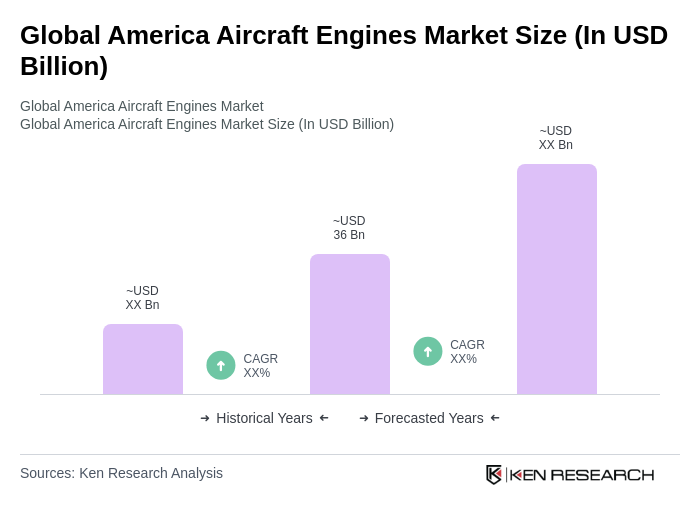
- The America Aircraft Engines Market is valued at USD 36 billion, based on a five-year historical analysis. This valuation aligns with multiple industry sources indicating the Americas market in the mid–thirty billions range, with North America accounting for the largest share within global engines demand .
- The United States and Canada dominate the America Aircraft Engines Market due to robust aerospace manufacturing, high R&D intensity, and the presence of leading engine OEMs and risk?sharing partners across the supply chain, including GE Aerospace, Pratt & Whitney, Honeywell, and Safran’s CFM joint venture footprint in North America .
- In 2023, the U.S. government advanced policies to scale sustainable aviation fuels (SAF) through incentives and targets rather than a blanket mandate, including the SAF blender’s tax credit and the government-wide SAF Grand Challenge aiming to expand SAF production to support deep emissions reductions by mid?century; while not a mandate on airlines, these policies are catalyzing engine efficiency and compatibility advances for SAF use .
Global America Aircraft Engines Market Segmentation
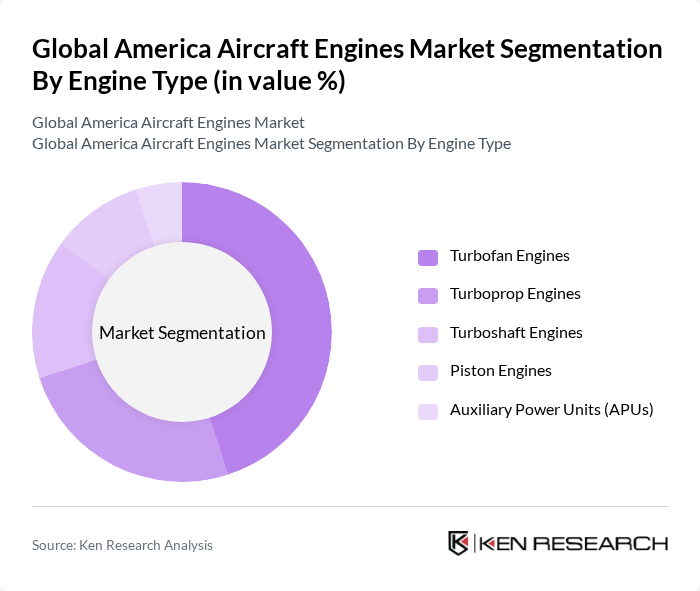
By Engine Type:The aircraft engines market can be segmented into various types, including turbofan engines, turboprop engines, turboshaft engines, piston engines, and auxiliary power units (APUs). Among these, turbofan engines are the most widely used due to their efficiency and performance in commercial aviation. Turboprop engines are favored for regional flights, while turboshaft engines are primarily utilized in helicopters. Piston engines are common in general aviation, and APUs are essential for providing power to aircraft while on the ground .
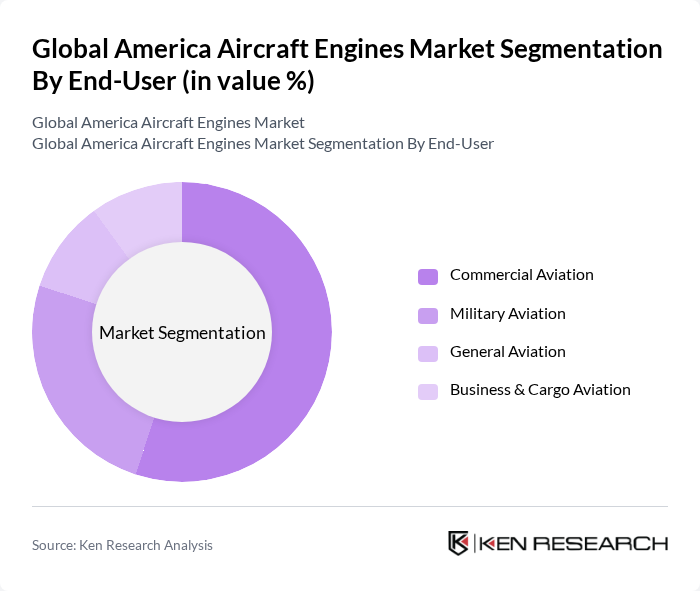
By End-User:The market can also be segmented based on end-users, which include commercial aviation, military aviation, general aviation, and business & cargo aviation. The commercial aviation segment holds the largest share due to the increasing number of air travelers and the expansion of airline fleets. Military aviation is also significant, driven by defense budgets and modernization programs. General aviation and business & cargo aviation segments are growing as well, supported by rising demand for private and cargo flights .
Global America Aircraft Engines Market Competitive Landscape
The Global America Aircraft Engines Market is characterized by a dynamic mix of regional and international players. Leading participants such as GE Aerospace (General Electric Company), Pratt & Whitney (RTX Corporation), Rolls-Royce plc, Safran Aircraft Engines (Safran S.A.), Honeywell Aerospace (Honeywell International Inc.), MTU Aero Engines AG, Engine Alliance LLC, International Aero Engines (IAE) LLC, Williams International, Raytheon Technologies Corporation (legacy reference; now RTX Corporation), General Electric Honda Aero Engines, LLC, CFMI – CFM International (Safran Aircraft Engines & GE Aerospace), Rolls-Royce Deutschland Ltd & Co KG, Turbomeca (now Safran Helicopter Engines), Lycoming Engines (A Textron Inc. company) contribute to innovation, geographic expansion, and service delivery in this space .
Global America Aircraft Engines Market Industry Analysis
Growth Drivers
- Increasing Demand for Fuel-Efficient Engines:The global aviation industry is projected to consume approximately 99 billion gallons of jet fuel in future, driving the need for fuel-efficient engines. With fuel costs representing about 25% to 30% of airline operating expenses, airlines are increasingly investing in advanced engine technologies that reduce fuel consumption by up to 15%. This trend is supported by the International Air Transport Association (IATA), which anticipates mid-single-digit annual growth in air traffic in future, further propelling demand for efficient engines.
- Technological Advancements in Engine Design:The aircraft engine sector is witnessing significant innovations, with R&D investments by leading aero engine manufacturers collectively in the tens of billions of USD in future. These advancements include the development of advanced materials and additive manufacturing techniques, which enhance engine performance and reduce weight. For instance, the introduction of ceramic matrix composites can improve thermal efficiency and enable higher operating temperatures, contributing to lower emissions and operational costs. Such innovations are crucial for meeting the evolving demands of the aviation market.
- Expansion of the Aviation Sector:The global commercial aviation market continues to expand with passenger traffic growth and cargo demand recovery, necessitating increases in aircraft production and, consequently, aircraft engines. Total passengers carried have surpassed pre-pandemic levels in aggregate, supporting higher aircraft utilization and orders, with particularly strong growth in emerging markets.
Market Challenges
- High R&D Costs:The aircraft engine industry faces substantial R&D expenditures, with leading manufacturers collectively spending several billions of USD annually. These costs are driven by the need for continuous innovation to meet stringent performance and environmental standards. Companies must allocate significant resources to develop next-generation engines, which can strain financial capabilities, especially for smaller manufacturers. This challenge is compounded by the long development cycles typical in the aerospace sector, often exceeding a decade.
- Stringent Regulatory Requirements:Compliance with evolving regulatory frameworks poses a significant challenge for aircraft engine manufacturers. The Federal Aviation Administration and the European Union Aviation Safety Agency continue to tighten environmental and certification requirements, including CO2 and non-CO2 emissions standards and noise limits, requiring manufacturers to invest heavily in compliance technologies. Non-compliance can lead to costly penalties and delays in product launches, impacting overall market competitiveness and profitability.
Global America Aircraft Engines Market Future Outlook
The future of the aircraft engine market is poised for transformative changes driven by sustainability and technological innovation. As airlines increasingly prioritize eco-friendly operations, the shift towards sustainable aviation fuels and electric propulsion systems is expected to gain momentum. Additionally, advancements in digital manufacturing and predictive maintenance technologies will enhance operational efficiency and reduce downtime. These trends will shape the competitive landscape, encouraging collaboration among industry players to foster innovation and meet emerging market demands.
Market Opportunities
- Growth in Emerging Markets:Emerging markets, particularly in Asia-Pacific and Africa, are projected to see sustained increases in air travel above mature market averages. This growth presents significant opportunities for aircraft engine manufacturers to expand their market presence and cater to the rising demand for new aircraft, thereby driving engine sales and fostering regional partnerships.
- Development of Hybrid and Electric Engines:The hybrid and electric aircraft propulsion segment is attracting increasing public and private funding in future, driven by the need for reduced emissions and operational costs. Companies that invest in this technology can capitalize on the growing demand for sustainable aviation solutions, positioning themselves as leaders in the evolving market landscape.
Scope of the Report
| Segment | Sub-Segments |
|---|---|
| By Engine Type | Turbofan Engines Turboprop Engines Turboshaft Engines Piston Engines Auxiliary Power Units (APUs) |
| By End-User | Commercial Aviation Military Aviation General Aviation Business & Cargo Aviation |
| By Thrust/Power Class | <20,000 lbf (or <1,000 shp for turboprop/shaft) ,000–35,000 lbf (or 1,000–3,000 shp) >35,000 lbf (or >3,000 shp) |
| By Application | Narrow-body Aircraft Wide-body Aircraft Regional & Commuter Aircraft Helicopters Business Jets |
| By Component | Fan & Inlet Compressor Combustor Turbine Exhaust & Nacelle |
| By Sales Channel | OEM (New Engine Sales) Aftermarket (MRO, Spares) |
| By Maintenance Type | Line Maintenance Base/Heavy Maintenance Engine Overhaul & Performance Restoration On-wing & Predictive Maintenance |
Key Target Audience
Investors and Venture Capitalist Firms
Government and Regulatory Bodies (e.g., Federal Aviation Administration, National Aeronautics and Space Administration)
Aircraft Manufacturers
Engine Manufacturers
Aerospace Component Suppliers
Maintenance, Repair, and Overhaul (MRO) Service Providers
Airline Operators
Defense Contractors
Players Mentioned in the Report:
GE Aerospace (General Electric Company)
Pratt & Whitney (RTX Corporation)
Rolls-Royce plc
Safran Aircraft Engines (Safran S.A.)
Honeywell Aerospace (Honeywell International Inc.)
MTU Aero Engines AG
Engine Alliance LLC
International Aero Engines (IAE) LLC
Williams International
Raytheon Technologies Corporation (legacy reference; now RTX Corporation)
General Electric Honda Aero Engines, LLC
CFMI CFM International (Safran Aircraft Engines & GE Aerospace)
Rolls-Royce Deutschland Ltd & Co KG
Turbomeca (now Safran Helicopter Engines)
Lycoming Engines (A Textron Inc. company)
Table of Contents
Market Assessment Phase
1. Executive Summary and Approach
2. Global America Aircraft Engines Market Overview
2.1 Key Insights and Strategic Recommendations
2.2 Global America Aircraft Engines Market Overview
2.3 Definition and Scope
2.4 Evolution of Market Ecosystem
2.5 Timeline of Key Regulatory Milestones
2.6 Value Chain & Stakeholder Mapping
2.7 Business Cycle Analysis
2.8 Policy & Incentive Landscape
3. Global America Aircraft Engines Market Analysis
3.1 Growth Drivers
3.1.1 Increasing demand for fuel-efficient engines
3.1.2 Technological advancements in engine design
3.1.3 Expansion of the aviation sector
3.1.4 Government investments in aerospace
3.2 Market Challenges
3.2.1 High R&D costs
3.2.2 Stringent regulatory requirements
3.2.3 Supply chain disruptions
3.2.4 Competition from alternative propulsion systems
3.3 Market Opportunities
3.3.1 Growth in emerging markets
3.3.2 Development of hybrid and electric engines
3.3.3 Increasing demand for military aircraft engines
3.3.4 Partnerships and collaborations for innovation
3.4 Market Trends
3.4.1 Shift towards sustainable aviation
3.4.2 Digitalization in engine manufacturing
3.4.3 Customization of engine solutions
3.4.4 Focus on predictive maintenance technologies
3.5 Government Regulation
3.5.1 Emission standards compliance
3.5.2 Safety regulations for aircraft engines
3.5.3 Incentives for green technology adoption
3.5.4 Export control regulations
4. SWOT Analysis
5. Stakeholder Analysis
6. Porter's Five Forces Analysis
7. Global America Aircraft Engines Market Market Size, 2019-2024
7.1 By Value
7.2 By Volume
7.3 By Average Selling Price
8. Global America Aircraft Engines Market Segmentation
8.1 By Engine Type
8.1.1 Turbofan Engines
8.1.2 Turboprop Engines
8.1.3 Turboshaft Engines
8.1.4 Piston Engines
8.1.5 Auxiliary Power Units (APUs)
8.2 By End-User
8.2.1 Commercial Aviation
8.2.2 Military Aviation
8.2.3 General Aviation
8.2.4 Business & Cargo Aviation
8.3 By Thrust/Power Class
8.3.1 <20,000 lbf (or <1,000 shp for turboprop/shaft)
8.3.2 20,000–35,000 lbf (or 1,000–3,000 shp)
8.3.3 >35,000 lbf (or >3,000 shp)
8.4 By Application
8.4.1 Narrow-body Aircraft
8.4.2 Wide-body Aircraft
8.4.3 Regional & Commuter Aircraft
8.4.4 Helicopters
8.4.5 Business Jets
8.5 By Component
8.5.1 Fan & Inlet
8.5.2 Compressor
8.5.3 Combustor
8.5.4 Turbine
8.5.5 Exhaust & Nacelle
8.6 By Sales Channel
8.6.1 OEM (New Engine Sales)
8.6.2 Aftermarket (MRO, Spares)
8.7 By Maintenance Type
8.7.1 Line Maintenance
8.7.2 Base/Heavy Maintenance
8.7.3 Engine Overhaul & Performance Restoration
8.7.4 On-wing & Predictive Maintenance
9. Global America Aircraft Engines Market Competitive Analysis
9.1 Market Share of Key Players
9.2 Cross Comparison of Key Players
9.2.1 Company Name
9.2.2 Engine Portfolio Breadth (turbofan/turboprop/turboshaft/piston/APU)
9.2.3 Civil vs. Military Revenue Mix (%)
9.2.4 Installed Base in the Americas (in-service engines)
9.2.5 New Engine Deliveries in the Americas (last 12 months)
9.2.6 Order Backlog Linked to Americas Operators
9.2.7 Aftermarket/MRO Revenue in the Americas
9.2.8 Average Time on Wing / Dispatch Reliability
9.2.9 Specific Fuel Consumption (SFC) leadership by class
9.2.10 R&D Intensity (% of revenue)
9.2.11 SAF/Electrification Readiness (certs, test hours, partnerships)
9.2.12 Partner Network Depth (airframers, MROs, lessors)
9.3 SWOT Analysis of Top Players
9.4 Pricing Analysis
9.5 Detailed Profile of Major Companies
9.5.1 GE Aerospace (General Electric Company)
9.5.2 Pratt & Whitney (RTX Corporation)
9.5.3 Rolls-Royce plc
9.5.4 Safran Aircraft Engines (Safran S.A.)
9.5.5 Honeywell Aerospace (Honeywell International Inc.)
9.5.6 MTU Aero Engines AG
9.5.7 Engine Alliance LLC
9.5.8 International Aero Engines (IAE) LLC
9.5.9 Williams International
9.5.10 Raytheon Technologies Corporation (legacy reference; now RTX Corporation)
9.5.11 General Electric Honda Aero Engines, LLC
9.5.12 CFMI – CFM International (Safran Aircraft Engines & GE Aerospace)
9.5.13 Rolls-Royce Deutschland Ltd & Co KG
9.5.14 Turbomeca (now Safran Helicopter Engines)
9.5.15 Lycoming Engines (A Textron Inc. company)
10. Global America Aircraft Engines Market End-User Analysis
10.1 Procurement Behavior of Key Ministries
10.1.1 Defense Procurement Trends
10.1.2 Civil Aviation Authority Guidelines
10.1.3 Budget Allocation for Aviation
10.2 Corporate Spend on Infrastructure & Energy
10.2.1 Investment in Airport Infrastructure
10.2.2 Funding for Research and Development
10.2.3 Expenditure on Maintenance and Upgrades
10.3 Pain Point Analysis by End-User Category
10.3.1 Cost Management in Airlines
10.3.2 Reliability Issues in Military Engines
10.3.3 Performance Expectations from General Aviation
10.4 User Readiness for Adoption
10.4.1 Adoption of New Technologies
10.4.2 Training and Skill Development Needs
10.5 Post-Deployment ROI and Use Case Expansion
10.5.1 Evaluation of Engine Performance
10.5.2 Expansion into New Markets
10.5.3 Long-term Maintenance Contracts
11. Global America Aircraft Engines Market Future Size, 2025-2030
11.1 By Value
11.2 By Volume
11.3 By Average Selling Price
Go-To-Market Strategy Phase
1. Whitespace Analysis + Business Model Canvas
1.1 Market Gaps Identification
1.2 Value Proposition Development
1.3 Revenue Streams Analysis
1.4 Cost Structure Evaluation
1.5 Key Partnerships Exploration
1.6 Customer Segmentation
1.7 Channels of Distribution
2. Marketing and Positioning Recommendations
2.1 Branding Strategies
2.2 Product USPs
2.3 Target Market Identification
2.4 Communication Strategy
2.5 Digital Marketing Approaches
3. Distribution Plan
3.1 Urban Retail Strategies
3.2 Rural NGO Tie-ups
3.3 Online Distribution Channels
3.4 Direct Sales Approaches
4. Channel & Pricing Gaps
4.1 Underserved Routes
4.2 Pricing Bands Analysis
4.3 Competitor Pricing Strategies
5. Unmet Demand & Latent Needs
5.1 Category Gaps Identification
5.2 Consumer Segments Analysis
5.3 Emerging Trends Exploration
6. Customer Relationship
6.1 Loyalty Programs Development
6.2 After-sales Service Enhancements
6.3 Customer Feedback Mechanisms
7. Value Proposition
7.1 Sustainability Initiatives
7.2 Integrated Supply Chains
7.3 Competitive Advantages
8. Key Activities
8.1 Regulatory Compliance
8.2 Branding Initiatives
8.3 Distribution Setup
9. Entry Strategy Evaluation
9.1 Domestic Market Entry Strategy
9.1.1 Product Mix Considerations
9.1.2 Pricing Band Strategy
9.1.3 Packaging Solutions
9.2 Export Entry Strategy
9.2.1 Target Countries Identification
9.2.2 Compliance Roadmap Development
10. Entry Mode Assessment
10.1 Joint Ventures
10.2 Greenfield Investments
10.3 Mergers & Acquisitions
10.4 Distributor Model Evaluation
11. Capital and Timeline Estimation
11.1 Capital Requirements Analysis
11.2 Timelines for Market Entry
12. Control vs Risk Trade-Off
12.1 Ownership vs Partnerships
12.2 Risk Management Strategies
13. Profitability Outlook
13.1 Breakeven Analysis
13.2 Long-term Sustainability Strategies
14. Potential Partner List
14.1 Distributors Identification
14.2 Joint Ventures Opportunities
14.3 Acquisition Targets
15. Execution Roadmap
15.1 Phased Plan for Market Entry
15.1.1 Market Setup
15.1.2 Market Entry
15.1.3 Growth Acceleration
15.1.4 Scale & Stabilize
15.2 Key Activities and Milestones
15.2.1 Milestone Planning
15.2.2 Activity Tracking
Research Methodology
Phase 1: Approach1
Desk Research
- Industry reports from aviation authorities and aerospace organizations
- Market analysis publications from leading aviation research firms
- Statistical data from government aviation departments and international aviation bodies
Primary Research
- Interviews with senior engineers and R&D heads at aircraft engine manufacturers
- Surveys with procurement managers in commercial and military aviation sectors
- Field interviews with maintenance and operations personnel at major airlines
Validation & Triangulation
- Cross-validation of findings through multiple industry reports and expert opinions
- Triangulation of data from primary interviews and secondary sources
- Sanity checks conducted through expert panel discussions and feedback sessions
Phase 2: Market Size Estimation1
Top-down Assessment
- Analysis of global aircraft engine market size based on revenue from major regions
- Segmentation by engine type (turbofan, turbojet, turboprop) and application (commercial, military)
- Incorporation of trends in air travel demand and fleet expansion plans
Bottom-up Modeling
- Volume estimates based on production rates of leading aircraft manufacturers
- Cost analysis derived from component pricing and assembly costs
- Estimation of aftermarket services and maintenance revenue streams
Forecasting & Scenario Analysis
- Multi-variable regression analysis incorporating fuel prices, technological advancements, and regulatory changes
- Scenario modeling based on varying growth rates in air travel and defense spending
- Baseline, optimistic, and pessimistic forecasts through 2035
Phase 3: CATI Sample Composition1
| Scope Item/Segment | Sample Size | Target Respondent Profiles |
|---|---|---|
| Commercial Aircraft Engine Manufacturers | 100 | Product Development Managers, Engineering Directors |
| Military Aircraft Engine Suppliers | 80 | Procurement Officers, Program Managers |
| Maintenance, Repair, and Overhaul (MRO) Services | 70 | Operations Managers, Technical Directors |
| Aircraft OEMs | 90 | Supply Chain Managers, Quality Assurance Heads |
| Aerospace Component Manufacturers | 60 | Sales Managers, Engineering Leads |
Frequently Asked Questions
What is the current value of the Global America Aircraft Engines Market?
The Global America Aircraft Engines Market is valued at approximately USD 36 billion, based on a five-year historical analysis. This valuation reflects the significant demand for aircraft engines in the Americas, particularly in North America, which holds the largest market share.
Which countries dominate the America Aircraft Engines Market?
What are the main types of aircraft engines in the market?
What are the key growth drivers for the America Aircraft Engines Market?
Other Regional/Country Reports
Indonesia Aircraft Engines Market
Malaysia Aircraft Engines Market
Why Buy From Us?

What makes us stand out is that our consultants follow Robust, Refine and Result (RRR) methodology. Robust for clear definitions, approaches and sanity checking, Refine for differentiating respondents' facts and opinions, and Result for presenting data with story.

We have set a benchmark in the industry by offering our clients with syndicated and customized market research reports featuring coverage of entire market as well as meticulous research and analyst insights.

While we don't replace traditional research, we flip the method upside down. Our dual approach of Top Bottom & Bottom Top ensures quality deliverable by not just verifying company fundamentals but also looking at the sector and macroeconomic factors.

With one step in the future, our research team constantly tries to show you the bigger picture. We help with some of the tough questions you may encounter along the way: How is the industry positioned? Best marketing channel? KPI's of competitors? By aligning every element, we help maximize success.

Our report gives you instant access to the answers and sources that other companies might choose to hide. We elaborate each steps of research methodology we have used and showcase you the sample size to earn your trust.

If you need any support, we are here! We pride ourselves on universe strength, data quality, and quick, friendly, and professional service.