About the Report
Base Year 2024Global Anti Biofilm Wound Dressing Market Overview
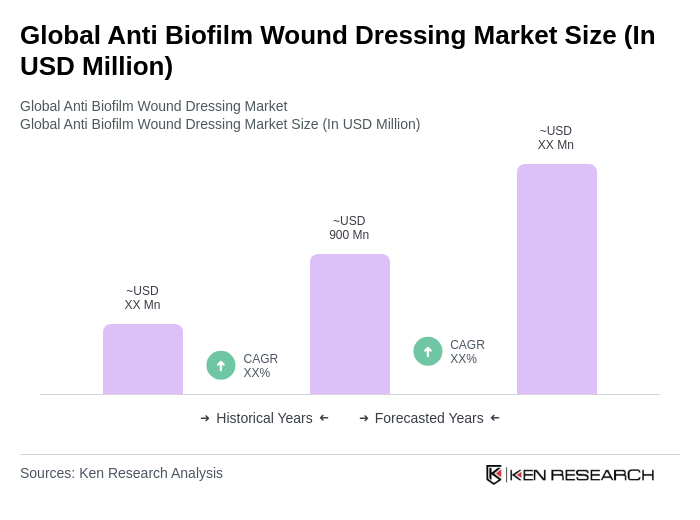
- The Global Anti Biofilm Wound Dressing Market is valued at USD 900 million, based on a five-year historical analysis. This growth is primarily driven by the increasing prevalence of chronic wounds, rising awareness about advanced wound care, and the growing geriatric population. The demand for effective wound management solutions has surged, leading to innovations in dressing technologies that combat biofilm formation .
- Key players in this market are predominantly located in North America and Europe, with the United States and Germany being significant contributors. The dominance of these regions is supported by advanced healthcare infrastructure, high healthcare expenditure, robust reimbursement in advanced wound care, and strong R&D activity in wound care technologies .
- The U.S. Food and Drug Administration regulates antimicrobial wound dressings primarily through the 510(k) pathway and guidance on antimicrobial/antiseptic drug products and wound dressings; however, there were no specific new FDA guidelines in 2023 that uniquely targeted anti-biofilm claims. FDA expectations emphasize substantial equivalence, appropriate biocompatibility, antimicrobial performance testing, and, when relevant, clinical evidence for anti-infective indications .
Global Anti Biofilm Wound Dressing Market Segmentation
By Type:The market is segmented into various types of anti-biofilm dressings, each designed to address specific wound care needs. The subsegments include:
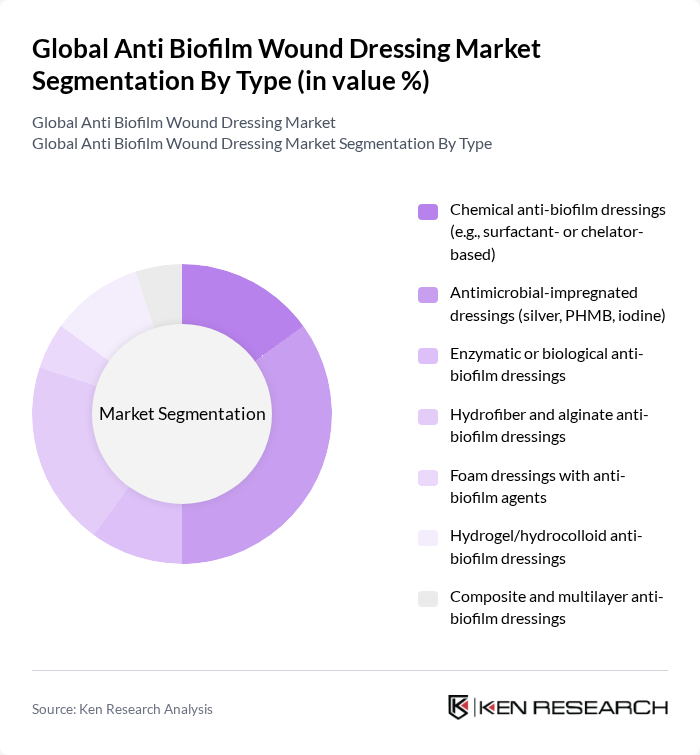
The antimicrobial-impregnated dressings segment is currently dominating the market due to their broad-spectrum antimicrobial properties and extensive clinical use in managing infected or at-risk wounds. Silver, iodine, and PHMB-based products are widely adopted in chronic wounds and surgical settings as part of infection prevention protocols and biofilm management strategies .
By End-User:The market is segmented based on end-users, which include:
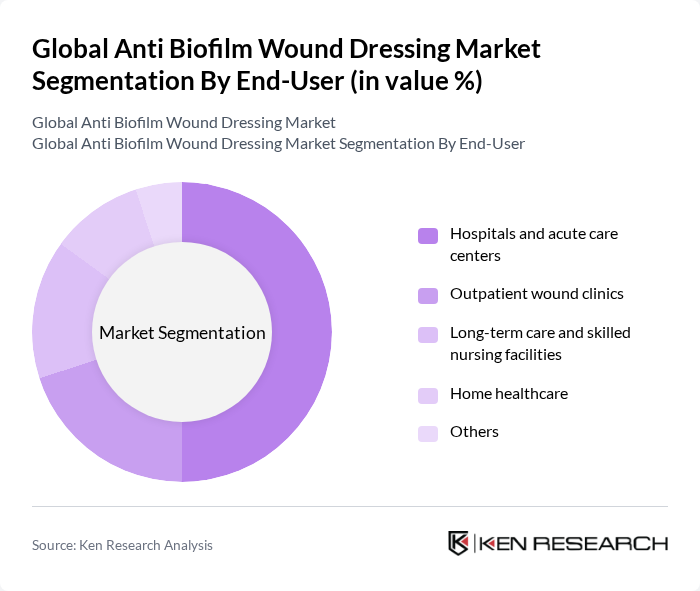
Hospitals and acute care centers are the leading end-users of anti-biofilm wound dressings given the high volume of surgical procedures, complexity of inpatient wounds, and institutional focus on infection prevention and antimicrobial stewardship. Procurement of advanced wound dressings in hospitals and outpatient wound centers is widely reported as a driver for market adoption .
Global Anti Biofilm Wound Dressing Market Competitive Landscape
The Global Anti Biofilm Wound Dressing Market is characterized by a dynamic mix of regional and international players. Leading participants such as Smith+Nephew plc, 3M Company, Convatec Group plc, Medline Industries, LP, Mölnlycke Health Care AB, KCI (Acelity) – now 3M Health Care, PAUL HARTMANN AG, Coloplast A/S, Derma Sciences (Integra LifeSciences), Integra LifeSciences Corporation, Johnson & Johnson (Ethicon), B. Braun Melsungen AG, Systagenix Wound Management (Acelity/3M legacy), Medline Remedy & Optifoam (Medline portfolio), Urgo Medical (Laboratoires URGO) contribute to innovation, geographic expansion, and service delivery in this space.
Global Anti Biofilm Wound Dressing Market Industry Analysis
Growth Drivers
- Increasing Prevalence of Chronic Wounds:The global prevalence of chronic wounds is projected to reach 2.5 million cases in future, driven by factors such as diabetes and obesity. According to the World Health Organization, diabetes alone affects over 422 million people worldwide, leading to a significant rise in diabetic foot ulcers. This growing patient population necessitates advanced wound care solutions, thereby propelling the demand for anti biofilm wound dressings that effectively manage chronic wounds and prevent infections.
- Rising Awareness About Advanced Wound Care:Increased awareness regarding advanced wound care techniques is evident, with educational initiatives leading to a 30% rise in healthcare professionals' knowledge about biofilm management. The global wound care market is expected to reach $20 billion in future, reflecting a shift towards innovative treatment options. This heightened awareness is crucial in promoting the adoption of anti biofilm wound dressings, which are essential for effective wound healing and infection control.
- Technological Advancements in Wound Dressing Materials:The development of advanced materials, such as hydrogels and nanofibers, is revolutionizing wound care. In future, the market for advanced wound dressings is anticipated to grow to $8 billion, driven by innovations that enhance moisture retention and antimicrobial properties. These technological advancements are critical in creating effective anti biofilm dressings, which are designed to combat biofilm formation and promote faster healing, thus meeting the evolving needs of patients and healthcare providers.
Market Challenges
- High Cost of Advanced Wound Dressings:The cost of advanced wound dressings can be prohibitive, with prices ranging from $20 to $100 per unit. This high cost poses a significant barrier to adoption, particularly in low-income regions where healthcare budgets are constrained. According to the World Bank, healthcare expenditure in developing countries averages only $100 per capita, limiting access to essential wound care products and hindering market growth in these areas.
- Limited Reimbursement Policies:Reimbursement policies for advanced wound care products are often inadequate, with only 40% of advanced dressings covered by insurance in many regions. This lack of financial support discourages healthcare providers from utilizing these innovative solutions, as patients may face out-of-pocket expenses. The disparity in reimbursement across different countries further complicates market access, particularly in regions where healthcare systems are underfunded and unable to support advanced treatment options.
Global Anti Biofilm Wound Dressing Market Future Outlook
The future of the anti biofilm wound dressing market appears promising, driven by ongoing innovations and a growing emphasis on personalized healthcare solutions. As the geriatric population continues to expand, the demand for tailored wound care products will increase. Additionally, the integration of digital health technologies, such as telemedicine and remote monitoring, is expected to enhance patient outcomes. These trends indicate a shift towards more effective and accessible wound care solutions, positioning the market for significant growth in the coming years.
Market Opportunities
- Expansion in Emerging Markets:Emerging markets, particularly in Asia and Africa, present significant growth opportunities due to increasing healthcare investments. The World Bank projects healthcare spending in these regions to rise by 15% annually, creating a demand for advanced wound care products. This expansion can lead to greater accessibility and adoption of anti biofilm wound dressings, addressing the needs of underserved populations.
- Development of Innovative Products:The continuous development of innovative wound care products, such as smart dressings that monitor healing, is a key opportunity. With an estimated 25% of new products expected to incorporate digital health features in future, manufacturers can leverage this trend to enhance patient engagement and improve treatment outcomes, thereby driving market growth and differentiation.
Scope of the Report
| Segment | Sub-Segments |
|---|---|
| By Type | Chemical anti-biofilm dressings (e.g., surfactant- or chelator-based) Antimicrobial-impregnated dressings (silver, PHMB, iodine) Enzymatic or biological anti-biofilm dressings Hydrofiber and alginate anti-biofilm dressings Foam dressings with anti-biofilm agents Hydrogel/hydrocolloid anti-biofilm dressings Composite and multilayer anti-biofilm dressings |
| By End-User | Hospitals and acute care centers Outpatient wound clinics Long-term care and skilled nursing facilities Home healthcare Others |
| By Application | Chronic wounds (diabetic foot ulcers, venous leg ulcers, pressure injuries) Surgical and post-operative wounds Traumatic and acute wounds Burns Others |
| By Distribution Channel | Direct hospital and GPO/IDN contracts Medical distributors and wholesalers Retail and hospital pharmacies E-commerce and manufacturer online portals Others |
| By Material | Silver-, iodine-, and PHMB-based materials Hydrofiber, alginate, and cellulose-based materials Foam, silicone, and polyurethane Bioactive and biodegradable polymers |
| By Region | North America Europe Asia-Pacific Latin America Middle East & Africa Others |
| By Price Range | Economy Mid-tier Premium Others |
Key Target Audience
Investors and Venture Capitalist Firms
Government and Regulatory Bodies (e.g., U.S. Food and Drug Administration, European Medicines Agency)
Manufacturers and Producers
Distributors and Retailers
Healthcare Providers and Hospitals
Pharmaceutical Companies
Medical Device Regulatory Authorities
Health Insurance Companies
Players Mentioned in the Report:
Smith+Nephew plc
3M Company
Convatec Group plc
Medline Industries, LP
Molnlycke Health Care AB
KCI (Acelity) now 3M Health Care
PAUL HARTMANN AG
Coloplast A/S
Derma Sciences (Integra LifeSciences)
Integra LifeSciences Corporation
Johnson & Johnson (Ethicon)
B. Braun Melsungen AG
Systagenix Wound Management (Acelity/3M legacy)
Medline Remedy & Optifoam (Medline portfolio)
Urgo Medical (Laboratoires URGO)
Table of Contents
Market Assessment Phase
1. Executive Summary and Approach
2. Global Anti Biofilm Wound Dressing Market Overview
2.1 Key Insights and Strategic Recommendations
2.2 Global Anti Biofilm Wound Dressing Market Overview
2.3 Definition and Scope
2.4 Evolution of Market Ecosystem
2.5 Timeline of Key Regulatory Milestones
2.6 Value Chain & Stakeholder Mapping
2.7 Business Cycle Analysis
2.8 Policy & Incentive Landscape
3. Global Anti Biofilm Wound Dressing Market Analysis
3.1 Growth Drivers
3.1.1 Increasing prevalence of chronic wounds
3.1.2 Rising awareness about advanced wound care
3.1.3 Technological advancements in wound dressing materials
3.1.4 Growing geriatric population
3.2 Market Challenges
3.2.1 High cost of advanced wound dressings
3.2.2 Limited reimbursement policies
3.2.3 Lack of awareness in developing regions
3.2.4 Stringent regulatory requirements
3.3 Market Opportunities
3.3.1 Expansion in emerging markets
3.3.2 Development of innovative products
3.3.3 Strategic partnerships and collaborations
3.3.4 Increasing investment in healthcare infrastructure
3.4 Market Trends
3.4.1 Shift towards bioactive and antimicrobial dressings
3.4.2 Growing demand for personalized wound care solutions
3.4.3 Integration of digital health technologies
3.4.4 Focus on sustainability in product development
3.5 Government Regulation
3.5.1 FDA guidelines for wound care products
3.5.2 CE marking requirements in Europe
3.5.3 ISO standards for medical devices
3.5.4 National health policies promoting advanced wound care
4. SWOT Analysis
5. Stakeholder Analysis
6. Porter's Five Forces Analysis
7. Global Anti Biofilm Wound Dressing Market Market Size, 2019-2024
7.1 By Value
7.2 By Volume
7.3 By Average Selling Price
8. Global Anti Biofilm Wound Dressing Market Segmentation
8.1 By Type
8.1.1 Chemical anti-biofilm dressings (e.g., surfactant- or chelator-based)
8.1.2 Antimicrobial-impregnated dressings (silver, PHMB, iodine)
8.1.3 Enzymatic or biological anti-biofilm dressings
8.1.4 Hydrofiber and alginate anti-biofilm dressings
8.1.5 Foam dressings with anti-biofilm agents
8.1.6 Hydrogel/hydrocolloid anti-biofilm dressings
8.1.7 Composite and multilayer anti-biofilm dressings
8.2 By End-User
8.2.1 Hospitals and acute care centers
8.2.2 Outpatient wound clinics
8.2.3 Long-term care and skilled nursing facilities
8.2.4 Home healthcare
8.2.5 Others
8.3 By Application
8.3.1 Chronic wounds (diabetic foot ulcers, venous leg ulcers, pressure injuries)
8.3.2 Surgical and post-operative wounds
8.3.3 Traumatic and acute wounds
8.3.4 Burns
8.3.5 Others
8.4 By Distribution Channel
8.4.1 Direct hospital and GPO/IDN contracts
8.4.2 Medical distributors and wholesalers
8.4.3 Retail and hospital pharmacies
8.4.4 E-commerce and manufacturer online portals
8.4.5 Others
8.5 By Material
8.5.1 Silver-, iodine-, and PHMB-based materials
8.5.2 Hydrofiber, alginate, and cellulose-based materials
8.5.3 Foam, silicone, and polyurethane
8.5.4 Bioactive and biodegradable polymers
8.6 By Region
8.6.1 North America
8.6.2 Europe
8.6.3 Asia-Pacific
8.6.4 Latin America
8.6.5 Middle East & Africa
8.6.6 Others
8.7 By Price Range
8.7.1 Economy
8.7.2 Mid-tier
8.7.3 Premium
8.7.4 Others
9. Global Anti Biofilm Wound Dressing Market Competitive Analysis
9.1 Market Share of Key Players
9.2 Cross Comparison of Key Players
9.2.1 Company Name
9.2.2 Group Size (Large, Medium, or Small as per industry convention)
9.2.3 Global advanced wound care revenue and growth (YoY)
9.2.4 Anti-biofilm portfolio breadth (SKUs, indications covered)
9.2.5 Regional coverage (countries with regulatory approvals)
9.2.6 Clinical evidence strength (peer-reviewed studies/RCTs)
9.2.7 R&D intensity (R&D spend % of revenue; patents filed)
9.2.8 New product launch cadence (last 3 years)
9.2.9 Hospital/GPO penetration (IDN contracts, formulary wins)
9.2.10 Manufacturing footprint and supply reliability (lead times, OTIF)
9.2.11 Average selling price positioning (economy/mid/premium)
9.2.12 Gross margin for anti-biofilm dressings
9.2.13 Post-market surveillance and complaint rate
9.2.14 Customer satisfaction and clinician adoption (KOL usage, NPS)
9.3 SWOT Analysis of Top Players
9.4 Pricing Analysis
9.5 Detailed Profile of Major Companies
9.5.1 Smith+Nephew plc
9.5.2 3M Company
9.5.3 Convatec Group plc
9.5.4 Medline Industries, LP
9.5.5 Mölnlycke Health Care AB
9.5.6 KCI (Acelity) – now 3M Health Care
9.5.7 PAUL HARTMANN AG
9.5.8 Coloplast A/S
9.5.9 Derma Sciences (Integra LifeSciences)
9.5.10 Integra LifeSciences Corporation
9.5.11 Johnson & Johnson (Ethicon)
9.5.12 B. Braun Melsungen AG
9.5.13 Systagenix Wound Management (Acelity/3M legacy)
9.5.14 Medline Remedy & Optifoam (Medline portfolio)
9.5.15 Urgo Medical (Laboratoires URGO)
10. Global Anti Biofilm Wound Dressing Market End-User Analysis
10.1 Procurement Behavior of Key Ministries
10.1.1 Government healthcare procurement policies
10.1.2 Budget allocation for wound care products
10.1.3 Evaluation criteria for suppliers
10.1.4 Contracting processes and timelines
10.2 Corporate Spend on Infrastructure & Energy
10.2.1 Investment in healthcare facilities
10.2.2 Spending on advanced medical technologies
10.2.3 Budgeting for wound care management
10.3 Pain Point Analysis by End-User Category
10.3.1 Challenges faced by hospitals
10.3.2 Issues in home healthcare
10.3.3 Needs of long-term care facilities
10.4 User Readiness for Adoption
10.4.1 Awareness of advanced wound care solutions
10.4.2 Training and education requirements
10.4.3 Adoption barriers in different settings
10.5 Post-Deployment ROI and Use Case Expansion
10.5.1 Measurement of cost savings
10.5.2 Impact on patient outcomes
10.5.3 Opportunities for product expansion
11. Global Anti Biofilm Wound Dressing Market Future Size, 2025-2030
11.1 By Value
11.2 By Volume
11.3 By Average Selling Price
Go-To-Market Strategy Phase
1. Whitespace Analysis + Business Model Canvas
1.1 Market gaps and opportunities
1.2 Business model components
2. Marketing and Positioning Recommendations
2.1 Branding strategies
2.2 Product USPs
3. Distribution Plan
3.1 Urban retail vs rural NGO tie-ups
4. Channel & Pricing Gaps
4.1 Underserved routes
4.2 Pricing bands
5. Unmet Demand & Latent Needs
5.1 Category gaps
5.2 Consumer segments
6. Customer Relationship
6.1 Loyalty programs
6.2 After-sales service
7. Value Proposition
7.1 Sustainability
7.2 Integrated supply chains
8. Key Activities
8.1 Regulatory compliance
8.2 Branding
8.3 Distribution setup
9. Entry Strategy Evaluation
9.1 Domestic Market Entry Strategy
9.1.1 Product mix
9.1.2 Pricing band
9.1.3 Packaging
9.2 Export Entry Strategy
9.2.1 Target countries
9.2.2 Compliance roadmap
10. Entry Mode Assessment
10.1 JV
10.2 Greenfield
10.3 M&A
10.4 Distributor Model
11. Capital and Timeline Estimation
11.1 Capital requirements
11.2 Timelines
12. Control vs Risk Trade-Off
12.1 Ownership vs Partnerships
13. Profitability Outlook
13.1 Breakeven analysis
13.2 Long-term sustainability
14. Potential Partner List
14.1 Distributors
14.2 JVs
14.3 Acquisition targets
15. Execution Roadmap
15.1 Phased Plan for Market Entry
15.1.1 Market Setup
15.1.2 Market Entry
15.1.3 Growth Acceleration
15.1.4 Scale & Stabilize
15.2 Key Activities and Milestones
15.2.1 Milestone planning
15.2.2 Activity tracking
Research Methodology
Phase 1: Approach1
Desk Research
- Analysis of industry reports from healthcare and wound care associations
- Review of published articles in medical journals focusing on biofilm-related wound healing
- Examination of market data from government health departments and regulatory bodies
Primary Research
- Interviews with product development managers at leading wound dressing manufacturers
- Surveys with healthcare professionals specializing in wound care and infection management
- Field interviews with hospital procurement officers and clinical staff
Validation & Triangulation
- Cross-validation of findings through multiple expert interviews and focus groups
- Triangulation of data from clinical studies, market reports, and expert opinions
- Sanity checks through feedback from a panel of wound care specialists
Phase 2: Market Size Estimation1
Top-down Assessment
- Estimation of market size based on global healthcare expenditure on wound care
- Segmentation by geographical regions and healthcare settings (hospitals, clinics)
- Incorporation of trends in chronic wound prevalence and aging population statistics
Bottom-up Modeling
- Volume estimates derived from sales data of leading biofilm wound dressing products
- Cost analysis based on pricing strategies of various wound dressing solutions
- Calculation of market size using unit sales multiplied by average selling prices
Forecasting & Scenario Analysis
- Multi-variable regression analysis incorporating factors like technological advancements and healthcare policies
- Scenario modeling based on potential market disruptions and emerging trends in wound care
- Development of baseline, optimistic, and pessimistic forecasts through 2030
Phase 3: CATI Sample Composition1
| Scope Item/Segment | Sample Size | Target Respondent Profiles |
|---|---|---|
| Hospital Wound Care Departments | 120 | Wound Care Specialists, Nursing Staff |
| Home Healthcare Providers | 90 | Home Health Aides, Care Coordinators |
| Pharmaceutical Distributors | 60 | Sales Representatives, Distribution Managers |
| Research Institutions | 50 | Clinical Researchers, Academic Professors |
| Medical Device Regulatory Bodies | 40 | Regulatory Affairs Specialists, Compliance Officers |
Frequently Asked Questions
What is the current value of the Global Anti Biofilm Wound Dressing Market?
The Global Anti Biofilm Wound Dressing Market is valued at approximately USD 900 million, driven by the increasing prevalence of chronic wounds, heightened awareness of advanced wound care, and a growing geriatric population.
What factors are driving the growth of the anti biofilm wound dressing market?
Which regions dominate the Global Anti Biofilm Wound Dressing Market?
What types of anti biofilm wound dressings are available in the market?
Other Regional/Country Reports
Indonesia Anti Biofilm Wound Dressing Market
Why Buy From Us?

What makes us stand out is that our consultants follow Robust, Refine and Result (RRR) methodology. Robust for clear definitions, approaches and sanity checking, Refine for differentiating respondents' facts and opinions, and Result for presenting data with story.

We have set a benchmark in the industry by offering our clients with syndicated and customized market research reports featuring coverage of entire market as well as meticulous research and analyst insights.

While we don't replace traditional research, we flip the method upside down. Our dual approach of Top Bottom & Bottom Top ensures quality deliverable by not just verifying company fundamentals but also looking at the sector and macroeconomic factors.

With one step in the future, our research team constantly tries to show you the bigger picture. We help with some of the tough questions you may encounter along the way: How is the industry positioned? Best marketing channel? KPI's of competitors? By aligning every element, we help maximize success.

Our report gives you instant access to the answers and sources that other companies might choose to hide. We elaborate each steps of research methodology we have used and showcase you the sample size to earn your trust.

If you need any support, we are here! We pride ourselves on universe strength, data quality, and quick, friendly, and professional service.