Ken Research Logo

Global Antiseptics And Disinfectants Market Size, Share, Growth Drivers, Trends, Opportunities & Forecast 2025–2030

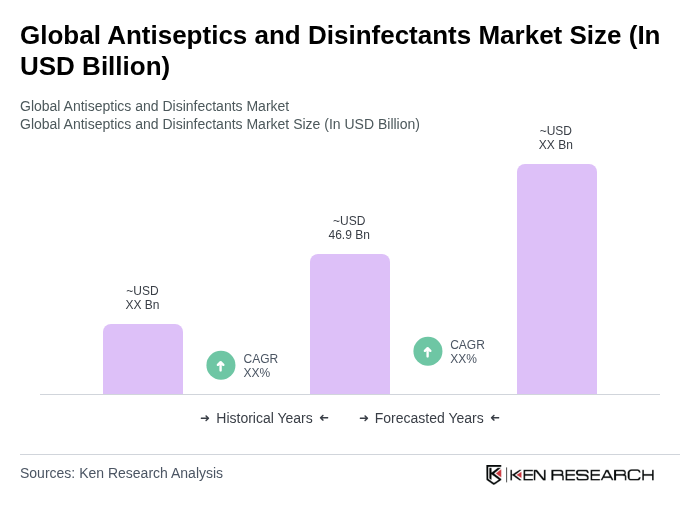
The global antiseptics and disinfectants market, valued at $46.9 billion, is driven by rising hygiene awareness, healthcare infections, and expanding applications in various sectors.

Region:Global

Author(s):Dev

Product Code:KRAD1707

Pages:80

Published On:November 2025
About the Report

Base Year 2024

Global Antiseptics and Disinfectants Market Overview

  • The Global Antiseptics and Disinfectants Market is valued at USD 46.9 billion, based on a five?year historical analysis. This growth is primarily driven by the increasing awareness of hygiene and infection control, particularly in healthcare settings, as well as the rising incidence of healthcare-associated infections. The demand for effective antiseptics and disinfectants has surged due to the ongoing global health challenges, including pandemics and the need for stringent sanitation protocols across various sectors. Key growth drivers include the rising number of surgical procedures, expanding healthcare infrastructure, and increased hospital admissions, which collectively amplify the need for effective sterilization and infection prevention solutions .
  • Key players in this market include the United States, Germany, and China, which maintain dominance due to advanced healthcare infrastructure, substantial investments in research and development, and rigorous regulatory frameworks ensuring product efficacy and safety. North America holds a leading market share, supported by a high volume of surgical procedures and a large healthcare workforce, while Europe and Asia-Pacific are experiencing rapid expansion driven by increased healthcare spending and industrial applications .
  • In 2023, the U.S. Environmental Protection Agency (EPA) updated its regulatory requirements through theEPA Antimicrobial Testing Program (ATP), mandating that all disinfectant products undergo comprehensive efficacy testing against a broader spectrum of pathogens, including emerging viral threats. The EPA’s ATP, administered under the authority of the Federal Insecticide, Fungicide, and Rodenticide Act (FIFRA), requires manufacturers to demonstrate product effectiveness through standardized laboratory protocols before market approval. This regulation enhances public health safety and drives innovation in product formulations .
Global Antiseptics and Disinfectants Market Size

Global Antiseptics and Disinfectants Market Segmentation

By Type:The market is segmented into alcohol-based antiseptics, chlorhexidine and biguanides, iodine-based antiseptics, hydrogen peroxide and peroxides, quaternary ammonium compounds, phenols & derivatives, enzyme-based disinfectants, aldehydes, and others.Quaternary ammonium compoundscurrently lead the market by revenue share, driven by their broad-spectrum efficacy and extensive use in healthcare and industrial sanitation. Alcohol-based antiseptics and aldehydes also hold significant shares due to their effectiveness and rapid action against a wide range of pathogens .
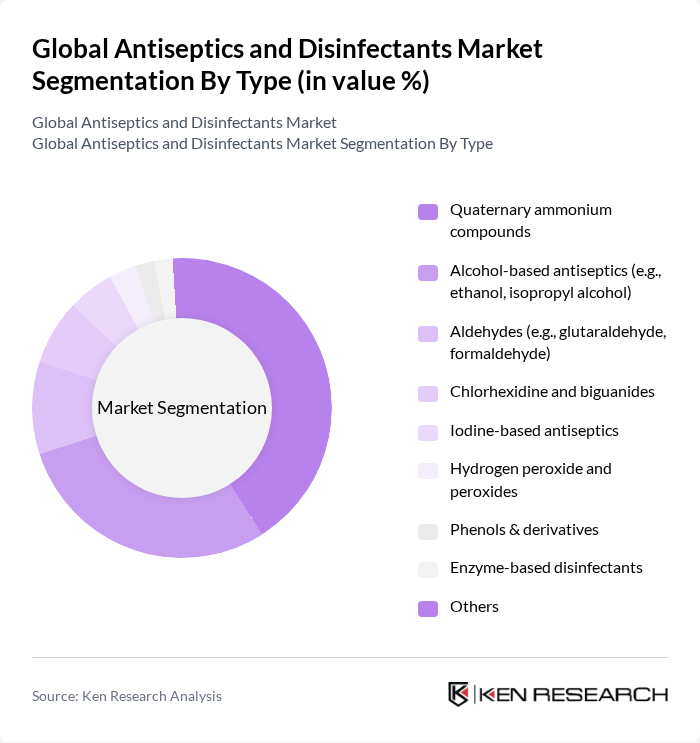
Global Antiseptics and Disinfectants Market segmentation by Type.

By End-User:The market is segmented by end-users, including hospitals, clinics, household consumers, the food processing industry, the hospitality sector, laboratories & research facilities, and others.Hospitalsare the predominant end-user segment, accounting for the largest share due to the critical need for infection control and the high volume of antiseptic and disinfectant usage in patient care and surgical environments. Clinics, food processing, and household segments also contribute significantly, reflecting broader adoption across sectors .
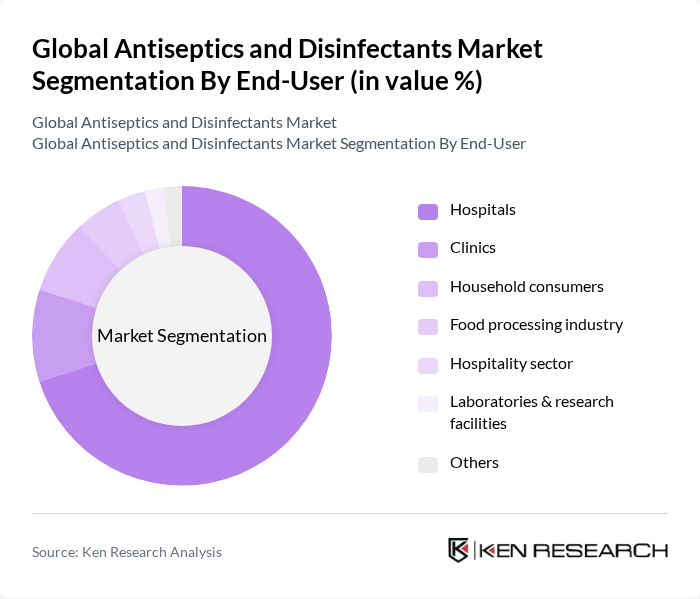
Global Antiseptics and Disinfectants Market segmentation by End-User.

Global Antiseptics and Disinfectants Market Competitive Landscape

The Global Antiseptics and Disinfectants Market is characterized by a dynamic mix of regional and international players. Leading participants such as Johnson & Johnson, Reckitt Benckiser Group plc, 3M Company, Procter & Gamble, Ecolab Inc., Kimberly-Clark Corporation, Henkel AG & Co. KGaA, Unilever PLC, Diversey Holdings, Ltd., GOJO Industries, Inc., Medline Industries, LP, BODE Chemie GmbH, Spartan Chemical Company, Inc., BioSafe Systems, LLC, The Clorox Company, Steris PLC, Becton, Dickinson and Company contribute to innovation, geographic expansion, and service delivery in this space.

Johnson & Johnson

1886

New Brunswick, New Jersey, USA

Reckitt Benckiser Group plc

1823

Slough, England

3M Company

1902

Maplewood, Minnesota, USA

Procter & Gamble

1837

Cincinnati, Ohio, USA

Ecolab Inc.

1923

St. Paul, Minnesota, USA

Company

Establishment Year

Headquarters

Group Size (Large, Medium, or Small as per industry convention)

Revenue Growth Rate (annual %)

Market Share (%)

Geographic Presence (number of countries/regions)

Product Portfolio Breadth (number of SKUs or product categories)

R&D Investment (% of revenue)

Global Antiseptics and Disinfectants Market Industry Analysis

Growth Drivers

  • Increasing Awareness of Hygiene and Infection Control:The global push for improved hygiene practices has led to a significant increase in the demand for antiseptics and disinfectants. In future, the World Health Organization reported that 70% of healthcare facilities worldwide have implemented enhanced infection control measures, resulting in a projected increase in antiseptic usage by 1.5 billion units. This heightened awareness is driven by public health campaigns and the ongoing threat of infectious diseases, emphasizing the importance of cleanliness in both healthcare and everyday environments.
  • Rising Incidence of Healthcare-Associated Infections:Healthcare-associated infections (HAIs) are a growing concern, with the Centers for Disease Control and Prevention estimating that 1 in 31 hospital patients has at least one HAI on any given day. This translates to approximately 1.7 million infections annually in the U.S. alone. The increasing prevalence of HAIs is driving healthcare facilities to invest heavily in antiseptics and disinfectants, with spending projected to reach $10 billion in future, as hospitals seek to mitigate infection risks and improve patient safety.
  • Expanding Applications in Various Industries:The versatility of antiseptics and disinfectants is leading to their adoption across multiple sectors, including food processing, hospitality, and personal care. In future, the food and beverage industry is expected to account for over $5 billion in disinfectant sales, driven by stringent hygiene standards and consumer demand for safe products. This expansion into diverse applications is fostering innovation and increasing market penetration, as companies develop tailored solutions for specific industry needs.

Market Challenges

  • Stringent Regulatory Requirements:The antiseptics and disinfectants market faces significant challenges due to stringent regulatory frameworks imposed by health authorities. In future, the U.S. Environmental Protection Agency (EPA) is expected to enforce new guidelines that require extensive testing and documentation for product approval. This regulatory burden can delay product launches and increase costs, potentially stifling innovation and limiting market entry for smaller companies that may lack the resources to comply with these regulations.
  • Competition from Alternative Products:The market is increasingly challenged by the emergence of alternative cleaning solutions, such as natural and organic products. In future, the market for eco-friendly cleaning products is projected to reach $3 billion, attracting consumers who prioritize sustainability. This shift poses a threat to traditional antiseptics and disinfectants, as companies must adapt their offerings to compete effectively, potentially leading to price wars and reduced profit margins in the industry.

Global Antiseptics and Disinfectants Market Future Outlook

The future of the antiseptics and disinfectants market appears promising, driven by ongoing innovations and evolving consumer preferences. As sustainability becomes a priority, companies are likely to invest in research and development to create eco-friendly formulations that meet regulatory standards. Additionally, the integration of smart technologies in disinfecting solutions is expected to enhance efficiency and effectiveness, catering to the growing demand for advanced cleaning methods in both commercial and residential settings.

Market Opportunities

  • Growth in the E-commerce Sector:The rise of e-commerce presents a significant opportunity for antiseptics and disinfectants, with online sales projected to exceed $2 billion in future. This growth is driven by consumer preferences for convenience and the ability to access a wider range of products. Companies that enhance their online presence and distribution channels can capitalize on this trend, reaching a broader audience and increasing sales.
  • Development of Eco-Friendly Products:The increasing consumer demand for sustainable products is creating opportunities for companies to innovate in eco-friendly antiseptics and disinfectants. In future, the market for green cleaning products is expected to grow by $1 billion, as consumers seek safer alternatives. Companies that invest in developing biodegradable and non-toxic formulations can differentiate themselves and capture a growing segment of environmentally conscious consumers.

Scope of the Report

SegmentSub-Segments
By Type

Alcohol-based antiseptics (e.g., ethanol, isopropyl alcohol)

Chlorhexidine and biguanides

Iodine-based antiseptics

Hydrogen peroxide and peroxides

Quaternary ammonium compounds

Phenols & derivatives

Enzyme-based disinfectants

Aldehydes (e.g., glutaraldehyde, formaldehyde)

Others

By End-User

Hospitals

Clinics

Household consumers

Food processing industry

Hospitality sector

Laboratories & research facilities

Others

By Application

Surface disinfectants

Hand sanitizers

Medical device disinfectants

Enzymatic cleaners

Water treatment

Others

By Distribution Channel

Online retail

Supermarkets/Hypermarkets

Pharmacies

Direct sales (B2B)

Others

By Formulation

Liquid

Gel

Foam

Wipes

Others

By Packaging Type

Bottles

Pouches

Bulk containers

Others

By Region

North America

Europe

Asia-Pacific

Latin America

Middle East & Africa

Key Target Audience

Investors and Venture Capitalist Firms

Government and Regulatory Bodies (e.g., U.S. Environmental Protection Agency, European Medicines Agency)

Manufacturers and Producers

Distributors and Retailers

Healthcare Institutions and Hospitals

Pharmaceutical Companies

Public Health Organizations (e.g., World Health Organization)

Industry Associations (e.g., American Cleaning Institute)

Players Mentioned in the Report:

Johnson & Johnson

Reckitt Benckiser Group plc

3M Company

Procter & Gamble

Ecolab Inc.

Kimberly-Clark Corporation

Henkel AG & Co. KGaA

Unilever PLC

Diversey Holdings, Ltd.

GOJO Industries, Inc.

Medline Industries, LP

BODE Chemie GmbH

Spartan Chemical Company, Inc.

BioSafe Systems, LLC

The Clorox Company

Steris PLC

Becton, Dickinson and Company

Table of Contents

Market Assessment Phase

1. Executive Summary and Approach


2. Global Antiseptics and Disinfectants Market Overview

2.1 Key Insights and Strategic Recommendations

2.2 Global Antiseptics and Disinfectants Market Overview

2.3 Definition and Scope

2.4 Evolution of Market Ecosystem

2.5 Timeline of Key Regulatory Milestones

2.6 Value Chain & Stakeholder Mapping

2.7 Business Cycle Analysis

2.8 Policy & Incentive Landscape


3. Global Antiseptics and Disinfectants Market Analysis

3.1 Growth Drivers

3.1.1 Increasing awareness of hygiene and infection control
3.1.2 Rising incidence of healthcare-associated infections
3.1.3 Expanding applications in various industries
3.1.4 Technological advancements in product formulations

3.2 Market Challenges

3.2.1 Stringent regulatory requirements
3.2.2 Competition from alternative products
3.2.3 Supply chain disruptions
3.2.4 Price sensitivity among consumers

3.3 Market Opportunities

3.3.1 Growth in the e-commerce sector
3.3.2 Expansion in emerging markets
3.3.3 Development of eco-friendly products
3.3.4 Increased demand in the food and beverage industry

3.4 Market Trends

3.4.1 Shift towards sustainable and natural ingredients
3.4.2 Rising demand for multi-purpose disinfectants
3.4.3 Increased focus on research and development
3.4.4 Growing popularity of smart disinfecting technologies

3.5 Government Regulation

3.5.1 Compliance with WHO guidelines
3.5.2 Registration and approval processes for new products
3.5.3 Labeling and marketing regulations
3.5.4 Environmental regulations on chemical usage

4. SWOT Analysis


5. Stakeholder Analysis


6. Porter's Five Forces Analysis


7. Global Antiseptics and Disinfectants Market Market Size, 2019-2024

7.1 By Value

7.2 By Volume

7.3 By Average Selling Price


8. Global Antiseptics and Disinfectants Market Segmentation

8.1 By Type

8.1.1 Alcohol-based antiseptics (e.g., ethanol, isopropyl alcohol)
8.1.2 Chlorhexidine and biguanides
8.1.3 Iodine-based antiseptics
8.1.4 Hydrogen peroxide and peroxides
8.1.5 Quaternary ammonium compounds
8.1.6 Phenols & derivatives
8.1.7 Enzyme-based disinfectants
8.1.8 Aldehydes (e.g., glutaraldehyde, formaldehyde)
8.1.9 Others

8.2 By End-User

8.2.1 Hospitals
8.2.2 Clinics
8.2.3 Household consumers
8.2.4 Food processing industry
8.2.5 Hospitality sector
8.2.6 Laboratories & research facilities
8.2.7 Others

8.3 By Application

8.3.1 Surface disinfectants
8.3.2 Hand sanitizers
8.3.3 Medical device disinfectants
8.3.4 Enzymatic cleaners
8.3.5 Water treatment
8.3.6 Others

8.4 By Distribution Channel

8.4.1 Online retail
8.4.2 Supermarkets/Hypermarkets
8.4.3 Pharmacies
8.4.4 Direct sales (B2B)
8.4.5 Others

8.5 By Formulation

8.5.1 Liquid
8.5.2 Gel
8.5.3 Foam
8.5.4 Wipes
8.5.5 Others

8.6 By Packaging Type

8.6.1 Bottles
8.6.2 Pouches
8.6.3 Bulk containers
8.6.4 Others

8.7 By Region

8.7.1 North America
8.7.2 Europe
8.7.3 Asia-Pacific
8.7.4 Latin America
8.7.5 Middle East & Africa

9. Global Antiseptics and Disinfectants Market Competitive Analysis

9.1 Market Share of Key Players

9.2 KPIs for Cross Comparison of Key Players

9.2.1 Company Name
9.2.2 Group Size (Large, Medium, or Small as per industry convention)
9.2.3 Revenue Growth Rate (annual %)
9.2.4 Market Share (%)
9.2.5 Geographic Presence (number of countries/regions)
9.2.6 Product Portfolio Breadth (number of SKUs or product categories)
9.2.7 R&D Investment (% of revenue)
9.2.8 Regulatory Compliance Record (number of approvals, certifications)
9.2.9 Distribution Network Strength (number of distribution partners/channels)
9.2.10 Sustainability Initiatives (number of eco-friendly products, ESG scores)
9.2.11 Customer Satisfaction Score (Net Promoter Score or equivalent)
9.2.12 Brand Recognition (global ranking or survey results)

9.3 SWOT Analysis of Top Players

9.4 Pricing Analysis

9.5 Detailed Profile of Major Companies

9.5.1 Johnson & Johnson
9.5.2 Reckitt Benckiser Group plc
9.5.3 3M Company
9.5.4 Procter & Gamble
9.5.5 Ecolab Inc.
9.5.6 Kimberly-Clark Corporation
9.5.7 Henkel AG & Co. KGaA
9.5.8 Unilever PLC
9.5.9 Diversey Holdings, Ltd.
9.5.10 GOJO Industries, Inc.
9.5.11 Medline Industries, LP
9.5.12 BODE Chemie GmbH
9.5.13 Spartan Chemical Company, Inc.
9.5.14 BioSafe Systems, LLC
9.5.15 The Clorox Company
9.5.16 Steris PLC
9.5.17 Becton, Dickinson and Company

10. Global Antiseptics and Disinfectants Market End-User Analysis

10.1 Procurement Behavior of Key Ministries

10.1.1 Government purchasing policies
10.1.2 Budget allocation for health and safety
10.1.3 Supplier selection criteria
10.1.4 Contract management practices

10.2 Corporate Spend on Infrastructure & Energy

10.2.1 Investment in sanitation facilities
10.2.2 Budget for health and safety compliance
10.2.3 Spending on training and awareness programs
10.2.4 Allocation for emergency preparedness

10.3 Pain Point Analysis by End-User Category

10.3.1 Healthcare sector challenges
10.3.2 Household consumer concerns
10.3.3 Industrial application issues
10.3.4 Regulatory compliance difficulties

10.4 User Readiness for Adoption

10.4.1 Awareness of product benefits
10.4.2 Availability of products
10.4.3 Training and education needs
10.4.4 Perceived effectiveness of products

10.5 Post-Deployment ROI and Use Case Expansion

10.5.1 Measurement of effectiveness
10.5.2 Cost savings analysis
10.5.3 User feedback and satisfaction
10.5.4 Opportunities for product diversification

11. Global Antiseptics and Disinfectants Market Future Size, 2025-2030

11.1 By Value

11.2 By Volume

11.3 By Average Selling Price


Go-To-Market Strategy Phase

1. Whitespace Analysis + Business Model Canvas

1.1 Market gaps identification

1.2 Value proposition development

1.3 Revenue model exploration

1.4 Customer segmentation analysis

1.5 Competitive landscape overview

1.6 Key partnerships identification

1.7 Resource allocation strategy


2. Marketing and Positioning Recommendations

2.1 Branding strategies

2.2 Product USPs

2.3 Target audience identification

2.4 Communication strategy

2.5 Digital marketing approach

2.6 Offline marketing tactics

2.7 Performance metrics


3. Distribution Plan

3.1 Urban retail strategy

3.2 Rural NGO tie-ups

3.3 E-commerce integration

3.4 Direct sales approach

3.5 Distribution partnerships

3.6 Logistics and supply chain management

3.7 Inventory management strategies


4. Channel & Pricing Gaps

4.1 Underserved routes

4.2 Pricing bands analysis

4.3 Competitor pricing comparison

4.4 Value-based pricing strategy

4.5 Discount and promotion strategies

4.6 Price elasticity assessment

4.7 Customer willingness to pay


5. Unmet Demand & Latent Needs

5.1 Category gaps identification

5.2 Consumer segments analysis

5.3 Product development opportunities

5.4 Market entry barriers

5.5 Customer feedback incorporation

5.6 Trend analysis for future needs

5.7 Innovation opportunities


6. Customer Relationship

6.1 Loyalty programs

6.2 After-sales service

6.3 Customer engagement strategies

6.4 Feedback and improvement loops

6.5 Community building initiatives

6.6 Customer education programs

6.7 Relationship management tools


7. Value Proposition

7.1 Sustainability initiatives

7.2 Integrated supply chains

7.3 Unique selling propositions

7.4 Customer-centric approach

7.5 Competitive advantages

7.6 Value delivery mechanisms

7.7 Long-term vision alignment


8. Key Activities

8.1 Regulatory compliance

8.2 Branding efforts

8.3 Distribution setup

8.4 Marketing campaigns

8.5 Product development

8.6 Customer support initiatives

8.7 Performance monitoring


9. Entry Strategy Evaluation

9.1 Domestic Market Entry Strategy

9.1.1 Product mix considerations
9.1.2 Pricing band analysis
9.1.3 Packaging strategies

9.2 Export Entry Strategy

9.2.1 Target countries selection
9.2.2 Compliance roadmap development

10. Entry Mode Assessment

10.1 Joint Ventures

10.2 Greenfield investments

10.3 Mergers & Acquisitions

10.4 Distributor Model

10.5 Risk assessment

10.6 Strategic fit evaluation

10.7 Long-term partnership considerations


11. Capital and Timeline Estimation

11.1 Capital requirements

11.2 Timelines for market entry

11.3 Budget allocation

11.4 Financial projections

11.5 Funding sources identification

11.6 Cost management strategies

11.7 Milestone tracking


12. Control vs Risk Trade-Off

12.1 Ownership considerations

12.2 Partnership dynamics

12.3 Risk mitigation strategies

12.4 Control mechanisms

12.5 Long-term sustainability

12.6 Exit strategies

12.7 Performance evaluation


13. Profitability Outlook

13.1 Breakeven analysis

13.2 Long-term sustainability

13.3 Profit margin assessment

13.4 Revenue growth projections

13.5 Cost structure analysis

13.6 Financial health indicators

13.7 Investment return expectations


1


Research Methodology

ApproachModellingSample

Phase 1: Approach1

Desk Research

  • Analysis of market reports from industry associations such as the American Cleaning Institute
  • Review of scientific literature on antiseptic and disinfectant efficacy and safety
  • Examination of regulatory frameworks and guidelines from health authorities like WHO and CDC

Primary Research

  • Interviews with product managers at leading antiseptic and disinfectant manufacturers
  • Surveys with healthcare professionals regarding product usage and preferences
  • Field interviews with distributors and retailers in the cleaning products sector

Validation & Triangulation

  • Cross-validation of findings through multiple data sources including sales data and market trends
  • Triangulation of insights from primary interviews with secondary research findings
  • Sanity checks conducted through expert panels comprising industry veterans

Phase 2: Market Size Estimation1

Top-down Assessment

  • Estimation of market size based on global healthcare expenditure and cleaning product sales
  • Segmentation by application areas such as healthcare, food service, and household use
  • Incorporation of growth rates from emerging markets and developed regions

Bottom-up Modeling

  • Volume estimates derived from sales data of key product categories (e.g., hand sanitizers, surface disinfectants)
  • Cost analysis based on pricing strategies of major manufacturers
  • Calculation of market size using unit sales multiplied by average selling prices

Forecasting & Scenario Analysis

  • Multi-variable forecasting models incorporating trends in hygiene awareness and infection control
  • Scenario analysis based on potential regulatory changes and public health initiatives
  • Development of baseline, optimistic, and pessimistic market growth projections through 2030

Phase 3: CATI Sample Composition1

Scope Item/SegmentSample SizeTarget Respondent Profiles
Healthcare Facility Disinfectant Usage120Infection Control Managers, Hospital Administrators
Household Cleaning Product Preferences90Homeowners, Cleaning Product Buyers
Food Service Sanitization Practices60Restaurant Managers, Food Safety Officers
Industrial Cleaning Solutions50Facility Managers, Operations Directors
Retail Sector Disinfectant Sales Trends70Retail Buyers, Category Managers

Frequently Asked Questions

What is the current value of the Global Antiseptics and Disinfectants Market?

The Global Antiseptics and Disinfectants Market is valued at approximately USD 46.9 billion, reflecting a significant increase driven by heightened awareness of hygiene and infection control, particularly in healthcare settings.

What are the main drivers of growth in the antiseptics and disinfectants market?

Which regions dominate the Global Antiseptics and Disinfectants Market?

What types of antiseptics and disinfectants are most commonly used?

Other Regional/Country Reports

Indonesia Antiseptics And Disinfectants Market

Malaysia Antiseptics And Disinfectants Market

KSA Antiseptics And Disinfectants Market

APAC Antiseptics And Disinfectants Market

SEA Antiseptics And Disinfectants Market

Vietnam Antiseptics And Disinfectants Market

Other Adjacent Reports

Egypt Infection Prevention Market

APAC hand sanitizer market size, share, growth drivers, trends, opportunities & forecast 2025–2030Bahrain surface disinfectant market Size, Share, Growth Drivers, Trends, Opportunities & Forecast 2025–2030

Malaysia Medical Sterilization Market

Singapore Hygiene Products Market

Brazil Cleaning Chemicals Market

Belgium Personal Care Antiseptics Market

Indonesia Food Processing Disinfectants Market

Bahrain Veterinary Antiseptics Market

Thailand Water Purification Market

Why Buy From Us?

Refine Robust Result (RRR) Framework

What makes us stand out is that our consultants follow Robust, Refine and Result (RRR) methodology. Robust for clear definitions, approaches and sanity checking, Refine for differentiating respondents' facts and opinions, and Result for presenting data with story.

Our Reach Is Unmatched

We have set a benchmark in the industry by offering our clients with syndicated and customized market research reports featuring coverage of entire market as well as meticulous research and analyst insights.

Shifting the Research Paradigm

While we don't replace traditional research, we flip the method upside down. Our dual approach of Top Bottom & Bottom Top ensures quality deliverable by not just verifying company fundamentals but also looking at the sector and macroeconomic factors.

More Insights-Better Decisions

With one step in the future, our research team constantly tries to show you the bigger picture. We help with some of the tough questions you may encounter along the way: How is the industry positioned? Best marketing channel? KPI's of competitors? By aligning every element, we help maximize success.

Transparency and Trust

Our report gives you instant access to the answers and sources that other companies might choose to hide. We elaborate each steps of research methodology we have used and showcase you the sample size to earn your trust.

Round the Clock Support

If you need any support, we are here! We pride ourselves on universe strength, data quality, and quick, friendly, and professional service.

Why Clients Choose Us?

400000+
Reports in repository
150+
Consulting projects a year
100+
Analysts
8000+
Client Queries in 2022








