About the Report
Base Year 2024Global Artificial Intelligence In Food And Beverages Market Overview
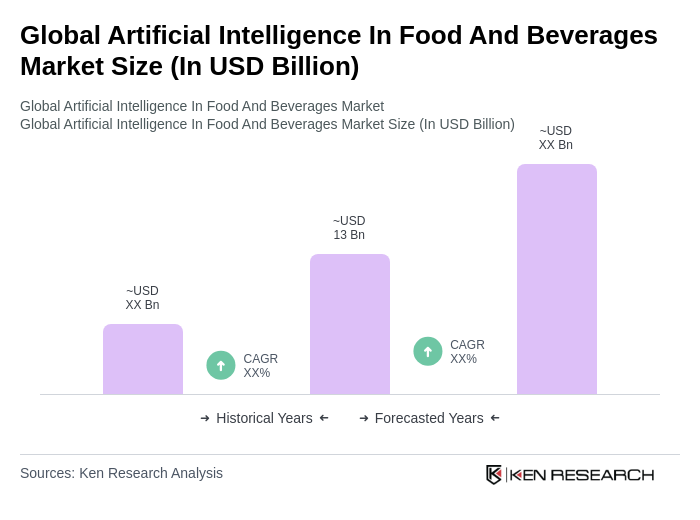
- The Global Artificial Intelligence in Food and Beverages Market is valued at USD 11–13 billion, based on a five-year historical analysis. This value aligns with multiple recent market assessments that place the market around USD 8–11 billion in the prior year and approximately USD 13 billion currently, reflecting rapid adoption across processing, quality control, and retail applications . This growth is primarily driven by the increasing adoption of AI technologies for enhancing operational efficiency, improving food safety, and personalizing consumer experiences; recent analyses highlight AI’s role in quality control, traceability, predictive maintenance, and demand forecasting across the F&B value chain . The integration of AI in supply chain management and predictive analytics has also contributed significantly to market expansion, with computer vision for inspection, inventory optimization, and waste reduction cited as core use cases .
- Key players in this market include the United States, Germany, and China, which dominate due to their advanced technological infrastructure, significant investments in AI research, and a strong presence of major food and beverage companies. Recent market coverage shows North America with a leading share and strong innovation base, while Asia Pacific (driven by China and broader APAC incentives) is expanding rapidly; Germany anchors European industrial adoption in manufacturing and supply chains . The U.S. leads in innovation and deployment of AI solutions, while Germany and China are rapidly adopting these technologies to enhance their manufacturing and supply chain processes .
- In 2023, the European Union progressed the AI Act, and in 2024–2025 the EU formally adopted and published the AI Act, establishing a horizontal, risk-based framework covering AI uses across sectors, including food and beverages. The regulation emphasizes transparency, accountability, and safety, imposing obligations on providers and users of high-risk systems and setting rules for transparency in certain AI applications .
Global Artificial Intelligence In Food And Beverages Market Segmentation
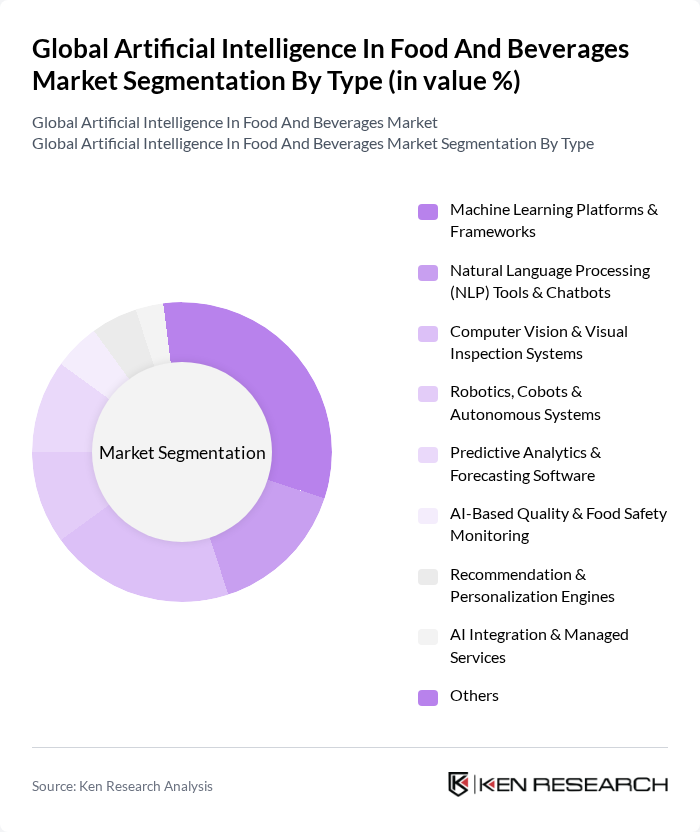
By Type:The market is segmented into various types of AI technologies, including Machine Learning Platforms & Frameworks, Natural Language Processing (NLP) Tools & Chatbots, Computer Vision & Visual Inspection Systems, Robotics, Cobots & Autonomous Systems, Predictive Analytics & Forecasting Software, AI-Based Quality & Food Safety Monitoring, Recommendation & Personalization Engines, AI Integration & Managed Services, and Others. Among these, Machine Learning Platforms & Frameworks are leading due to their versatility and ability to analyze large datasets effectively; industry sources highlight broad platform adoption for model development, computer vision for quality inspection, and predictive analytics for maintenance and demand planning across F&B operations .
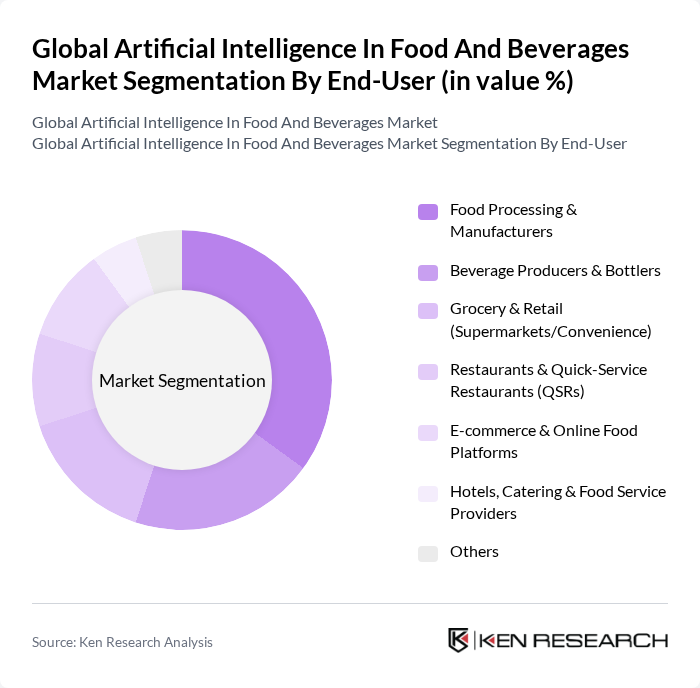
By End-User:The end-user segmentation includes Food Processing & Manufacturers, Beverage Producers & Bottlers, Grocery & Retail (Supermarkets/Convenience), Restaurants & Quick-Service Restaurants (QSRs), E-commerce & Online Food Platforms, Hotels, Catering & Food Service Providers, and Others. The Food Processing & Manufacturers segment is currently the most dominant, driven by the need for efficiency and quality control in production processes; adoption is concentrated in production, packaging, quality inspection, and predictive maintenance, while retail and QSR use personalization, dynamic pricing, and inventory optimization .
Global Artificial Intelligence In Food And Beverages Market Competitive Landscape
The Global Artificial Intelligence In Food And Beverages Market is characterized by a dynamic mix of regional and international players. Leading participants such as IBM Corporation, Microsoft Corporation, Google LLC, SAP SE, Oracle Corporation, Siemens AG, Rockwell Automation, Inc., ABB Ltd., Schneider Electric SE, Zebra Technologies Corporation, JBT Corporation, Tomra Systems ASA, PathAI Diagnostics, Inc. (formerly Sample6 assets), Poka Inc., C3.ai, Inc., Aspen Technology, Inc., UiPath Inc., Blue Yonder Group, Inc., SymphonyAI (SymphonyAI Industrial), Trax Retail, Afresh Technologies, Databricks, Inc., NVIDIA Corporation, Anyline GmbH, Clarifai, Inc., Kensho Technologies, LLC, Halla I/O, Inc. (Halla), Tastewise Technologies Ltd., NotCo (The Not Company SpA), Coca-Cola Company contribute to innovation, geographic expansion, and service delivery in this space .
Global Artificial Intelligence In Food And Beverages Market Industry Analysis
Growth Drivers
- Increasing Demand for Automation:The global food and beverage industry is projected to reach $5.5 trillion in future, with automation playing a crucial role in this growth. Automation technologies, including AI, are expected to reduce operational costs by up to 30%, according to the World Economic Forum. This demand for efficiency drives investments in AI solutions, enabling companies to streamline production processes and enhance productivity, ultimately meeting the rising consumer demand for faster service and higher quality products.
- Enhanced Food Safety and Quality Control:The global food safety market is anticipated to reach $20 billion in future, with AI technologies significantly contributing to this growth. AI systems can analyze vast amounts of data to identify potential hazards, reducing foodborne illnesses by up to 50%. The implementation of AI-driven quality control measures ensures compliance with stringent safety regulations, thereby enhancing consumer trust and brand loyalty in an increasingly competitive market.
- Rising Consumer Preferences for Personalized Products:A report by McKinsey indicates that 70% of consumers are more likely to purchase from brands that offer personalized experiences. The AI-driven personalization market in food and beverages is expected to grow significantly, with companies leveraging data analytics to tailor products to individual preferences. This trend is supported by the increasing availability of consumer data, allowing businesses to create targeted marketing strategies and enhance customer satisfaction, driving sales growth.
Market Challenges
- High Initial Investment Costs:The implementation of AI technologies in the food and beverage sector often requires substantial upfront investments, estimated at around $1.2 million for mid-sized companies. This financial barrier can deter smaller businesses from adopting AI solutions, limiting their competitiveness. Additionally, ongoing maintenance and updates can further strain budgets, making it challenging for companies to justify the return on investment in a rapidly evolving technological landscape.
- Data Privacy and Security Concerns:With the increasing reliance on data-driven AI solutions, concerns regarding data privacy and security have escalated. According to a report by Cybersecurity Ventures, cybercrime is projected to cost the global economy $10.5 trillion annually in future. Food and beverage companies face the challenge of protecting sensitive consumer data while complying with regulations such as GDPR, which can impose fines of up to €20 million or 4% of annual global turnover, creating significant operational risks.
Global Artificial Intelligence In Food And Beverages Market Future Outlook
The future of AI in the food and beverage industry appears promising, driven by technological advancements and evolving consumer expectations. Companies are increasingly adopting AI solutions to enhance operational efficiency and improve customer experiences. As the market matures, we can expect a surge in innovative applications, particularly in areas like predictive analytics and smart packaging. These developments will not only streamline supply chains but also foster sustainability, aligning with global trends toward environmentally friendly practices and personalized consumer offerings.
Market Opportunities
- Expansion of E-commerce in Food Sector:The e-commerce food market is projected to reach $200 billion in future, presenting significant opportunities for AI integration. Companies can leverage AI to optimize online shopping experiences, enhance inventory management, and personalize marketing strategies, ultimately driving sales and customer engagement in this rapidly growing segment.
- Development of Smart Packaging Solutions:The smart packaging market is expected to grow to $30 billion in future, driven by consumer demand for convenience and sustainability. AI technologies can enhance packaging solutions by providing real-time data on product freshness and safety, thereby improving supply chain efficiency and reducing waste, which is increasingly important to environmentally conscious consumers.
Scope of the Report
| Segment | Sub-Segments |
|---|---|
| By Type | Machine Learning Platforms & Frameworks Natural Language Processing (NLP) Tools & Chatbots Computer Vision & Visual Inspection Systems Robotics, Cobots & Autonomous Systems Predictive Analytics & Forecasting Software AI-Based Quality & Food Safety Monitoring Recommendation & Personalization Engines AI Integration & Managed Services Others |
| By End-User | Food Processing & Manufacturers Beverage Producers & Bottlers Grocery & Retail (Supermarkets/Convenience) Restaurants & Quick-Service Restaurants (QSRs) E-commerce & Online Food Platforms Hotels, Catering & Food Service Providers Others |
| By Application | Inventory & Waste Management Demand Forecasting & Sales Planning Quality Assurance & Contaminant Detection Customer Engagement & Conversational AI Supply Chain Optimization & Traceability Predictive Maintenance & OEE Improvement Product Development & Flavor Optimization Dynamic Pricing & Promotion Optimization Others |
| By Distribution Channel | Direct (Enterprise/B2B) Sales Online Marketplaces & SaaS System Integrators & VARs Distributors & Resellers Others |
| By Region | North America Europe Asia-Pacific Latin America Middle East & Africa Others |
| By Price Range | Budget (Entry-Level AI Tools) Mid-Range (Modular AI Solutions) Premium (Enterprise-Grade Platforms) Others |
| By Technology Integration | AI with IoT/Edge (Smart Sensors & Connected Lines) AI with Blockchain (Traceability & Provenance) AI with Big Data & Cloud Analytics Digital Twins & Simulation Others |
Key Target Audience
Investors and Venture Capitalist Firms
Government and Regulatory Bodies (e.g., Food and Drug Administration, European Food Safety Authority)
Manufacturers and Producers
Distributors and Retailers
Food Safety and Quality Assurance Agencies
Technology Providers
Industry Associations (e.g., International Food and Beverage Alliance)
Financial Institutions
Players Mentioned in the Report:
IBM Corporation
Microsoft Corporation
Google LLC
SAP SE
Oracle Corporation
Siemens AG
Rockwell Automation, Inc.
ABB Ltd.
Schneider Electric SE
Zebra Technologies Corporation
JBT Corporation
Tomra Systems ASA
PathAI Diagnostics, Inc. (formerly Sample6 assets)
Poka Inc.
C3.ai, Inc.
Aspen Technology, Inc.
UiPath Inc.
Blue Yonder Group, Inc.
SymphonyAI (SymphonyAI Industrial)
Trax Retail
Afresh Technologies
Databricks, Inc.
NVIDIA Corporation
Anyline GmbH
Clarifai, Inc.
Kensho Technologies, LLC
Halla I/O, Inc. (Halla)
Tastewise Technologies Ltd.
NotCo (The Not Company SpA)
Coca-Cola Company
Table of Contents
Market Assessment Phase
1. Executive Summary and Approach
2. Global Artificial Intelligence In Food And Beverages Market Overview
2.1 Key Insights and Strategic Recommendations
2.2 Global Artificial Intelligence In Food And Beverages Market Overview
2.3 Definition and Scope
2.4 Evolution of Market Ecosystem
2.5 Timeline of Key Regulatory Milestones
2.6 Value Chain & Stakeholder Mapping
2.7 Business Cycle Analysis
2.8 Policy & Incentive Landscape
3. Global Artificial Intelligence In Food And Beverages Market Analysis
3.1 Growth Drivers
3.1.1 Increasing Demand for Automation
3.1.2 Enhanced Food Safety and Quality Control
3.1.3 Rising Consumer Preferences for Personalized Products
3.1.4 Efficiency in Supply Chain Management
3.2 Market Challenges
3.2.1 High Initial Investment Costs
3.2.2 Data Privacy and Security Concerns
3.2.3 Lack of Skilled Workforce
3.2.4 Integration with Legacy Systems
3.3 Market Opportunities
3.3.1 Expansion of E-commerce in Food Sector
3.3.2 Adoption of AI in Food Production Processes
3.3.3 Development of Smart Packaging Solutions
3.3.4 Collaborations with Tech Startups
3.4 Market Trends
3.4.1 Growth of AI-Powered Food Delivery Services
3.4.2 Increasing Use of Predictive Analytics
3.4.3 Rise of Sustainable Food Practices
3.4.4 Integration of AI with IoT in Food Supply Chains
3.5 Government Regulation
3.5.1 Food Safety Standards Compliance
3.5.2 Data Protection Regulations
3.5.3 AI Ethics Guidelines
3.5.4 Support for AI Research and Development
4. SWOT Analysis
5. Stakeholder Analysis
6. Porter's Five Forces Analysis
7. Global Artificial Intelligence In Food And Beverages Market Market Size, 2019-2024
7.1 By Value
7.2 By Volume
7.3 By Average Selling Price
8. Global Artificial Intelligence In Food And Beverages Market Segmentation
8.1 By Type
8.1.1 Machine Learning Platforms & Frameworks
8.1.2 Natural Language Processing (NLP) Tools & Chatbots
8.1.3 Computer Vision & Visual Inspection Systems
8.1.4 Robotics, Cobots & Autonomous Systems
8.1.5 Predictive Analytics & Forecasting Software
8.1.6 AI-Based Quality & Food Safety Monitoring
8.1.7 Recommendation & Personalization Engines
8.1.8 AI Integration & Managed Services
8.1.9 Others
8.2 By End-User
8.2.1 Food Processing & Manufacturers
8.2.2 Beverage Producers & Bottlers
8.2.3 Grocery & Retail (Supermarkets/Convenience)
8.2.4 Restaurants & Quick-Service Restaurants (QSRs)
8.2.5 E-commerce & Online Food Platforms
8.2.6 Hotels, Catering & Food Service Providers
8.2.7 Others
8.3 By Application
8.3.1 Inventory & Waste Management
8.3.2 Demand Forecasting & Sales Planning
8.3.3 Quality Assurance & Contaminant Detection
8.3.4 Customer Engagement & Conversational AI
8.3.5 Supply Chain Optimization & Traceability
8.3.6 Predictive Maintenance & OEE Improvement
8.3.7 Product Development & Flavor Optimization
8.3.8 Dynamic Pricing & Promotion Optimization
8.3.9 Others
8.4 By Distribution Channel
8.4.1 Direct (Enterprise/B2B) Sales
8.4.2 Online Marketplaces & SaaS
8.4.3 System Integrators & VARs
8.4.4 Distributors & Resellers
8.4.5 Others
8.5 By Region
8.5.1 North America
8.5.2 Europe
8.5.3 Asia-Pacific
8.5.4 Latin America
8.5.5 Middle East & Africa
8.5.6 Others
8.6 By Price Range
8.6.1 Budget (Entry-Level AI Tools)
8.6.2 Mid-Range (Modular AI Solutions)
8.6.3 Premium (Enterprise-Grade Platforms)
8.6.4 Others
8.7 By Technology Integration
8.7.1 AI with IoT/Edge (Smart Sensors & Connected Lines)
8.7.2 AI with Blockchain (Traceability & Provenance)
8.7.3 AI with Big Data & Cloud Analytics
8.7.4 Digital Twins & Simulation
8.7.5 Others
9. Global Artificial Intelligence In Food And Beverages Market Competitive Analysis
9.1 Market Share of Key Players
9.2 Cross Comparison of Key Players
9.2.1 Company Name
9.2.2 Segment Focus (Processing, Retail, QSR, Supply Chain, Food Safety)
9.2.3 Product Coverage (Vision, NLP, Predictive, Robotics, Platform)
9.2.4 Organization Size (Enterprise/Mid-Market/SMB Focus)
9.2.5 Global Footprint (Regions Served)
9.2.6 Revenue Growth Rate (YoY %)
9.2.7 Recurring Revenue Mix (SaaS/Services %)
9.2.8 Customer Penetration (No. of F&B Clients/Logos)
9.2.9 Deployment Model (Cloud/Edge/On-Prem)
9.2.10 Model Performance KPIs (Accuracy/Recall for QA/Forecast MAPE)
9.2.11 Operational Uplift (OEE %, Waste Reduction %, Downtime Reduction %)
9.2.12 Time-to-Value (Avg. Go-Live Time)
9.2.13 Integration Depth (ERP/MES/SCM/PLM Connectors)
9.2.14 Pricing Model (Per-Unit/Per-Line/SaaS Tier/Enterprise)
9.2.15 Customer Retention/Net Revenue Retention (%)
9.2.16 Security & Compliance (ISO 27001, GFSI, FDA/FSMA enablement)
9.2.17 Innovation Velocity (Release Cadence, R&D % of Revenue)
9.2.18 Partner Ecosystem (SIs, Cloud, Hardware, OEMs)
9.2.19 Case Study Outcomes (Yield %, Throughput %, AOV uplift in QSR)
9.2.20 Brand Recognition (Analyst Mentions/Awards)
9.3 SWOT Analysis of Top Players
9.4 Pricing Analysis
9.5 Detailed Profile of Major Companies
9.5.1 IBM Corporation
9.5.2 Microsoft Corporation
9.5.3 Google LLC
9.5.4 SAP SE
9.5.5 Oracle Corporation
9.5.6 Siemens AG
9.5.7 Rockwell Automation, Inc.
9.5.8 ABB Ltd.
9.5.9 Schneider Electric SE
9.5.10 Zebra Technologies Corporation
9.5.11 JBT Corporation
9.5.12 Tomra Systems ASA
9.5.13 PathAI Diagnostics, Inc. (formerly Sample6 assets)
9.5.14 Poka Inc.
9.5.15 C3.ai, Inc.
9.5.16 Aspen Technology, Inc.
9.5.17 UiPath Inc.
9.5.18 Blue Yonder Group, Inc.
9.5.19 SymphonyAI (SymphonyAI Industrial)
9.5.20 Trax Retail
9.5.21 Afresh Technologies
9.5.22 Databricks, Inc.
9.5.23 NVIDIA Corporation
9.5.24 Anyline GmbH
9.5.25 Clarifai, Inc.
9.5.26 Kensho Technologies, LLC
9.5.27 Halla I/O, Inc. (Halla)
9.5.28 Tastewise Technologies Ltd.
9.5.29 NotCo (The Not Company SpA)
9.5.30 Coca-Cola Company
10. Global Artificial Intelligence In Food And Beverages Market End-User Analysis
10.1 Procurement Behavior of Key Ministries
10.1.1 Government Procurement Policies
10.1.2 Budget Allocations for Food Safety
10.1.3 Collaboration with Private Sector
10.2 Corporate Spend on Infrastructure & Energy
10.2.1 Investment in AI Technologies
10.2.2 Funding for Research and Development
10.2.3 Expenditure on Training and Development
10.3 Pain Point Analysis by End-User Category
10.3.1 Food Safety Concerns
10.3.2 Supply Chain Disruptions
10.3.3 Consumer Demand Fluctuations
10.4 User Readiness for Adoption
10.4.1 Awareness of AI Benefits
10.4.2 Training Needs Assessment
10.4.3 Infrastructure Readiness
10.5 Post-Deployment ROI and Use Case Expansion
10.5.1 Measurement of ROI Metrics
10.5.2 Case Studies of Successful Implementations
10.5.3 Future Use Case Identification
11. Global Artificial Intelligence In Food And Beverages Market Future Size, 2025-2030
11.1 By Value
11.2 By Volume
11.3 By Average Selling Price
Go-To-Market Strategy Phase
1. Whitespace Analysis + Business Model Canvas
1.1 Market Gaps Identification
1.2 Value Proposition Development
1.3 Revenue Streams Analysis
1.4 Key Resources and Activities
1.5 Customer Segments and Relationships
1.6 Channels for Delivery
1.7 Cost Structure Overview
2. Marketing and Positioning Recommendations
2.1 Branding Strategies
2.2 Product USPs
2.3 Target Audience Identification
2.4 Communication Strategies
2.5 Digital Marketing Approaches
3. Distribution Plan
3.1 Urban Retail Strategies
3.2 Rural NGO Tie-ups
3.3 E-commerce Distribution Channels
3.4 Partnerships with Distributors
4. Channel & Pricing Gaps
4.1 Underserved Routes
4.2 Pricing Bands Analysis
4.3 Competitor Pricing Strategies
5. Unmet Demand & Latent Needs
5.1 Category Gaps Identification
5.2 Consumer Segments Analysis
5.3 Emerging Trends and Needs
6. Customer Relationship
6.1 Loyalty Programs
6.2 After-sales Service Strategies
6.3 Customer Feedback Mechanisms
7. Value Proposition
7.1 Sustainability Initiatives
7.2 Integrated Supply Chains
7.3 Competitive Advantages
8. Key Activities
8.1 Regulatory Compliance
8.2 Branding Initiatives
8.3 Distribution Setup
9. Entry Strategy Evaluation
9.1 Domestic Market Entry Strategy
9.1.1 Product Mix Considerations
9.1.2 Pricing Band Strategy
9.1.3 Packaging Innovations
9.2 Export Entry Strategy
9.2.1 Target Countries Analysis
9.2.2 Compliance Roadmap Development
10. Entry Mode Assessment
10.1 Joint Ventures
10.2 Greenfield Investments
10.3 Mergers & Acquisitions
10.4 Distributor Model Evaluation
11. Capital and Timeline Estimation
11.1 Capital Requirements Overview
11.2 Timelines for Implementation
12. Control vs Risk Trade-Off
12.1 Ownership vs Partnerships Analysis
13. Profitability Outlook
13.1 Breakeven Analysis
13.2 Long-term Sustainability Strategies
14. Potential Partner List
14.1 Distributors
14.2 Joint Ventures
14.3 Acquisition Targets
15. Execution Roadmap
15.1 Phased Plan for Market Entry
15.1.1 Market Setup
15.1.2 Market Entry
15.
Research Methodology
Phase 1: Approach1
Desk Research
- Analysis of industry reports from food and beverage associations and market research firms
- Review of academic journals and publications focusing on AI applications in food technology
- Examination of government publications and policy documents related to food safety and AI regulations
Primary Research
- Interviews with technology leads at major food and beverage companies
- Surveys with AI solution providers specializing in the food sector
- Field interviews with food scientists and product developers utilizing AI in R&D
Validation & Triangulation
- Cross-validation of findings through multiple data sources including market trends and expert opinions
- Triangulation of insights from industry reports, expert interviews, and consumer feedback
- Sanity checks conducted through expert panel reviews to ensure data accuracy
Phase 2: Market Size Estimation1
Top-down Assessment
- Estimation of market size based on global food and beverage industry revenue and AI adoption rates
- Segmentation by application areas such as supply chain optimization, quality control, and customer engagement
- Incorporation of trends in consumer preferences towards AI-driven food solutions
Bottom-up Modeling
- Data collection from leading AI technology providers on their market share and revenue
- Estimation of AI implementation costs across various food and beverage processes
- Volume x cost analysis for AI applications in production, distribution, and marketing
Forecasting & Scenario Analysis
- Multi-factor regression analysis incorporating growth rates of AI technology and food industry trends
- Scenario modeling based on varying levels of AI adoption and regulatory impacts
- Development of baseline, optimistic, and pessimistic forecasts through 2030
Phase 3: CATI Sample Composition1
| Scope Item/Segment | Sample Size | Target Respondent Profiles |
|---|---|---|
| AI in Food Production | 110 | Production Managers, Technology Officers |
| AI in Supply Chain Management | 95 | Supply Chain Analysts, Logistics Coordinators |
| AI in Quality Control | 85 | Quality Assurance Managers, Food Safety Experts |
| AI in Consumer Engagement | 90 | Marketing Directors, Customer Experience Managers |
| AI in Product Development | 75 | R&D Managers, Food Technologists |
Frequently Asked Questions
What is the current value of the Global Artificial Intelligence in Food and Beverages Market?
The Global Artificial Intelligence in Food and Beverages Market is valued at approximately USD 1113 billion, reflecting significant growth from previous years, driven by the adoption of AI technologies in processing, quality control, and retail applications.
What are the main drivers of growth in the AI in Food and Beverages Market?
Which regions are leading in the AI in Food and Beverages Market?
What are the key applications of AI in the food and beverage industry?
Other Regional/Country Reports
Indonesia Artificial Intelligence In Food And Beverages Market
Malaysia Artificial Intelligence In Food And Beverages Market
APAC Artificial Intelligence In Food And Beverages Market
SEA Artificial Intelligence In Food And Beverages Market
Why Buy From Us?

What makes us stand out is that our consultants follow Robust, Refine and Result (RRR) methodology. Robust for clear definitions, approaches and sanity checking, Refine for differentiating respondents' facts and opinions, and Result for presenting data with story.

We have set a benchmark in the industry by offering our clients with syndicated and customized market research reports featuring coverage of entire market as well as meticulous research and analyst insights.

While we don't replace traditional research, we flip the method upside down. Our dual approach of Top Bottom & Bottom Top ensures quality deliverable by not just verifying company fundamentals but also looking at the sector and macroeconomic factors.

With one step in the future, our research team constantly tries to show you the bigger picture. We help with some of the tough questions you may encounter along the way: How is the industry positioned? Best marketing channel? KPI's of competitors? By aligning every element, we help maximize success.

Our report gives you instant access to the answers and sources that other companies might choose to hide. We elaborate each steps of research methodology we have used and showcase you the sample size to earn your trust.

If you need any support, we are here! We pride ourselves on universe strength, data quality, and quick, friendly, and professional service.