Region:Global
Author(s):Dev
Product Code:KRAD0426
Pages:94
Published On:August 2025
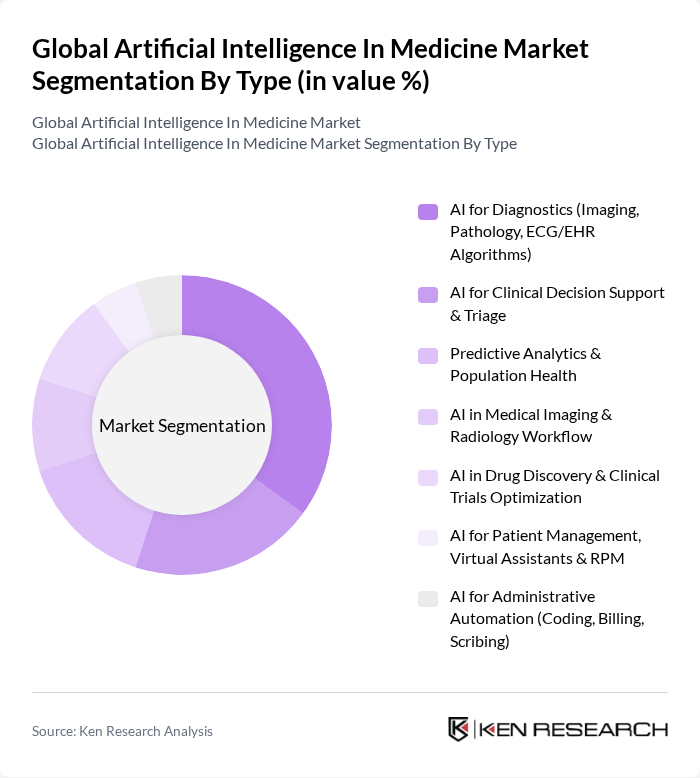
By Type:The market is segmented into various types, including AI for Diagnostics, AI for Clinical Decision Support & Triage, Predictive Analytics & Population Health, AI in Medical Imaging & Radiology Workflow, AI in Drug Discovery & Clinical Trials Optimization, AI for Patient Management, Virtual Assistants & RPM, and AI for Administrative Automation. Among these, AI for Diagnostics is currently the leading subsegment, driven by the increasing adoption of AI technologies in imaging and pathology, which enhances diagnostic accuracy and efficiency. Evidence indicates medical imaging/diagnostics as a core revenue driver, with high deployment across radiology and pathology and strong regulatory clearance activity supporting clinical use .
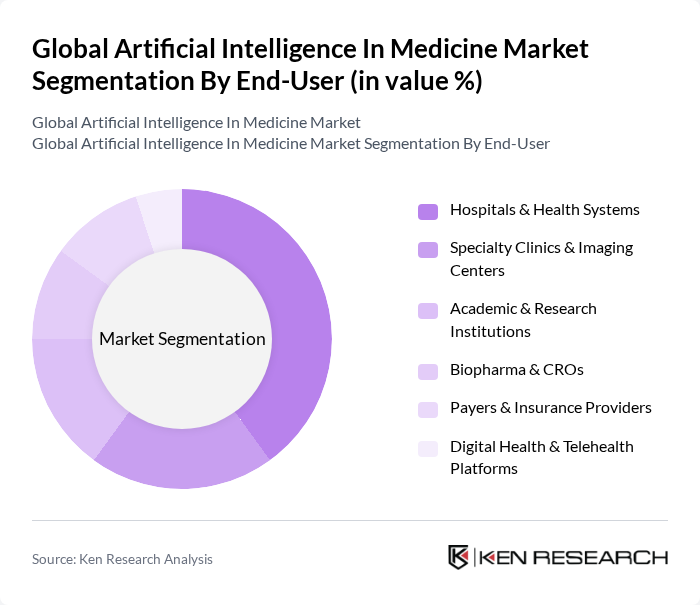
By End-User:The market is segmented by end-users, including Hospitals & Health Systems, Specialty Clinics & Imaging Centers, Academic & Research Institutions, Biopharma & CROs, Payers & Insurance Providers, and Digital Health & Telehealth Platforms. Hospitals & Health Systems are the dominant end-user segment, as they increasingly adopt AI solutions to improve patient care, streamline operations, and reduce costs .
The Global Artificial Intelligence In Medicine Market is characterized by a dynamic mix of regional and international players. Leading participants such as IBM Watson Health (Merative), Google Health (Google Cloud Healthcare & DeepMind), Siemens Healthineers, Philips Healthcare, GE HealthCare, Oracle Health (Cerner), Medtronic, NVIDIA, Microsoft (Azure for Healthcare), Tempus, Zebra Medical Vision (Nanox AI), Aidoc, PathAI, Babylon Health (defunct; legacy AI triage IP), Qventus contribute to innovation, geographic expansion, and service delivery in this space.
The future of AI in medicine is poised for transformative growth, driven by technological advancements and increasing healthcare demands. As AI systems become more sophisticated, their integration into clinical workflows will enhance diagnostic accuracy and patient management. Additionally, the focus on ethical AI practices will shape regulatory frameworks, ensuring patient safety and data integrity. Collaborations between healthcare providers and technology firms will further accelerate innovation, leading to more effective AI applications in medicine.
| Segment | Sub-Segments |
|---|---|
| By Type | AI for Diagnostics (Imaging, Pathology, ECG/EHR Algorithms) AI for Clinical Decision Support & Triage Predictive Analytics & Population Health AI in Medical Imaging & Radiology Workflow AI in Drug Discovery & Clinical Trials Optimization AI for Patient Management, Virtual Assistants & RPM AI for Administrative Automation (Coding, Billing, Scribing) |
| By End-User | Hospitals & Health Systems Specialty Clinics & Imaging Centers Academic & Research Institutions Biopharma & CROs Payers & Insurance Providers Digital Health & Telehealth Platforms |
| By Application | Radiology & Imaging Oncology Cardiology Neurology Precision/Personalized Medicine & Genomics Pathology & Laboratory Medicine |
| By Component | Software (Platforms, Models, NLP/CV/ML) Hardware (GPU/ASIC/FPGA, Edge Devices) Services (Deployment, Integration, Support) |
| By Sales Channel | Direct Enterprise Sales Channel Partners/Resellers & OEM Online/Marketplace |
| By Distribution Mode | On-Premises Cloud/SaaS |
| By Pricing Strategy | Per-Study/Per-Scan Pricing Subscription (Seat, Site, or Enterprise) Value-Based/Outcomes-Linked Pricing |
| Scope Item/Segment | Sample Size | Target Respondent Profiles |
|---|---|---|
| AI in Diagnostic Imaging | 120 | Radiologists, Imaging Technologists |
| AI for Predictive Analytics in Patient Care | 80 | Healthcare Data Analysts, Clinical Decision Makers |
| AI-Driven Telemedicine Solutions | 70 | Telehealth Coordinators, IT Managers |
| AI in Drug Discovery | 60 | Pharmaceutical Researchers, Biotech Executives |
| AI for Patient Management Systems | 90 | Healthcare Administrators, IT Directors |
The Global Artificial Intelligence in Medicine Market is valued at approximately USD 1819 billion, reflecting significant growth driven by advancements in AI technologies and increasing adoption across various healthcare applications, including diagnostics and clinical decision support.

What makes us stand out is that our consultants follow Robust, Refine and Result (RRR) methodology. Robust for clear definitions, approaches and sanity checking, Refine for differentiating respondents' facts and opinions, and Result for presenting data with story.

We have set a benchmark in the industry by offering our clients with syndicated and customized market research reports featuring coverage of entire market as well as meticulous research and analyst insights.

While we don't replace traditional research, we flip the method upside down. Our dual approach of Top Bottom & Bottom Top ensures quality deliverable by not just verifying company fundamentals but also looking at the sector and macroeconomic factors.

With one step in the future, our research team constantly tries to show you the bigger picture. We help with some of the tough questions you may encounter along the way: How is the industry positioned? Best marketing channel? KPI's of competitors? By aligning every element, we help maximize success.

Our report gives you instant access to the answers and sources that other companies might choose to hide. We elaborate each steps of research methodology we have used and showcase you the sample size to earn your trust.

If you need any support, we are here! We pride ourselves on universe strength, data quality, and quick, friendly, and professional service.













