About the Report
Base Year 2024Global Ascorbic Acid Market Overview
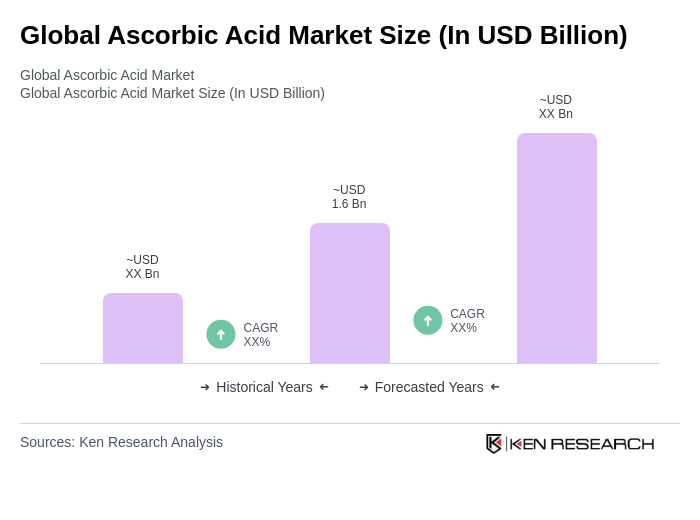
- The Global Ascorbic Acid Market is valued at USD 1.6 billion, based on a five-year historical analysis. Multiple industry sources position the market around the mid?USD one billion range, with recent assessments indicating values near the low?to?mid USD one billion level, supported by growth in fortified foods, supplements, and personal care applications .
- Key producers and consuming regions include China, the United States, and Germany. China maintains a dominant supply position due to large?scale, cost?efficient production and vertical integration, while the United States and Germany remain significant demand centers tied to advanced pharmaceutical, nutraceutical, and cosmetics industries that utilize vitamin C and its derivatives .
- The European Union framework governing food additives (including ascorbic acid, E300–E305) requires compliance with purity criteria and labeling under harmonized additive rules and specifications; ongoing application of these requirements ensures quality and consumer information across the bloc .
Global Ascorbic Acid Market Segmentation
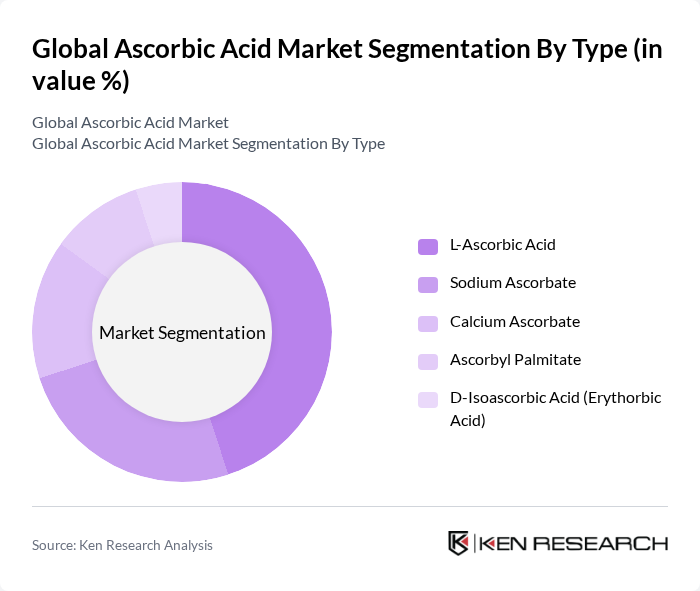
By Type:The ascorbic acid market is segmented into various types, including L-Ascorbic Acid, Sodium Ascorbate, Calcium Ascorbate, Ascorbyl Palmitate, and D-Isoascorbic Acid (Erythorbic Acid). Among these,L-Ascorbic Acidis the most widely used form due to its biological activity as vitamin C and effectiveness as an antioxidant; it is prevalent in food preservation and fortification and widely used in topical cosmetics for skin-brightening and anti?oxidative benefits .Sodium AscorbateandCalcium Ascorbateare buffered salts favored in pharmaceutical and supplement formulations for improved gastric tolerance and stability across dosage forms .
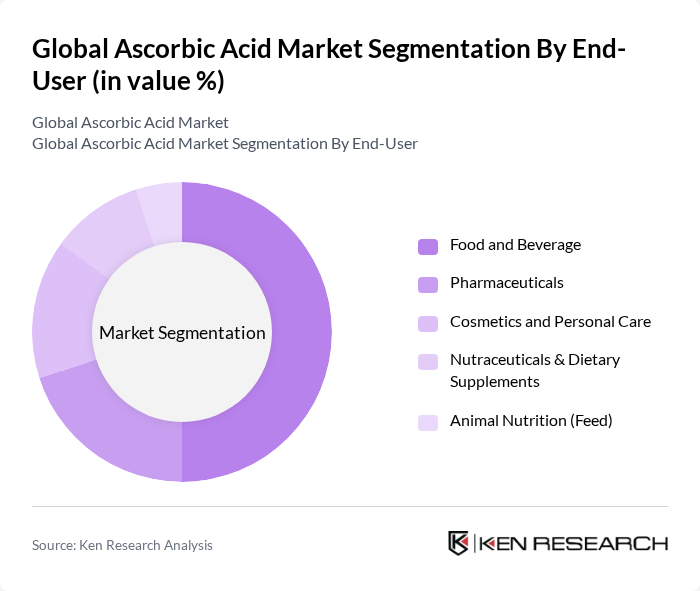
By End-User:The end-user segmentation of the ascorbic acid market includes Food and Beverage, Pharmaceuticals, Cosmetics and Personal Care, Nutraceuticals & Dietary Supplements, and Animal Nutrition (Feed). TheFood and Beveragesector holds the largest share, with usage as an antioxidant and preservative to control oxidation and preserve color, as well as for fortification in beverages and processed foods . ThePharmaceuticalsandNutraceuticals & Dietary Supplementssegments are significant due to widespread use for vitamin C deficiency management and preventive health, whileCosmetics and Personal Careleverages L?ascorbic acid and derivatives in topical formulations for stability and skin benefits .
Global Ascorbic Acid Market Competitive Landscape
The Global Ascorbic Acid Market is characterized by a dynamic mix of regional and international players. Leading participants such as dsm-firmenich, BASF SE, CSPC Pharmaceutical Group Limited (Hebei), Northeast Pharmaceutical Group Co., Ltd., Zhejiang NHU Co., Ltd., Zhejiang Medicine Co., Ltd. (Xinchang Pharmaceutical Factory), Shandong Luwei Pharmaceutical Co., Ltd., North China Pharmaceutical Group Corporation (NCPC), Anhui Tiger Biotech Co., Ltd., Shandong Tianli Pharmaceutical Co., Ltd., The Wright Group, Kemin Industries, Inc., Glanbia Nutritionals, Lonza Group Ltd., Merck KGaA contribute to innovation, geographic expansion, and service delivery in this space .
Global Ascorbic Acid Market Industry Analysis
Growth Drivers
- Increasing Demand for Nutritional Supplements:The global nutritional supplements market is projected to reach $278 billion in future, driven by a growing health-conscious population. In future, the demand for vitamin C supplements, particularly ascorbic acid, surged, with sales exceeding 1.5 billion units. This trend is supported by rising disposable incomes, particularly in regions like Asia-Pacific, where health awareness is increasing, leading to higher consumption of dietary supplements.
- Rising Awareness of Health Benefits:A significant increase in consumer awareness regarding the health benefits of ascorbic acid has been observed, with 70% of consumers in a recent survey acknowledging its role in immune support. The World Health Organization reported that vitamin C deficiency affects approximately 7% of the global population, further driving demand for fortified products. This awareness is particularly pronounced in North America and Europe, where health education campaigns are prevalent.
- Expanding Applications in Food and Beverage Industry:The food and beverage sector is increasingly incorporating ascorbic acid as a preservative and antioxidant. In future, the global food additives market was valued at $50 billion, with ascorbic acid accounting for a significant share. The trend towards clean-label products is pushing manufacturers to use natural preservatives, further enhancing the demand for ascorbic acid in various food applications, including beverages and processed foods.
Market Challenges
- Fluctuating Raw Material Prices:The price volatility of raw materials used in the production of ascorbic acid poses a significant challenge. In future, the cost of corn, a primary feedstock, increased by 15% due to adverse weather conditions affecting crop yields. This fluctuation impacts production costs, leading to potential price increases for consumers and reduced profit margins for manufacturers, complicating market dynamics.
- Stringent Regulatory Compliance:The ascorbic acid market faces challenges from stringent regulations imposed by food safety authorities. In future, the FDA updated its guidelines, requiring more rigorous testing and documentation for food additives. Compliance costs have risen, with companies spending an average of $200,000 annually to meet these standards. This regulatory burden can hinder market entry for smaller firms and increase operational costs for established players.
Global Ascorbic Acid Market Future Outlook
The future of the ascorbic acid market appears promising, driven by increasing consumer demand for health-oriented products and innovations in product formulations. The trend towards natural and organic ingredients is expected to shape product development, with manufacturers focusing on sustainable sourcing practices. Additionally, the growth of e-commerce platforms is likely to enhance product accessibility, allowing consumers to easily purchase ascorbic acid supplements and fortified foods, further expanding market reach.
Market Opportunities
- Expansion in Emerging Markets:Emerging markets, particularly in Asia and Africa, present significant growth opportunities for ascorbic acid. With a combined population exceeding 3 billion, these regions are witnessing rising health awareness and disposable incomes, leading to increased demand for nutritional supplements and fortified foods, which can drive market growth substantially.
- Innovations in Product Formulations:The development of innovative product formulations, such as effervescent tablets and functional beverages, is creating new avenues for ascorbic acid applications. Companies investing in R&D to create unique delivery methods are likely to capture a larger market share, appealing to health-conscious consumers seeking convenient and effective nutritional solutions.
Scope of the Report
| Segment | Sub-Segments |
|---|---|
| By Type | L-Ascorbic Acid Sodium Ascorbate Calcium Ascorbate Ascorbyl Palmitate D-Isoascorbic Acid (Erythorbic Acid) |
| By End-User | Food and Beverage Pharmaceuticals Cosmetics and Personal Care Nutraceuticals & Dietary Supplements Animal Nutrition (Feed) |
| By Application | Antioxidant Preservative Nutritional Fortification/Supplement Reducing & Flour Treatment Agent (Bakery/Meat Processing) Skin Care Active (Brightening/Anti-aging) |
| By Distribution Channel | Direct (B2B) Sales Distributors/Wholesalers Online (E-commerce/Marketplace) Retail & Specialty Stores |
| By Region | North America Europe Asia-Pacific Latin America Middle East & Africa |
| By Price Range | Economy Mid-Range Premium |
| By Packaging Type | Bulk Packaging (25 kg bags/drums) Retail Packaging (consumer formats) Liquid/Solution Formats |
Key Target Audience
Investors and Venture Capitalist Firms
Government and Regulatory Bodies (e.g., Food and Drug Administration, European Food Safety Authority)
Manufacturers and Producers
Distributors and Retailers
Pharmaceutical Companies
Food and Beverage Companies
Health and Wellness Product Companies
Financial Institutions
Players Mentioned in the Report:
dsm-firmenich
BASF SE
CSPC Pharmaceutical Group Limited (Hebei)
Northeast Pharmaceutical Group Co., Ltd.
Zhejiang NHU Co., Ltd.
Zhejiang Medicine Co., Ltd. (Xinchang Pharmaceutical Factory)
Shandong Luwei Pharmaceutical Co., Ltd.
North China Pharmaceutical Group Corporation (NCPC)
Anhui Tiger Biotech Co., Ltd.
Shandong Tianli Pharmaceutical Co., Ltd.
The Wright Group
Kemin Industries, Inc.
Glanbia Nutritionals
Lonza Group Ltd.
Merck KGaA
Table of Contents
Market Assessment Phase
1. Executive Summary and Approach
2. Global Ascorbic Acid Market Overview
2.1 Key Insights and Strategic Recommendations
2.2 Global Ascorbic Acid Market Overview
2.3 Definition and Scope
2.4 Evolution of Market Ecosystem
2.5 Timeline of Key Regulatory Milestones
2.6 Value Chain & Stakeholder Mapping
2.7 Business Cycle Analysis
2.8 Policy & Incentive Landscape
3. Global Ascorbic Acid Market Analysis
3.1 Growth Drivers
3.1.1 Increasing Demand for Nutritional Supplements
3.1.2 Rising Awareness of Health Benefits
3.1.3 Expanding Applications in Food and Beverage Industry
3.1.4 Growth in Cosmetic and Personal Care Products
3.2 Market Challenges
3.2.1 Fluctuating Raw Material Prices
3.2.2 Stringent Regulatory Compliance
3.2.3 Competition from Synthetic Alternatives
3.2.4 Supply Chain Disruptions
3.3 Market Opportunities
3.3.1 Expansion in Emerging Markets
3.3.2 Innovations in Product Formulations
3.3.3 Increasing Use in Functional Foods
3.3.4 Collaborations with Health Organizations
3.4 Market Trends
3.4.1 Shift Towards Natural and Organic Products
3.4.2 Growth of E-commerce Channels
3.4.3 Rising Popularity of Vegan and Vegetarian Products
3.4.4 Focus on Sustainable Sourcing
3.5 Government Regulation
3.5.1 Food Safety Standards
3.5.2 Labeling Requirements
3.5.3 Import and Export Regulations
3.5.4 Environmental Compliance Standards
4. SWOT Analysis
5. Stakeholder Analysis
6. Porter's Five Forces Analysis
7. Global Ascorbic Acid Market Market Size, 2019-2024
7.1 By Value
7.2 By Volume
7.3 By Average Selling Price
8. Global Ascorbic Acid Market Segmentation
8.1 By Type
8.1.1 L-Ascorbic Acid
8.1.2 Sodium Ascorbate
8.1.3 Calcium Ascorbate
8.1.4 Ascorbyl Palmitate
8.1.5 D-Isoascorbic Acid (Erythorbic Acid)
8.2 By End-User
8.2.1 Food and Beverage
8.2.2 Pharmaceuticals
8.2.3 Cosmetics and Personal Care
8.2.4 Nutraceuticals & Dietary Supplements
8.2.5 Animal Nutrition (Feed)
8.3 By Application
8.3.1 Antioxidant
8.3.2 Preservative
8.3.3 Nutritional Fortification/Supplement
8.3.4 Reducing & Flour Treatment Agent (Bakery/Meat Processing)
8.3.5 Skin Care Active (Brightening/Anti-aging)
8.4 By Distribution Channel
8.4.1 Direct (B2B) Sales
8.4.2 Distributors/Wholesalers
8.4.3 Online (E-commerce/Marketplace)
8.4.4 Retail & Specialty Stores
8.5 By Region
8.5.1 North America
8.5.2 Europe
8.5.3 Asia-Pacific
8.5.4 Latin America
8.5.5 Middle East & Africa
8.6 By Price Range
8.6.1 Economy
8.6.2 Mid-Range
8.6.3 Premium
8.7 By Packaging Type
8.7.1 Bulk Packaging (25 kg bags/drums)
8.7.2 Retail Packaging (consumer formats)
8.7.3 Liquid/Solution Formats
9. Global Ascorbic Acid Market Competitive Analysis
9.1 Market Share of Key Players
9.2 Cross Comparison of Key Players
9.2.1 Company Name
9.2.2 Production Capacity (MT/year)
9.2.3 Revenue from Ascorbic Acid/Vitamin C (latest FY)
9.2.4 Geographic Footprint (number of production sites/regions served)
9.2.5 Feedstock/Process Technology (Reichstein vs. two-step fermentation/biotech)
9.2.6 Average Selling Price Index (bulk crystalline, coated, DC grades)
9.2.7 Product Portfolio Breadth (pharma/food/cosmetic/feed grades, derivatives)
9.2.8 Certifications & Compliance (USP/EP/FCC, GMP, ISO, FSSC 22000)
9.2.9 Supply Chain Reliability (lead time, on-time delivery, vertical integration)
9.2.10 R&D/Innovation Intensity (patents, new formulations, stability tech)
9.2.11 Customer Mix (share of F&B, pharma, nutraceutical, feed)
9.2.12 ESG Metrics (energy intensity, emissions, waste reduction initiatives)
9.3 SWOT Analysis of Top Players
9.4 Pricing Analysis
9.5 Detailed Profile of Major Companies
9.5.1 dsm-firmenich
9.5.2 BASF SE
9.5.3 CSPC Pharmaceutical Group Limited (Hebei)
9.5.4 Northeast Pharmaceutical Group Co., Ltd.
9.5.5 Zhejiang NHU Co., Ltd.
9.5.6 Zhejiang Medicine Co., Ltd. (Xinchang Pharmaceutical Factory)
9.5.7 Shandong Luwei Pharmaceutical Co., Ltd.
9.5.8 North China Pharmaceutical Group Corporation (NCPC)
9.5.9 Anhui Tiger Biotech Co., Ltd.
9.5.10 Shandong Tianli Pharmaceutical Co., Ltd.
9.5.11 The Wright Group
9.5.12 Kemin Industries, Inc.
9.5.13 Glanbia Nutritionals
9.5.14 Lonza Group Ltd.
9.5.15 Merck KGaA
10. Global Ascorbic Acid Market End-User Analysis
10.1 Procurement Behavior of Key Ministries
10.1.1 Government Health Agencies
10.1.2 Food Safety Authorities
10.1.3 Regulatory Bodies
10.2 Corporate Spend on Infrastructure & Energy
10.2.1 Investment in Nutritional Products
10.2.2 Budget Allocation for Health Initiatives
10.2.3 Expenditure on Research and Development
10.3 Pain Point Analysis by End-User Category
10.3.1 Quality Assurance Issues
10.3.2 Supply Chain Reliability
10.3.3 Cost Management Challenges
10.4 User Readiness for Adoption
10.4.1 Awareness of Health Benefits
10.4.2 Availability of Products
10.4.3 Willingness to Pay
10.5 Post-Deployment ROI and Use Case Expansion
10.5.1 Measurement of Health Outcomes
10.5.2 Expansion into New Markets
10.5.3 Long-term Customer Engagement
11. Global Ascorbic Acid Market Future Size, 2025-2030
11.1 By Value
11.2 By Volume
11.3 By Average Selling Price
Go-To-Market Strategy Phase
1. Whitespace Analysis + Business Model Canvas
1.1 Market Gaps Identification
1.2 Value Proposition Development
1.3 Revenue Streams Analysis
1.4 Customer Segmentation
1.5 Key Partnerships
1.6 Cost Structure Analysis
1.7 Competitive Advantage
2. Marketing and Positioning Recommendations
2.1 Branding Strategies
2.2 Product USPs
2.3 Target Audience Identification
2.4 Communication Strategy
2.5 Digital Marketing Tactics
3. Distribution Plan
3.1 Urban Retail Strategies
3.2 Rural NGO Tie-ups
3.3 E-commerce Integration
3.4 Wholesale Partnerships
4. Channel & Pricing Gaps
4.1 Underserved Routes
4.2 Pricing Bands Analysis
4.3 Competitor Pricing Comparison
5. Unmet Demand & Latent Needs
5.1 Category Gaps
5.2 Consumer Segments Analysis
5.3 Product Development Opportunities
6. Customer Relationship
6.1 Loyalty Programs
6.2 After-sales Service
6.3 Customer Feedback Mechanisms
7. Value Proposition
7.1 Sustainability Initiatives
7.2 Integrated Supply Chains
7.3 Customer-Centric Innovations
8. Key Activities
8.1 Regulatory Compliance
8.2 Branding Efforts
8.3 Distribution Setup
9. Entry Strategy Evaluation
9.1 Domestic Market Entry Strategy
9.1.1 Product Mix Considerations
9.1.2 Pricing Band Strategy
9.1.3 Packaging Solutions
9.2 Export Entry Strategy
9.2.1 Target Countries Identification
9.2.2 Compliance Roadmap Development
10. Entry Mode Assessment
10.1 Joint Ventures
10.2 Greenfield Investments
10.3 Mergers & Acquisitions
10.4 Distributor Model Evaluation
11. Capital and Timeline Estimation
11.1 Capital Requirements
11.2 Timelines for Implementation
12. Control vs Risk Trade-Off
12.1 Ownership Considerations
12.2 Partnerships Evaluation
13. Profitability Outlook
13.1 Breakeven Analysis
13.2 Long-term Sustainability Strategies
14. Potential Partner List
14.1 Distributors
14.2 Joint Ventures
14.3 Acquisition Targets
15. Execution Roadmap
15.1 Phased Plan for Market Entry
15.1.1 Market Setup
15.1.2 Market Entry
15.1.3 Growth Acceleration
15.1.4 Scale & Stabilize
15.2 Key Activities and Milestones
15.2.1 Milestone Identification
15.2.2 Activity Scheduling
Research Methodology
Phase 1: Approach1
Desk Research
- Analysis of global trade statistics from the Food and Agriculture Organization (FAO)
- Review of industry reports from chemical associations and market research firms
- Examination of published articles and white papers on ascorbic acid applications and trends
Primary Research
- Interviews with key opinion leaders in the food and beverage industry
- Surveys targeting pharmaceutical manufacturers utilizing ascorbic acid
- Field interviews with suppliers and distributors of ascorbic acid
Validation & Triangulation
- Cross-validation of data from multiple sources including trade publications and market reports
- Triangulation of findings from primary interviews with secondary data insights
- Sanity checks through expert panels comprising industry veterans and analysts
Phase 2: Market Size Estimation1
Top-down Assessment
- Estimation of market size based on global consumption patterns of ascorbic acid
- Segmentation by application areas such as food preservation, pharmaceuticals, and cosmetics
- Incorporation of regional market dynamics and growth drivers
Bottom-up Modeling
- Collection of production data from major ascorbic acid manufacturers
- Estimation of market share based on sales volume and pricing strategies
- Analysis of import/export data to assess market penetration and demand
Forecasting & Scenario Analysis
- Utilization of time-series analysis to project future market trends
- Scenario modeling based on regulatory changes and health trends impacting demand
- Development of baseline, optimistic, and pessimistic forecasts through 2030
Phase 3: CATI Sample Composition1
| Scope Item/Segment | Sample Size | Target Respondent Profiles |
|---|---|---|
| Food and Beverage Manufacturers | 120 | Product Development Managers, Quality Assurance Specialists |
| Pharmaceutical Companies | 100 | Regulatory Affairs Managers, R&D Directors |
| Cosmetic Product Developers | 80 | Formulation Chemists, Brand Managers |
| Distributors and Suppliers | 70 | Sales Managers, Supply Chain Coordinators |
| Research Institutions | 60 | Research Scientists, Market Analysts |
Frequently Asked Questions
What is the current value of the Global Ascorbic Acid Market?
The Global Ascorbic Acid Market is valued at approximately USD 1.6 billion, based on a five-year historical analysis. Recent assessments indicate values near the low-to-mid USD one billion range, driven by growth in fortified foods, supplements, and personal care applications.
Which regions are the largest producers and consumers of ascorbic acid?
What are the main types of ascorbic acid available in the market?
What are the primary end-user segments for ascorbic acid?
Other Regional/Country Reports
Indonesia Ascorbic Acid Market
Malaysia Ascorbic Acid Market
APAC Ascorbic Acid Market
SEA Ascorbic Acid Market
Why Buy From Us?

What makes us stand out is that our consultants follow Robust, Refine and Result (RRR) methodology. Robust for clear definitions, approaches and sanity checking, Refine for differentiating respondents' facts and opinions, and Result for presenting data with story.

We have set a benchmark in the industry by offering our clients with syndicated and customized market research reports featuring coverage of entire market as well as meticulous research and analyst insights.

While we don't replace traditional research, we flip the method upside down. Our dual approach of Top Bottom & Bottom Top ensures quality deliverable by not just verifying company fundamentals but also looking at the sector and macroeconomic factors.

With one step in the future, our research team constantly tries to show you the bigger picture. We help with some of the tough questions you may encounter along the way: How is the industry positioned? Best marketing channel? KPI's of competitors? By aligning every element, we help maximize success.

Our report gives you instant access to the answers and sources that other companies might choose to hide. We elaborate each steps of research methodology we have used and showcase you the sample size to earn your trust.

If you need any support, we are here! We pride ourselves on universe strength, data quality, and quick, friendly, and professional service.