About the Report
Base Year 2024Listen to the audio summary
Global Automated Poultry Farm Market Overview
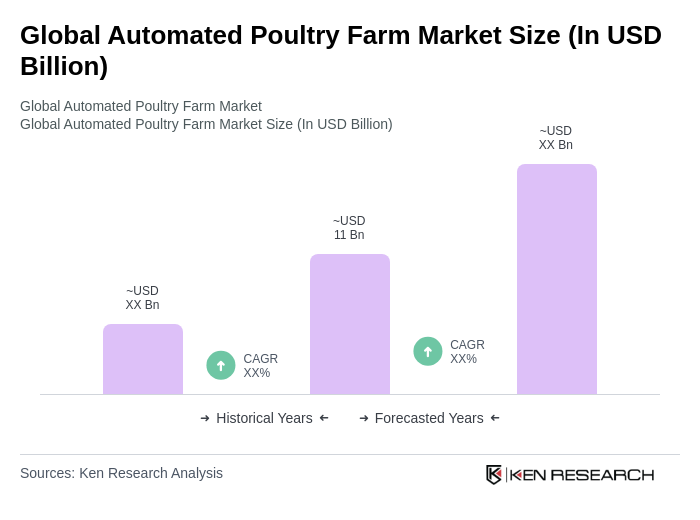
- The Global Automated Poultry Farm Market is valued at USD 11 billion, based on a five-year historical analysis. This growth is primarily driven by the increasing demand for poultry products, advancements in automation technology, and the need for efficient farm management practices. The integration of IoT and AI technologies in poultry farming has significantly enhanced productivity and operational efficiency, leading to a surge in market value.
- Countries such as the United States, China, and Brazil dominate the Global Automated Poultry Farm Market due to their large-scale poultry production and consumption. The U.S. benefits from advanced agricultural practices and technology adoption, while China and Brazil have substantial investments in poultry infrastructure, making them key players in the global market.
- In 2023, the European Union implemented regulations aimed at enhancing animal welfare standards in poultry farming. This includes mandatory compliance with biosecurity measures and improved living conditions for poultry, which has led to increased operational costs for farmers but is expected to enhance product quality and consumer trust in the long run.
Global Automated Poultry Farm Market Segmentation
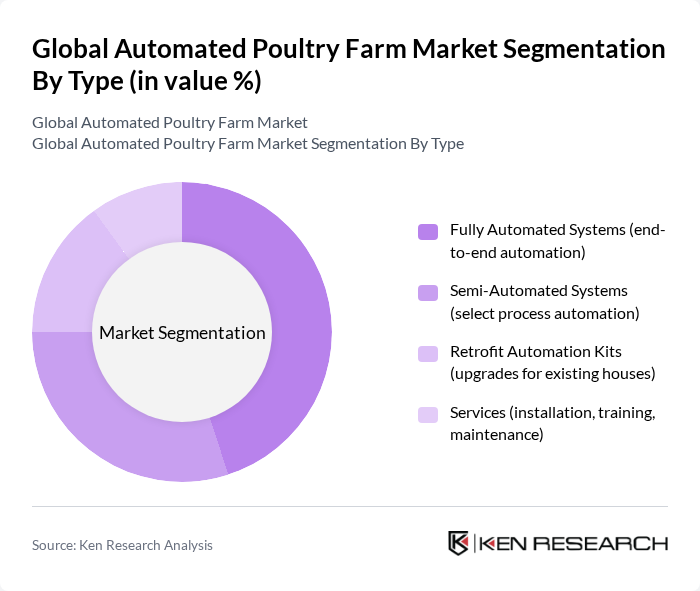
By Type:The market is segmented into Fully Automated Systems, Semi-Automated Systems, Retrofit Automation Kits, and Services. Fully Automated Systems are gaining traction due to their ability to streamline operations and reduce labor costs, supported by integrated AI/IoT controls and robotics for climate, feeding, and egg handling. Semi-Automated Systems cater to farms seeking a balance between automation and manual processes for specific tasks like feeding or ventilation control. Retrofit Automation Kits are popular among existing farms seeking upgrades to legacy houses without full rebuilds, covering sensors, controllers, and motorized mechanisms, while Services encompass installation, training, preventive maintenance, and software updates to ensure uptime and performance of automated systems.
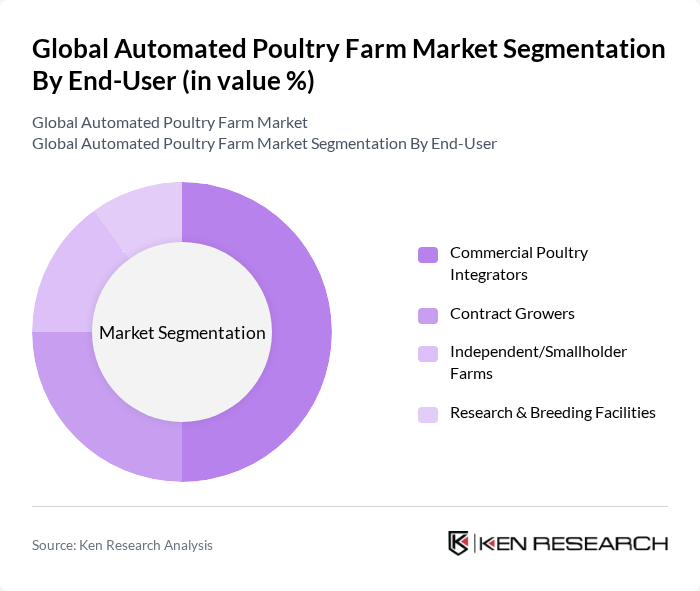
By End-User:The end-user segmentation includes Commercial Poultry Integrators, Contract Growers, Independent/Smallholder Farms, and Research & Breeding Facilities. Commercial Poultry Integrators dominate the market due to their large-scale operations and significant investments in automation technologies. Contract Growers are increasingly adopting automated solutions to meet the demands of integrators. Independent farms are gradually transitioning to automation, while research facilities focus on developing innovative solutions for the industry.
Global Automated Poultry Farm Market Competitive Landscape
The Global Automated Poultry Farm Market is characterized by a dynamic mix of regional and international players. Leading participants such as Big Dutchman, Vencomatic Group, Chore-Time (CTB Inc., a Berkshire Hathaway company), Jansen Poultry Equipment, Facco, Petersime, Jamesway Incubator Company, Roxell (CTB Inc.), Lubing Maschinenfabrik, SKA Poultry Equipment, Farmer Automatic (Big Dutchman Group), Predicta GUARD (Poultry Sense / MSD Animal Health Intelligence), Munters (climate control), Cumberland (CTB Inc.), Yangzhou LiVi Machinery contribute to innovation, geographic expansion, and service delivery in this space.
Global Automated Poultry Farm Market Industry Analysis
Growth Drivers
- Increasing Demand for Poultry Products:The global poultry meat consumption reached approximately 136 million metric tons in future, driven by rising populations and changing dietary preferences. The World Bank projects that by future, poultry demand will increase by 2.6% annually, particularly in developing regions. This surge in demand necessitates efficient production methods, propelling the adoption of automated poultry farming technologies to meet consumer needs while ensuring quality and safety standards.
- Technological Advancements in Automation:The automation technology market in agriculture is expected to reach $13 billion by future, with poultry farming being a significant contributor. Innovations such as robotics, AI, and machine learning enhance operational efficiency and productivity. For instance, automated feeding systems can reduce feed waste by up to 21%, directly impacting profitability. These advancements are crucial for poultry farms aiming to optimize their operations and reduce labor dependency.
- Rising Labor Costs:Labor costs in agriculture have risen significantly, with average hourly wages for farm workers in the U.S. reaching $16.00 in future. This trend is mirrored globally, prompting poultry producers to seek automation solutions to mitigate labor expenses. By investing in automated systems, farms can reduce labor needs by up to 31%, allowing them to allocate resources more effectively and maintain competitive pricing in the market.
Market Challenges
- High Initial Investment Costs:The upfront costs for implementing automated poultry farming systems can exceed $510,000, depending on the scale and technology used. This financial barrier can deter small to medium-sized farms from adopting automation. Additionally, the return on investment may take several years, making it a challenging decision for many producers who are hesitant to commit significant capital without guaranteed short-term benefits.
- Regulatory Compliance Issues:The poultry industry faces stringent regulations regarding animal welfare and food safety, which can complicate the implementation of automated systems. Compliance with these regulations often requires additional investments in technology and training. For example, the European Union's regulations mandate specific welfare standards that automated systems must meet, potentially increasing operational costs and complicating the integration of new technologies.
Global Automated Poultry Farm Market Future Outlook
The future of automated poultry farming is poised for significant transformation, driven by technological innovations and evolving consumer preferences. As farms increasingly adopt smart farming practices, the integration of IoT and data analytics will enhance operational efficiency and decision-making. Furthermore, the focus on sustainability will lead to the development of eco-friendly automated solutions, ensuring that poultry production meets both market demands and environmental standards. This evolution will likely reshape the industry landscape, fostering growth and resilience.
Market Opportunities
- Expansion into Emerging Markets:Emerging markets, particularly in Asia and Africa, are experiencing rapid urbanization and rising incomes, leading to increased poultry consumption. By future, these regions are expected to account for over 41% of global poultry demand. This presents a significant opportunity for automated poultry farming solutions to cater to the growing market while improving production efficiency and food security.
- Integration of IoT in Poultry Farming:The Internet of Things (IoT) is revolutionizing poultry farming by enabling real-time monitoring and data collection. By future, the IoT in agriculture market is projected to reach $21 billion. Implementing IoT solutions can enhance biosecurity measures and optimize resource management, providing farmers with actionable insights to improve productivity and reduce operational costs.
Scope of the Report
| Segment | Sub-Segments |
|---|---|
| By Type | Fully Automated Systems (end-to-end automation) Semi-Automated Systems (select process automation) Retrofit Automation Kits (upgrades for existing houses) Services (installation, training, maintenance) |
| By End-User | Commercial Poultry Integrators Contract Growers Independent/Smallholder Farms Research & Breeding Facilities |
| By Region | North America Europe Asia-Pacific Latin America Middle East & Africa |
| By Technology | Automated Feeding & Watering Systems Climate & Ventilation Control Egg Collection, Nesting & Grading Waste/Manure Handling & Litter Management Robotics (e.g., floor robots, mortality removal) IoT Sensors & Farm Management Software (AI/ML analytics) |
| By Application | Broilers (meat production) Layers (table eggs) Breeders (parent & grandparent stock) Hatcheries (incubation & hatching automation) |
| By Investment Source | Private Investments Government Funding Multilateral/Development Finance Co-ops & Producer Associations |
| By Policy Support | Grants and Subsidies Tax Incentives Research and Development Support Animal Welfare & Biosecurity Compliance Programs |
Key Target Audience
Investors and Venture Capitalist Firms
Government and Regulatory Bodies (e.g., Food and Agriculture Organization, U.S. Department of Agriculture)
Poultry Farm Operators and Owners
Equipment Manufacturers and Suppliers
Agri-tech Startups and Innovators
Logistics and Supply Chain Companies
Animal Health and Nutrition Companies
Trade Associations and Industry Groups
Players Mentioned in the Report:
Big Dutchman
Vencomatic Group
Chore-Time (CTB Inc., a Berkshire Hathaway company)
Jansen Poultry Equipment
Facco
Petersime
Jamesway Incubator Company
Roxell (CTB Inc.)
Lubing Maschinenfabrik
SKA Poultry Equipment
Farmer Automatic (Big Dutchman Group)
Predicta GUARD (Poultry Sense / MSD Animal Health Intelligence)
Munters (climate control)
Cumberland (CTB Inc.)
Yangzhou LiVi Machinery
Table of Contents
Market Assessment Phase
1. Executive Summary and Approach
2. Global Automated Poultry Farm Market Overview
2.1 Key Insights and Strategic Recommendations
2.2 Global Automated Poultry Farm Market Overview
2.3 Definition and Scope
2.4 Evolution of Market Ecosystem
2.5 Timeline of Key Regulatory Milestones
2.6 Value Chain & Stakeholder Mapping
2.7 Business Cycle Analysis
2.8 Policy & Incentive Landscape
3. Global Automated Poultry Farm Market Analysis
3.1 Growth Drivers
3.1.1 Increasing Demand for Poultry Products
3.1.2 Technological Advancements in Automation
3.1.3 Rising Labor Costs
3.1.4 Enhanced Biosecurity Measures
3.2 Market Challenges
3.2.1 High Initial Investment Costs
3.2.2 Regulatory Compliance Issues
3.2.3 Limited Awareness of Automation Benefits
3.2.4 Supply Chain Disruptions
3.3 Market Opportunities
3.3.1 Expansion into Emerging Markets
3.3.2 Integration of IoT in Poultry Farming
3.3.3 Sustainable Farming Practices
3.3.4 Customization of Automated Solutions
3.4 Market Trends
3.4.1 Shift Towards Smart Farming
3.4.2 Increasing Focus on Animal Welfare
3.4.3 Adoption of Data Analytics
3.4.4 Growth of Vertical Farming
3.5 Government Regulation
3.5.1 Animal Welfare Regulations
3.5.2 Environmental Protection Standards
3.5.3 Food Safety Regulations
3.5.4 Subsidies for Automation Technologies
4. SWOT Analysis
5. Stakeholder Analysis
6. Porter's Five Forces Analysis
7. Global Automated Poultry Farm Market Market Size, 2019-2024
7.1 By Value
7.2 By Volume
7.3 By Average Selling Price
8. Global Automated Poultry Farm Market Segmentation
8.1 By Type
8.1.1 Fully Automated Systems (end-to-end automation)
8.1.2 Semi-Automated Systems (select process automation)
8.1.3 Retrofit Automation Kits (upgrades for existing houses)
8.1.4 Services (installation, training, maintenance)
8.2 By End-User
8.2.1 Commercial Poultry Integrators
8.2.2 Contract Growers
8.2.3 Independent/Smallholder Farms
8.2.4 Research & Breeding Facilities
8.3 By Region
8.3.1 North America
8.3.2 Europe
8.3.3 Asia-Pacific
8.3.4 Latin America
8.3.5 Middle East & Africa
8.4 By Technology
8.4.1 Automated Feeding & Watering Systems
8.4.2 Climate & Ventilation Control
8.4.3 Egg Collection, Nesting & Grading
8.4.4 Waste/Manure Handling & Litter Management
8.4.5 Robotics (e.g., floor robots, mortality removal)
8.4.6 IoT Sensors & Farm Management Software (AI/ML analytics)
8.5 By Application
8.5.1 Broilers (meat production)
8.5.2 Layers (table eggs)
8.5.3 Breeders (parent & grandparent stock)
8.5.4 Hatcheries (incubation & hatching automation)
8.6 By Investment Source
8.6.1 Private Investments
8.6.2 Government Funding
8.6.3 Multilateral/Development Finance
8.6.4 Co-ops & Producer Associations
8.7 By Policy Support
8.7.1 Grants and Subsidies
8.7.2 Tax Incentives
8.7.3 Research and Development Support
8.7.4 Animal Welfare & Biosecurity Compliance Programs
9. Global Automated Poultry Farm Market Competitive Analysis
9.1 Market Share of Key Players
9.2 Cross Comparison of Key Players
9.2.1 Company Name (equipment/software/service scope)
9.2.2 Scale Tier (Global, Regional, Niche)
9.2.3 Revenue from Poultry Automation (latest FY, USD)
9.2.4 Installed Base / Houses Equipped (units)
9.2.5 Geographic Footprint (countries served)
9.2.6 Product Breadth (feeding, climate, egg, robotics, software)
9.2.7 Innovation Pipeline (patents/new launches per year)
9.2.8 Integration & Interoperability (open protocols/IoT compatibility)
9.2.9 After-sales Network (service technicians, response SLAs)
9.2.10 Customer Mix (integrators vs. independent farms)
9.2.11 Average Payback Period for Customers (months)
9.2.12 Pricing Model (CAPEX, leasing, subscription software)
9.3 SWOT Analysis of Top Players
9.4 Pricing Analysis
9.5 Detailed Profile of Major Companies
9.5.1 Big Dutchman
9.5.2 Vencomatic Group
9.5.3 Chore-Time (CTB Inc., a Berkshire Hathaway company)
9.5.4 Jansen Poultry Equipment
9.5.5 Facco
9.5.6 Petersime
9.5.7 Jamesway Incubator Company
9.5.8 Roxell (CTB Inc.)
9.5.9 Lubing Maschinenfabrik
9.5.10 SKA Poultry Equipment
9.5.11 Farmer Automatic (Big Dutchman Group)
9.5.12 Predicta GUARD (Poultry Sense / MSD Animal Health Intelligence)
9.5.13 Munters (climate control)
9.5.14 Cumberland (CTB Inc.)
9.5.15 Yangzhou LiVi Machinery
10. Global Automated Poultry Farm Market End-User Analysis
10.1 Procurement Behavior of Key Ministries
10.1.1 Government Procurement Policies
10.1.2 Budget Allocations for Poultry Automation
10.1.3 Collaboration with Private Sector
10.2 Corporate Spend on Infrastructure & Energy
10.2.1 Investment in Automation Technologies
10.2.2 Energy Efficiency Initiatives
10.2.3 Infrastructure Development Plans
10.3 Pain Point Analysis by End-User Category
10.3.1 Cost Management Challenges
10.3.2 Technology Integration Issues
10.3.3 Labor Shortages
10.4 User Readiness for Adoption
10.4.1 Awareness of Automation Benefits
10.4.2 Training and Skill Development Needs
10.4.3 Financial Readiness
10.5 Post-Deployment ROI and Use Case Expansion
10.5.1 Measurement of ROI
10.5.2 Expansion into New Use Cases
10.5.3 Long-term Sustainability Considerations
11. Global Automated Poultry Farm Market Future Size, 2025-2030
11.1 By Value
11.2 By Volume
11.3 By Average Selling Price
Go-To-Market Strategy Phase
1. Whitespace Analysis + Business Model Canvas
1.1 Market Gaps Identification
1.2 Business Model Development
2. Marketing and Positioning Recommendations
2.1 Branding Strategies
2.2 Product USPs
3. Distribution Plan
3.1 Urban Retail Strategies
3.2 Rural NGO Tie-ups
4. Channel & Pricing Gaps
4.1 Underserved Routes
4.2 Pricing Bands Analysis
5. Unmet Demand & Latent Needs
5.1 Category Gaps
5.2 Consumer Segments
6. Customer Relationship
6.1 Loyalty Programs
6.2 After-sales Service
7. Value Proposition
7.1 Sustainability Initiatives
7.2 Integrated Supply Chains
8. Key Activities
8.1 Regulatory Compliance
8.2 Branding Efforts
8.3 Distribution Setup
9. Entry Strategy Evaluation
9.1 Domestic Market Entry Strategy
9.1.1 Product Mix Considerations
9.1.2 Pricing Band Strategy
9.1.3 Packaging Solutions
9.2 Export Entry Strategy
9.2.1 Target Countries Identification
9.2.2 Compliance Roadmap Development
10. Entry Mode Assessment
10.1 Joint Ventures
10.2 Greenfield Investments
10.3 Mergers & Acquisitions
10.4 Distributor Model Evaluation
11. Capital and Timeline Estimation
11.1 Capital Requirements
11.2 Timelines for Implementation
12. Control vs Risk Trade-Off
12.1 Ownership Considerations
12.2 Partnerships Evaluation
13. Profitability Outlook
13.1 Breakeven Analysis
13.2 Long-term Sustainability Strategies
14. Potential Partner List
14.1 Distributors
14.2 Joint Ventures
14.3 Acquisition Targets
15. Execution Roadmap
15.1 Phased Plan for Market Entry
15.1.1 Market Setup
15.1.2 Market Entry
15.1.3 Growth Acceleration
15.1.4 Scale & Stabilize
15.2 Key Activities and Milestones
15.2.1 Milestone Planning
15.2.2 Activity Tracking
Research Methodology
Phase 1: Approach1
Desk Research
- Industry reports from agricultural and poultry associations
- Market analysis publications from agricultural technology journals
- Government publications on poultry farming regulations and trends
Primary Research
- Interviews with farm owners utilizing automated poultry systems
- Surveys with technology providers in the poultry automation sector
- Field visits to automated poultry farms for observational insights
Validation & Triangulation
- Cross-validation of data from multiple industry sources and reports
- Triangulation of insights from primary interviews and secondary data
- Sanity checks through expert panels comprising industry veterans
Phase 2: Market Size Estimation1
Top-down Assessment
- Analysis of global poultry production statistics and automation adoption rates
- Segmentation of market size by geographic regions and poultry types
- Incorporation of trends in consumer demand for automated poultry products
Bottom-up Modeling
- Estimation of market size based on the number of automated farms and their capacities
- Cost analysis of automation technologies and their market penetration
- Volume x price basis for different automation solutions in poultry farming
Forecasting & Scenario Analysis
- Multi-factor regression analysis considering technological advancements and labor costs
- Scenario modeling based on regulatory changes and market dynamics
- Baseline, optimistic, and pessimistic forecasts through 2030
Phase 3: CATI Sample Composition1
| Scope Item/Segment | Sample Size | Target Respondent Profiles |
|---|---|---|
| Automated Poultry Farm Owners | 120 | Poultry Farm Operators, Business Owners |
| Poultry Equipment Manufacturers | 90 | Product Managers, Sales Directors |
| Agricultural Technology Consultants | 70 | Consultants, Industry Analysts |
| Veterinary Experts in Poultry | 60 | Veterinarians, Animal Health Specialists |
| Regulatory Bodies and Associations | 50 | Policy Makers, Regulatory Officers |
Frequently Asked Questions
What is the current value of the Global Automated Poultry Farm Market?
The Global Automated Poultry Farm Market is valued at approximately USD 11 billion, reflecting significant growth driven by increasing poultry product demand, advancements in automation technology, and the integration of IoT and AI in farm management practices.
Which countries are leading in the Global Automated Poultry Farm Market?
What are the main types of automated poultry systems available?
What are the key growth drivers for the automated poultry farm market?
Other Regional/Country Reports
Indonesia Automated Poultry Farm Market
Malaysia Automated Poultry Farm Market
APAC Automated Poultry Farm Market
SEA Automated Poultry Farm Market
Why Buy From Us?

What makes us stand out is that our consultants follow Robust, Refine and Result (RRR) methodology. Robust for clear definitions, approaches and sanity checking, Refine for differentiating respondents' facts and opinions, and Result for presenting data with story.

We have set a benchmark in the industry by offering our clients with syndicated and customized market research reports featuring coverage of entire market as well as meticulous research and analyst insights.

While we don't replace traditional research, we flip the method upside down. Our dual approach of Top Bottom & Bottom Top ensures quality deliverable by not just verifying company fundamentals but also looking at the sector and macroeconomic factors.

With one step in the future, our research team constantly tries to show you the bigger picture. We help with some of the tough questions you may encounter along the way: How is the industry positioned? Best marketing channel? KPI's of competitors? By aligning every element, we help maximize success.

Our report gives you instant access to the answers and sources that other companies might choose to hide. We elaborate each steps of research methodology we have used and showcase you the sample size to earn your trust.

If you need any support, we are here! We pride ourselves on universe strength, data quality, and quick, friendly, and professional service.