














Region:Global
Author(s):Dev
Product Code:KRAC0333
Pages:99
Published On:August 2025

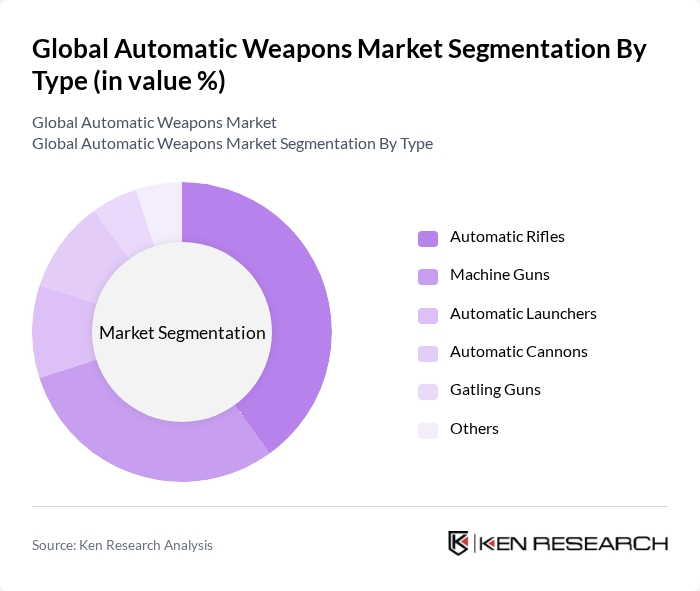
By Type:The market is segmented into various types of automatic weapons, including Automatic Rifles, Machine Guns, Automatic Launchers, Automatic Cannons, Gatling Guns, and Others. Among these, Automatic Rifles and Machine Guns are the most prominent subsegments, driven by their widespread use in military and law enforcement applications. The demand for these weapons is influenced by their effectiveness in combat situations and the ongoing modernization of armed forces. Recent trends show increased adoption of modular automatic rifles and remote-operated machine guns, reflecting a shift toward enhanced versatility and operator safety.
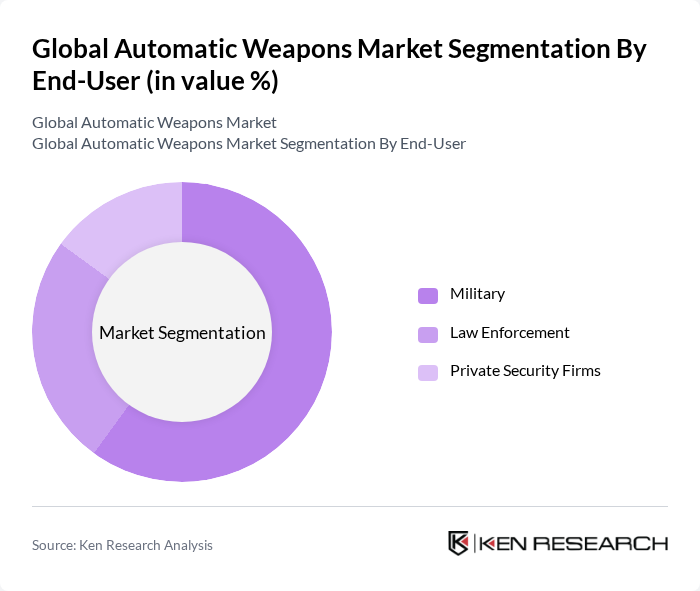
By End-User:The market is categorized into Military, Law Enforcement, and Private Security Firms. The Military segment holds the largest share due to the continuous need for advanced weaponry in defense operations. Law enforcement agencies also contribute significantly to the market, driven by the need for effective tools to combat crime and terrorism. The Private Security Firms segment is growing as security concerns rise globally. Military procurement is further accelerated by modernization programs and cross-border conflict escalation, while law enforcement agencies increasingly deploy automatic weapons for counter-terrorism and urban security operations.
The Global Automatic Weapons Market is characterized by a dynamic mix of regional and international players. Leading participants such as Lockheed Martin Corporation, Northrop Grumman Corporation, BAE Systems plc, General Dynamics Corporation, Rheinmetall AG, Thales Group, Leonardo S.p.A., FN Herstal, Heckler & Koch GmbH, Colt's Manufacturing Company LLC, Israel Weapon Industries (IWI), SIG Sauer GmbH & Co. KG, Beretta Holding S.p.A., ?eská zbrojovka Group (CZG), Zastava Arms contribute to innovation, geographic expansion, and service delivery in this space. These companies are actively investing in R&D for next-generation weapon systems, modular platforms, and AI-enabled targeting solutions, further driving competitive differentiation and market growth.
The future of the automatic weapons market is poised for transformation, driven by technological advancements and evolving defense strategies. As nations increasingly prioritize modernization, the integration of artificial intelligence and smart technologies into weapon systems will become prevalent. Additionally, the rise of private military contractors is expected to reshape procurement dynamics, creating new avenues for growth. The focus on cybersecurity in defense will also influence the development of automatic weapons, ensuring they meet contemporary security challenges while enhancing operational effectiveness.
| Segment | Sub-Segments |
|---|---|
| By Type | Automatic Rifles Machine Guns Automatic Launchers Automatic Cannons Gatling Guns Others |
| By End-User | Military Law Enforcement Private Security Firms |
| By Application | Combat Operations Training and Simulation Security Operations Research and Development |
| By Distribution Channel | Direct Sales Distributors Government Contracts |
| By Region | North America Europe Asia-Pacific Latin America Middle East & Africa |
| By Caliber | Small Caliber Medium Caliber Large Caliber |
| By Technology | Conventional Weapons Smart Weapons Modular Weapons Systems Others |
| Scope Item/Segment | Sample Size | Target Respondent Profiles |
|---|---|---|
| Military Procurement Departments | 100 | Procurement Officers, Defense Budget Analysts |
| Defense Manufacturers | 70 | Product Managers, Sales Directors |
| Military Analysts and Consultants | 50 | Defense Analysts, Strategic Planners |
| Government Defense Agencies | 60 | Policy Makers, Regulatory Officials |
| Industry Experts and Academics | 40 | Research Scholars, Defense Studies Professors |
The Global Automatic Weapons Market is valued at approximately USD 8.3 billion, reflecting a significant increase driven by rising military expenditures, geopolitical tensions, and advancements in weapon technology over the past five years.

What makes us stand out is that our consultants follow Robust, Refine and Result (RRR) methodology. Robust for clear definitions, approaches and sanity checking, Refine for differentiating respondents' facts and opinions, and Result for presenting data with story.

We have set a benchmark in the industry by offering our clients with syndicated and customized market research reports featuring coverage of entire market as well as meticulous research and analyst insights.

While we don't replace traditional research, we flip the method upside down. Our dual approach of Top Bottom & Bottom Top ensures quality deliverable by not just verifying company fundamentals but also looking at the sector and macroeconomic factors.

With one step in the future, our research team constantly tries to show you the bigger picture. We help with some of the tough questions you may encounter along the way: How is the industry positioned? Best marketing channel? KPI's of competitors? By aligning every element, we help maximize success.

Our report gives you instant access to the answers and sources that other companies might choose to hide. We elaborate each steps of research methodology we have used and showcase you the sample size to earn your trust.

If you need any support, we are here! We pride ourselves on universe strength, data quality, and quick, friendly, and professional service.