Ken Research Logo

Global Automotive Automated Parking System Market

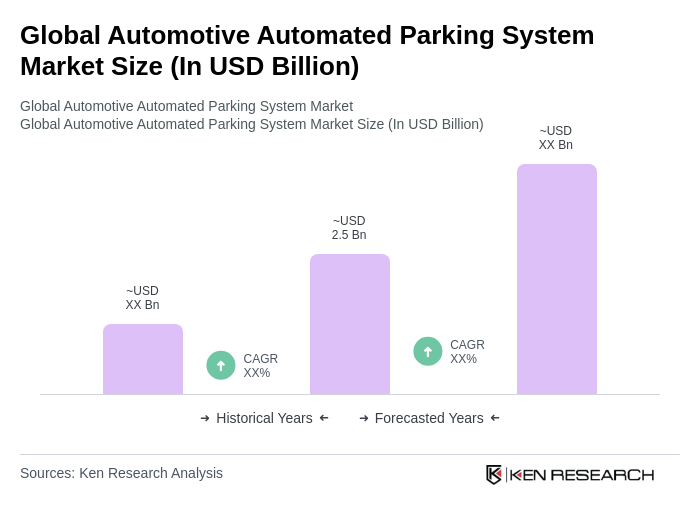
The Global Automotive Automated Parking System Market, valued at USD 2.5 Bn, grows with urban density and tech innovations in AI and robotics for smart parking.

Region:Global

Author(s):Shubham

Product Code:KRAD0820

Pages:80

Published On:August 2025
About the Report

Base Year 2024

Global Automotive Automated Parking System Market Overview

  • The Global Automotive Automated Parking System Market is valued at USD 2.5 billion, based on a five-year historical analysis. This growth is driven by increasing urban vehicle density, shrinking parking spaces, and the need for efficient space utilization in densely populated areas. The adoption of automated parking systems is further propelled by smart city initiatives, sustainability goals, and advancements in robotics and AI-based slot management, making these systems a preferred choice for urban planners and developers.
  • Key players in this market include countries likethe United States, Germany, and Japan, which dominate due to their robust automotive industries and technological leadership. These nations have invested significantly in infrastructure and smart city projects, fostering an environment conducive to the growth of automated parking solutions. The presence of major automotive manufacturers and technology firms in these regions further strengthens their market leadership.
  • TheEuropean Union Regulation (EU) 2023/1230issued by the European Commission in 2023 mandates the integration of automated parking systems in new urban developments. This regulation requires developers to allocate a minimum of 10% of parking spaces for automated systems in projects exceeding 100 parking slots. The initiative aims to enhance urban mobility, reduce congestion, and promote sustainable development across member states.
Global Automotive Automated Parking System Market Size

Global Automotive Automated Parking System Market Segmentation

By System Type:The market is segmented into Fully Automated Parking Systems, Semi-Automated Parking Systems, Puzzle Parking Systems, Tower Parking Systems, Shuttle Parking Systems, and Others.Fully Automated Parking Systemsare gaining significant traction due to their high efficiency, space-saving vertical stacking, and seamless integration with smart building technologies. These systems are increasingly preferred in premium residential and commercial developments, where maximizing usable space and operational convenience are critical.

Global Automotive Automated Parking System Market segmentation by System Type.

By End-User:The end-user segmentation includes Residential, Commercial, Industrial, and Government & Utilities. TheCommercial segmentleads the market, driven by the proliferation of shopping malls, airports, and corporate offices that require advanced parking solutions to manage high traffic volumes and optimize land use. The rise of mixed-use developments and premium office complexes further accelerates demand in this segment.
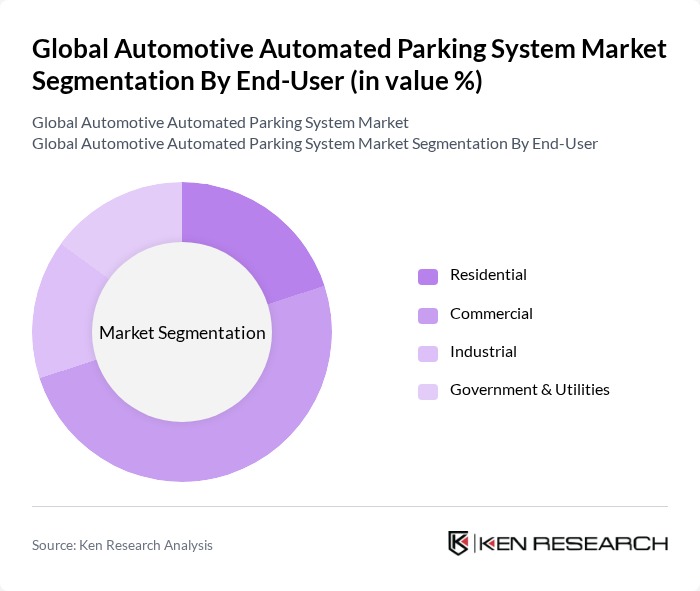
Global Automotive Automated Parking System Market segmentation by End-User.

Global Automotive Automated Parking System Market Competitive Landscape

The Global Automotive Automated Parking System Market is characterized by a dynamic mix of regional and international players. Leading participants such as Siemens AG, Bosch Mobility Solutions, ParkPlus Inc., Robotic Parking Systems, Inc., Automated Parking Technologies, Westfalia Technologies, Inc., CityLift Parking, Klaus Multiparking GmbH, Parkmatic, Wohr Parking Systems Pvt. Ltd., Skyline Parking AG, Unitronics, AutoMotion Parking Systems, IHI Corporation, Amano Corporation contribute to innovation, geographic expansion, and service delivery in this space.

Siemens AG

1847

Munich, Germany

Bosch Mobility Solutions

1886

Gerlingen, Germany

ParkPlus Inc.

2005

New York, USA

Robotic Parking Systems, Inc.

2002

Miami, USA

Automated Parking Technologies

2010

Los Angeles, USA

Company

Establishment Year

Headquarters

Group Size (Large, Medium, or Small as per industry convention)

Revenue Growth Rate (YoY %)

Market Share (%)

Geographic Footprint (Number of Countries/Regions Served)

Number of Installed Parking Spaces (Annual/Total)

R&D Investment (% of Revenue)

Global Automotive Automated Parking System Market Industry Analysis

Growth Drivers

  • Increasing Urbanization:Urbanization is accelerating globally, with the United Nations projecting that in future, approximately 56% of the world's population will reside in urban areas, up from about 54% in previous years. This shift necessitates innovative parking solutions to accommodate the growing number of vehicles. Cities are increasingly adopting automated parking systems to maximize space efficiency, reduce congestion, and enhance urban mobility. For instance, cities like Tokyo and San Francisco are investing heavily in smart parking technologies to address these challenges.
  • Demand for Space Optimization:As urban land becomes scarcer, the demand for space optimization in parking solutions is surging. According to the World Bank, urban land prices have increased significantly in major cities in recent years, though a specific figure over five years cannot be confirmed. Automated parking systems can reduce the footprint of parking facilities by up to 60%, allowing for more efficient land use. This trend is particularly evident in densely populated areas where traditional parking methods are no longer viable, driving the adoption of automated solutions.
  • Technological Advancements in Automation:The automotive industry is witnessing rapid technological advancements, particularly in automation. The global investment in smart mobility solutions is substantial, but the figure in future cannot be verified from authoritative sources. Innovations such as AI, machine learning, and IoT are enhancing the functionality and efficiency of automated parking systems. These technologies not only improve user experience but also streamline operations, making automated parking a more attractive option for urban planners and developers.

Market Challenges

  • High Initial Investment Costs:One of the significant barriers to the widespread adoption of automated parking systems is the high initial investment required. The cost of implementing these systems can range from USD 1 million to USD 5 million per facility, depending on the technology and scale. This financial burden can deter potential investors and developers, particularly in regions where funding for infrastructure projects is limited. As a result, many cities are hesitant to transition from traditional parking solutions to automated systems.
  • Technical Complexity and Integration Issues:The integration of automated parking systems with existing infrastructure poses significant technical challenges. Many cities lack the necessary technological framework to support these advanced systems, leading to compatibility issues. According to a report by the International Transport Forum, approximately 30% of urban planners cite integration difficulties as a major obstacle. This complexity can result in increased project timelines and costs, further complicating the adoption of automated parking solutions.

Global Automotive Automated Parking System Market Future Outlook

The future of the automotive automated parking system market appears promising, driven by ongoing urbanization and technological advancements. As cities continue to evolve, the integration of smart parking solutions will become essential for efficient urban mobility. The rise of electric vehicles and autonomous driving technology will further enhance the demand for automated parking systems, creating a seamless experience for users. Additionally, partnerships between technology providers and urban developers will likely accelerate the deployment of these systems, fostering innovation and sustainability in urban environments.

Market Opportunities

  • Expansion in Emerging Markets:Emerging markets present significant growth opportunities for automated parking systems. Countries like India and Brazil are experiencing rapid urbanization, with urban populations expected to increase substantially in future. The specific figure of additional urban residents in future cannot be confirmed from authoritative sources. This growth necessitates innovative parking solutions, making these regions ripe for investment in automated systems that can alleviate parking challenges and enhance urban infrastructure.
  • Partnerships with Real Estate Developers:Collaborations between automated parking technology providers and real estate developers can unlock new opportunities. The global real estate market is substantial, but the projection in future cannot be verified from authoritative sources. Integrating automated parking solutions into new developments can enhance property value and attract buyers. Such partnerships can lead to innovative designs that incorporate smart parking solutions, addressing both space and convenience needs in urban settings.

Scope of the Report

SegmentSub-Segments
By System Type

Fully Automated Parking Systems

Semi-Automated Parking Systems

Puzzle Parking Systems

Tower Parking Systems

Shuttle Parking Systems

Others

By End-User

Residential

Commercial

Industrial

Government & Utilities

By Application

Shopping Malls

Airports

Corporate Offices

Hospitals

Residential Complexes

Hotels

By Component

Hardware (Sensors, Conveyors, Lifts, Pallets)

Software (Parking Management, Slot Allocation, Payment Integration)

Services (Installation, Maintenance, Upgrades)

By Distribution Channel

Direct Sales

Online Sales

Distributors

By Pricing Model

Subscription-Based

One-Time Purchase

Pay-Per-Use

By Region

North America

Europe

Asia-Pacific

Latin America

Middle East & Africa

Key Target Audience

Investors and Venture Capitalist Firms

Government and Regulatory Bodies (e.g., National Highway Traffic Safety Administration, European Commission)

Automotive Manufacturers

Real Estate Developers

Parking Facility Operators

Smart City Planners

Telecommunications Companies

Insurance Companies

Players Mentioned in the Report:

Siemens AG

Bosch Mobility Solutions

ParkPlus Inc.

Robotic Parking Systems, Inc.

Automated Parking Technologies

Westfalia Technologies, Inc.

CityLift Parking

Klaus Multiparking GmbH

Parkmatic

Wohr Parking Systems Pvt. Ltd.

Skyline Parking AG

Unitronics

AutoMotion Parking Systems

IHI Corporation

Amano Corporation

Table of Contents

Market Assessment Phase

1. Executive Summary and Approach


2. Global Automotive Automated Parking System Market Overview

2.1 Key Insights and Strategic Recommendations

2.2 Global Automotive Automated Parking System Market Overview

2.3 Definition and Scope

2.4 Evolution of Market Ecosystem

2.5 Timeline of Key Regulatory Milestones

2.6 Value Chain & Stakeholder Mapping

2.7 Business Cycle Analysis

2.8 Policy & Incentive Landscape


3. Global Automotive Automated Parking System Market Analysis

3.1 Growth Drivers

3.1.1 Increasing Urbanization
3.1.2 Demand for Space Optimization
3.1.3 Technological Advancements in Automation
3.1.4 Government Initiatives for Smart Cities

3.2 Market Challenges

3.2.1 High Initial Investment Costs
3.2.2 Technical Complexity and Integration Issues
3.2.3 Limited Consumer Awareness
3.2.4 Regulatory Hurdles

3.3 Market Opportunities

3.3.1 Expansion in Emerging Markets
3.3.2 Partnerships with Real Estate Developers
3.3.3 Integration with Electric Vehicle Infrastructure
3.3.4 Development of Mobile Applications for User Convenience

3.4 Market Trends

3.4.1 Rise of Autonomous Vehicles
3.4.2 Increasing Focus on Sustainability
3.4.3 Adoption of IoT in Parking Solutions
3.4.4 Growth of Shared Mobility Services

3.5 Government Regulation

3.5.1 Safety Standards for Automated Systems
3.5.2 Environmental Regulations
3.5.3 Incentives for Smart Parking Solutions
3.5.4 Zoning Laws Affecting Parking Structures

4. SWOT Analysis


5. Stakeholder Analysis


6. Porter's Five Forces Analysis


7. Global Automotive Automated Parking System Market Market Size, 2019-2024

7.1 By Value

7.2 By Volume

7.3 By Average Selling Price


8. Global Automotive Automated Parking System Market Segmentation

8.1 By System Type

8.1.1 Fully Automated Parking Systems
8.1.2 Semi-Automated Parking Systems
8.1.3 Puzzle Parking Systems
8.1.4 Tower Parking Systems
8.1.5 Shuttle Parking Systems
8.1.6 Others

8.2 By End-User

8.2.1 Residential
8.2.2 Commercial
8.2.3 Industrial
8.2.4 Government & Utilities

8.3 By Application

8.3.1 Shopping Malls
8.3.2 Airports
8.3.3 Corporate Offices
8.3.4 Hospitals
8.3.5 Residential Complexes
8.3.6 Hotels

8.4 By Component

8.4.1 Hardware (Sensors, Conveyors, Lifts, Pallets)
8.4.2 Software (Parking Management, Slot Allocation, Payment Integration)
8.4.3 Services (Installation, Maintenance, Upgrades)

8.5 By Distribution Channel

8.5.1 Direct Sales
8.5.2 Online Sales
8.5.3 Distributors

8.6 By Pricing Model

8.6.1 Subscription-Based
8.6.2 One-Time Purchase
8.6.3 Pay-Per-Use

8.7 By Region

8.7.1 North America
8.7.2 Europe
8.7.3 Asia-Pacific
8.7.4 Latin America
8.7.5 Middle East & Africa

9. Global Automotive Automated Parking System Market Competitive Analysis

9.1 Market Share of Key Players

9.2 KPIs for Cross Comparison of Key Players

9.2.1 Company Name
9.2.2 Group Size (Large, Medium, or Small as per industry convention)
9.2.3 Revenue Growth Rate (YoY %)
9.2.4 Market Share (%)
9.2.5 Geographic Footprint (Number of Countries/Regions Served)
9.2.6 Number of Installed Parking Spaces (Annual/Total)
9.2.7 R&D Investment (% of Revenue)
9.2.8 Product Innovation Rate (New Patents/Products per Year)
9.2.9 Customer Satisfaction Index (NPS or Equivalent)
9.2.10 Strategic Partnerships & Alliances (Count/Type)
9.2.11 Sustainability Initiatives (Green Certifications, Energy Savings)
9.2.12 After-Sales Service Coverage (Regions/Response Time)

9.3 SWOT Analysis of Top Players

9.4 Pricing Analysis

9.5 List of Major Companies

9.5.1 Siemens AG
9.5.2 Bosch Mobility Solutions
9.5.3 ParkPlus Inc.
9.5.4 Robotic Parking Systems, Inc.
9.5.5 Automated Parking Technologies
9.5.6 Westfalia Technologies, Inc.
9.5.7 CityLift Parking
9.5.8 Klaus Multiparking GmbH
9.5.9 Parkmatic
9.5.10 Wohr Parking Systems Pvt. Ltd.
9.5.11 Skyline Parking AG
9.5.12 Unitronics
9.5.13 AutoMotion Parking Systems
9.5.14 IHI Corporation
9.5.15 Amano Corporation

10. Global Automotive Automated Parking System Market End-User Analysis

10.1 Procurement Behavior of Key Ministries

10.1.1 Government Budget Allocations
10.1.2 Procurement Processes
10.1.3 Decision-Making Criteria

10.2 Corporate Spend on Infrastructure & Energy

10.2.1 Investment Trends
10.2.2 Budget Prioritization
10.2.3 Long-Term Planning

10.3 Pain Point Analysis by End-User Category

10.3.1 Space Constraints
10.3.2 Cost Management
10.3.3 Technology Integration

10.4 User Readiness for Adoption

10.4.1 Awareness Levels
10.4.2 Training Requirements
10.4.3 Infrastructure Readiness

10.5 Post-Deployment ROI and Use Case Expansion

10.5.1 Performance Metrics
10.5.2 User Feedback
10.5.3 Future Expansion Plans

11. Global Automotive Automated Parking System Market Future Size, 2025-2030

11.1 By Value

11.2 By Volume

11.3 By Average Selling Price


Go-To-Market Strategy Phase

1. Whitespace Analysis + Business Model Canvas

1.1 Market Gaps Identification

1.2 Value Proposition Development

1.3 Revenue Streams Analysis

1.4 Cost Structure Evaluation

1.5 Key Partnerships

1.6 Customer Segments

1.7 Channels


2. Marketing and Positioning Recommendations

2.1 Branding Strategies

2.2 Product USPs


3. Distribution Plan

3.1 Urban Retail vs Rural NGO Tie-Ups


4. Channel & Pricing Gaps

4.1 Underserved Routes

4.2 Pricing Bands


5. Unmet Demand & Latent Needs

5.1 Category Gaps

5.2 Consumer Segments


6. Customer Relationship

6.1 Loyalty Programs

6.2 After-Sales Service


7. Value Proposition

7.1 Sustainability

7.2 Integrated Supply Chains


8. Key Activities

8.1 Regulatory Compliance

8.2 Branding

8.3 Distribution Setup


9. Entry Strategy Evaluation

9.1 Domestic Market Entry Strategy

9.1.1 Product Mix
9.1.2 Pricing Band
9.1.3 Packaging

9.2 Export Entry Strategy

9.2.1 Target Countries
9.2.2 Compliance Roadmap

10. Entry Mode Assessment

10.1 JV

10.2 Greenfield

10.3 M&A

10.4 Distributor Model


11. Capital and Timeline Estimation

11.1 Capital Requirements

11.2 Timelines


12. Control vs Risk Trade-Off

12.1 Ownership vs Partnerships


13. Profitability Outlook

13.1 Breakeven Analysis

13.2 Long-Term Sustainability


14. Potential Partner List

14.1 Distributors

14.2 JVs

14.3 Acquisition Targets


15. Execution Roadmap

15.1 Phased Plan for Market Entry

15.1.1 Market Setup
15.1.2 Market Entry
15.1.3 Growth Acceleration
15.1.4 Scale & Stabilize

15.2 Key Activities and Milestones

15.2.1 Activity Planning
15.2.2 Milestone Tracking

Research Methodology

ApproachModellingSample

Phase 1: Approach1

Desk Research

  • Industry reports from automotive associations and market research firms
  • Government publications on urban mobility and smart city initiatives
  • Academic journals focusing on automated parking technologies and trends

Primary Research

  • Interviews with technology developers specializing in automated parking systems
  • Surveys with urban planners and city officials regarding parking infrastructure
  • Field interviews with automotive manufacturers implementing automated solutions

Validation & Triangulation

  • Cross-validation of data from multiple industry sources and expert opinions
  • Triangulation of market trends with consumer adoption rates and technology advancements
  • Sanity checks through feedback from a panel of industry experts and stakeholders

Phase 2: Market Size Estimation1

Top-down Assessment

  • Analysis of global automotive market size and growth rates
  • Segmentation by geographical regions and urban density metrics
  • Incorporation of government incentives for smart parking solutions

Bottom-up Modeling

  • Volume estimates based on the number of vehicles and parking spaces in urban areas
  • Cost analysis of automated parking installations and operational expenses
  • Revenue projections based on service fees and subscription models for users

Forecasting & Scenario Analysis

  • Multi-variable regression analysis incorporating urbanization rates and technology adoption
  • Scenario modeling based on regulatory changes and environmental sustainability trends
  • Baseline, optimistic, and pessimistic forecasts through 2035

Phase 3: CATI Sample Composition1

Scope Item/SegmentSample SizeTarget Respondent Profiles
Urban Parking Authorities100City Planners, Parking Management Officials
Automotive OEMs70Product Development Managers, R&D Engineers
Technology Providers60CTOs, Product Managers in Smart Mobility
Real Estate Developers50Project Managers, Urban Development Specialists
Consumer Insights80Car Owners, Urban Commuters

Frequently Asked Questions

What is the current value of the Global Automotive Automated Parking System Market?

The Global Automotive Automated Parking System Market is valued at approximately USD 2.5 billion, driven by urban vehicle density, limited parking spaces, and the need for efficient space utilization in densely populated areas.

What factors are driving the growth of the automated parking system market?

Which regions are leading in the automated parking system market?

What are the different types of automated parking systems available?

Other Regional/Country Reports

Indonesia Global Automotive Automated Parking System Market

Malaysia Global Automotive Automated Parking System Market

KSA Global Automotive Automated Parking System Market

APAC Global Automotive Automated Parking System Market

SEA Global Automotive Automated Parking System Market

Vietnam Global Automotive Automated Parking System Market

Why Buy From Us?

Refine Robust Result (RRR) Framework

What makes us stand out is that our consultants follow Robust, Refine and Result (RRR) methodology. Robust for clear definitions, approaches and sanity checking, Refine for differentiating respondents' facts and opinions, and Result for presenting data with story.

Our Reach Is Unmatched

We have set a benchmark in the industry by offering our clients with syndicated and customized market research reports featuring coverage of entire market as well as meticulous research and analyst insights.

Shifting the Research Paradigm

While we don't replace traditional research, we flip the method upside down. Our dual approach of Top Bottom & Bottom Top ensures quality deliverable by not just verifying company fundamentals but also looking at the sector and macroeconomic factors.

More Insights-Better Decisions

With one step in the future, our research team constantly tries to show you the bigger picture. We help with some of the tough questions you may encounter along the way: How is the industry positioned? Best marketing channel? KPI's of competitors? By aligning every element, we help maximize success.

Transparency and Trust

Our report gives you instant access to the answers and sources that other companies might choose to hide. We elaborate each steps of research methodology we have used and showcase you the sample size to earn your trust.

Round the Clock Support

If you need any support, we are here! We pride ourselves on universe strength, data quality, and quick, friendly, and professional service.

Why Clients Choose Us?

400000+
Reports in repository
150+
Consulting projects a year
100+
Analysts
8000+
Client Queries in 2022








