About the Report
Base Year 2024Listen to the audio summary
Global Automotive E Commerce Market Overview
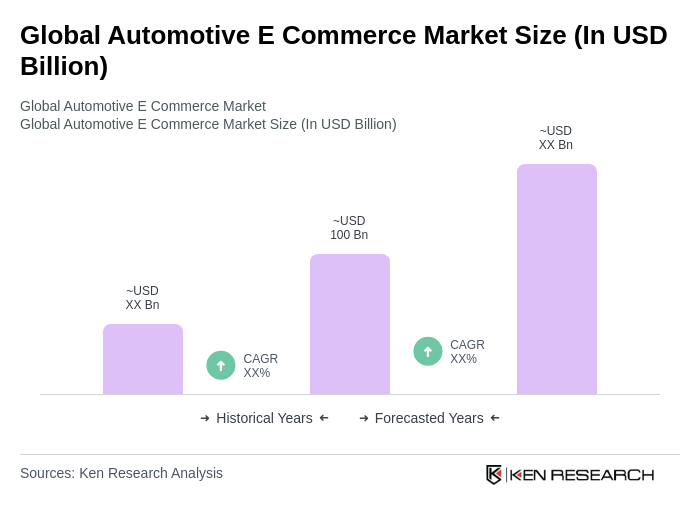
- The Global Automotive E Commerce Market is valued at approximately USD 100 billion, based on a five-year historical analysis. The rise in consumer preference for convenience and the growing penetration of smartphones and internet access have significantly contributed to this market growth.
- Countries such as the United States, Germany, and China dominate the Global Automotive E Commerce Market due to strong automotive production bases, high online retail maturity, and leading platforms and marketplaces supporting automotive parts and vehicle transactions.
- In 2023, the European Union advanced consumer-protection requirements in digital markets that affect online auto retail, including strengthened rules on pre-contract information, pricing transparency, and platform accountability under frameworks such as the Omnibus Directive and the Digital Services Act; these measures reinforce transparency and informed choice in online automotive purchases.
Global Automotive E Commerce Market Segmentation
By Type:The segmentation by type includes various categories such as New Vehicles, Used Vehicles, Automotive Parts & Accessories, Tires & Wheels, Tools, Oils & Consumables, Telematics, Electronics & Infotainment, and Services & Subscriptions. Each of these subsegments plays a crucial role in the overall market dynamics.
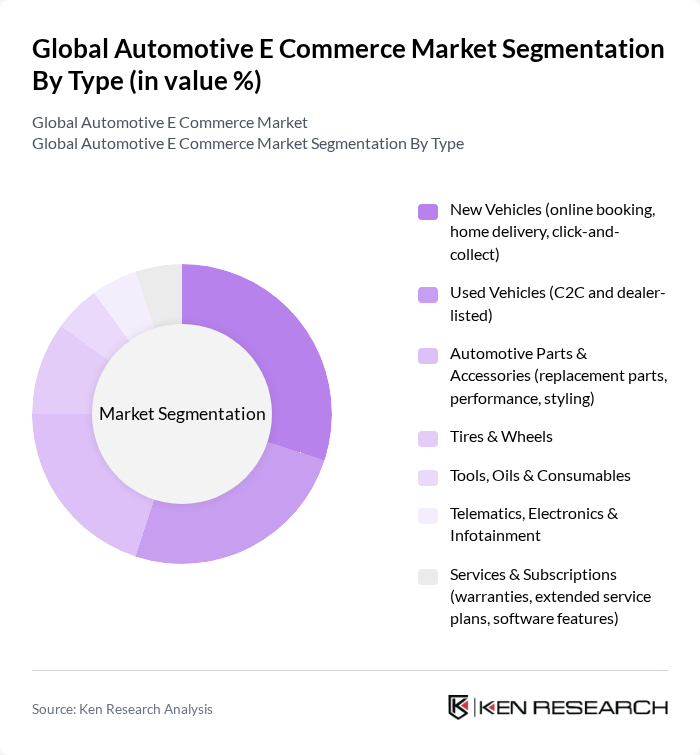
The New Vehicles segment is currently dominating the market due to the increasing trend of online vehicle purchases, which offers consumers convenience and a wider selection. The rise of digital platforms has made it easier for consumers to compare prices and features, leading to a significant shift in buying behavior. Additionally, the growing acceptance of home delivery services has further propelled this segment's growth. The Used Vehicles segment also shows strong performance, driven by the demand for affordable options and the increasing trust in online transactions.
By End-User:The end-user segmentation includes Individual Consumers, Professional Installers/Workshops, Fleet Operators & Mobility Providers, and Automotive Dealerships & Independent Retailers. Each segment has unique needs and purchasing behaviors that influence the overall market.
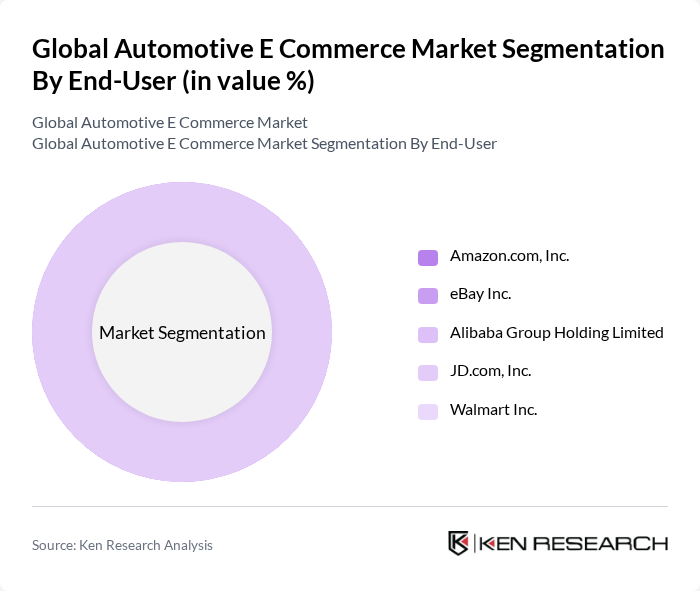
The Individual Consumers segment is leading the market, primarily due to the growing trend of DIY (Do It Yourself) automotive maintenance and repair. Consumers are increasingly turning to online platforms for purchasing parts and accessories, driven by the desire for cost savings and convenience. Professional Installers and Workshops also represent a significant portion of the market, as they rely on e-commerce for sourcing parts and tools efficiently. Fleet Operators and Mobility Providers are emerging as key players, leveraging online platforms to manage their vehicle maintenance needs effectively.
Global Automotive E Commerce Market Competitive Landscape
The Global Automotive E Commerce Market is characterized by a dynamic mix of regional and international players. Leading participants such as Amazon.com, Inc., eBay Inc., Alibaba Group Holding Limited, JD.com, Inc., Walmart Inc., AutoZone, Inc., Advance Auto Parts, Inc., Genuine Parts Company (NAPA), LKQ Corporation, CarParts.com, Inc., RockAuto, LLC, CARiD (VerticalScope Inc.), O’Reilly Automotive, Inc., Auto1 Group SE, Carvana Co., Vroom, Inc., Cars.com Inc., AutoTrader Group (AutoTrader.co.uk – Auto Trader Group plc), CarGurus, Inc., TrueCar, Inc., Edmunds.com, Inc., Cox Automotive, Inc. (Kelley Blue Book, Autotrader.com, Manheim), Denso Corporation (aftermarket e-commerce initiatives), Robert Bosch GmbH (Bosch Automotive Aftermarket), Tuhu Car Inc. contribute to innovation, geographic expansion, and service delivery in this space.
Global Automotive E Commerce Market Industry Analysis
Growth Drivers
- Increasing Online Vehicle Sales:The global online vehicle sales reached approximately 14 million units in future, reflecting a significant shift in consumer purchasing behavior. With the automotive industry projected to see a 20% increase in online sales in future, driven by enhanced digital marketing strategies and user-friendly platforms, this trend is expected to continue. The convenience of online shopping, coupled with the growing availability of vehicle options, is propelling this growth, particularly in urban areas where traditional dealerships are less accessible.
- Rise in Digital Payment Solutions:The adoption of digital payment solutions has surged, with global e-commerce transactions expected to exceed $7 trillion in future. This growth is supported by the increasing use of mobile wallets and contactless payment methods, which accounted for over 50% of online transactions in future. As consumers become more comfortable with these technologies, automotive e-commerce platforms are likely to benefit from higher conversion rates and increased customer satisfaction, facilitating smoother transactions and enhancing overall sales.
- Growing Consumer Preference for Convenience:A recent survey indicated that 85% of consumers prefer the convenience of online shopping for vehicle purchases, highlighting a significant shift in consumer behavior. This preference is further supported by the increasing availability of home delivery services, which have grown by 30% in the automotive sector since future. As consumers prioritize time-saving solutions, automotive e-commerce platforms that offer seamless online experiences and efficient delivery options are well-positioned to capture a larger market share.
Market Challenges
- High Competition Among E Commerce Platforms:The automotive e-commerce landscape is becoming increasingly saturated, with over 400 platforms competing for market share in future. This intense competition has led to price wars and reduced profit margins, making it challenging for new entrants to establish themselves. As established players invest heavily in marketing and technology, smaller platforms may struggle to differentiate themselves, potentially leading to market consolidation and reduced consumer choice in the long term.
- Consumer Trust and Security Concerns:Despite the growth of online vehicle sales, consumer trust remains a significant barrier, with 70% of potential buyers expressing concerns about data security and fraud. High-profile data breaches in recent years have heightened these fears, leading to increased scrutiny of e-commerce platforms. To overcome this challenge, companies must invest in robust cybersecurity measures and transparent policies to build consumer confidence and encourage more buyers to engage in online transactions.
Global Automotive E Commerce Market Future Outlook
The automotive e-commerce market is poised for transformative growth, driven by technological advancements and evolving consumer preferences. As platforms increasingly integrate AI and machine learning, personalized shopping experiences will enhance customer engagement. Additionally, the expansion into emerging markets, where internet penetration is rapidly increasing, presents significant opportunities. Companies that adapt to these trends and prioritize consumer trust will likely thrive, positioning themselves as leaders in the evolving automotive landscape.
Market Opportunities
- Integration of AI and Machine Learning:The integration of AI technologies can enhance customer experiences by providing personalized recommendations and predictive analytics. This capability is expected to improve conversion rates significantly, as tailored offerings resonate more with consumers, potentially increasing sales by up to 25% in the next few years.
- Expansion into Emerging Markets:Emerging markets, particularly in Asia and Africa, are witnessing rapid growth in internet access, with over 1.5 billion new users expected in future. This demographic shift presents a lucrative opportunity for automotive e-commerce platforms to tap into new customer bases, driving sales and brand recognition in previously underserved regions.
Scope of the Report
| Segment | Sub-Segments |
|---|---|
| By Type | New Vehicles (online booking, home delivery, click-and-collect) Used Vehicles (C2C and dealer-listed) Automotive Parts & Accessories (replacement parts, performance, styling) Tires & Wheels Tools, Oils & Consumables Telematics, Electronics & Infotainment Services & Subscriptions (warranties, extended service plans, software features) |
| By End-User | Individual Consumers (DIY) Professional Installers/Workshops (DIFM) Fleet Operators & Mobility Providers Automotive Dealerships & Independent Retailers |
| By Sales Channel | OEM-Operated Stores (direct-to-consumer) Specialist Aftermarket Retailers (pure-play e-tailers) Third-Party Marketplaces Omnichannel (online-to-offline, BOPIS) |
| By Payment Method | Credit/Debit Cards Digital Wallets & BNPL Bank Transfers Cash on Delivery (select markets) |
| By Region | North America Europe Asia-Pacific Latin America Middle East & Africa |
| By Customer Demographics | Age Group Income Level Geographic Location |
| By Vehicle Type | Passenger Cars SUVs & Crossovers Light Commercial Vehicles Heavy Commercial Vehicles Electric Vehicles (EVs) & Hybrids Performance & Luxury Vehicles |
Key Target Audience
Investors and Venture Capitalist Firms
Government and Regulatory Bodies (e.g., National Highway Traffic Safety Administration, European Commission)
Automotive Manufacturers and Producers
Online Automotive Retail Platforms
Logistics and Supply Chain Companies
Payment Processing Companies
Automotive Parts Suppliers
Insurance Providers
Players Mentioned in the Report:
Amazon.com, Inc.
eBay Inc.
Alibaba Group Holding Limited
JD.com, Inc.
Walmart Inc.
AutoZone, Inc.
Advance Auto Parts, Inc.
Genuine Parts Company (NAPA)
LKQ Corporation
CarParts.com, Inc.
RockAuto, LLC
CARiD (VerticalScope Inc.)
OReilly Automotive, Inc.
Auto1 Group SE
Carvana Co.
Vroom, Inc.
Cars.com Inc.
AutoTrader Group (AutoTrader.co.uk Auto Trader Group plc)
CarGurus, Inc.
TrueCar, Inc.
Edmunds.com, Inc.
Cox Automotive, Inc. (Kelley Blue Book, Autotrader.com, Manheim)
Denso Corporation (aftermarket e-commerce initiatives)
Robert Bosch GmbH (Bosch Automotive Aftermarket)
Tuhu Car Inc.
Table of Contents
Market Assessment Phase
1. Executive Summary and Approach
2. Global Automotive E Commerce Market Overview
2.1 Key Insights and Strategic Recommendations
2.2 Global Automotive E Commerce Market Overview
2.3 Definition and Scope
2.4 Evolution of Market Ecosystem
2.5 Timeline of Key Regulatory Milestones
2.6 Value Chain & Stakeholder Mapping
2.7 Business Cycle Analysis
2.8 Policy & Incentive Landscape
3. Global Automotive E Commerce Market Analysis
3.1 Growth Drivers
3.1.1 Increasing Online Vehicle Sales
3.1.2 Rise in Digital Payment Solutions
3.1.3 Growing Consumer Preference for Convenience
3.1.4 Expansion of Automotive E Commerce Platforms
3.2 Market Challenges
3.2.1 High Competition Among E Commerce Platforms
3.2.2 Regulatory Compliance Issues
3.2.3 Consumer Trust and Security Concerns
3.2.4 Logistics and Delivery Challenges
3.3 Market Opportunities
3.3.1 Integration of AI and Machine Learning
3.3.2 Expansion into Emerging Markets
3.3.3 Development of Mobile E Commerce Solutions
3.3.4 Partnerships with Automotive Manufacturers
3.4 Market Trends
3.4.1 Growth of Subscription-Based Models
3.4.2 Increased Use of Augmented Reality in Sales
3.4.3 Shift Towards Sustainable Automotive Options
3.4.4 Enhanced Customer Personalization Techniques
3.5 Government Regulation
3.5.1 Data Protection Regulations
3.5.2 E Commerce Taxation Policies
3.5.3 Consumer Rights Legislation
3.5.4 Environmental Compliance Standards
4. SWOT Analysis
5. Stakeholder Analysis
6. Porter's Five Forces Analysis
7. Global Automotive E Commerce Market Market Size, 2019-2024
7.1 By Value
7.2 By Volume
7.3 By Average Selling Price
8. Global Automotive E Commerce Market Segmentation
8.1 By Type
8.1.1 New Vehicles (online booking, home delivery, click-and-collect)
8.1.2 Used Vehicles (C2C and dealer-listed)
8.1.3 Automotive Parts & Accessories (replacement parts, performance, styling)
8.1.4 Tires & Wheels
8.1.5 Tools, Oils & Consumables
8.1.6 Telematics, Electronics & Infotainment
8.1.7 Services & Subscriptions (warranties, extended service plans, software features)
8.2 By End-User
8.2.1 Individual Consumers (DIY)
8.2.2 Professional Installers/Workshops (DIFM)
8.2.3 Fleet Operators & Mobility Providers
8.2.4 Automotive Dealerships & Independent Retailers
8.3 By Sales Channel
8.3.1 OEM-Operated Stores (direct-to-consumer)
8.3.2 Specialist Aftermarket Retailers (pure-play e-tailers)
8.3.3 Third-Party Marketplaces
8.3.4 Omnichannel (online-to-offline, BOPIS)
8.4 By Payment Method
8.4.1 Credit/Debit Cards
8.4.2 Digital Wallets & BNPL
8.4.3 Bank Transfers
8.4.4 Cash on Delivery (select markets)
8.5 By Region
8.5.1 North America
8.5.2 Europe
8.5.3 Asia-Pacific
8.5.4 Latin America
8.5.5 Middle East & Africa
8.6 By Customer Demographics
8.6.1 Age Group
8.6.2 Income Level
8.6.3 Geographic Location
8.7 By Vehicle Type
8.7.1 Passenger Cars
8.7.2 SUVs & Crossovers
8.7.3 Light Commercial Vehicles
8.7.4 Heavy Commercial Vehicles
8.7.5 Electric Vehicles (EVs) & Hybrids
8.7.6 Performance & Luxury Vehicles
9. Global Automotive E Commerce Market Competitive Analysis
9.1 Market Share of Key Players
9.2 Cross Comparison of Key Players
9.2.1 Company Name
9.2.2 Group Size (Large, Medium, Small)
9.2.3 Gross Merchandise Value (GMV)
9.2.4 Revenue Growth Rate (YoY)
9.2.5 Active Buyers/Users
9.2.6 Average Order Value (AOV)
9.2.7 Customer Acquisition Cost (CAC)
9.2.8 Customer Retention/Repeat Purchase Rate
9.2.9 Conversion Rate
9.2.10 Fulfillment SLA (on-time delivery rate)
9.2.11 Return Rate/Refund Ratio
9.2.12 Stock-Keeping Units (SKU) Count/Assortment Depth
9.2.13 Market Coverage (countries/regions served)
9.2.14 Take Rate/Commission (for marketplaces)
9.3 SWOT Analysis of Top Players
9.4 Pricing Analysis
9.5 Detailed Profile of Major Companies
9.5.1 Amazon.com, Inc.
9.5.2 eBay Inc.
9.5.3 Alibaba Group Holding Limited
9.5.4 JD.com, Inc.
9.5.5 Walmart Inc.
9.5.6 AutoZone, Inc.
9.5.7 Advance Auto Parts, Inc.
9.5.8 Genuine Parts Company (NAPA)
9.5.9 LKQ Corporation
9.5.10 CarParts.com, Inc.
9.5.11 RockAuto, LLC
9.5.12 CARiD (VerticalScope Inc.)
9.5.13 O’Reilly Automotive, Inc.
9.5.14 Auto1 Group SE
9.5.15 Carvana Co.
9.5.16 Vroom, Inc.
9.5.17 Cars.com Inc.
9.5.18 AutoTrader Group (AutoTrader.co.uk – Auto Trader Group plc)
9.5.19 CarGurus, Inc.
9.5.20 TrueCar, Inc.
9.5.21 Edmunds.com, Inc.
9.5.22 Cox Automotive, Inc. (Kelley Blue Book, Autotrader.com, Manheim)
9.5.23 Denso Corporation (aftermarket e-commerce initiatives)
9.5.24 Robert Bosch GmbH (Bosch Automotive Aftermarket)
9.5.25 Tuhu Car Inc.
10. Global Automotive E Commerce Market End-User Analysis
10.1 Procurement Behavior of Key Ministries
10.1.1 Government Fleet Purchases
10.1.2 Procurement Policies for Electric Vehicles
10.1.3 Budget Allocations for Transportation
10.2 Corporate Spend on Infrastructure & Energy
10.2.1 Investment in Charging Infrastructure
10.2.2 Expenditure on Fleet Management Solutions
10.3 Pain Point Analysis by End-User Category
10.3.1 Cost of Ownership Concerns
10.3.2 Availability of Financing Options
10.4 User Readiness for Adoption
10.4.1 Awareness of E Commerce Platforms
10.4.2 Digital Literacy Levels
10.5 Post-Deployment ROI and Use Case Expansion
10.5.1 Evaluation of Cost Savings
10.5.2 Expansion into New Markets
11. Global Automotive E Commerce Market Future Size, 2025-2030
11.1 By Value
11.2 By Volume
11.3 By Average Selling Price
Go-To-Market Strategy Phase
1. Whitespace Analysis + Business Model Canvas
1.1 Identification of Market Gaps
1.2 Business Model Framework
2. Marketing and Positioning Recommendations
2.1 Branding Strategies
2.2 Product USPs
3. Distribution Plan
3.1 Urban Retail Strategies
3.2 Rural NGO Tie-Ups
4. Channel & Pricing Gaps
4.1 Underserved Routes
4.2 Pricing Bands
5. Unmet Demand & Latent Needs
5.1 Category Gaps
5.2 Consumer Segments
6. Customer Relationship
6.1 Loyalty Programs
6.2 After-Sales Service
7. Value Proposition
7.1 Sustainability Initiatives
7.2 Integrated Supply Chains
8. Key Activities
8.1 Regulatory Compliance
8.2 Branding Efforts
8.3 Distribution Setup
9. Entry Strategy Evaluation
9.1 Domestic Market Entry Strategy
9.1.1 Product Mix Considerations
9.1.2 Pricing Band Analysis
9.1.3 Packaging Strategies
9.2 Export Entry Strategy
9.2.1 Target Countries
9.2.2 Compliance Roadmap
10. Entry Mode Assessment
10.1 Joint Ventures
10.2 Greenfield Investments
10.3 Mergers & Acquisitions
10.4 Distributor Model
11. Capital and Timeline Estimation
11.1 Capital Requirements
11.2 Timelines for Implementation
12. Control vs Risk Trade-Off
12.1 Ownership vs Partnerships
13. Profitability Outlook
13.1 Breakeven Analysis
13.2 Long-Term Sustainability
14. Potential Partner List
14.1 Distributors
14.2 Joint Ventures
14.3 Acquisition Targets
15. Execution Roadmap
15.1 Phased Plan for Market Entry
15.1.1 Market Setup
15.1.2 Market Entry
15.1.3 Growth Acceleration
15.1.4 Scale & Stabilize
15.2 Key Activities and Milestones
15.2.1 Milestone Planning
Research Methodology
Phase 1: Approach1
Desk Research
- Analysis of industry reports from automotive e-commerce associations and market research firms
- Review of online sales data from major automotive e-commerce platforms and marketplaces
- Examination of consumer behavior studies and trends in online automotive purchases
Primary Research
- Interviews with executives from leading automotive e-commerce companies
- Surveys targeting automotive consumers to understand purchasing preferences and behaviors
- Focus groups with automotive industry experts to gather insights on market dynamics
Validation & Triangulation
- Cross-validation of findings through multiple data sources, including sales figures and consumer surveys
- Triangulation of insights from primary interviews with secondary data trends
- Sanity checks conducted through expert panel reviews to ensure data accuracy
Phase 2: Market Size Estimation1
Top-down Assessment
- Estimation of total market size based on overall automotive sales and e-commerce penetration rates
- Segmentation of the market by vehicle type, parts, and accessories sold online
- Incorporation of macroeconomic factors influencing online automotive sales growth
Bottom-up Modeling
- Collection of sales data from key automotive e-commerce platforms to establish baseline figures
- Analysis of average transaction values and purchase frequency among online automotive shoppers
- Estimation of growth rates based on historical data and emerging market trends
Forecasting & Scenario Analysis
- Development of forecasting models using historical sales data and projected e-commerce growth rates
- Scenario analysis based on varying levels of consumer adoption and technological advancements
- Creation of best-case, worst-case, and most-likely scenarios through 2030
Phase 3: CATI Sample Composition1
| Scope Item/Segment | Sample Size | Target Respondent Profiles |
|---|---|---|
| Online Vehicle Sales | 120 | eCommerce Managers, Sales Directors |
| Automotive Parts and Accessories | 100 | Product Managers, Supply Chain Analysts |
| Consumer Insights on Automotive Purchases | 140 | Automotive Consumers, Market Researchers |
| Logistics and Delivery Services in Automotive E-commerce | 80 | Logistics Managers, Operations Directors |
| Technological Innovations in Automotive E-commerce | 70 | IT Managers, Digital Transformation Leads |
Frequently Asked Questions
What is the current value of the Global Automotive E Commerce Market?
The Global Automotive E Commerce Market is valued at approximately USD 100 billion, reflecting significant growth driven by consumer preferences for convenience and increased smartphone and internet penetration over the past five years.
Which countries dominate the Global Automotive E Commerce Market?
What are the key segments in the Global Automotive E Commerce Market?
How has consumer behavior shifted in the automotive e-commerce sector?
Other Regional/Country Reports
Indonesia Automotive E Commerce Market
Malaysia Automotive E Commerce Market
APAC Automotive E Commerce Market
SEA Automotive E Commerce Market
Why Buy From Us?

What makes us stand out is that our consultants follow Robust, Refine and Result (RRR) methodology. Robust for clear definitions, approaches and sanity checking, Refine for differentiating respondents' facts and opinions, and Result for presenting data with story.

We have set a benchmark in the industry by offering our clients with syndicated and customized market research reports featuring coverage of entire market as well as meticulous research and analyst insights.

While we don't replace traditional research, we flip the method upside down. Our dual approach of Top Bottom & Bottom Top ensures quality deliverable by not just verifying company fundamentals but also looking at the sector and macroeconomic factors.

With one step in the future, our research team constantly tries to show you the bigger picture. We help with some of the tough questions you may encounter along the way: How is the industry positioned? Best marketing channel? KPI's of competitors? By aligning every element, we help maximize success.

Our report gives you instant access to the answers and sources that other companies might choose to hide. We elaborate each steps of research methodology we have used and showcase you the sample size to earn your trust.

If you need any support, we are here! We pride ourselves on universe strength, data quality, and quick, friendly, and professional service.