About the Report
Base Year 2024Listen to the audio summary
Global Automotive Financing Market Overview
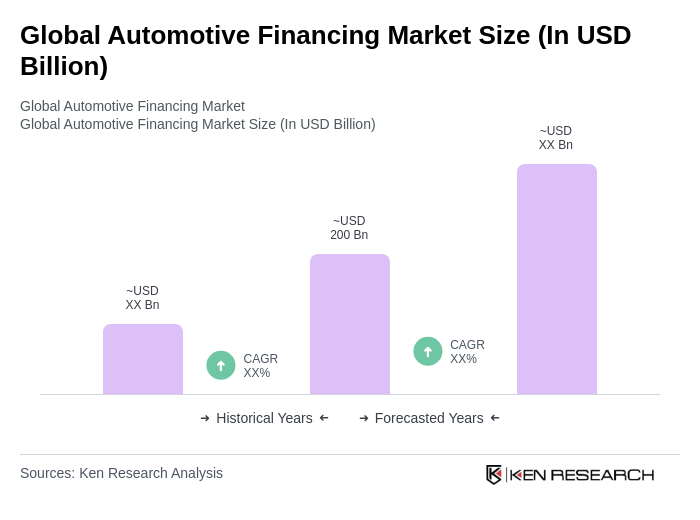
- The Global Automotive Financing Market is valued at USD 280–295 billion, based on a five-year historical analysis. Multiple industry trackers place the market in the high USD 200 billions range, with estimates such as USD 277.52 billion and USD 283.66 billion reported, reflecting consistent sizing across reputable sources . Key growth drivers include elevated vehicle prices that increase financing demand, ongoing digitization of credit origination and servicing, and wider availability of captive and bank-led products improving affordability and access .
- Key players in this market include the United States, Germany, and China, which dominate due to their robust automotive industries and established financial systems. Europe leads by regional share, with strong captive finance penetration from German OEMs, while North America and Asia Pacific contribute significant volumes through bank, captive, and independent lenders aligned to large vehicle sales bases .
- In 2023, the European Union advanced regulations and guidance to promote sustainable finance that affect auto lending and leasing, including the EU Taxonomy and Sustainable Finance Disclosure Regulation (SFDR), which encourage the development and labeling of green financing and leasing products for low?emission vehicles, supporting a shift toward electric and hybrid vehicle financing .
Global Automotive Financing Market Segmentation
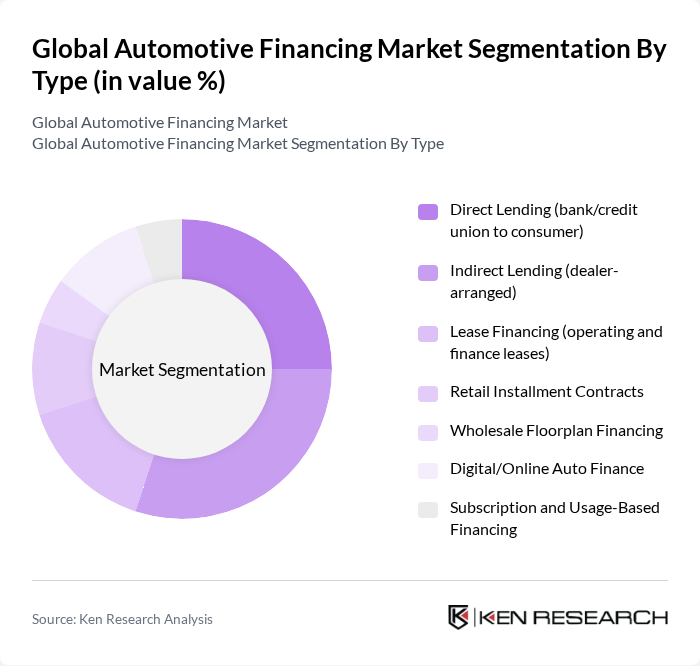
By Type:The automotive financing market can be segmented into various types, including Direct Lending, Indirect Lending, Lease Financing, Retail Installment Contracts, Wholesale Floorplan Financing, Digital/Online Auto Finance, and Subscription and Usage-Based Financing. Each of these segments caters to different consumer needs and preferences, with digital financing gaining traction due to the rise of online and mobile origination platforms offered by banks and captives .
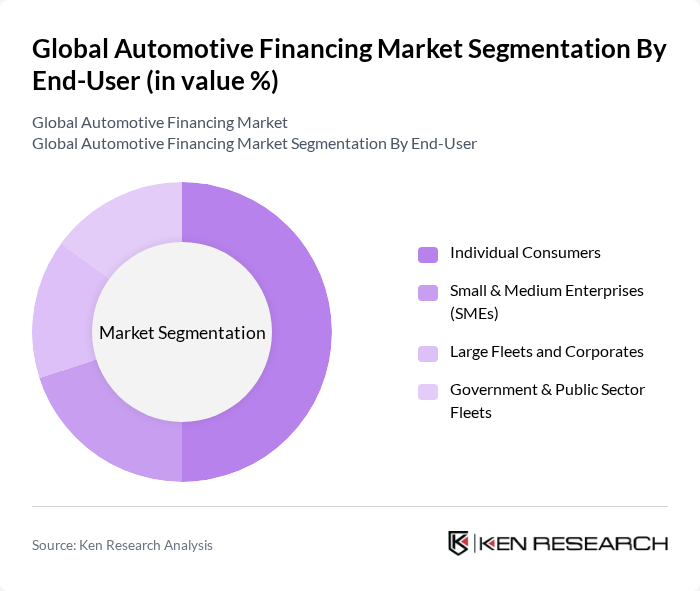
By End-User:This segment includes Individual Consumers, Small & Medium Enterprises (SMEs), Large Fleets and Corporates, and Government & Public Sector Fleets. The individual consumer segment is particularly significant, driven by persistent consumer demand, higher vehicle transaction prices boosting financing uptake, and expanded captive/bank product offerings with digital onboarding .
Global Automotive Financing Market Competitive Landscape
The Global Automotive Financing Market is characterized by a dynamic mix of regional and international players. Leading participants such as Toyota Financial Services (Toyota Motor Credit Corporation), Ford Credit (Ford Motor Credit Company), Volkswagen Financial Services AG, BMW Financial Services, Mercedes?Benz Mobility AG (Mercedes?Benz Financial Services), General Motors Financial Company, Inc. (GM Financial), Nissan Motor Acceptance Company (NMAC), American Honda Finance Corporation (Honda Financial Services), Hyundai Capital America (Hyundai Motor Finance), Kia Finance (Kia Motors Finance), Stellantis Financial Services (U.S.), Ally Financial Inc., Santander Consumer USA, Capital One Auto Finance, Bank of America Auto Loans, JPMorgan Chase & Co. (Chase Auto), Wells Fargo Auto, Credit Acceptance Corporation, TD Auto Finance LLC, and Volvo Financial Services (VFS US LLC) contribute to innovation, geographic expansion, and service delivery in this space.
Global Automotive Financing Market Industry Analysis
Growth Drivers
- Increasing Consumer Demand for Vehicles:In future, global vehicle sales are projected to reach approximately 87 million units, driven by a resurgence in consumer confidence and a growing preference for personal mobility. The International Organization of Motor Vehicle Manufacturers (OICA) reported a 12% increase in sales from the previous year, indicating a robust recovery post-pandemic. This surge in demand directly correlates with the rising need for automotive financing solutions, as consumers seek affordable payment options to acquire new vehicles.
- Expansion of Financing Options:The automotive financing landscape is evolving, with a notable increase in diverse financing options available to consumers. In future, the number of financing institutions offering tailored automotive loans is expected to exceed 1,300 globally, up from 1,100 previously. This expansion includes traditional banks, credit unions, and fintech companies, providing consumers with competitive interest rates and flexible terms, thereby enhancing accessibility to vehicle ownership through financing.
- Technological Advancements in Financing Solutions:The integration of technology in automotive financing is transforming the industry. By future, it is estimated that 65% of financing applications will be processed through digital platforms, significantly reducing approval times to under 25 minutes. Innovations such as AI-driven credit assessments and blockchain for secure transactions are enhancing efficiency and transparency, making financing more appealing to tech-savvy consumers who prioritize convenience and speed in their purchasing decisions.
Market Challenges
- High-Interest Rates:As of early future, average interest rates for automotive loans are projected to hover around 8.0%, a significant increase from 5.5% previously. This rise is primarily due to tightening monetary policies aimed at curbing inflation. Higher interest rates can deter potential buyers from seeking financing, leading to a slowdown in vehicle sales and, consequently, a contraction in the automotive financing market as consumers become more cautious about taking on debt.
- Regulatory Compliance Issues:The automotive financing sector faces increasing scrutiny from regulatory bodies, with new compliance requirements expected to be implemented in future. For instance, the Consumer Financial Protection Bureau (CFPB) is set to enforce stricter guidelines on loan disclosures and fair lending practices. These regulations may impose additional operational costs on financing institutions, potentially limiting their ability to offer competitive rates and innovative products, thus impacting market growth.
Global Automotive Financing Market Future Outlook
The automotive financing market is poised for significant transformation in the coming years, driven by technological advancements and evolving consumer preferences. The shift towards online financing solutions is expected to streamline the application process, enhancing customer experience. Additionally, the increasing focus on electric vehicle financing will create new opportunities for lenders to cater to environmentally conscious consumers. As the market adapts to these trends, innovative financing models will likely emerge, reshaping the competitive landscape and driving growth.
Market Opportunities
- Growth in Electric Vehicle Financing:With electric vehicle sales projected to reach 12 million units in future, there is a substantial opportunity for financing institutions to develop specialized loan products tailored for EV buyers. This segment is expected to attract environmentally conscious consumers, creating a niche market that can drive profitability and enhance brand loyalty among financing providers.
- Development of Digital Financing Platforms:The rise of digital financing platforms presents a significant opportunity for growth. By future, it is anticipated that 45% of all automotive financing transactions will occur through digital channels. This shift allows lenders to reduce operational costs and improve customer engagement, positioning themselves favorably in a competitive market increasingly dominated by tech-driven solutions.
Scope of the Report
| Segment | Sub-Segments |
|---|---|
| By Type | Direct Lending (bank/credit union to consumer) Indirect Lending (dealer-arranged) Lease Financing (operating and finance leases) Retail Installment Contracts Wholesale Floorplan Financing Digital/Online Auto Finance Subscription and Usage-Based Financing |
| By End-User | Individual Consumers Small & Medium Enterprises (SMEs) Large Fleets and Corporates Government & Public Sector Fleets |
| By Financing Provider | Banks Captive Finance (OEM-affiliated) Independent Finance Companies Credit Unions & Cooperative Lenders Fintech & Online Lenders |
| By Vehicle Type | New Passenger Vehicles Used Passenger Vehicles Light Commercial Vehicles (LCVs) Heavy Commercial Vehicles (HCVs)/Trucks & Buses Electric Vehicles (Battery EVs, PHEVs) Luxury & Premium Vehicles |
| By Loan/Lease Tenure | Short-term (?36 months) Medium-term (37–60 months) Long-term (>60 months) |
| By Channel | OEM/Dealer Channel Direct-to-Consumer (online and branch) Aggregators & Marketplaces |
| By Customer Credit Tier | Prime Borrowers Near-prime Borrowers Subprime Borrowers Deep Subprime Borrowers |
Key Target Audience
Investors and Venture Capitalist Firms
Government and Regulatory Bodies (e.g., National Highway Traffic Safety Administration, European Commission)
Automotive Manufacturers and Producers
Automotive Dealerships and Retailers
Financial Institutions and Banks
Insurance Companies
Automotive Leasing Companies
Industry Associations (e.g., Automotive Finance Association)
Players Mentioned in the Report:
Toyota Financial Services (Toyota Motor Credit Corporation)
Ford Credit (Ford Motor Credit Company)
Volkswagen Financial Services AG
BMW Financial Services
MercedesBenz Mobility AG (MercedesBenz Financial Services)
General Motors Financial Company, Inc. (GM Financial)
Nissan Motor Acceptance Company (NMAC)
American Honda Finance Corporation (Honda Financial Services)
Hyundai Capital America (Hyundai Motor Finance)
Kia Finance (Kia Motors Finance)
Stellantis Financial Services (U.S.)
Ally Financial Inc.
Santander Consumer USA
Capital One Auto Finance
Bank of America Auto Loans
JPMorgan Chase & Co. (Chase Auto)
Wells Fargo Auto
Credit Acceptance Corporation
TD Auto Finance LLC
Volvo Financial Services (VFS US LLC)
Table of Contents
Market Assessment Phase
1. Executive Summary and Approach
2. Global Automotive Financing Market Overview
2.1 Key Insights and Strategic Recommendations
2.2 Global Automotive Financing Market Overview
2.3 Definition and Scope
2.4 Evolution of Market Ecosystem
2.5 Timeline of Key Regulatory Milestones
2.6 Value Chain & Stakeholder Mapping
2.7 Business Cycle Analysis
2.8 Policy & Incentive Landscape
3. Global Automotive Financing Market Analysis
3.1 Growth Drivers
3.1.1 Increasing consumer demand for vehicles
3.1.2 Expansion of financing options
3.1.3 Rise in disposable income
3.1.4 Technological advancements in financing solutions
3.2 Market Challenges
3.2.1 High-interest rates
3.2.2 Regulatory compliance issues
3.2.3 Economic downturns affecting consumer spending
3.2.4 Competition from alternative financing sources
3.3 Market Opportunities
3.3.1 Growth in electric vehicle financing
3.3.2 Expansion into emerging markets
3.3.3 Development of digital financing platforms
3.3.4 Partnerships with automotive manufacturers
3.4 Market Trends
3.4.1 Shift towards online financing solutions
3.4.2 Increasing focus on customer experience
3.4.3 Adoption of AI in credit assessment
3.4.4 Growth of subscription-based vehicle financing
3.5 Government Regulation
3.5.1 Consumer protection laws
3.5.2 Interest rate caps
3.5.3 Disclosure requirements for financing terms
3.5.4 Incentives for electric vehicle financing
4. SWOT Analysis
5. Stakeholder Analysis
6. Porter's Five Forces Analysis
7. Global Automotive Financing Market Market Size, 2019-2024
7.1 By Value
7.2 By Volume
7.3 By Average Selling Price
8. Global Automotive Financing Market Segmentation
8.1 By Type
8.1.1 Direct Lending (bank/credit union to consumer)
8.1.2 Indirect Lending (dealer-arranged)
8.1.3 Lease Financing (operating and finance leases)
8.1.4 Retail Installment Contracts
8.1.5 Wholesale Floorplan Financing
8.1.6 Digital/Online Auto Finance
8.1.7 Subscription and Usage-Based Financing
8.2 By End-User
8.2.1 Individual Consumers
8.2.2 Small & Medium Enterprises (SMEs)
8.2.3 Large Fleets and Corporates
8.2.4 Government & Public Sector Fleets
8.3 By Financing Provider
8.3.1 Banks
8.3.2 Captive Finance (OEM-affiliated)
8.3.3 Independent Finance Companies
8.3.4 Credit Unions & Cooperative Lenders
8.3.5 Fintech & Online Lenders
8.4 By Vehicle Type
8.4.1 New Passenger Vehicles
8.4.2 Used Passenger Vehicles
8.4.3 Light Commercial Vehicles (LCVs)
8.4.4 Heavy Commercial Vehicles (HCVs)/Trucks & Buses
8.4.5 Electric Vehicles (Battery EVs, PHEVs)
8.4.6 Luxury & Premium Vehicles
8.5 By Loan/Lease Tenure
8.5.1 Short-term (?36 months)
8.5.2 Medium-term (37–60 months)
8.5.3 Long-term (>60 months)
8.6 By Channel
8.6.1 OEM/Dealer Channel
8.6.2 Direct-to-Consumer (online and branch)
8.6.3 Aggregators & Marketplaces
8.7 By Customer Credit Tier
8.7.1 Prime Borrowers
8.7.2 Near-prime Borrowers
8.7.3 Subprime Borrowers
8.7.4 Deep Subprime Borrowers
9. Global Automotive Financing Market Competitive Analysis
9.1 Market Share of Key Players
9.2 Cross Comparison of Key Players
9.2.1 Company Name
9.2.2 Ownership Type (Bank, Captive OEM, Independent, Credit Union, Fintech)
9.2.3 Auto Finance Portfolio Size (outstandings, USD)
9.2.4 New vs. Used Mix (%)
9.2.5 Lease vs. Loan Mix (%)
9.2.6 Geographic Revenue Mix (Americas/EMEA/APAC %)
9.2.7 Yield/Net Interest Margin on Auto Book (%)
9.2.8 Average APR by Credit Tier (Prime/Subprime)
9.2.9 90+ Day Delinquency Rate (%)
9.2.10 Net Charge-off/Default Rate (%)
9.2.11 Cost of Funds (%)
9.2.12 Operating Efficiency (Cost-to-Income, %)
9.2.13 Customer Acquisition Cost (per funded loan)
9.2.14 Average Loan/Lease Term (months)
9.2.15 Average Loan Amount/Ticket Size (USD)
9.2.16 EV Financing Penetration (%)
9.2.17 OEM/Dealer Penetration Rate (%)
9.2.18 Securitization Volume (ABS issuance, USD)
9.2.19 Digital Origination Rate (%)
9.2.20 Return on Equity (ROE) for Auto Finance Unit (%)
9.3 SWOT Analysis of Top Players
9.4 Pricing Analysis
9.5 Detailed Profile of Major Companies
9.5.1 Toyota Financial Services (Toyota Motor Credit Corporation)
9.5.2 Ford Credit (Ford Motor Credit Company)
9.5.3 Volkswagen Financial Services AG
9.5.4 BMW Financial Services
9.5.5 Mercedes?Benz Mobility AG (Mercedes?Benz Financial Services)
9.5.6 General Motors Financial Company, Inc. (GM Financial)
9.5.7 Nissan Motor Acceptance Company (NMAC)
9.5.8 American Honda Finance Corporation (Honda Financial Services)
9.5.9 Hyundai Capital America (Hyundai Motor Finance)
9.5.10 Kia Finance (Kia Motors Finance)
9.5.11 Stellantis Financial Services (U.S.)
9.5.12 Ally Financial Inc.
9.5.13 Santander Consumer USA
9.5.14 Capital One Auto Finance
9.5.15 Bank of America Auto Loans
9.5.16 JPMorgan Chase & Co. (Chase Auto)
9.5.17 Wells Fargo Auto
9.5.18 Credit Acceptance Corporation
9.5.19 TD Auto Finance LLC
9.5.20 Volvo Financial Services (VFS US LLC)
10. Global Automotive Financing Market End-User Analysis
10.1 Procurement Behavior of Key Ministries
10.1.1 Budget Allocation Trends
10.1.2 Decision-Making Processes
10.1.3 Preferred Financing Options
10.2 Corporate Spend on Infrastructure & Energy
10.2.1 Investment in Fleet Financing
10.2.2 Budgeting for Vehicle Acquisition
10.2.3 Financing for Sustainable Vehicles
10.3 Pain Point Analysis by End-User Category
10.3.1 High Financing Costs
10.3.2 Limited Access to Credit
10.3.3 Complexity of Financing Terms
10.4 User Readiness for Adoption
10.4.1 Awareness of Financing Options
10.4.2 Comfort with Digital Financing Platforms
10.4.3 Trust in Financial Institutions
10.5 Post-Deployment ROI and Use Case Expansion
10.5.1 Evaluation of Financing Effectiveness
10.5.2 Expansion into New Vehicle Types
10.5.3 Long-term Financial Planning
11. Global Automotive Financing Market Future Size, 2025-2030
11.1 By Value
11.2 By Volume
11.3 By Average Selling Price
Go-To-Market Strategy Phase
1. Whitespace Analysis + Business Model Canvas
1.1 Market Gaps Identification
1.2 Value Proposition Development
1.3 Revenue Streams Analysis
1.4 Cost Structure Evaluation
1.5 Key Partnerships Exploration
1.6 Customer Segmentation
1.7 Channels of Distribution
2. Marketing and Positioning Recommendations
2.1 Branding Strategies
2.2 Product USPs
2.3 Target Market Positioning
2.4 Communication Strategies
2.5 Digital Marketing Approaches
3. Distribution Plan
3.1 Urban Retail Strategies
3.2 Rural NGO Tie-ups
3.3 Online Distribution Channels
3.4 Partnerships with Dealerships
4. Channel & Pricing Gaps
4.1 Underserved Routes
4.2 Pricing Bands Analysis
4.3 Competitor Pricing Strategies
4.4 Customer Sensitivity to Pricing
5. Unmet Demand & Latent Needs
5.1 Category Gaps Identification
5.2 Consumer Segments Analysis
5.3 Emerging Trends in Consumer Preferences
5.4 Future Demand Projections
6. Customer Relationship
6.1 Loyalty Programs
6.2 After-sales Service Enhancements
6.3 Customer Feedback Mechanisms
6.4 Relationship Management Strategies
7. Value Proposition
7.1 Sustainability Initiatives
7.2 Integrated Supply Chains
7.3 Customer-Centric Offerings
7.4 Competitive Differentiation
8. Key Activities
8.1 Regulatory Compliance
8.2 Branding Initiatives
8.3 Distribution Setup
8.4 Training and Development
9. Entry Strategy Evaluation
9.1 Domestic Market Entry Strategy
9.1.1 Product Mix Considerations
9.1.2 Pricing Band Strategy
9.1.3 Packaging Options
9.2 Export Entry Strategy
9.2.1 Target Countries Analysis
9.2.2 Compliance Roadmap Development
10. Entry Mode Assessment
10.1 Joint Ventures
10.2 Greenfield Investments
10.3 Mergers & Acquisitions
10.4 Distributor Model Evaluation
11. Capital and Timeline Estimation
11.1 Capital Requirements
11.2 Timelines for Implementation
12. Control vs Risk Trade-Off
12.1 Ownership vs Partnerships
12.2 Risk Management Strategies
13. Profitability Outlook
13.1 Breakeven Analysis
13.2 Long-term Sustainability Strategies
14. Potential Partner List
14.1 Distributors
14.2 Joint Ventures
14.3 Acquisition Targets
15. Execution Roadmap
15.1 Phased Plan for Market Entry
15.1.1 Market Setup
15.1.2 Market Entry
15.1.3 Growth Acceleration
15.1.4 Scale & Stabilize
15.2 Key Activities and Milestones
15.2.1 Milestone Planning
15.2.2 Activity Tracking
Research Methodology
Phase 1: Approach1
Desk Research
- Analysis of industry reports from automotive financing associations and financial institutions
- Review of market trends and forecasts from government publications and automotive trade journals
- Examination of financial statements and annual reports from leading automotive financing companies
Primary Research
- Interviews with financial analysts specializing in automotive financing
- Surveys with automotive dealerships regarding financing options and consumer preferences
- Field interviews with executives from automotive financing firms to gather insights on market dynamics
Validation & Triangulation
- Cross-validation of data through multiple sources including trade publications and financial reports
- Triangulation of findings from primary interviews with secondary data insights
- Sanity checks conducted through expert panel reviews to ensure data accuracy
Phase 2: Market Size Estimation1
Top-down Assessment
- Estimation of total automotive financing market size based on national vehicle sales data
- Segmentation of market by financing type (e.g., loans, leases) and geographical regions
- Incorporation of macroeconomic indicators such as interest rates and consumer credit availability
Bottom-up Modeling
- Collection of data on financing volumes from major automotive lenders and banks
- Analysis of average loan amounts and lease terms across different vehicle categories
- Calculation of market size based on aggregated financing data from dealerships and financial institutions
Forecasting & Scenario Analysis
- Multi-variable regression analysis incorporating economic growth, consumer confidence, and automotive sales trends
- Scenario modeling based on potential changes in interest rates and regulatory impacts on financing
- Development of baseline, optimistic, and pessimistic forecasts through 2030
Phase 3: CATI Sample Composition1
| Scope Item/Segment | Sample Size | Target Respondent Profiles |
|---|---|---|
| Automotive Dealership Financing Options | 150 | Finance Managers, Sales Directors |
| Consumer Preferences in Automotive Financing | 140 | Car Buyers, Financial Advisors |
| Leasing vs. Buying Trends | 100 | Leasing Managers, Automotive Analysts |
| Impact of Interest Rates on Financing | 80 | Economists, Financial Planners |
| Regulatory Impacts on Automotive Financing | 70 | Compliance Officers, Legal Advisors |
Frequently Asked Questions
What is the current value of the Global Automotive Financing Market?
The Global Automotive Financing Market is valued between USD 280 billion and USD 295 billion, based on a five-year historical analysis. Estimates from various industry trackers consistently place the market in the high USD 200 billion range.
What are the key growth drivers of the automotive financing market?
Which regions dominate the Global Automotive Financing Market?
How is the automotive financing market affected by regulations in the European Union?
Other Regional/Country Reports
Indonesia Automotive Financing Market
Malaysia Automotive Financing Market
APAC Automotive Financing Market
SEA Automotive Financing Market
Why Buy From Us?

What makes us stand out is that our consultants follow Robust, Refine and Result (RRR) methodology. Robust for clear definitions, approaches and sanity checking, Refine for differentiating respondents' facts and opinions, and Result for presenting data with story.

We have set a benchmark in the industry by offering our clients with syndicated and customized market research reports featuring coverage of entire market as well as meticulous research and analyst insights.

While we don't replace traditional research, we flip the method upside down. Our dual approach of Top Bottom & Bottom Top ensures quality deliverable by not just verifying company fundamentals but also looking at the sector and macroeconomic factors.

With one step in the future, our research team constantly tries to show you the bigger picture. We help with some of the tough questions you may encounter along the way: How is the industry positioned? Best marketing channel? KPI's of competitors? By aligning every element, we help maximize success.

Our report gives you instant access to the answers and sources that other companies might choose to hide. We elaborate each steps of research methodology we have used and showcase you the sample size to earn your trust.

If you need any support, we are here! We pride ourselves on universe strength, data quality, and quick, friendly, and professional service.