About the Report
Base Year 2024Listen to the audio summary
Global Automotive Tires Market Overview
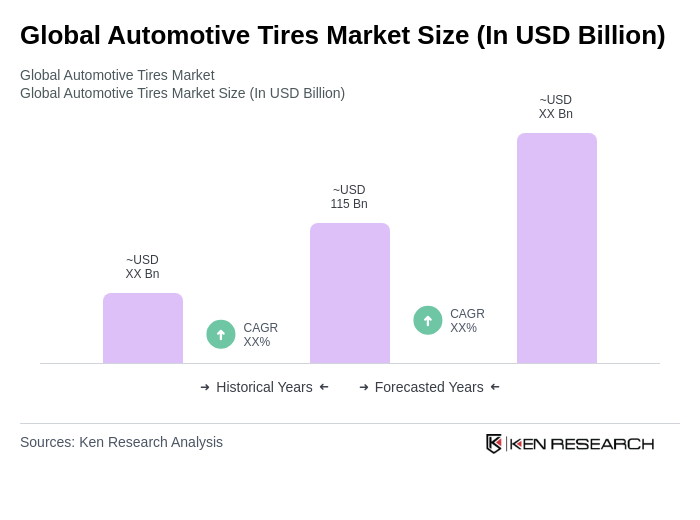
- The Global Automotive Tires Market is valued at approximately USD 115 billion, based on a five-year historical analysis. Recent industry assessments place the market value near USD 113.9 billion and USD 129.6 billion, reflecting consolidated global tire demand across passenger and commercial vehicle segments . The market is driven by rising vehicle parc, technological advances (low rolling resistance compounds, smart/connected tires), and heightened safety-performance requirements. Electrification is reshaping tire design toward higher load indices, reduced rolling resistance, and noise-optimized patterns, while sustainability initiatives are accelerating bio-based materials, recycled content, and extended producer responsibility programs .
- Key demand and production hubs include the United States, China, and Germany. China leads global tire manufacturing and vehicle ownership growth, supported by scale and export capacity; the United States remains a major replacement market with high per-vehicle tire spending; Germany anchors premium OE demand tied to luxury and performance automakers that specify advanced tire fitments .
- The European Union mandates tire labeling for fuel efficiency (rolling resistance), wet grip, and external rolling noise under Regulation (EU) 2020/740, applicable from mid-2021 with updates in the 2023–2024 period to expand applicability and surveillance. The framework aims to steer consumers toward energy-efficient and safer tires and obliges manufacturers to provide standardized labels and product information sheets .
Global Automotive Tires Market Segmentation
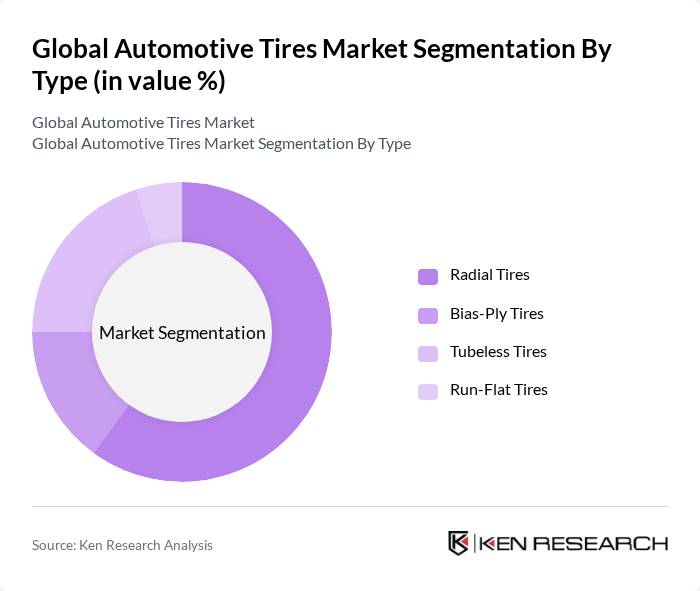
By Type:The market is segmented into various types of tires, each catering to different consumer needs and vehicle specifications. The primary subsegments include Radial Tires, Bias-Ply Tires, Tubeless Tires, and Run-Flat Tires.Radial tiresdominate the market for on-road applications due to better tread life, fuel efficiency from lower rolling resistance, ride comfort, and heat management—attributes favored by both OEM and replacement channels globally . The increasing demand for high-performance, durable, and energy-efficient tires—especially for EVs—continues to reinforce radial adoption across passenger and commercial categories .
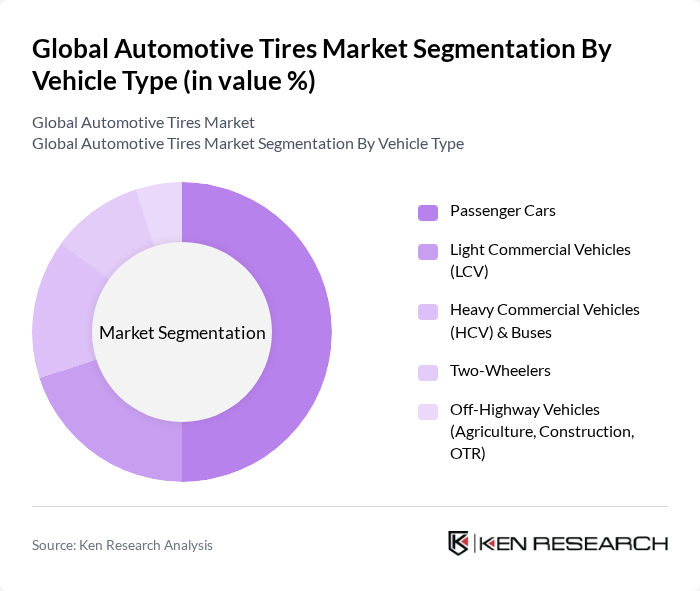
By Vehicle Type:This segmentation includes Passenger Cars, Light Commercial Vehicles (LCV), Heavy Commercial Vehicles (HCV) & Buses, Two-Wheelers, and Off-Highway Vehicles (Agriculture, Construction, OTR).Passenger carshold the largest share of the market, supported by the sizable global replacement cycle and OE fitments in high-volume segments. Rapid e-commerce growth and last-mile delivery networks are sustaining LCV tire demand, while infrastructure and construction activity underpin HCV/OTR consumption .
Global Automotive Tires Market Competitive Landscape
The Global Automotive Tires Market is characterized by a dynamic mix of regional and international players. Leading participants such as Bridgestone Corporation, Michelin Group, The Goodyear Tire & Rubber Company, Continental AG, Pirelli & C. S.p.A., Sumitomo Rubber Industries, Ltd. (Dunlop, Falken), The Yokohama Rubber Co., Ltd., Hankook Tire & Technology Co., Ltd., Kumho Tire Co., Inc., Apollo Tyres Ltd., MRF Ltd. (Madras Rubber Factory), Nokian Tyres plc, Toyo Tire Corporation, Zhongce Rubber Group Co., Ltd. (Westlake, Chaoyang), Giti Tire Pte. Ltd., CEAT Ltd., JK Tyre & Industries Ltd., Sailun Group Co., Ltd., Maxxis International (Cheng Shin Rubber Ind. Co., Ltd.), Linglong Tire (Shandong Linglong Tire Co., Ltd.) contribute to innovation, geographic expansion, and service delivery in this space.
Global Automotive Tires Market Industry Analysis
Growth Drivers
- Increasing Vehicle Production:The global vehicle production reached approximately 93 million units recently, with projections indicating a rise to 85 million units in the near future. This surge is driven by robust demand in emerging markets, particularly in Asia-Pacific, where vehicle production is expected to grow by 5% annually. As vehicle production increases, the demand for tires will correspondingly rise, creating a significant growth driver for the automotive tires market in None.
- Rising Demand for Fuel-Efficient Tires:The global market for fuel-efficient tires is projected to reach $30 billion in the near future, driven by consumer preferences for sustainability and cost savings. In None, the adoption of fuel-efficient tires is expected to increase by 15% as consumers become more environmentally conscious. This trend is further supported by government incentives promoting energy-efficient vehicles, thereby enhancing the demand for advanced tire technologies that improve fuel efficiency.
- Growth in E-commerce and Logistics:The e-commerce sector is projected to grow to $6 trillion globally in the near future, significantly impacting logistics and transportation. In None, the logistics industry is expected to expand by 10% annually, leading to increased demand for commercial vehicles and, consequently, tires. This growth in e-commerce necessitates durable and high-performance tires, driving innovation and production in the automotive tires market to meet these logistical demands.
Market Challenges
- Fluctuating Raw Material Prices:The automotive tire industry faces significant challenges due to volatile raw material prices, particularly for natural rubber and synthetic compounds. Recently, natural rubber prices fluctuated between $1.50 and $2.00 per kilogram, impacting production costs. This volatility can lead to increased tire prices, affecting consumer demand and profitability for manufacturers in None, creating a challenging market environment.
- Stringent Environmental Regulations:Governments worldwide are implementing stricter environmental regulations, particularly concerning tire manufacturing and disposal. In None, compliance costs associated with these regulations are projected to increase by 20% in the near future. Manufacturers must invest in sustainable practices and technologies to meet these standards, which can strain financial resources and impact overall market competitiveness in the automotive tires sector.
Global Automotive Tires Market Future Outlook
The automotive tires market is poised for significant transformation driven by technological advancements and changing consumer preferences. The integration of smart technologies in tire manufacturing is expected to enhance performance and safety, while the shift towards sustainable materials will align with global environmental goals. Additionally, the increasing adoption of electric vehicles will create new demand dynamics, necessitating innovative tire solutions tailored for electric mobility. These trends will shape the market landscape, fostering growth and innovation in the coming years.
Market Opportunities
- Expansion in Emerging Markets:Emerging markets, particularly in Asia and Africa, present significant growth opportunities for tire manufacturers. With a projected increase in vehicle ownership rates, the demand for tires is expected to rise substantially. This expansion is anticipated to create a market worth over $10 billion in the near future, driven by urbanization and rising disposable incomes in these regions.
- Development of Smart Tires:The development of smart tires equipped with IoT technology is a burgeoning opportunity in the automotive tires market. These tires can provide real-time data on performance and safety, enhancing user experience. The market for smart tires is expected to grow to $5 billion in the near future, driven by increasing consumer demand for advanced automotive technologies and safety features.
Scope of the Report
| Segment | Sub-Segments |
|---|---|
| By Type | Radial Tires Bias-Ply Tires Tubeless Tires Run-Flat Tires |
| By Vehicle Type | Passenger Cars Light Commercial Vehicles (LCV) Heavy Commercial Vehicles (HCV) & Buses Two-Wheelers Off-Highway Vehicles (Agriculture, Construction, OTR) |
| By Application | On-Road/Highway (All-Season, Summer, Winter) Off-Road/All-Terrain Performance/Racing EV-Specific Tires |
| By Distribution Channel | OEM Aftermarket – Online Aftermarket – Offline (Dealers, Specialty Retail) Wholesale/Distributors |
| By Price Range | Economy Mid-Range Premium/Ultra-High Performance Specialty (Winter, Run-Flat, OTR) |
| By Region | North America Europe Asia-Pacific Latin America Middle East & Africa |
| By Rim Size | ?15 Inches –18 Inches –21 Inches ?22 Inches |
Key Target Audience
Investors and Venture Capitalist Firms
Government and Regulatory Bodies (e.g., National Highway Traffic Safety Administration, Environmental Protection Agency)
Manufacturers and Producers
Distributors and Retailers
Automotive OEMs (Original Equipment Manufacturers)
Fleet Management Companies
Automotive Aftermarket Service Providers
Logistics and Supply Chain Companies
Players Mentioned in the Report:
Bridgestone Corporation
Michelin Group
The Goodyear Tire & Rubber Company
Continental AG
Pirelli & C. S.p.A.
Sumitomo Rubber Industries, Ltd. (Dunlop, Falken)
The Yokohama Rubber Co., Ltd.
Hankook Tire & Technology Co., Ltd.
Kumho Tire Co., Inc.
Apollo Tyres Ltd.
MRF Ltd. (Madras Rubber Factory)
Nokian Tyres plc
Toyo Tire Corporation
Zhongce Rubber Group Co., Ltd. (Westlake, Chaoyang)
Giti Tire Pte. Ltd.
CEAT Ltd.
JK Tyre & Industries Ltd.
Sailun Group Co., Ltd.
Maxxis International (Cheng Shin Rubber Ind. Co., Ltd.)
Linglong Tire (Shandong Linglong Tire Co., Ltd.)
Table of Contents
Market Assessment Phase
1. Executive Summary and Approach
2. Global Automotive Tires Market Overview
2.1 Key Insights and Strategic Recommendations
2.2 Global Automotive Tires Market Overview
2.3 Definition and Scope
2.4 Evolution of Market Ecosystem
2.5 Timeline of Key Regulatory Milestones
2.6 Value Chain & Stakeholder Mapping
2.7 Business Cycle Analysis
2.8 Policy & Incentive Landscape
3. Global Automotive Tires Market Analysis
3.1 Growth Drivers
3.1.1 Increasing Vehicle Production
3.1.2 Rising Demand for Fuel-Efficient Tires
3.1.3 Growth in E-commerce and Logistics
3.1.4 Technological Advancements in Tire Manufacturing
3.2 Market Challenges
3.2.1 Fluctuating Raw Material Prices
3.2.2 Stringent Environmental Regulations
3.2.3 Intense Competition
3.2.4 Supply Chain Disruptions
3.3 Market Opportunities
3.3.1 Expansion in Emerging Markets
3.3.2 Development of Smart Tires
3.3.3 Increasing Adoption of Electric Vehicles
3.3.4 Growth in Retreading Services
3.4 Market Trends
3.4.1 Shift Towards Sustainable Materials
3.4.2 Rise of Online Tire Retailing
3.4.3 Integration of IoT in Tire Monitoring
3.4.4 Customization and Personalization of Tires
3.5 Government Regulation
3.5.1 Emission Standards for Tires
3.5.2 Safety Regulations for Tire Manufacturing
3.5.3 Recycling and Waste Management Policies
3.5.4 Import Tariffs and Trade Policies
4. SWOT Analysis
5. Stakeholder Analysis
6. Porter's Five Forces Analysis
7. Global Automotive Tires Market Market Size, 2019-2024
7.1 By Value
7.2 By Volume
7.3 By Average Selling Price
8. Global Automotive Tires Market Segmentation
8.1 By Type
8.1.1 Radial Tires
8.1.2 Bias-Ply Tires
8.1.3 Tubeless Tires
8.1.4 Run-Flat Tires
8.2 By Vehicle Type
8.2.1 Passenger Cars
8.2.2 Light Commercial Vehicles (LCV)
8.2.3 Heavy Commercial Vehicles (HCV) & Buses
8.2.4 Two-Wheelers
8.2.5 Off-Highway Vehicles (Agriculture, Construction, OTR)
8.3 By Application
8.3.1 On-Road/Highway (All-Season, Summer, Winter)
8.3.2 Off-Road/All-Terrain
8.3.3 Performance/Racing
8.3.4 EV-Specific Tires
8.4 By Distribution Channel
8.4.1 OEM
8.4.2 Aftermarket – Online
8.4.3 Aftermarket – Offline (Dealers, Specialty Retail)
8.4.4 Wholesale/Distributors
8.5 By Price Range
8.5.1 Economy
8.5.2 Mid-Range
8.5.3 Premium/Ultra-High Performance
8.5.4 Specialty (Winter, Run-Flat, OTR)
8.6 By Region
8.6.1 North America
8.6.2 Europe
8.6.3 Asia-Pacific
8.6.4 Latin America
8.6.5 Middle East & Africa
8.7 By Rim Size
8.7.1 ?15 Inches
8.7.2 16–18 Inches
8.7.3 19–21 Inches
8.7.4 ?22 Inches
9. Global Automotive Tires Market Competitive Analysis
9.1 Market Share of Key Players
9.2 Cross Comparison of Key Players
9.2.1 Company Name
9.2.2 Group Size (Global, Regional, Niche)
9.2.3 Global Tire Revenue (USD) and YoY Growth
9.2.4 OEM vs Aftermarket Mix (%)
9.2.5 Production Capacity (Million Units/Year)
9.2.6 Geographic Footprint (Manufacturing Plants/Regions Served)
9.2.7 Product Portfolio Breadth (PCR, TBR, OTR, Two-Wheeler, EV, Run-Flat)
9.2.8 ASP by Segment (PCR/TBR) and Pricing Positioning
9.2.9 R&D Intensity (% of Revenue) and Patent Activity
9.2.10 Sustainability KPIs (Recycled Content, Rolling Resistance Ratings, CO2 Targets)
9.2.11 Distribution Strength (Own Retail/Franchise/Online Presence)
9.2.12 Warranty/Claim Rate and Customer Satisfaction Indices
9.3 SWOT Analysis of Top Players
9.4 Pricing Analysis
9.5 Detailed Profile of Major Companies
9.5.1 Bridgestone Corporation
9.5.2 Michelin Group
9.5.3 The Goodyear Tire & Rubber Company
9.5.4 Continental AG
9.5.5 Pirelli & C. S.p.A.
9.5.6 Sumitomo Rubber Industries, Ltd. (Dunlop, Falken)
9.5.7 The Yokohama Rubber Co., Ltd.
9.5.8 Hankook Tire & Technology Co., Ltd.
9.5.9 Kumho Tire Co., Inc.
9.5.10 Apollo Tyres Ltd.
9.5.11 MRF Ltd. (Madras Rubber Factory)
9.5.12 Nokian Tyres plc
9.5.13 Toyo Tire Corporation
9.5.14 Zhongce Rubber Group Co., Ltd. (Westlake, Chaoyang)
9.5.15 Giti Tire Pte. Ltd.
9.5.16 CEAT Ltd.
9.5.17 JK Tyre & Industries Ltd.
9.5.18 Sailun Group Co., Ltd.
9.5.19 Maxxis International (Cheng Shin Rubber Ind. Co., Ltd.)
9.5.20 Linglong Tire (Shandong Linglong Tire Co., Ltd.)
10. Global Automotive Tires Market End-User Analysis
10.1 Procurement Behavior of Key Ministries
10.1.1 Government Fleet Management
10.1.2 Public Transportation Needs
10.1.3 Infrastructure Development Projects
10.1.4 Environmental Compliance Requirements
10.2 Corporate Spend on Infrastructure & Energy
10.2.1 Investment in Fleet Upgrades
10.2.2 Budget Allocation for Maintenance
10.2.3 Spending on Sustainable Solutions
10.3 Pain Point Analysis by End-User Category
10.3.1 Cost of Ownership
10.3.2 Performance Reliability
10.3.3 Availability of Quality Products
10.3.4 After-Sales Support
10.4 User Readiness for Adoption
10.4.1 Awareness of New Technologies
10.4.2 Willingness to Invest in Quality
10.4.3 Training and Support Needs
10.5 Post-Deployment ROI and Use Case Expansion
10.5.1 Performance Metrics Tracking
10.5.2 Long-Term Cost Savings
10.5.3 Expansion into New Markets
10.5.4 Customer Feedback Integration
11. Global Automotive Tires Market Future Size, 2025-2030
11.1 By Value
11.2 By Volume
11.3 By Average Selling Price
Go-To-Market Strategy Phase
1. Whitespace Analysis + Business Model Canvas
1.1 Market Gaps Identification
1.2 Value Proposition Development
1.3 Revenue Streams Analysis
1.4 Cost Structure Evaluation
1.5 Key Partnerships Exploration
1.6 Customer Segmentation
1.7 Channels of Distribution
2. Marketing and Positioning Recommendations
2.1 Branding Strategies
2.2 Product USPs
2.3 Target Market Identification
2.4 Communication Strategies
2.5 Digital Marketing Approaches
3. Distribution Plan
3.1 Urban Retail Strategies
3.2 Rural NGO Tie-Ups
3.3 E-commerce Integration
3.4 Logistics Optimization
4. Channel & Pricing Gaps
4.1 Underserved Routes
4.2 Pricing Bands Analysis
4.3 Competitor Pricing Strategies
5. Unmet Demand & Latent Needs
5.1 Category Gaps Identification
5.2 Consumer Segments Analysis
5.3 Product Development Opportunities
6. Customer Relationship
6.1 Loyalty Programs
6.2 After-Sales Service Enhancements
6.3 Customer Feedback Mechanisms
7. Value Proposition
7.1 Sustainability Initiatives
7.2 Integrated Supply Chains
7.3 Competitive Differentiation
8. Key Activities
8.1 Regulatory Compliance
8.2 Branding Initiatives
8.3 Distribution Setup
9. Entry Strategy Evaluation
9.1 Domestic Market Entry Strategy
9.1.1 Product Mix Considerations
9.1.2 Pricing Band Strategy
9.1.3 Packaging Innovations
9.2 Export Entry Strategy
9.2.1 Target Countries Analysis
9.2.2 Compliance Roadmap Development
10. Entry Mode Assessment
10.1 Joint Ventures
10.2 Greenfield Investments
10.3 Mergers & Acquisitions
10.4 Distributor Model Evaluation
11. Capital and Timeline Estimation
11.1 Capital Requirements Analysis
11.2 Timelines for Implementation
12. Control vs Risk Trade-Off
12.1 Ownership vs Partnerships
13. Profitability Outlook
13.1 Breakeven Analysis
13.2 Long-Term Sustainability Strategies
14. Potential Partner List
14.1 Distributors
14.2 Joint Ventures
14.3 Acquisition Targets
15. Execution Roadmap
15.1 Phased Plan for Market Entry
15.1.1 Market Setup
15.1.2 Market Entry
15.1.3 Growth Acceleration
15.1.4 Scale & Stabilize
15.2 Key Activities and Milestones
15.2.1 Activity Planning
15.2.2 Milestone Tracking
Research Methodology
Phase 1: Approach1
Desk Research
- Industry reports from automotive associations and tire manufacturers
- Market analysis publications from automotive market research firms
- Government publications on automotive regulations and standards
Primary Research
- Interviews with product managers at leading tire manufacturers
- Surveys with automotive retailers and distributors
- Field interviews with automotive service center operators
Validation & Triangulation
- Cross-validation of market data with historical sales figures
- Triangulation of insights from primary and secondary research sources
- Sanity checks through expert panels comprising industry veterans
Phase 2: Market Size Estimation1
Top-down Assessment
- Analysis of global automotive production and tire replacement rates
- Segmentation by tire type (e.g., passenger, commercial, specialty)
- Incorporation of regional market dynamics and growth trends
Bottom-up Modeling
- Volume estimates based on sales data from major tire retailers
- Cost analysis derived from average selling prices across tire categories
- Estimation of market share based on production capacities of key players
Forecasting & Scenario Analysis
- Multi-variable regression analysis incorporating economic indicators
- Scenario modeling based on technological advancements in tire manufacturing
- Baseline, optimistic, and pessimistic forecasts through 2030
Phase 3: CATI Sample Composition1
| Scope Item/Segment | Sample Size | Target Respondent Profiles |
|---|---|---|
| Passenger Vehicle Tire Market | 150 | Product Managers, Retail Buyers |
| Commercial Vehicle Tire Market | 100 | Fleet Managers, Procurement Specialists |
| Specialty Tires (e.g., agricultural, industrial) | 80 | Operations Managers, Equipment Dealers |
| Tire Recycling and Sustainability Initiatives | 70 | Sustainability Officers, Environmental Managers |
| Emerging Markets Tire Demand | 90 | Market Analysts, Regional Sales Directors |
Frequently Asked Questions
What is the current value of the Global Automotive Tires Market?
The Global Automotive Tires Market is valued at approximately USD 115 billion, with recent assessments indicating values between USD 113.9 billion and USD 129.6 billion. This reflects strong demand across both passenger and commercial vehicle segments.
What factors are driving the growth of the automotive tires market?
Which regions are the largest markets for automotive tires?
What types of tires dominate the automotive tires market?
Other Regional/Country Reports
Indonesia Automotive Tires Market
Malaysia Automotive Tires Market
APAC Automotive Tires Market
SEA Automotive Tires Market
Why Buy From Us?

What makes us stand out is that our consultants follow Robust, Refine and Result (RRR) methodology. Robust for clear definitions, approaches and sanity checking, Refine for differentiating respondents' facts and opinions, and Result for presenting data with story.

We have set a benchmark in the industry by offering our clients with syndicated and customized market research reports featuring coverage of entire market as well as meticulous research and analyst insights.

While we don't replace traditional research, we flip the method upside down. Our dual approach of Top Bottom & Bottom Top ensures quality deliverable by not just verifying company fundamentals but also looking at the sector and macroeconomic factors.

With one step in the future, our research team constantly tries to show you the bigger picture. We help with some of the tough questions you may encounter along the way: How is the industry positioned? Best marketing channel? KPI's of competitors? By aligning every element, we help maximize success.

Our report gives you instant access to the answers and sources that other companies might choose to hide. We elaborate each steps of research methodology we have used and showcase you the sample size to earn your trust.

If you need any support, we are here! We pride ourselves on universe strength, data quality, and quick, friendly, and professional service.