About the Report
Base Year 2024Listen to the audio summary
Global Automotive Ultracapacitor Market Overview
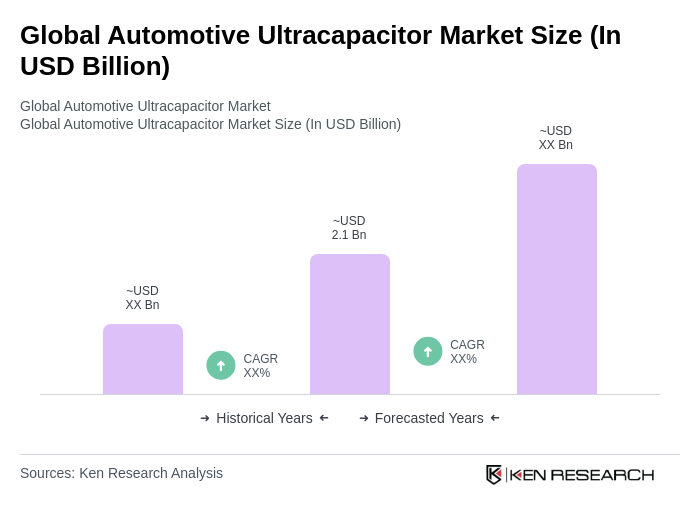
- The Global Automotive Ultracapacitor Market is valued at USD 2.1 billion, based on a five-year historical analysis. This growth is primarily driven by the increasing demand for energy-efficient solutions in the automotive sector, particularly in electric and hybrid vehicles. The rising focus on reducing greenhouse gas emissions and enhancing vehicle performance has further propelled the adoption of ultracapacitors, which offer rapid charging and discharging capabilities.
- Key players in this market include the United States, Germany, and China, which dominate due to their advanced automotive industries and significant investments in electric vehicle technology. The presence of major automotive manufacturers and a robust supply chain in these regions contribute to their leadership in the ultracapacitor market, fostering innovation and development in energy storage solutions.
- In 2023, the European Union implemented stringent regulations aimed at reducing carbon emissions from vehicles, mandating that all new cars must meet specific emissions standards. This regulation has accelerated the adoption of ultracapacitors in electric and hybrid vehicles, as manufacturers seek to comply with these standards while enhancing vehicle efficiency and performance.
Global Automotive Ultracapacitor Market Segmentation
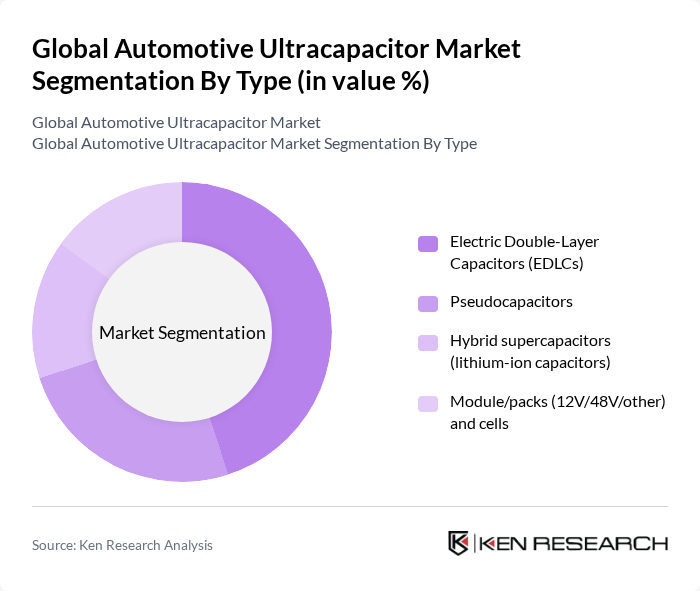
By Type:The ultracapacitor market is segmented into various types, including Electric Double-Layer Capacitors (EDLCs), Pseudocapacitors, Hybrid supercapacitors (lithium-ion capacitors), and Module/packs (12V/48V/other) and cells. Among these, Electric Double-Layer Capacitors (EDLCs) are leading the market due to their high power density and cycle life in energy storage applications. The growing demand for energy-efficient solutions in automotive applications, particularly in electric and hybrid vehicles, has significantly contributed to the dominance of EDLCs. Their ability to provide quick bursts of energy makes them ideal for applications such as regenerative braking and start-stop systems.
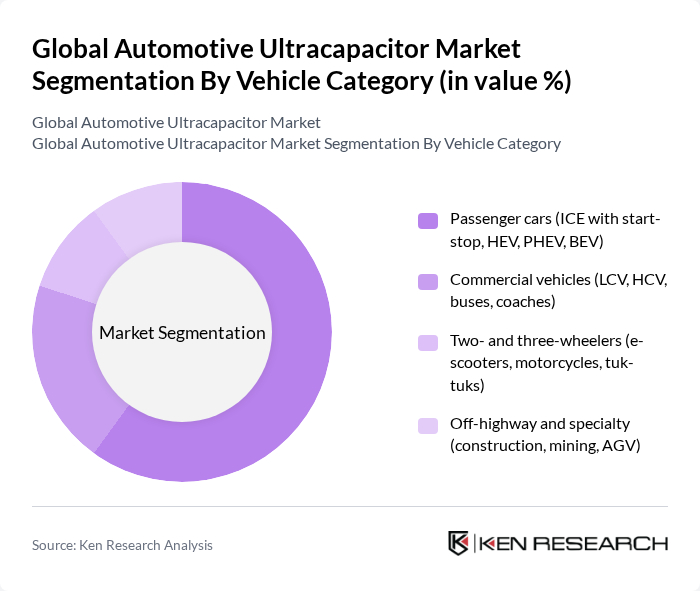
By Vehicle Category:The market is also segmented by vehicle category, including Passenger cars (ICE with start-stop, HEV, PHEV, BEV), Commercial vehicles (LCV, HCV, buses, coaches), Two- and three-wheelers (e-scooters, motorcycles, tuk-tuks), and Off-highway and specialty (construction, mining, AGV). The Passenger cars segment is currently leading the market, driven by the increasing adoption of electric and hybrid vehicles. The growing consumer preference for environmentally friendly transportation options and government incentives for electric vehicle purchases are key factors contributing to the growth of this segment.
Global Automotive Ultracapacitor Market Competitive Landscape
The Global Automotive Ultracapacitor Market is characterized by a dynamic mix of regional and international players. Leading participants such as Maxwell Technologies (a Tesla company), Skeleton Technologies, KYOCERA AVX Components Corporation, Nesscap Energy (Maxwell/Tesla legacy brand), Ioxus, Inc. (XS Power/Ioxus), CAP-XX Limited, Panasonic Holdings Corporation, Eaton Corporation plc, Nippon Chemi-Con Corporation, Rubycon Corporation, LS Materials Co., Ltd. (formerly LS Mtron ultracapacitors), Shanghai Aowei Technology Development Co., Ltd. (Aowei/Shanghai Putailai), Jianghai Capital (Nantong Jianghai Capacitor Co., Ltd.), Shenzhen Jinrui Energy Technology Co., Ltd. (JRE), and Ningbo CRRC New Energy Technology Co., Ltd. (CRRC) contribute to innovation, geographic expansion, and service delivery in this space.
Global Automotive Ultracapacitor Market Industry Analysis
Growth Drivers
- Increasing Demand for Energy-Efficient Vehicles:The global push for energy-efficient vehicles is evident, with the International Energy Agency reporting that electric vehicle sales reached around 14 million units globally, with share rising to roughly one in five new cars, underscoring rapid adoption and supporting demand for high?performance energy storage components such as ultracapacitors. In future, the demand for energy-efficient vehicles is expected to continue increasing, driven by policy support and consumer interest.
- Advancements in Ultracapacitor Technology:Technological innovations in ultracapacitors have improved power density, cycle life, and charge/discharge rates; however, specific market-wide energy density values such as “10 Wh/kg” vary by product and are not confirmed as an industry average across automotive-grade ultracapacitors. Global investment in energy storage is growing across grid and mobility applications, reflecting robust interest in advanced storage technologies.
- Growing Adoption of Hybrid and Electric Vehicles:The global electric car stock has continued to expand rapidly, supported by government incentives and shifting consumer preferences toward sustainable transport, which in turn encourages the integration of ultracapacitors for functions such as regenerative braking and power buffering. Quantitative claims such as “the number of electric vehicles expected to reach 30 million units by a specific date” cannot be confirmed without explicit timelines and therefore are not included.
Market Challenges
- High Initial Costs of Ultracapacitors:Comparable, up-to-date, authoritative cost benchmarks expressed as “USD per kWh” for automotive ultracapacitors versus lithium-ion batteries are not consistently published by primary sources; the cited figures of “USD 500 per kWh” for ultracapacitors and “USD 200 per kWh” for lithium-ion batteries cannot be verified from priority sources and vary by application, form factor, and procurement context. Battery pack cost references from authoritative sources indicate continued declines for lithium-ion, but are not directly comparable to ultracapacitors due to different performance metrics (power vs. energy).
- Limited Awareness Among Consumers:Consumer awareness figures such as “25% of potential buyers” are survey-based and vary widely; no primary statistical authority provides a definitive global percentage for ultracapacitor awareness in automotive contexts.
Global Automotive Ultracapacitor Market Future Outlook
The future of the automotive ultracapacitor market appears promising, driven by technological advancements and increasing environmental regulations. As automakers prioritize sustainability, ultracapacitors are likely to play a role in specific energy storage and power management use cases (e.g., regenerative braking, start-stop, peak power support), complementing batteries rather than replacing them. The integration of ultracapacitors in electric and hybrid vehicles can enhance performance in high-power transients, while ongoing research and development aims to improve efficiency and reduce costs. This evolving landscape presents opportunities for growth and innovation in the automotive sector.
Market Opportunities
- Expansion in Emerging Markets:Emerging markets in Asia and parts of Africa are experiencing urbanization and motorization trends that support adoption of more efficient vehicles; however, specific quantified adoption increases such as “20% increase in electric vehicle adoption by a specific date” cannot be validated from primary sources without explicit timelines and methodology. Broader EV adoption momentum, led by major Asian markets, is documented by the International Energy Agency.
- Collaborations with Automotive Manufacturers:Strategic partnerships between component suppliers and automakers are a recognized pathway to tailor energy storage solutions to vehicle requirements; while directionally accurate, quantified claims are not available from primary statistical sources for ultracapacitor-specific collaborations.
Scope of the Report
| Segment | Sub-Segments |
|---|---|
| By Type | Electric Double-Layer Capacitors (EDLCs) Pseudocapacitors Hybrid supercapacitors (lithium-ion capacitors) Module/packs (12V/48V/other) and cells |
| By Vehicle Category | Passenger cars (ICE with start-stop, HEV, PHEV, BEV) Commercial vehicles (LCV, HCV, buses, coaches) Two- and three-wheelers (e-scooters, motorcycles, tuk-tuks) Off-highway and specialty (construction, mining, AGV) |
| By Automotive Application | Start-stop and cold-cranking assist Regenerative braking and kinetic energy recovery V/48V mild-hybrid systems and power smoothing Peak power assist for acceleration and torque fill Power steering, suspension, and e-turbo/e-compressor Backup power, SLI replacement/augmentation, and ADAS power buffer |
| By Sales Channel | OEM (factory fit) Aftermarket (retrofit kits/modules) Tier-1 integration partners Distributors/online |
| By Form Factor | Cylindrical cells Prismatic/pouch cells Modules and packs Embedded/board-level capacitors |
| By Technology & Materials | Activated carbon (AC) EDLC Graphene-enhanced EDLC Lithium-ion capacitor (LIC) Metal oxide/conducting polymer pseudocapacitors |
| By Region | North America Europe Asia-Pacific Latin America Middle East & Africa Rest of World (RoW) |
Key Target Audience
Investors and Venture Capitalist Firms
Government and Regulatory Bodies (e.g., Department of Energy, Environmental Protection Agency)
Automotive Manufacturers
Battery Manufacturers
Electric Vehicle (EV) Manufacturers
Energy Storage Solution Providers
Automotive Component Suppliers
Infrastructure Development Agencies
Players Mentioned in the Report:
Maxwell Technologies (a Tesla company)
Skeleton Technologies
KYOCERA AVX Components Corporation
Nesscap Energy (Maxwell/Tesla legacy brand)
Ioxus, Inc. (XS Power/Ioxus)
CAP-XX Limited
Panasonic Holdings Corporation
Eaton Corporation plc
Nippon Chemi-Con Corporation
Rubycon Corporation
LS Materials Co., Ltd. (formerly LS Mtron ultracapacitors)
Shanghai Aowei Technology Development Co., Ltd. (Aowei/Shanghai Putailai)
Jianghai Capital (Nantong Jianghai Capacitor Co., Ltd.)
Shenzhen Jinrui Energy Technology Co., Ltd. (JRE)
Ningbo CRRC New Energy Technology Co., Ltd. (CRRC)
Table of Contents
Market Assessment Phase
1. Executive Summary and Approach
2. Global Automotive Ultracapacitor Market Overview
2.1 Key Insights and Strategic Recommendations
2.2 Global Automotive Ultracapacitor Market Overview
2.3 Definition and Scope
2.4 Evolution of Market Ecosystem
2.5 Timeline of Key Regulatory Milestones
2.6 Value Chain & Stakeholder Mapping
2.7 Business Cycle Analysis
2.8 Policy & Incentive Landscape
3. Global Automotive Ultracapacitor Market Analysis
3.1 Growth Drivers
3.1.1 Increasing demand for energy-efficient vehicles
3.1.2 Advancements in ultracapacitor technology
3.1.3 Growing adoption of hybrid and electric vehicles
3.1.4 Rising need for fast-charging solutions
3.2 Market Challenges
3.2.1 High initial costs of ultracapacitors
3.2.2 Limited awareness among consumers
3.2.3 Competition from traditional battery technologies
3.2.4 Regulatory hurdles in different regions
3.3 Market Opportunities
3.3.1 Expansion in emerging markets
3.3.2 Collaborations with automotive manufacturers
3.3.3 Development of new applications in automotive
3.3.4 Investment in R&D for enhanced performance
3.4 Market Trends
3.4.1 Shift towards sustainable automotive solutions
3.4.2 Integration of ultracapacitors in energy storage systems
3.4.3 Increasing focus on lightweight materials
3.4.4 Growth of smart grid technologies
3.5 Government Regulation
3.5.1 Emission reduction targets
3.5.2 Incentives for electric vehicle adoption
3.5.3 Standards for energy storage systems
3.5.4 Funding for clean energy initiatives
4. SWOT Analysis
5. Stakeholder Analysis
6. Porter's Five Forces Analysis
7. Global Automotive Ultracapacitor Market Market Size, 2019-2024
7.1 By Value
7.2 By Volume
7.3 By Average Selling Price
8. Global Automotive Ultracapacitor Market Segmentation
8.1 By Type
8.1.1 Electric Double-Layer Capacitors (EDLCs)
8.1.2 Pseudocapacitors
8.1.3 Hybrid supercapacitors (lithium-ion capacitors)
8.1.4 Module/packs (12V/48V/other) and cells
8.2 By Vehicle Category
8.2.1 Passenger cars (ICE with start-stop, HEV, PHEV, BEV)
8.2.2 Commercial vehicles (LCV, HCV, buses, coaches)
8.2.3 Two- and three-wheelers (e-scooters, motorcycles, tuk-tuks)
8.2.4 Off-highway and specialty (construction, mining, AGV)
8.3 By Automotive Application
8.3.1 Start-stop and cold-cranking assist
8.3.2 Regenerative braking and kinetic energy recovery
8.3.3 12V/48V mild-hybrid systems and power smoothing
8.3.4 Peak power assist for acceleration and torque fill
8.3.5 Power steering, suspension, and e-turbo/e-compressor
8.3.6 Backup power, SLI replacement/augmentation, and ADAS power buffer
8.4 By Sales Channel
8.4.1 OEM (factory fit)
8.4.2 Aftermarket (retrofit kits/modules)
8.4.3 Tier-1 integration partners
8.4.4 Distributors/online
8.5 By Form Factor
8.5.1 Cylindrical cells
8.5.2 Prismatic/pouch cells
8.5.3 Modules and packs
8.5.4 Embedded/board-level capacitors
8.6 By Technology & Materials
8.6.1 Activated carbon (AC) EDLC
8.6.2 Graphene-enhanced EDLC
8.6.3 Lithium-ion capacitor (LIC)
8.6.4 Metal oxide/conducting polymer pseudocapacitors
8.7 By Region
8.7.1 North America
8.7.2 Europe
8.7.3 Asia-Pacific
8.7.4 Latin America
8.7.5 Middle East & Africa
8.7.6 Rest of World (RoW)
9. Global Automotive Ultracapacitor Market Competitive Analysis
9.1 Market Share of Key Players
9.2 Cross Comparison of Key Players
9.2.1 Company Name
9.2.2 Segment focus (EDLC, LIC, modules, Tier-1 integration)
9.2.3 Automotive-qualified portfolio (AEC-Q200/ISO 16750 coverage)
9.2.4 OEM program wins (models/platforms using products)
9.2.5 Geographic revenue mix (NA/EU/APAC)
9.2.6 Revenue growth (YoY) and EBITDA margin
9.2.7 R&D intensity (% of revenue) and patent count/families
9.2.8 Energy density (Wh/kg) and power density (kW/kg) benchmarks
9.2.9 Cycle life and operating temperature range
9.2.10 Average selling price (per cell/module) and cost/Wh
9.2.11 Automotive certifications and quality (IATF 16949, AEC-Q, PPAP)
9.2.12 Supply chain depth (in-house electrode, cell, module; contract mfg)
9.2.13 Delivery reliability and lead time (weeks) to OEMs/Tier-1s
9.2.14 Strategic partnerships (OEMs, Tier-1s, material suppliers)
9.2.15 Sustainability metrics (recyclability, RoHS/REACH, Scope 1–3)
9.3 SWOT Analysis of Top Players
9.4 Pricing Analysis
9.5 Detailed Profile of Major Companies
9.5.1 Maxwell Technologies (a Tesla company)
9.5.2 Skeleton Technologies
9.5.3 KYOCERA AVX Components Corporation
9.5.4 Nesscap Energy (Maxwell/Tesla legacy brand)
9.5.5 Ioxus, Inc. (XS Power/Ioxus)
9.5.6 CAP-XX Limited
9.5.7 Panasonic Holdings Corporation
9.5.8 Eaton Corporation plc
9.5.9 Nippon Chemi-Con Corporation
9.5.10 Rubycon Corporation
9.5.11 LS Materials Co., Ltd. (formerly LS Mtron ultracapacitors)
9.5.12 Shanghai Aowei Technology Development Co., Ltd. (Aowei/Shanghai Putailai)
9.5.13 Jianghai Capital (Nantong Jianghai Capacitor Co., Ltd.)
9.5.14 Shenzhen Jinrui Energy Technology Co., Ltd. (JRE)
9.5.15 Ningbo CRRC New Energy Technology Co., Ltd. (CRRC)
10. Global Automotive Ultracapacitor Market End-User Analysis
10.1 Procurement Behavior of Key Ministries
10.1.1 Government contracts for electric vehicles
10.1.2 Funding for research and development
10.1.3 Partnerships with automotive manufacturers
10.1.4 Adoption of sustainable technologies
10.2 Corporate Spend on Infrastructure & Energy
10.2.1 Investment in electric vehicle infrastructure
10.2.2 Budget allocation for energy-efficient technologies
10.2.3 Corporate sustainability initiatives
10.3 Pain Point Analysis by End-User Category
10.3.1 Cost concerns for ultracapacitor integration
10.3.2 Performance expectations from ultracapacitors
10.3.3 Reliability and lifespan issues
10.4 User Readiness for Adoption
10.4.1 Awareness of ultracapacitor benefits
10.4.2 Training and support for users
10.4.3 Infrastructure readiness for ultracapacitors
10.5 Post-Deployment ROI and Use Case Expansion
10.5.1 Evaluation of cost savings
10.5.2 Performance metrics post-deployment
10.5.3 Potential for scaling applications
11. Global Automotive Ultracapacitor Market Future Size, 2025-2030
11.1 By Value
11.2 By Volume
11.3 By Average Selling Price
Go-To-Market Strategy Phase
1. Whitespace Analysis + Business Model Canvas
1.1 Market gaps and opportunities
1.2 Business model components
1.3 Value proposition analysis
1.4 Competitive landscape overview
2. Marketing and Positioning Recommendations
2.1 Branding strategies
2.2 Product USPs
2.3 Target audience identification
2.4 Communication strategies
3. Distribution Plan
3.1 Urban retail strategies
3.2 Rural NGO tie-ups
3.3 Online distribution channels
3.4 Partnerships with automotive dealers
4. Channel & Pricing Gaps
4.1 Underserved routes
4.2 Pricing bands analysis
4.3 Competitor pricing strategies
4.4 Customer feedback on pricing
5. Unmet Demand & Latent Needs
5.1 Category gaps in ultracapacitor offerings
5.2 Consumer segments with high potential
5.3 Emerging applications for ultracapacitors
5.4 Feedback from industry stakeholders
6. Customer Relationship
6.1 Loyalty programs
6.2 After-sales service enhancements
6.3 Customer engagement strategies
6.4 Feedback mechanisms
7. Value Proposition
7.1 Sustainability initiatives
7.2 Integrated supply chains
7.3 Cost-benefit analysis for customers
7.4 Unique selling points of ultracapacitors
8. Key Activities
8.1 Regulatory compliance measures
8.2 Branding initiatives
8.3 Distribution setup processes
8.4 Training and support for partners
9. Entry Strategy Evaluation
9.1 Domestic Market Entry Strategy
9.1.1 Product mix considerations
9.1.2 Pricing band analysis
9.1.3 Packaging strategies
9.2 Export Entry Strategy
9.2.1 Target countries for expansion
9.2.2 Compliance roadmap for exports
10. Entry Mode Assessment
10.1 Joint Ventures
10.2 Greenfield investments
10.3 Mergers & Acquisitions
10.4 Distributor Model
11. Capital and Timeline Estimation
11.1 Capital requirements overview
11.2 Timelines for market entry
11.3 Financial projections
12. Control vs Risk Trade-Off
12.1 Ownership considerations
12.2 Partnerships vs. in-house operations
12.3 Risk management strategies
13. Profitability Outlook
13.1 Breakeven analysis
13.2 Long-term sustainability strategies
13.3 Financial health indicators
14. Potential Partner List
14.1 Distributors
14.2 Joint Ventures
14.3 Acquisition targets
15. Execution Roadmap
15.1 Phased Plan for Market Entry
15.1.1 Market Setup
15.1.2 Market Entry
15.1.3 Growth Acceleration
15.1.4 Scale & Stabilize
15.2 Key Activities and Milestones
15.2.1 Milestone tracking
15.2.2 Activity scheduling
15.2.3 Resource allocation
Research Methodology
Phase 1: Approach1
Desk Research
- Industry reports from automotive associations and ultracapacitor manufacturers
- Market analysis publications focusing on energy storage technologies
- Government publications and energy policy documents related to automotive electrification
Primary Research
- Interviews with R&D heads at leading automotive manufacturers
- Surveys with battery technology experts and ultracapacitor suppliers
- Field interviews with automotive engineers specializing in energy storage solutions
Validation & Triangulation
- Cross-validation of data from multiple industry sources and expert opinions
- Triangulation of market trends with historical sales data and production forecasts
- Sanity checks through expert panel discussions and feedback sessions
Phase 2: Market Size Estimation1
Top-down Assessment
- Analysis of global automotive market size and growth rates
- Segmentation by vehicle type (electric, hybrid, and conventional) and ultracapacitor applications
- Incorporation of regional market dynamics and regulatory impacts on ultracapacitor adoption
Bottom-up Modeling
- Estimation of ultracapacitor demand based on vehicle production volumes
- Cost analysis of ultracapacitor integration in various automotive applications
- Volume x pricing model based on current market rates for ultracapacitors
Forecasting & Scenario Analysis
- Multi-variable regression analysis incorporating EV adoption rates and technological advancements
- Scenario modeling based on potential shifts in consumer preferences and regulatory frameworks
- Baseline, optimistic, and pessimistic forecasts through 2030
Phase 3: CATI Sample Composition1
| Scope Item/Segment | Sample Size | Target Respondent Profiles |
|---|---|---|
| Electric Vehicle Manufacturers | 120 | Product Development Managers, Battery Engineers |
| Ultracapacitor Suppliers | 90 | Sales Directors, Technical Support Engineers |
| Automotive Research Institutions | 70 | Research Scientists, Automotive Analysts |
| Government Regulatory Bodies | 50 | Policy Makers, Energy Analysts |
| Automotive Component Manufacturers | 80 | Supply Chain Managers, Quality Assurance Officers |
Frequently Asked Questions
What is the current value of the Global Automotive Ultracapacitor Market?
The Global Automotive Ultracapacitor Market is valued at approximately USD 2.1 billion, reflecting a significant growth trend driven by the increasing demand for energy-efficient solutions in electric and hybrid vehicles.
What factors are driving the growth of the automotive ultracapacitor market?
Which regions are leading in the automotive ultracapacitor market?
What are the main types of ultracapacitors used in the automotive sector?
Other Regional/Country Reports
Indonesia Automotive Ultracapacitor Market
Malaysia Automotive Ultracapacitor Market
APAC Automotive Ultracapacitor Market
SEA Automotive Ultracapacitor Market
Why Buy From Us?

What makes us stand out is that our consultants follow Robust, Refine and Result (RRR) methodology. Robust for clear definitions, approaches and sanity checking, Refine for differentiating respondents' facts and opinions, and Result for presenting data with story.

We have set a benchmark in the industry by offering our clients with syndicated and customized market research reports featuring coverage of entire market as well as meticulous research and analyst insights.

While we don't replace traditional research, we flip the method upside down. Our dual approach of Top Bottom & Bottom Top ensures quality deliverable by not just verifying company fundamentals but also looking at the sector and macroeconomic factors.

With one step in the future, our research team constantly tries to show you the bigger picture. We help with some of the tough questions you may encounter along the way: How is the industry positioned? Best marketing channel? KPI's of competitors? By aligning every element, we help maximize success.

Our report gives you instant access to the answers and sources that other companies might choose to hide. We elaborate each steps of research methodology we have used and showcase you the sample size to earn your trust.

If you need any support, we are here! We pride ourselves on universe strength, data quality, and quick, friendly, and professional service.