About the Report
Base Year 2024Listen to the audio summary
Global Autonomous Forklift Market Overview
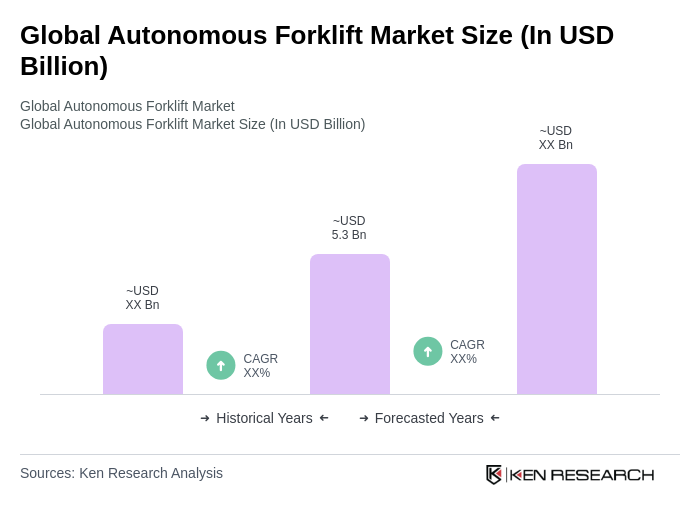
- The Global Autonomous Forklift Market is valued at USD 5.3 billion, based on a five-year historical analysis, reflecting consolidated estimates from multiple industry sources that place the market in the low-to-mid USD 5 billion range in the latest reported period. This growth is primarily driven by the increasing demand for automation in warehouses and manufacturing facilities to enhance operational efficiency and reduce labor costs, alongside labor shortages and safety improvements delivered by LiDAR- and vision-enabled navigation. The rise in e-commerce and the need for faster order fulfillment have further accelerated adoption across logistics and 3PL networks.
- Key players in this market include the United States, Germany, and China, which lead due to advanced manufacturing bases, strong intralogistics OEMs, and sustained investments in automation, with Asia Pacific cited as the largest regional market driven by e-commerce and logistics expansion.
- In 2023, the European Union advanced a safety regulatory framework for automated and autonomous machinery under the EU Machinery Regulation (replacing the Machinery Directive) and complementary standards for mobile industrial robots, aiming to ensure integrated safety functions (sensing, emergency stop, speed/zone monitoring) on autonomous industrial vehicles used in workplaces, including forklifts.
Global Autonomous Forklift Market Segmentation
By Type:
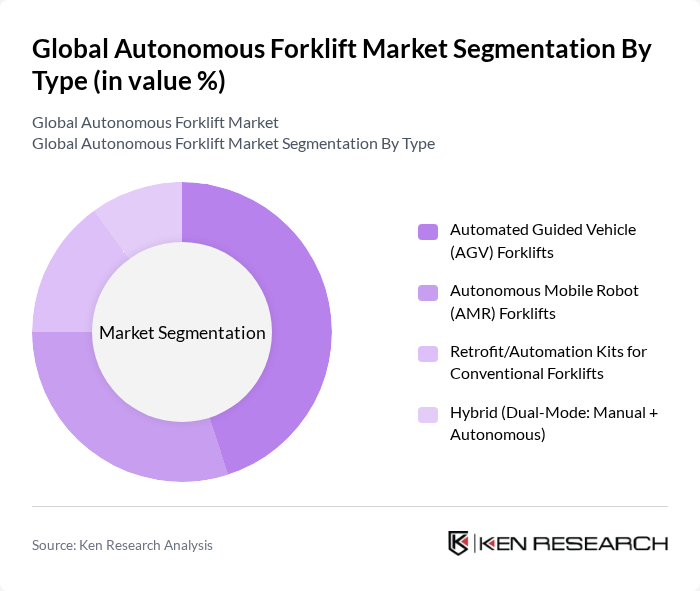
The segmentation by type includes Automated Guided Vehicle (AGV) Forklifts, Autonomous Mobile Robot (AMR) Forklifts, Retrofit/Automation Kits for Conventional Forklifts, and Hybrid (Dual-Mode: Manual + Autonomous). AGV forklifts historically have strong penetration in manufacturing and high-throughput logistics due to fixed-path operations and mature safety-certified navigation, while AMR forklifts have been rapidly adopted for flexible workflows, dynamic routing, and faster reconfiguration in e-commerce and 3PL environments. The growing trend toward software-driven fleet orchestration and vision/LiDAR SLAM has expanded use cases for both AGV and AMR formats across brownfield sites.
By End-User:
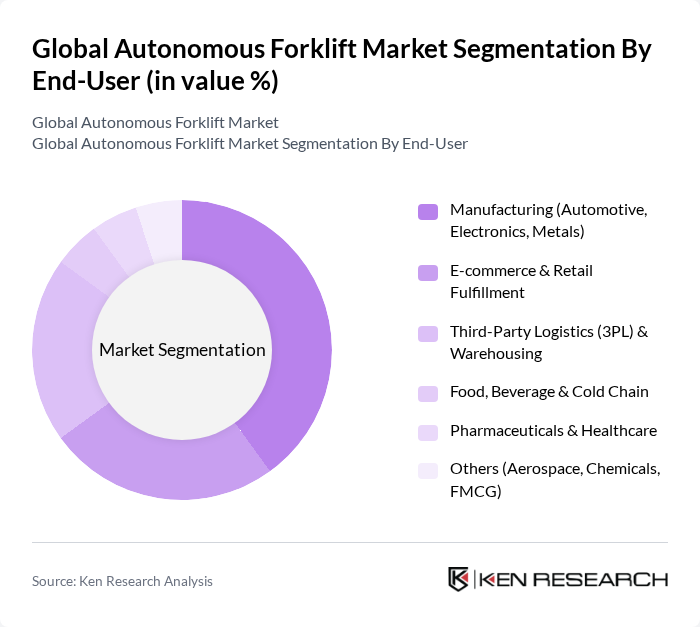
The end-user segmentation includes Manufacturing (Automotive, Electronics, Metals), E-commerce & Retail Fulfillment, Third-Party Logistics (3PL) & Warehousing, Food, Beverage & Cold Chain, Pharmaceuticals & Healthcare, and Others (Aerospace, Chemicals, FMCG). Manufacturing, particularly automotive and electronics, maintains strong demand given repetitive, high-volume material flows and precision requirements, while e-commerce and 3PL are accelerating adoption to address labor constraints and peak season variability through automated pallet movement and trailer unloading. Food and cold chain deployments are supported by consistent throughput needs and safety/hygiene advantages of automation in controlled environments.
Global Autonomous Forklift Market Competitive Landscape
The Global Autonomous Forklift Market is characterized by a dynamic mix of regional and international players. Leading participants such as Toyota Industries Corporation, KION Group AG (Linde Material Handling, STILL), Jungheinrich AG, Hyster-Yale Materials Handling, Inc. (Hyster, Yale), Crown Equipment Corporation, Mitsubishi Logisnext Co., Ltd. (UniCarriers, Nichiyu), Daifuku Co., Ltd., Seegrid Corporation, BALYO SA, AGILOX Services GmbH, Oceaneering International, Inc. (Mobile Robotics), SSI Schäfer Group, Rocla Solutions Oy (Mitsubishi Logisnext Europe), E&K Automation GmbH (EK Robotics), OTTO Motors by Rockwell Automation contribute to innovation, geographic expansion, and service delivery in this space, with OEMs and robotics firms collaborating on AI-powered navigation, digital twins, and trailer loading automation.
Global Autonomous Forklift Market Industry Analysis
Growth Drivers
- Increased Demand for Automation in Warehousing:The global push for automation in warehousing is driven by the need for efficiency and accuracy. In future, the warehousing sector is projected to reach $1.3 trillion, with automation technologies expected to account for 35% of this growth. Companies are investing heavily in autonomous solutions to streamline operations, reduce human error, and enhance productivity, leading to a significant uptick in demand for autonomous forklifts.
- Labor Shortages in Logistics and Supply Chain:The logistics sector is facing a critical labor shortage, with an estimated 1.5 million positions unfilled in the U.S. alone in future. This shortage is prompting companies to adopt autonomous forklifts to maintain operational efficiency. By automating material handling processes, businesses can mitigate the impact of labor shortages, ensuring that supply chains remain robust and responsive to market demands.
- Advancements in Robotics and AI Technology:The rapid evolution of robotics and artificial intelligence is a key driver for the autonomous forklift market. In future, the global robotics market is expected to exceed $250 billion, with AI technologies enhancing the capabilities of autonomous forklifts. These advancements enable improved navigation, obstacle detection, and decision-making, making autonomous forklifts more reliable and efficient in complex warehouse environments.
Market Challenges
- High Initial Investment Costs:One of the primary challenges facing the adoption of autonomous forklifts is the high initial investment required. The average cost of an autonomous forklift can range from $60,000 to $180,000, depending on the technology and features. This upfront expenditure can deter small to medium-sized enterprises from investing in automation, limiting market growth and adoption rates in the sector.
- Integration with Existing Systems:Integrating autonomous forklifts into existing warehouse management systems poses significant challenges. Many facilities operate on legacy systems that may not be compatible with new technologies. In future, approximately 65% of warehouses are expected to face integration issues, which can lead to operational disruptions and increased costs, hindering the overall adoption of autonomous solutions in the market.
Global Autonomous Forklift Market Future Outlook
The future of the autonomous forklift market appears promising, driven by technological advancements and increasing automation needs. As companies continue to prioritize operational efficiency, the integration of IoT and AI technologies will enhance the functionality of autonomous forklifts. Additionally, the growing emphasis on sustainability will likely lead to the development of electric and eco-friendly models, further propelling market growth. The focus on smart warehousing solutions will also create new avenues for innovation and investment in this sector.
Market Opportunities
- Expansion in E-commerce and Retail Sectors:The e-commerce sector is projected to reach $7.2 trillion in future, driving demand for efficient logistics solutions. Autonomous forklifts can significantly enhance order fulfillment processes, making them a vital asset for retailers looking to optimize their supply chains and meet consumer expectations for rapid delivery.
- Development of Smart Warehousing Solutions:The trend towards smart warehousing is creating opportunities for autonomous forklift manufacturers. In future, investments in smart warehouse technologies are expected to exceed $40 billion. This shift will encourage partnerships between technology providers and forklift manufacturers, fostering innovation and expanding market reach.
Scope of the Report
| Segment | Sub-Segments |
|---|---|
| By Type | Automated Guided Vehicle (AGV) Forklifts Autonomous Mobile Robot (AMR) Forklifts Retrofit/Automation Kits for Conventional Forklifts Hybrid (Dual-Mode: Manual + Autonomous) |
| By End-User | Manufacturing (Automotive, Electronics, Metals) E-commerce & Retail Fulfillment Third-Party Logistics (3PL) & Warehousing Food, Beverage & Cold Chain Pharmaceuticals & Healthcare Others (Aerospace, Chemicals, FMCG) |
| By Payload Capacity | Light Duty (Up to 1,000 kg) Medium Duty (1,000 kg - 3,000 kg) Heavy Duty (Above 3,000 kg) |
| By Application | Pallet Handling & Putaway (Indoor) Dock-to-Stock & Cross-Docking Replenishment & Order Picking Outdoor Yard & Trailer Loading Inventory Moves in Cold Storage |
| By Powertrain | Lithium-Ion Electric Lead-Acid Electric Hydrogen Fuel Cell Others (Diesel/LP with Autonomous Retrofit) |
| By Navigation Technology | LiDAR & SLAM-Based Vision-Based (Cameras/AI) QR/Reflector/Inductive Guidance GPS/RTK-Assisted (Outdoor) |
| By Region | North America Europe Asia-Pacific Latin America Middle East & Africa |
| By Sales Channel | Direct (OEM) System Integrators & Distributors Online & Marketplace |
| By Price Band | Budget (Entry-Level) Mid-Range Premium (High-End) |
Key Target Audience
Investors and Venture Capitalist Firms
Government and Regulatory Bodies (e.g., Occupational Safety and Health Administration, Federal Motor Carrier Safety Administration)
Manufacturers and Producers of Autonomous Forklifts
Logistics and Supply Chain Companies
Warehouse and Distribution Center Operators
Technology Providers and Software Developers
Industry Associations (e.g., Material Handling Industry, Robotics Industries Association)
Financial Institutions and Investment Banks
Players Mentioned in the Report:
Toyota Industries Corporation
KION Group AG (Linde Material Handling, STILL)
Jungheinrich AG
Hyster-Yale Materials Handling, Inc. (Hyster, Yale)
Crown Equipment Corporation
Mitsubishi Logisnext Co., Ltd. (UniCarriers, Nichiyu)
Daifuku Co., Ltd.
Seegrid Corporation
BALYO SA
AGILOX Services GmbH
Oceaneering International, Inc. (Mobile Robotics)
SSI Schafer Group
Rocla Solutions Oy (Mitsubishi Logisnext Europe)
E&K Automation GmbH (EK Robotics)
OTTO Motors by Rockwell Automation
Table of Contents
Market Assessment Phase
1. Executive Summary and Approach
2. Global Autonomous Forklift Market Overview
2.1 Key Insights and Strategic Recommendations
2.2 Global Autonomous Forklift Market Overview
2.3 Definition and Scope
2.4 Evolution of Market Ecosystem
2.5 Timeline of Key Regulatory Milestones
2.6 Value Chain & Stakeholder Mapping
2.7 Business Cycle Analysis
2.8 Policy & Incentive Landscape
3. Global Autonomous Forklift Market Analysis
3.1 Growth Drivers
3.1.1 Increased Demand for Automation in Warehousing
3.1.2 Labor Shortages in Logistics and Supply Chain
3.1.3 Advancements in Robotics and AI Technology
3.1.4 Rising Focus on Operational Efficiency
3.2 Market Challenges
3.2.1 High Initial Investment Costs
3.2.2 Integration with Existing Systems
3.2.3 Safety Concerns and Regulatory Compliance
3.2.4 Limited Awareness and Understanding of Technology
3.3 Market Opportunities
3.3.1 Expansion in E-commerce and Retail Sectors
3.3.2 Development of Smart Warehousing Solutions
3.3.3 Growth in Emerging Markets
3.3.4 Partnerships with Technology Providers
3.4 Market Trends
3.4.1 Increasing Adoption of IoT in Forklifts
3.4.2 Shift Towards Electric and Sustainable Solutions
3.4.3 Customization and Flexibility in Operations
3.4.4 Enhanced Data Analytics for Performance Monitoring
3.5 Government Regulation
3.5.1 Safety Standards for Autonomous Vehicles
3.5.2 Environmental Regulations on Emissions
3.5.3 Incentives for Automation Adoption
3.5.4 Compliance with Labor Laws
4. SWOT Analysis
5. Stakeholder Analysis
6. Porter's Five Forces Analysis
7. Global Autonomous Forklift Market Market Size, 2019-2024
7.1 By Value
7.2 By Volume
7.3 By Average Selling Price
8. Global Autonomous Forklift Market Segmentation
8.1 By Type
8.1.1 Automated Guided Vehicle (AGV) Forklifts
8.1.2 Autonomous Mobile Robot (AMR) Forklifts
8.1.3 Retrofit/Automation Kits for Conventional Forklifts
8.1.4 Hybrid (Dual-Mode: Manual + Autonomous)
8.2 By End-User
8.2.1 Manufacturing (Automotive, Electronics, Metals)
8.2.2 E-commerce & Retail Fulfillment
8.2.3 Third-Party Logistics (3PL) & Warehousing
8.2.4 Food, Beverage & Cold Chain
8.2.5 Pharmaceuticals & Healthcare
8.2.6 Others (Aerospace, Chemicals, FMCG)
8.3 By Payload Capacity
8.3.1 Light Duty (Up to 1,000 kg)
8.3.2 Medium Duty (1,000 kg - 3,000 kg)
8.3.3 Heavy Duty (Above 3,000 kg)
8.4 By Application
8.4.1 Pallet Handling & Putaway (Indoor)
8.4.2 Dock-to-Stock & Cross-Docking
8.4.3 Replenishment & Order Picking
8.4.4 Outdoor Yard & Trailer Loading
8.4.5 Inventory Moves in Cold Storage
8.5 By Powertrain
8.5.1 Lithium-Ion Electric
8.5.2 Lead-Acid Electric
8.5.3 Hydrogen Fuel Cell
8.5.4 Others (Diesel/LP with Autonomous Retrofit)
8.6 By Navigation Technology
8.6.1 LiDAR & SLAM-Based
8.6.2 Vision-Based (Cameras/AI)
8.6.3 QR/Reflector/Inductive Guidance
8.6.4 GPS/RTK-Assisted (Outdoor)
8.7 By Region
8.7.1 North America
8.7.2 Europe
8.7.3 Asia-Pacific
8.7.4 Latin America
8.7.5 Middle East & Africa
8.8 By Sales Channel
8.8.1 Direct (OEM)
8.8.2 System Integrators & Distributors
8.8.3 Online & Marketplace
8.9 By Price Band
8.9.1 Budget (Entry-Level)
8.9.2 Mid-Range
8.9.3 Premium (High-End)
9. Global Autonomous Forklift Market Competitive Analysis
9.1 Market Share of Key Players
9.2 Cross Comparison of Key Players
9.2.1 Company Name
9.2.2 Installed Base (Units Deployed)
9.2.3 Revenue from Autonomous/Automated Forklifts (USD)
9.2.4 YoY Growth in Autonomous Segment (%)
9.2.5 Geographic Footprint (Regions/Countries Served)
9.2.6 Product Portfolio Breadth (AGV/AMR/Retrofit/Hybrid)
9.2.7 Navigation Stack Maturity (LiDAR/SLAM/Vision/GPS)
9.2.8 Safety Certification Coverage (ISO 3691?4, CE, ANSI/ITSDF)
9.2.9 Average Deal Size / ASP (USD per Unit)
9.2.10 Integration Ecosystem (WMS/WES/ERP Partnerships)
9.2.11 Fleet Management & Telemetry Capabilities
9.2.12 Deployment Lead Time (Order-to-Go-Live, Weeks)
9.2.13 Service Model & Uptime SLA (%)
9.2.14 Reference Customers by Vertical
9.3 SWOT Analysis of Top Players
9.4 Pricing Analysis
9.5 Detailed Profile of Major Companies
9.5.1 Toyota Industries Corporation
9.5.2 KION Group AG (Linde Material Handling, STILL)
9.5.3 Jungheinrich AG
9.5.4 Hyster-Yale Materials Handling, Inc. (Hyster, Yale)
9.5.5 Crown Equipment Corporation
9.5.6 Mitsubishi Logisnext Co., Ltd. (UniCarriers, Nichiyu)
9.5.7 Daifuku Co., Ltd.
9.5.8 Seegrid Corporation
9.5.9 BALYO SA
9.5.10 AGILOX Services GmbH
9.5.11 Oceaneering International, Inc. (Mobile Robotics)
9.5.12 SSI Schäfer Group
9.5.13 Rocla Solutions Oy (Mitsubishi Logisnext Europe)
9.5.14 E&K Automation GmbH (EK Robotics)
9.5.15 OTTO Motors by Rockwell Automation
10. Global Autonomous Forklift Market End-User Analysis
10.1 Procurement Behavior of Key Ministries
10.1.1 Government Procurement Policies
10.1.2 Budget Allocations for Automation
10.1.3 Evaluation Criteria for Suppliers
10.2 Corporate Spend on Infrastructure & Energy
10.2.1 Investment Trends in Automation
10.2.2 Budgeting for Technology Upgrades
10.2.3 Cost-Benefit Analysis of Autonomous Solutions
10.3 Pain Point Analysis by End-User Category
10.3.1 Operational Inefficiencies
10.3.2 High Labor Costs
10.3.3 Safety and Compliance Issues
10.4 User Readiness for Adoption
10.4.1 Training and Skill Development Needs
10.4.2 Technology Acceptance Levels
10.4.3 Infrastructure Readiness
10.5 Post-Deployment ROI and Use Case Expansion
10.5.1 Measurement of ROI
10.5.2 Case Studies of Successful Implementations
10.5.3 Future Use Case Opportunities
11. Global Autonomous Forklift Market Future Size, 2025-2030
11.1 By Value
11.2 By Volume
11.3 By Average Selling Price
Go-To-Market Strategy Phase
1. Whitespace Analysis + Business Model Canvas
1.1 Market Gaps Identification
1.2 Business Model Development
2. Marketing and Positioning Recommendations
2.1 Branding Strategies
2.2 Product USPs
3. Distribution Plan
3.1 Urban Retail Strategies
3.2 Rural NGO Tie-Ups
4. Channel & Pricing Gaps
4.1 Underserved Routes
4.2 Pricing Bands Analysis
5. Unmet Demand & Latent Needs
5.1 Category Gaps
5.2 Consumer Segments
6. Customer Relationship
6.1 Loyalty Programs
6.2 After-Sales Service
7. Value Proposition
7.1 Sustainability Initiatives
7.2 Integrated Supply Chains
8. Key Activities
8.1 Regulatory Compliance
8.2 Branding Efforts
8.3 Distribution Setup
9. Entry Strategy Evaluation
9.1 Domestic Market Entry Strategy
9.1.1 Product Mix Considerations
9.1.2 Pricing Band Strategy
9.1.3 Packaging Solutions
9.2 Export Entry Strategy
9.2.1 Target Countries Identification
9.2.2 Compliance Roadmap Development
10. Entry Mode Assessment
10.1 Joint Ventures
10.2 Greenfield Investments
10.3 Mergers & Acquisitions
10.4 Distributor Model Evaluation
11. Capital and Timeline Estimation
11.1 Capital Requirements
11.2 Timelines for Implementation
12. Control vs Risk Trade-Off
12.1 Ownership Considerations
12.2 Partnerships Evaluation
13. Profitability Outlook
13.1 Breakeven Analysis
13.2 Long-Term Sustainability Strategies
14. Potential Partner List
14.1 Distributors
14.2 Joint Ventures
14.3 Acquisition Targets
15. Execution Roadmap
15.1 Phased Plan for Market Entry
15.1.1 Market Setup
15.1.2 Market Entry
15.1.3 Growth Acceleration
15.1.4 Scale & Stabilize
15.2 Key Activities and Milestones
15.2.1 Milestone Planning
15.2.2 Activity Tracking
Research Methodology
Phase 1: Approach1
Desk Research
- Industry reports from logistics and automation associations
- Market analysis publications focusing on autonomous vehicles and robotics
- Government and regulatory documents related to warehouse automation
Primary Research
- Interviews with warehouse managers utilizing autonomous forklifts
- Surveys with logistics consultants specializing in automation solutions
- Field interviews with technology providers in the autonomous forklift sector
Validation & Triangulation
- Cross-validation of market data through multiple industry sources
- Triangulation of insights from primary interviews and secondary data
- Sanity checks conducted with a panel of industry experts
Phase 2: Market Size Estimation1
Top-down Assessment
- Analysis of global logistics spending and its impact on forklift adoption
- Segmentation of market size by region and application sectors
- Incorporation of trends in e-commerce and warehouse automation
Bottom-up Modeling
- Volume estimates based on sales data from leading forklift manufacturers
- Operational cost analysis for autonomous forklift deployment
- Estimation of market share based on technology adoption rates
Forecasting & Scenario Analysis
- Multi-variable regression analysis considering economic indicators and technology trends
- Scenario modeling based on varying levels of automation adoption
- Projections for market growth through 2030 under different regulatory environments
Phase 3: CATI Sample Composition1
| Scope Item/Segment | Sample Size | Target Respondent Profiles |
|---|---|---|
| Warehouse Automation Adoption | 120 | Warehouse Managers, Operations Directors |
| Logistics and Supply Chain Optimization | 100 | Supply Chain Analysts, Logistics Coordinators |
| Technology Integration in Material Handling | 80 | IT Managers, Automation Engineers |
| Market Trends in Autonomous Vehicles | 70 | Industry Analysts, Business Development Managers |
| Investment in Robotics for Warehousing | 90 | Financial Analysts, Procurement Managers |
Frequently Asked Questions
What is the current value of the Global Autonomous Forklift Market?
The Global Autonomous Forklift Market is valued at approximately USD 5.3 billion, reflecting a significant growth trend driven by increased automation in warehouses and manufacturing facilities, as well as the rise in e-commerce and logistics demands.
What are the main drivers of growth in the autonomous forklift market?
Which regions are leading in the autonomous forklift market?
What types of autonomous forklifts are available in the market?
Other Regional/Country Reports
Indonesia Autonomous Forklift Market
Malaysia Autonomous Forklift Market
APAC Autonomous Forklift Market
Why Buy From Us?

What makes us stand out is that our consultants follow Robust, Refine and Result (RRR) methodology. Robust for clear definitions, approaches and sanity checking, Refine for differentiating respondents' facts and opinions, and Result for presenting data with story.

We have set a benchmark in the industry by offering our clients with syndicated and customized market research reports featuring coverage of entire market as well as meticulous research and analyst insights.

While we don't replace traditional research, we flip the method upside down. Our dual approach of Top Bottom & Bottom Top ensures quality deliverable by not just verifying company fundamentals but also looking at the sector and macroeconomic factors.

With one step in the future, our research team constantly tries to show you the bigger picture. We help with some of the tough questions you may encounter along the way: How is the industry positioned? Best marketing channel? KPI's of competitors? By aligning every element, we help maximize success.

Our report gives you instant access to the answers and sources that other companies might choose to hide. We elaborate each steps of research methodology we have used and showcase you the sample size to earn your trust.

If you need any support, we are here! We pride ourselves on universe strength, data quality, and quick, friendly, and professional service.