Region:Global
Author(s):Shubham
Product Code:KRAD0746
Pages:97
Published On:August 2025
By Type:The market is segmented into various types of weather radar systems, each serving specific operational needs in aviation.
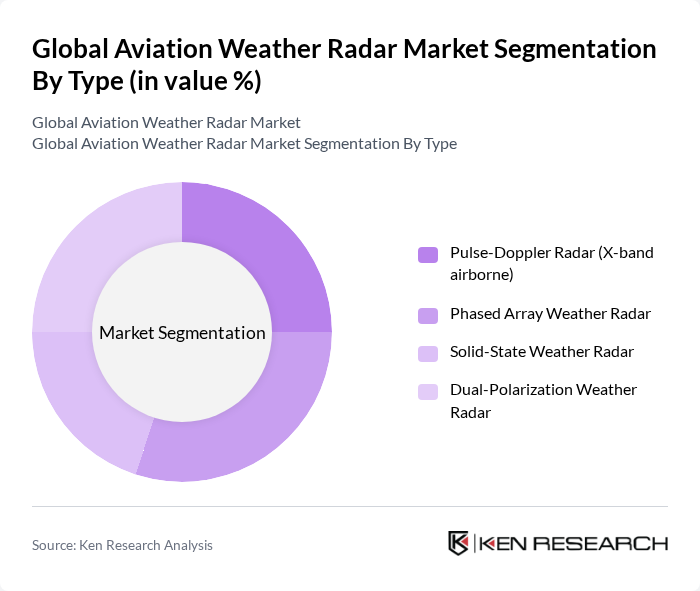
Phased array and solid-state architectures are gaining traction for faster volumetric scanning and higher reliability, but conventional X-band pulse-Doppler remains widely installed on commercial and business aircraft; dual-polarization is more prevalent in ground-based systems, with increasing integration and data fusion across ATM networks .
By End-User:The market is segmented based on the end-users of aviation weather radar systems, which include various sectors within the aviation industry.
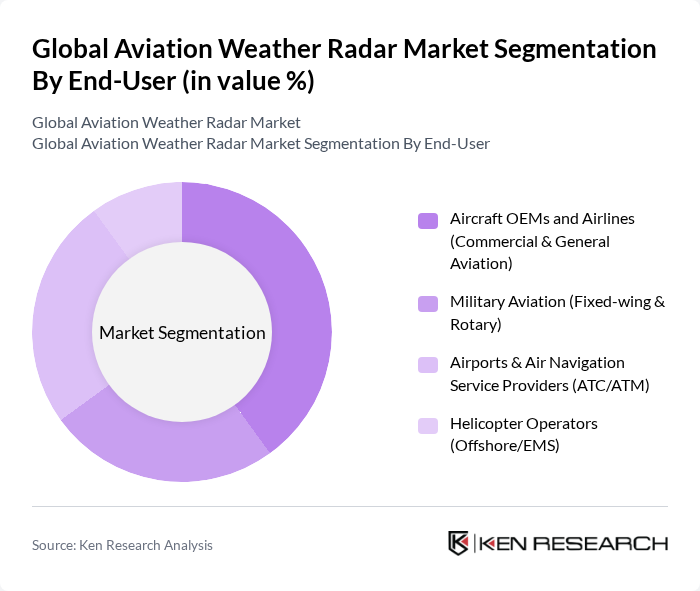
The Aircraft OEMs and Airlines segment leads due to fleet deliveries, retrofit programs, and avionics upgrades focused on turbulence/windshear detection, automation integration, and reliability improvements; ANSPs and airports continue investing in networked ground radars and data integration to support ATM efficiency .
The Global Aviation Weather Radar Market is characterized by a dynamic mix of regional and international players. Leading participants such as Honeywell International Inc., Collins Aerospace (RTX Corporation), L3Harris Technologies, Inc., Telephonics Corporation, EWR Radar Systems, Inc., Garmin Ltd., Vaisala Oyj, Leonardo S.p.A., Thales Group, Indra Sistemas, S.A., Mitsubishi Electric Corporation, Elta Systems Ltd. (IAI), BAE Systems plc, Northrop Grumman Corporation, Rockwell Collins (legacy brand under Collins Aerospace) contribute to innovation, geographic expansion, and service delivery in this space.
The future of the aviation weather radar market appears promising, driven by ongoing technological advancements and increasing safety regulations. As digitalization continues to reshape the aviation industry, the integration of AI and machine learning into radar systems will enhance predictive capabilities. Furthermore, the expansion into emerging markets, particularly in Asia-Pacific, is expected to create new opportunities for growth. These trends will likely lead to a more robust and responsive aviation weather radar ecosystem, addressing the evolving needs of the industry.
| Segment | Sub-Segments |
|---|---|
| By Type | Pulse-Doppler Radar (X-band airborne) Phased Array Weather Radar Solid-State Weather Radar Dual-Polarization Weather Radar |
| By End-User | Aircraft OEMs and Airlines (Commercial & General Aviation) Military Aviation (Fixed-wing & Rotary) Airports & Air Navigation Service Providers (ATC/ATM) Helicopter Operators (Offshore/EMS) |
| By Application | Onboard Weather Detection & Hazard Avoidance (Turbulence/Windshear) Air Traffic Management & Nowcasting Airport Surveillance & Weather Monitoring Search & Rescue and Mission Systems Support |
| By Component | Hardware (Transmitter/Receiver, Antenna, Signal Processor, LRUs) Software & Algorithms (Beamforming, Turbulence/Windshear, Nowcast) Services (Installation, Calibration, MRO, Upgrades) |
| By Distribution Channel | Direct to OEM (Line-fit) Aftermarket (Airlines/MROs) System Integrators & Distributors Government Procurement (Airports/ATC) |
| By Region | North America Europe Asia-Pacific Latin America Middle East & Africa |
| By Frequency/Range | X-Band (Airborne) C-Band (Airport/ATC) S-Band (Long-Range/En-Route) Ka/Ku-Band and Others |
| Scope Item/Segment | Sample Size | Target Respondent Profiles |
|---|---|---|
| Airport Operations | 110 | Airport Managers, Operations Directors |
| Aviation Weather Services | 85 | Meteorologists, Weather Analysts |
| Radar Technology Manufacturers | 60 | Product Managers, R&D Engineers |
| Regulatory Bodies | 45 | Policy Makers, Aviation Safety Inspectors |
| Airline Operations | 90 | Flight Operations Managers, Safety Officers |
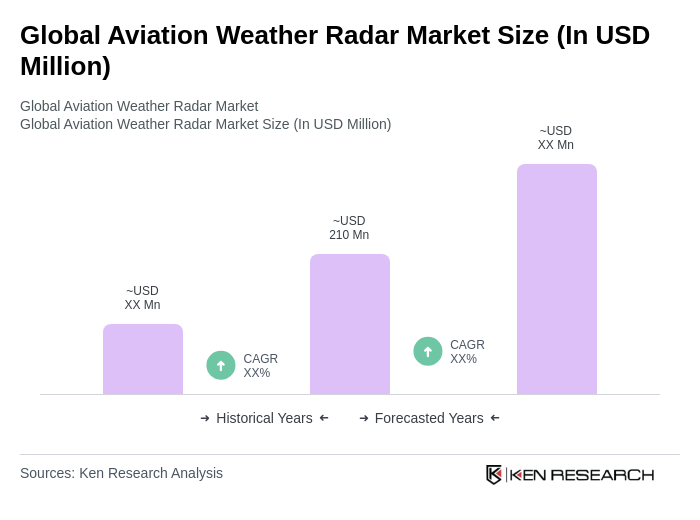
The Global Aviation Weather Radar Market is valued at approximately USD 210 million, reflecting historical analysis and demand across commercial, military, and general aviation fleets. This valuation aligns with various industry sources that estimate the market in the low hundreds of millions.

What makes us stand out is that our consultants follow Robust, Refine and Result (RRR) methodology. Robust for clear definitions, approaches and sanity checking, Refine for differentiating respondents' facts and opinions, and Result for presenting data with story.

We have set a benchmark in the industry by offering our clients with syndicated and customized market research reports featuring coverage of entire market as well as meticulous research and analyst insights.

While we don't replace traditional research, we flip the method upside down. Our dual approach of Top Bottom & Bottom Top ensures quality deliverable by not just verifying company fundamentals but also looking at the sector and macroeconomic factors.

With one step in the future, our research team constantly tries to show you the bigger picture. We help with some of the tough questions you may encounter along the way: How is the industry positioned? Best marketing channel? KPI's of competitors? By aligning every element, we help maximize success.

Our report gives you instant access to the answers and sources that other companies might choose to hide. We elaborate each steps of research methodology we have used and showcase you the sample size to earn your trust.

If you need any support, we are here! We pride ourselves on universe strength, data quality, and quick, friendly, and professional service.













