About the Report
Base Year 2024Global Baby Monitors Market Overview
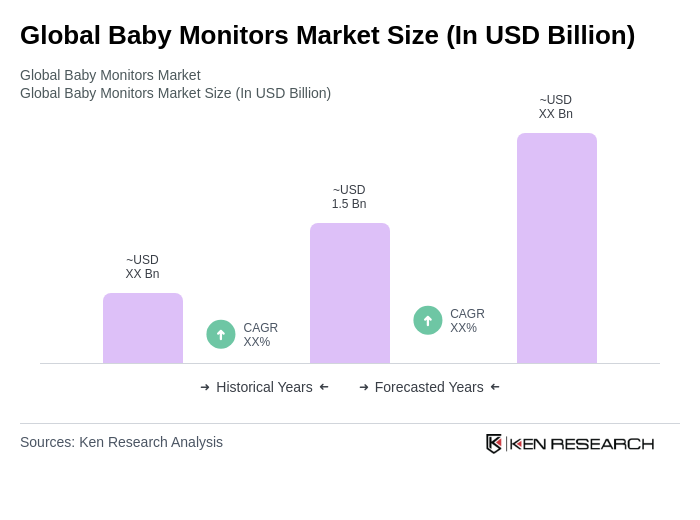
- The Global Baby Monitors Market is valued at USD 1.5 billion, based on a five-year historical analysis. Recent industry audits place the market around USD 1.5–1.65 billion, aligning with independent estimates that cite USD 1.5 billion and USD 1.65 billion, respectively . This growth is primarily driven by the increasing number of working parents, rising awareness about child safety, and advancements in technology that enhance the functionality of baby monitors, including AI-enabled sleep and breathing analytics and app-based remote monitoring . The demand for smart and app-enabled monitors has surged, reflecting a shift towards integrated, user-friendly solutions with features like HD video, two-way talk, sleep tracking, and alerts .
- Key markets include the United States, Germany, and China, supported by high consumer spending on baby products, strong retail and e-commerce penetration, and significant smart home adoption; North America is consistently cited as the largest regional market, with Asia-Pacific rising on the back of urbanization and working-parent demographics . The presence of established brands and robust distribution networks across mass retail, specialty baby channels, and online marketplaces further solidifies leadership positions .
- There is no federal U.S. regulation enacted in 2023 that universally mandates all baby monitors to meet a new secure wireless communication protocol; baby monitors generally fall under FCC radio equipment requirements and voluntary safety standards, while connected devices face evolving privacy and cybersecurity guidance rather than a single 2023 mandate specific to baby monitors. Accordingly, the cited claim of a 2023 U.S. regulation requiring secure wireless protocols for all baby monitors is not supported by authoritative policy notices or rulemakings from that period .
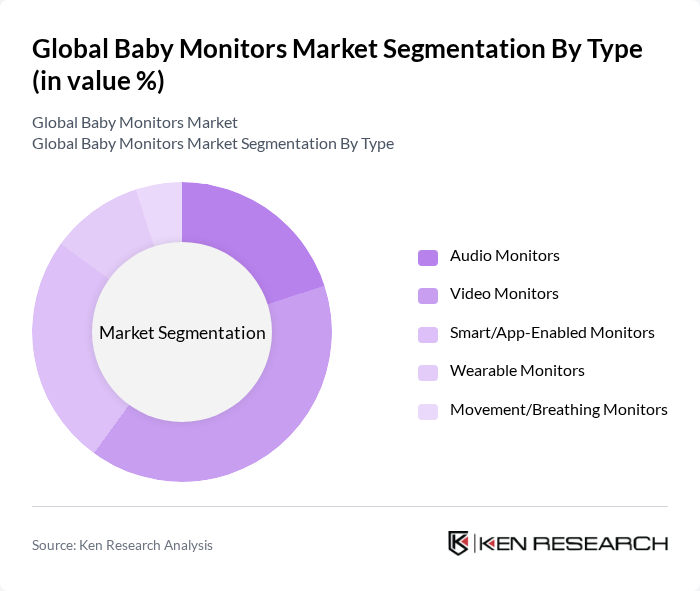
Global Baby Monitors Market Segmentation
By Type:The market is segmented into various types of baby monitors, including audio monitors, video monitors, smart/app-enabled monitors, wearable monitors, and movement/breathing monitors. Among these,video monitorshave gained significant traction due to real-time visual feedback and night vision, and are the largest product category, especially within smart audio-video formats . The increasing integration of smart technology into baby monitors has also led to a rise in demand forsmart/app-enabledmonitors, which offer remote access, alerts, sleep analytics, and voice assistant integrations via Wi?Fi/mobile apps .
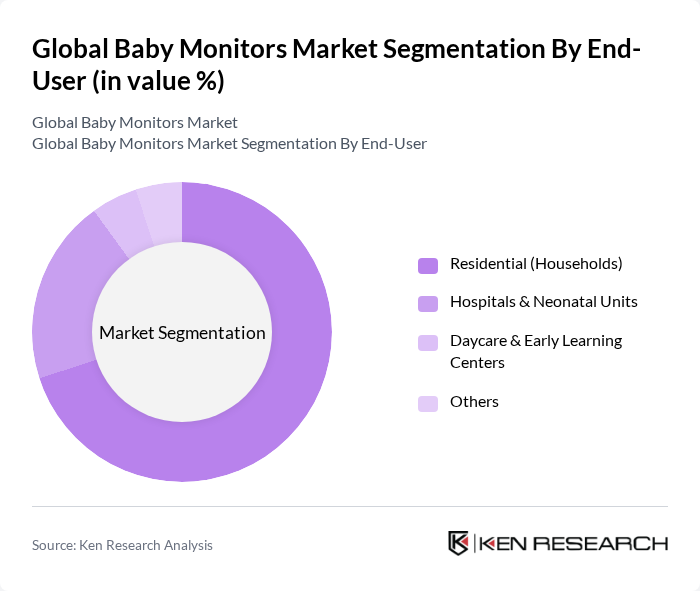
By End-User:The end-user segmentation includes residential (households), hospitals & neonatal units, daycare & early learning centers, and others. Theresidentialsegment dominates, driven by working-parent schedules, smart home adoption, and app-based remote monitoring expectations for at-home care . Hospitals and neonatal units also contribute, particularly for systems with vital sign or movement/breathing tracking capabilities .
Global Baby Monitors Market Competitive Landscape
The Global Baby Monitors Market is characterized by a dynamic mix of regional and international players. Leading participants such as Motorola Nursery (formerly Hubble Connected, licensed by Motorola), Philips Avent (Koninklijke Philips N.V.), Summer Infant, Inc. (Summer), Nanit, Inc., Owlet Baby Care, Inc., Angelcare Monitors Inc., VTech Communications, Inc. (VTech Holdings Limited), Babysense (Hisense Ltd.), iBaby Labs, Inc., Lollipop (Masterwork Aoitek Co., Ltd.), Miku, Inc., HelloBaby, Chicco (Artsana S.p.A.), Graco (Newell Brands), Arlo Technologies, Inc. contribute to innovation, geographic expansion, and service delivery in this space.
Global Baby Monitors Market Industry Analysis
Growth Drivers
- Increasing Parental Awareness of Child Safety:The global emphasis on child safety has surged, with 75% of parents prioritizing safety features in baby products. This heightened awareness is reflected in the increasing sales of baby monitors, which reached approximately 13 million units in the future. As families become more informed about potential risks, the demand for reliable monitoring solutions is expected to continue rising, supported by educational campaigns and community resources promoting child safety.
- Technological Advancements in Monitoring Devices:The integration of advanced technologies, such as HD video and two-way audio, has transformed baby monitors into sophisticated devices. In the future, over 65% of new models featured Wi-Fi connectivity, allowing parents to monitor their children remotely via smartphones. This trend is driven by consumer demand for enhanced functionality, with the global market for smart baby monitors projected to grow significantly as manufacturers innovate and improve product offerings.
- Rising Disposable Income Among Families:As global disposable income rises, particularly in emerging markets, families are increasingly willing to invest in premium baby monitoring solutions. In the future, the average household income in the U.S. is projected to reach $85,000, enabling parents to allocate more funds toward child safety products. This trend is expected to drive sales of high-end baby monitors, which offer advanced features and improved reliability, catering to the growing middle class.
Market Challenges
- High Competition Among Manufacturers:The baby monitor market is characterized by intense competition, with over 160 brands vying for market share. This saturation leads to price wars, which can erode profit margins. In the future, the average selling price of baby monitors decreased by 8%, making it challenging for manufacturers to maintain profitability while investing in innovation and marketing to differentiate their products in a crowded marketplace.
- Concerns Regarding Data Privacy and Security:With the rise of smart baby monitors, concerns about data privacy have escalated. In the future, 50% of parents expressed worries about unauthorized access to their devices. High-profile security breaches have raised alarms, prompting calls for stricter regulations. Manufacturers must address these concerns by implementing robust security measures, as failure to do so could lead to decreased consumer trust and potential legal ramifications.
Global Baby Monitors Market Future Outlook
The future of the baby monitors market appears promising, driven by ongoing technological advancements and increasing consumer demand for enhanced safety features. As manufacturers continue to innovate, integrating AI and machine learning into their products, the market is likely to see a surge in smart monitoring solutions. Additionally, the expansion into emerging markets will provide new growth avenues, as families seek reliable and affordable monitoring options to ensure their children's safety.
Market Opportunities
- Expansion into Emerging Markets:Emerging markets present significant growth opportunities for baby monitor manufacturers. With a projected increase in birth rates and rising disposable incomes, countries like India and Brazil are expected to see a surge in demand for baby monitoring solutions. This trend could lead to an estimated 25% increase in sales in these regions by the future, as families prioritize child safety.
- Development of Multi-Functional Devices:The demand for multi-functional baby monitors is on the rise, as parents seek devices that offer more than just basic monitoring. Products that combine features such as temperature monitoring, sleep tracking, and health monitoring are gaining traction. This trend is expected to create a market segment worth approximately $600 million by the future, as families look for comprehensive solutions to support their parenting needs.
Scope of the Report
| Segment | Sub-Segments |
|---|---|
| By Type | Audio Monitors Video Monitors Smart/App-Enabled Monitors Wearable Monitors Movement/Breathing Monitors |
| By End-User | Residential (Households) Hospitals & Neonatal Units Daycare & Early Learning Centers Others |
| By Distribution Channel | Online Retail (Marketplaces, Brand.com) Offline Retail (Specialty, Super/Hypermarkets, Pharmacies) Direct/B2B (Healthcare, Institutional) Others |
| By Price Range | Budget (Sub-$100) Mid-Range ($100–$250) Premium ($250+) |
| By Features | Night Vision & HD Video Two-Way Communication Temperature/Humidity & Sleep Tracking AI Analytics (Cry/Sound Detection, Face Detection) Non-Wi-Fi/RF (DECT/ FHSS) vs Wi?Fi Connectivity |
| By Technology | Audio Monitoring Video Monitoring Hybrid (Video + Movement/Breathing) |
| By Region | North America Europe Asia-Pacific Latin America Middle East & Africa |
Key Target Audience
Investors and Venture Capitalist Firms
Government and Regulatory Bodies (e.g., Consumer Product Safety Commission, Federal Communications Commission)
Manufacturers and Producers
Distributors and Retailers
Healthcare Providers and Pediatricians
Technology Providers
Industry Associations (e.g., Juvenile Products Manufacturers Association)
Financial Institutions
Players Mentioned in the Report:
Motorola Nursery (formerly Hubble Connected, licensed by Motorola)
Philips Avent (Koninklijke Philips N.V.)
Summer Infant, Inc. (Summer)
Nanit, Inc.
Owlet Baby Care, Inc.
Angelcare Monitors Inc.
VTech Communications, Inc. (VTech Holdings Limited)
Babysense (Hisense Ltd.)
iBaby Labs, Inc.
Lollipop (Masterwork Aoitek Co., Ltd.)
Miku, Inc.
HelloBaby
Chicco (Artsana S.p.A.)
Graco (Newell Brands)
Arlo Technologies, Inc.
Table of Contents
Market Assessment Phase
1. Executive Summary and Approach
2. Global Baby Monitors Market Overview
2.1 Key Insights and Strategic Recommendations
2.2 Global Baby Monitors Market Overview
2.3 Definition and Scope
2.4 Evolution of Market Ecosystem
2.5 Timeline of Key Regulatory Milestones
2.6 Value Chain & Stakeholder Mapping
2.7 Business Cycle Analysis
2.8 Policy & Incentive Landscape
3. Global Baby Monitors Market Analysis
3.1 Growth Drivers
3.1.1 Increasing parental awareness of child safety
3.1.2 Technological advancements in monitoring devices
3.1.3 Rising disposable income among families
3.1.4 Growing demand for smart home devices
3.2 Market Challenges
3.2.1 High competition among manufacturers
3.2.2 Concerns regarding data privacy and security
3.2.3 Rapid technological changes
3.2.4 Price sensitivity among consumers
3.3 Market Opportunities
3.3.1 Expansion into emerging markets
3.3.2 Development of multi-functional devices
3.3.3 Partnerships with healthcare providers
3.3.4 Increasing online sales channels
3.4 Market Trends
3.4.1 Integration of AI and machine learning
3.4.2 Growth of mobile applications for monitoring
3.4.3 Shift towards eco-friendly materials
3.4.4 Customization and personalization of products
3.5 Government Regulation
3.5.1 Safety standards for electronic devices
3.5.2 Data protection regulations
3.5.3 Certification requirements for baby products
3.5.4 Import/export regulations for electronic goods
4. SWOT Analysis
5. Stakeholder Analysis
6. Porter's Five Forces Analysis
7. Global Baby Monitors Market Market Size, 2019-2024
7.1 By Value
7.2 By Volume
7.3 By Average Selling Price
8. Global Baby Monitors Market Segmentation
8.1 By Type
8.1.1 Audio Monitors
8.1.2 Video Monitors
8.1.3 Smart/App-Enabled Monitors
8.1.4 Wearable Monitors
8.1.5 Movement/Breathing Monitors
8.2 By End-User
8.2.1 Residential (Households)
8.2.2 Hospitals & Neonatal Units
8.2.3 Daycare & Early Learning Centers
8.2.4 Others
8.3 By Distribution Channel
8.3.1 Online Retail (Marketplaces, Brand.com)
8.3.2 Offline Retail (Specialty, Super/Hypermarkets, Pharmacies)
8.3.3 Direct/B2B (Healthcare, Institutional)
8.3.4 Others
8.4 By Price Range
8.4.1 Budget (Sub-$100)
8.4.2 Mid-Range ($100–$250)
8.4.3 Premium ($250+)
8.5 By Features
8.5.1 Night Vision & HD Video
8.5.2 Two-Way Communication
8.5.3 Temperature/Humidity & Sleep Tracking
8.5.4 AI Analytics (Cry/Sound Detection, Face Detection)
8.5.5 Non-Wi-Fi/RF (DECT/ FHSS) vs Wi?Fi Connectivity
8.6 By Technology
8.6.1 Audio Monitoring
8.6.2 Video Monitoring
8.6.3 Hybrid (Video + Movement/Breathing)
8.7 By Region
8.7.1 North America
8.7.2 Europe
8.7.3 Asia-Pacific
8.7.4 Latin America
8.7.5 Middle East & Africa
9. Global Baby Monitors Market Competitive Analysis
9.1 Market Share of Key Players
9.2 Cross Comparison of Key Players
9.2.1 Company Name
9.2.2 Group Size (Large, Medium, or Small as per industry convention)
9.2.3 Revenue Growth Rate (YoY for baby monitor segment)
9.2.4 Market Penetration (No. of countries/retail doors; channel mix online vs offline)
9.2.5 Active Users/Install Base (for smart/app-enabled devices)
9.2.6 Average Selling Price (by flagship model tier)
9.2.7 Product Innovation Velocity (feature releases/firmware updates per year)
9.2.8 Distribution Efficiency (days of inventory; on-time fill rate)
9.2.9 Return/Defect Rate (RMA within 12 months)
9.2.10 Customer Satisfaction/Rating (avg. rating; NPS)
9.2.11 Data Privacy & Security Posture (Wi?Fi security, certifications, breach record)
9.2.12 Certifications & Compliance (FCC/CE, ASTM, EN standards)
9.3 SWOT Analysis of Top Players
9.4 Pricing Analysis
9.5 Detailed Profile of Major Companies
9.5.1 Motorola Nursery (formerly Hubble Connected, licensed by Motorola)
9.5.2 Philips Avent (Koninklijke Philips N.V.)
9.5.3 Summer Infant, Inc. (Summer)
9.5.4 Nanit, Inc.
9.5.5 Owlet Baby Care, Inc.
9.5.6 Angelcare Monitors Inc.
9.5.7 VTech Communications, Inc. (VTech Holdings Limited)
9.5.8 Babysense (Hisense Ltd.)
9.5.9 iBaby Labs, Inc.
9.5.10 Lollipop (Masterwork Aoitek Co., Ltd.)
9.5.11 Miku, Inc.
9.5.12 HelloBaby
9.5.13 Chicco (Artsana S.p.A.)
9.5.14 Graco (Newell Brands)
9.5.15 Arlo Technologies, Inc.
10. Global Baby Monitors Market End-User Analysis
10.1 Procurement Behavior of Key Ministries
10.1.1 Government procurement policies
10.1.2 Budget allocation for child safety products
10.1.3 Collaboration with manufacturers
10.1.4 Evaluation criteria for procurement
10.2 Corporate Spend on Infrastructure & Energy
10.2.1 Investment in child safety initiatives
10.2.2 Funding for technological advancements
10.2.3 Partnerships with tech companies
10.3 Pain Point Analysis by End-User Category
10.3.1 Safety concerns
10.3.2 Usability issues
10.3.3 Cost constraints
10.3.4 Technology adoption barriers
10.4 User Readiness for Adoption
10.4.1 Awareness of product benefits
10.4.2 Willingness to invest in technology
10.4.3 Availability of support and resources
10.5 Post-Deployment ROI and Use Case Expansion
10.5.1 Measurement of effectiveness
10.5.2 User feedback and improvement
10.5.3 Expansion into new functionalities
10.5.4 Long-term user engagement strategies
11. Global Baby Monitors Market Future Size, 2025-2030
11.1 By Value
11.2 By Volume
11.3 By Average Selling Price
Go-To-Market Strategy Phase
1. Whitespace Analysis + Business Model Canvas
1.1 Market gaps identification
1.2 Value proposition development
1.3 Revenue model exploration
1.4 Customer segmentation analysis
1.5 Competitive landscape assessment
1.6 Key partnerships identification
1.7 Resource allocation strategy
2. Marketing and Positioning Recommendations
2.1 Branding strategies
2.2 Product USPs
2.3 Target audience identification
2.4 Communication strategy
2.5 Digital marketing tactics
2.6 Customer engagement initiatives
3. Distribution Plan
3.1 Urban retail strategies
3.2 Rural NGO tie-ups
3.3 E-commerce partnerships
3.4 Direct-to-consumer models
3.5 Logistics and supply chain management
4. Channel & Pricing Gaps
4.1 Underserved routes
4.2 Pricing bands analysis
4.3 Competitor pricing comparison
4.4 Value-based pricing strategies
5. Unmet Demand & Latent Needs
5.1 Category gaps identification
5.2 Consumer segments analysis
5.3 Product development opportunities
5.4 Market entry strategies
6. Customer Relationship
6.1 Loyalty programs
6.2 After-sales service
6.3 Customer feedback mechanisms
6.4 Community building initiatives
7. Value Proposition
7.1 Sustainability initiatives
7.2 Integrated supply chains
7.3 Customer-centric product design
7.4 Competitive differentiation
8. Key Activities
8.1 Regulatory compliance
8.2 Branding efforts
8.3 Distribution setup
8.4 Market research activities
9. Entry Strategy Evaluation
9.1 Domestic Market Entry Strategy
9.1.1 Product mix considerations
9.1.2 Pricing band analysis
9.1.3 Packaging strategies
9.2 Export Entry Strategy
9.2.1 Target countries selection
9.2.2 Compliance roadmap development
10. Entry Mode Assessment
10.1 Joint Ventures
10.2 Greenfield investments
10.3 Mergers & Acquisitions
10.4 Distributor Model
11. Capital and Timeline Estimation
11.1 Capital requirements analysis
11.2 Timelines for market entry
12. Control vs Risk Trade-Off
12.1 Ownership considerations
12.2 Partnerships evaluation
13. Profitability Outlook
13.1 Breakeven analysis
13.2 Long-term sustainability strategies
14. Potential Partner List
14.1 Distributors
14.2 Joint Ventures
14.3 Acquisition targets
15. Execution Roadmap
15.1 Phased Plan for Market Entry
15.1.1 Market Setup
15.1.2 Market Entry
15.1.3 Growth Acceleration
15.1.4 Scale & Stabilize
15.2 Key Activities and Milestones
15.2.1 Activity planning
15.2.2 Milestone tracking
Research Methodology
Phase 1: Approach1
Desk Research
- Market reports from industry associations such as the Juvenile Products Manufacturers Association (JPMA)
- Analysis of sales data from major retailers and e-commerce platforms
- Review of consumer behavior studies and trends in baby product purchases
Primary Research
- Interviews with product managers at leading baby monitor manufacturers
- Surveys conducted with parents and caregivers regarding their preferences and usage
- Focus groups with child safety experts and pediatricians to gather insights on features
Validation & Triangulation
- Cross-validation of findings with sales data from multiple distribution channels
- Triangulation of consumer feedback with expert opinions and market trends
- Sanity checks through peer reviews and expert panel discussions
Phase 2: Market Size Estimation1
Top-down Assessment
- Estimation of total addressable market based on birth rates and parenting demographics
- Segmentation of market by product type (audio, video, smart monitors) and region
- Incorporation of trends in smart home technology adoption among parents
Bottom-up Modeling
- Volume estimates based on unit sales from major retailers and online platforms
- Pricing analysis of various baby monitor models across different market segments
- Calculation of market share based on sales data from key manufacturers
Forecasting & Scenario Analysis
- Multi-variable forecasting using factors such as technological advancements and consumer preferences
- Scenario analysis based on economic conditions and potential regulatory changes
- Development of baseline, optimistic, and pessimistic market growth projections through 2030
Phase 3: CATI Sample Composition1
| Scope Item/Segment | Sample Size | Target Respondent Profiles |
|---|---|---|
| Audio Baby Monitors | 100 | Parents of infants, Caregivers |
| Video Baby Monitors | 120 | Parents of toddlers, Childcare providers |
| Smart Baby Monitors | 80 | Tech-savvy parents, Early adopters |
| Market Trends and Preferences | 150 | Expectant parents, Parenting bloggers |
| Safety Features and Concerns | 90 | Pediatricians, Child safety experts |
Frequently Asked Questions
What is the current value of the Global Baby Monitors Market?
The Global Baby Monitors Market is valued at approximately USD 1.5 billion, with recent estimates ranging from USD 1.5 to USD 1.65 billion. This growth is attributed to factors such as increased parental awareness of child safety and advancements in technology.
What are the main drivers of growth in the baby monitor market?
Which regions are leading in the baby monitor market?
What types of baby monitors are available in the market?
Other Regional/Country Reports
Indonesia Baby Monitors Market
Malaysia Baby Monitors Market
APAC Baby Monitors Market
SEA Baby Monitors Market
Why Buy From Us?

What makes us stand out is that our consultants follow Robust, Refine and Result (RRR) methodology. Robust for clear definitions, approaches and sanity checking, Refine for differentiating respondents' facts and opinions, and Result for presenting data with story.

We have set a benchmark in the industry by offering our clients with syndicated and customized market research reports featuring coverage of entire market as well as meticulous research and analyst insights.

While we don't replace traditional research, we flip the method upside down. Our dual approach of Top Bottom & Bottom Top ensures quality deliverable by not just verifying company fundamentals but also looking at the sector and macroeconomic factors.

With one step in the future, our research team constantly tries to show you the bigger picture. We help with some of the tough questions you may encounter along the way: How is the industry positioned? Best marketing channel? KPI's of competitors? By aligning every element, we help maximize success.

Our report gives you instant access to the answers and sources that other companies might choose to hide. We elaborate each steps of research methodology we have used and showcase you the sample size to earn your trust.

If you need any support, we are here! We pride ourselves on universe strength, data quality, and quick, friendly, and professional service.