About the Report
Base Year 2024Global Back to School Market Overview
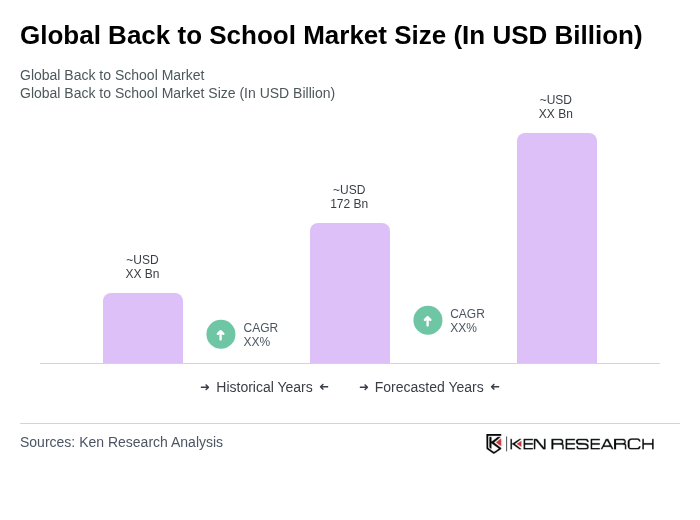
- The Global Back to School Market is valued at USD 172 billion, based on a five-year historical analysis. This growth is primarily driven by increasing enrollment rates in educational institutions, rising disposable incomes, the normalization of blended and hybrid learning models, and the growing trend of online shopping for school supplies. The market has seen a significant uptick in demand for both traditional and digital educational tools, with manufacturers launching student-optimized devices and retailers offering exclusive online discounts and bundled deals to attract consumers. These trends reflect changing consumer preferences and rapid technological advancements .
- Key players in this market include the United States, China, and Germany, which dominate due to their large student populations and robust retail infrastructures. The U.S. benefits from a well-established retail environment and high consumer spending, while China’s rapid urbanization and educational reforms contribute to its market strength. Germany's strong economy and emphasis on education further solidify its position in the market .
- In 2023, the U.S. government implemented the "Back to School Supplies Tax Holiday," under various state-level statutes such as the Texas Tax Code Section 151.326 and Florida’s Back-to-School Sales Tax Holiday (authorized by the Florida Legislature, 2023), allowing parents to purchase essential school supplies without incurring sales tax. These initiatives aim to alleviate financial burdens on families and stimulate consumer spending during the back-to-school season, thereby enhancing market growth and accessibility for educational resources .
Global Back to School Market Segmentation
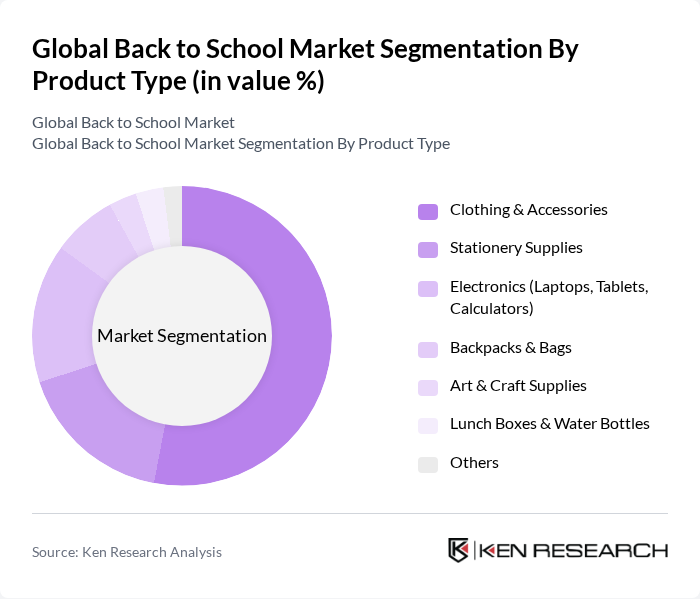
By Product Type:The product type segmentation includes various categories such as Clothing & Accessories, Stationery Supplies, Electronics (Laptops, Tablets, Calculators), Backpacks & Bags, Art & Craft Supplies, Lunch Boxes & Water Bottles, and Others. Among these, Clothing & Accessories currently hold the largest market share, reflecting the essential nature of uniforms and apparel in educational settings. Stationery Supplies and Electronics are also significant segments, with the latter experiencing the fastest growth due to the proliferation of e-learning and the need for reliable digital devices. Consumers increasingly favor quality and branded products, and the rise of hybrid learning has further boosted demand for laptops and tablets .
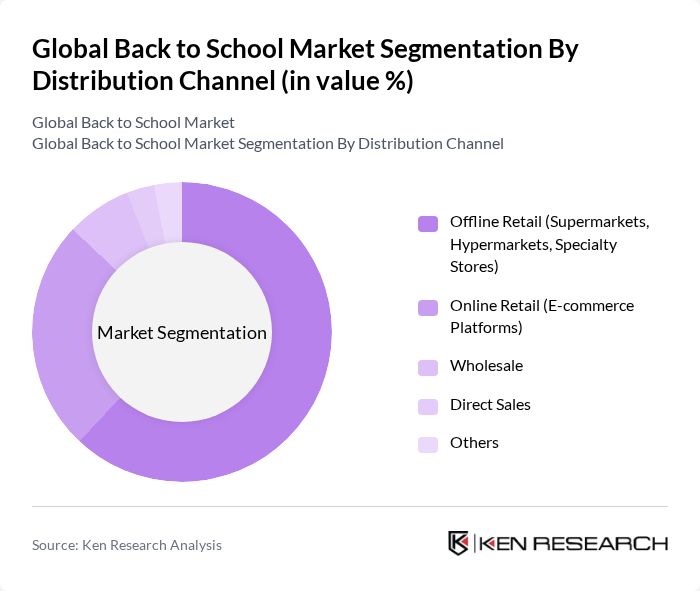
By Distribution Channel:The distribution channel segmentation encompasses Offline Retail (Supermarkets, Hypermarkets, Specialty Stores), Online Retail (E-commerce Platforms), Wholesale, Direct Sales, and Others. Offline Retail remains the dominant channel, benefiting from immediate product access and established consumer habits. However, Online Retail has seen significant growth, driven by the convenience of shopping from home, exclusive online promotions, and the increasing penetration of e-commerce platforms. The shift in consumer behavior toward digital channels is expected to continue, although traditional retail still plays a crucial role .
Global Back to School Market Competitive Landscape
The Global Back to School Market is characterized by a dynamic mix of regional and international players. Leading participants such as Staples Inc., Office Depot, Inc., Walmart Inc., Target Corporation, Amazon.com, Inc., Best Buy Co., Inc., Costco Wholesale Corporation, BIC Group, Crayola LLC, MeadWestvaco Corporation (now part of WestRock Company), 3M Company, Faber-Castell AG, Papeteries de Genval, S&S Worldwide, Inc., Elmer's Products, Inc., Kmart Corporation, TJ Maxx (The TJX Companies, Inc.), Dixon Ticonderoga Company, ACCO Brands Corporation, Pentel Co., Ltd. contribute to innovation, geographic expansion, and service delivery in this space.
Global Back to School Market Industry Analysis
Growth Drivers
- Increased Consumer Spending on Education:In future, consumer spending on education-related products is projected to reach approximately $1.5 trillion globally, reflecting a significant increase from previous years. This surge is driven by parents prioritizing educational resources for their children, with a notable 20% increase in spending on school supplies and technology. The rise in disposable income, particularly in emerging markets, further supports this trend, as families invest more in quality educational materials to enhance learning outcomes.
- Rise in E-commerce for School Supplies:E-commerce sales for school supplies are expected to exceed $100 billion in future, driven by the convenience of online shopping and the proliferation of digital platforms. The COVID-19 pandemic accelerated this shift, with a 30% increase in online purchases of educational materials. As consumers increasingly prefer the ease of home delivery and the ability to compare prices, traditional retail channels face mounting pressure to adapt to this evolving shopping behavior.
- Growing Demand for Eco-friendly Products:The market for eco-friendly school supplies is projected to grow to $25 billion in future, as consumers become more environmentally conscious. A survey indicated that 70% of parents are willing to pay a premium for sustainable products, reflecting a shift in purchasing behavior. This trend is supported by government initiatives promoting sustainability in education, encouraging manufacturers to innovate and offer greener alternatives, thus driving market growth in this segment.
Market Challenges
- Supply Chain Disruptions:The back-to-school market faces significant challenges due to ongoing supply chain disruptions, which have resulted in delays and increased costs. In future, it is estimated that 40% of retailers will experience stock shortages, impacting their ability to meet consumer demand. Factors such as geopolitical tensions and fluctuating shipping costs contribute to these disruptions, forcing companies to rethink their logistics strategies and inventory management practices.
- Price Sensitivity Among Consumers:With inflation rates projected to remain around 3.5% in future, consumers are increasingly price-sensitive, particularly regarding discretionary spending on school supplies. A recent report indicated that 60% of parents plan to cut back on non-essential items, which could lead to decreased sales for premium products. Retailers must navigate this challenge by offering competitive pricing and value-driven promotions to attract budget-conscious shoppers.
Global Back to School Market Future Outlook
The future of the back-to-school market appears promising, driven by technological advancements and evolving consumer preferences. As digital learning tools become more integrated into educational curricula, demand for innovative products will likely increase. Additionally, the trend towards personalization in school supplies is expected to gain traction, allowing brands to cater to individual student needs. Companies that adapt to these trends and invest in sustainable practices will be well-positioned to thrive in this dynamic market landscape.
Market Opportunities
- Expansion into Emerging Markets:Emerging markets present significant growth opportunities, with an estimated 1.2 billion children entering school in future. Companies that tailor their offerings to local preferences and invest in distribution networks can capture a share of this expanding demographic, driving revenue growth and brand loyalty in these regions.
- Development of Subscription Models:Subscription models for school supplies are gaining traction, with a projected market value of $5 billion in future. These models offer convenience and cost savings for families, allowing them to receive curated supplies regularly. Companies that implement subscription services can enhance customer retention and create a steady revenue stream, capitalizing on the growing demand for hassle-free shopping experiences.
Scope of the Report
| Segment | Sub-Segments |
|---|---|
| By Product Type | Clothing & Accessories Stationery Supplies Electronics (Laptops, Tablets, Calculators) Backpacks & Bags Art & Craft Supplies Lunch Boxes & Water Bottles Others |
| By Distribution Channel | Offline Retail (Supermarkets, Hypermarkets, Specialty Stores) Online Retail (E-commerce Platforms) Wholesale Direct Sales Others |
| By Consumer Demographics | Age Group (Children, Teens, College Students) Income Level (Low, Middle, High) Geographic Location (Urban, Rural) Others |
| By Brand Loyalty | Brand Loyal Customers Price-Sensitive Customers Trend-Focused Customers Others |
| By Seasonal Demand | Pre-Back to School Season Mid-Year Purchases Post-Season Sales Others |
| By Product Quality | Premium Products Mid-Range Products Budget Products Others |
| By Eco-Friendliness | Sustainable Products Conventional Products Others |
| By Region | North America (US, Canada) Europe (Germany, France, UK, Spain, Italy, Rest of Europe) Asia Pacific (China, Japan, South Korea, India, Australia, Rest of APAC) Latin America (Brazil, Mexico, Rest of Latin America) Middle East & Africa (GCC, South Africa, Rest of MEA) |
Key Target Audience
Investors and Venture Capitalist Firms
Government and Regulatory Bodies (e.g., Department of Education, Federal Trade Commission)
Manufacturers and Producers
Distributors and Retailers
Non-Profit Organizations and NGOs
Logistics and Supply Chain Companies
Advertising and Marketing Agencies
Financial Institutions
Players Mentioned in the Report:
Staples Inc.
Office Depot, Inc.
Walmart Inc.
Target Corporation
Amazon.com, Inc.
Best Buy Co., Inc.
Costco Wholesale Corporation
BIC Group
Crayola LLC
MeadWestvaco Corporation (now part of WestRock Company)
3M Company
Faber-Castell AG
Papeteries de Genval
S&S Worldwide, Inc.
Elmer's Products, Inc.
Kmart Corporation
TJ Maxx (The TJX Companies, Inc.)
Dixon Ticonderoga Company
ACCO Brands Corporation
Pentel Co., Ltd.
Table of Contents
Market Assessment Phase
1. Executive Summary and Approach
2. Global Back to School Market Overview
2.1 Key Insights and Strategic Recommendations
2.2 Global Back to School Market Overview
2.3 Definition and Scope
2.4 Evolution of Market Ecosystem
2.5 Timeline of Key Regulatory Milestones
2.6 Value Chain & Stakeholder Mapping
2.7 Business Cycle Analysis
2.8 Policy & Incentive Landscape
3. Global Back to School Market Analysis
3.1 Growth Drivers
3.1.1 Increased Consumer Spending on Education
3.1.2 Rise in E-commerce for School Supplies
3.1.3 Growing Demand for Eco-friendly Products
3.1.4 Technological Advancements in Educational Tools
3.2 Market Challenges
3.2.1 Supply Chain Disruptions
3.2.2 Price Sensitivity Among Consumers
3.2.3 Competition from Online Retailers
3.2.4 Seasonal Demand Fluctuations
3.3 Market Opportunities
3.3.1 Expansion into Emerging Markets
3.3.2 Development of Subscription Models
3.3.3 Partnerships with Educational Institutions
3.3.4 Innovations in Product Offerings
3.4 Market Trends
3.4.1 Increasing Use of Digital Learning Tools
3.4.2 Personalization of School Supplies
3.4.3 Growth of Second-Hand Market for School Items
3.4.4 Focus on Health and Safety in School Supplies
3.5 Government Regulation
3.5.1 Standards for Educational Materials
3.5.2 Regulations on Eco-friendly Products
3.5.3 Safety Regulations for School Supplies
3.5.4 Tax Incentives for Educational Purchases
4. SWOT Analysis
5. Stakeholder Analysis
6. Porter's Five Forces Analysis
7. Global Back to School Market Market Size, 2019-2024
7.1 By Value
7.2 By Volume
7.3 By Average Selling Price
8. Global Back to School Market Segmentation
8.1 By Product Type
8.1.1 Clothing & Accessories
8.1.2 Stationery Supplies
8.1.3 Electronics (Laptops, Tablets, Calculators)
8.1.4 Backpacks & Bags
8.1.5 Art & Craft Supplies
8.1.6 Lunch Boxes & Water Bottles
8.1.7 Others
8.2 By Distribution Channel
8.2.1 Offline Retail (Supermarkets, Hypermarkets, Specialty Stores)
8.2.2 Online Retail (E-commerce Platforms)
8.2.3 Wholesale
8.2.4 Direct Sales
8.2.5 Others
8.3 By Consumer Demographics
8.3.1 Age Group (Children, Teens, College Students)
8.3.2 Income Level (Low, Middle, High)
8.3.3 Geographic Location (Urban, Rural)
8.3.4 Others
8.4 By Brand Loyalty
8.4.1 Brand Loyal Customers
8.4.2 Price-Sensitive Customers
8.4.3 Trend-Focused Customers
8.4.4 Others
8.5 By Seasonal Demand
8.5.1 Pre-Back to School Season
8.5.2 Mid-Year Purchases
8.5.3 Post-Season Sales
8.5.4 Others
8.6 By Product Quality
8.6.1 Premium Products
8.6.2 Mid-Range Products
8.6.3 Budget Products
8.6.4 Others
8.7 By Eco-Friendliness
8.7.1 Sustainable Products
8.7.2 Conventional Products
8.7.3 Others
8.8 By Region
8.8.1 North America (US, Canada)
8.8.2 Europe (Germany, France, UK, Spain, Italy, Rest of Europe)
8.8.3 Asia Pacific (China, Japan, South Korea, India, Australia, Rest of APAC)
8.8.4 Latin America (Brazil, Mexico, Rest of Latin America)
8.8.5 Middle East & Africa (GCC, South Africa, Rest of MEA)
9. Global Back to School Market Competitive Analysis
9.1 Market Share of Key Players
9.2 KPIs for Cross Comparison of Key Players
9.2.1 Company Name
9.2.2 Group Size (Large, Medium, Small as per industry convention)
9.2.3 Annual Revenue (USD)
9.2.4 Revenue Growth Rate (%)
9.2.5 Market Share (%)
9.2.6 Geographic Presence (Number of Countries/Regions)
9.2.7 Product Portfolio Breadth (Number of SKUs/Categories)
9.2.8 E-commerce Penetration (%)
9.2.9 Customer Retention Rate (%)
9.2.10 Brand Recognition Index (Survey/Ranking)
9.2.11 Distribution Network Efficiency (Order Fulfillment Time, Coverage)
9.2.12 Customer Satisfaction Score (NPS or Equivalent)
9.3 SWOT Analysis of Top Players
9.4 Pricing Analysis
9.5 Detailed Profile of Major Companies
9.5.1 Staples Inc.
9.5.2 Office Depot, Inc.
9.5.3 Walmart Inc.
9.5.4 Target Corporation
9.5.5 Amazon.com, Inc.
9.5.6 Best Buy Co., Inc.
9.5.7 Costco Wholesale Corporation
9.5.8 BIC Group
9.5.9 Crayola LLC
9.5.10 MeadWestvaco Corporation (now part of WestRock Company)
9.5.11 3M Company
9.5.12 Faber-Castell AG
9.5.13 Papeteries de Genval
9.5.14 S&S Worldwide, Inc.
9.5.15 Elmer's Products, Inc.
9.5.16 Kmart Corporation
9.5.17 TJ Maxx (The TJX Companies, Inc.)
9.5.18 Dixon Ticonderoga Company
9.5.19 ACCO Brands Corporation
9.5.20 Pentel Co., Ltd.
10. Global Back to School Market End-User Analysis
10.1 Procurement Behavior of Key Ministries
10.1.1 Budget Allocation Trends
10.1.2 Procurement Processes
10.1.3 Supplier Selection Criteria
10.1.4 Others
10.2 Corporate Spend on Infrastructure & Energy
10.2.1 Investment in Educational Infrastructure
10.2.2 Spending on Technology Integration
10.2.3 Budgeting for School Supplies
10.2.4 Others
10.3 Pain Point Analysis by End-User Category
10.3.1 Challenges Faced by Schools
10.3.2 Issues for Parents
10.3.3 Concerns of Educational Institutions
10.3.4 Others
10.4 User Readiness for Adoption
10.4.1 Awareness of New Products
10.4.2 Willingness to Change Suppliers
10.4.3 Training Needs for New Technologies
10.4.4 Others
10.5 Post-Deployment ROI and Use Case Expansion
10.5.1 Measurement of ROI
10.5.2 Expansion Opportunities
10.5.3 Long-term Benefits Analysis
10.5.4 Others
11. Global Back to School Market Future Size, 2025-2030
11.1 By Value
11.2 By Volume
11.3 By Average Selling Price
Go-To-Market Strategy Phase
1. Whitespace Analysis + Business Model Canvas
1.1 Market Gaps Identification
1.2 Business Model Development
2. Marketing and Positioning Recommendations
2.1 Branding Strategies
2.2 Product USPs
3. Distribution Plan
3.1 Urban Retail vs Rural NGO Tie-ups
4. Channel & Pricing Gaps
4.1 Underserved Routes
4.2 Pricing Bands
5. Unmet Demand & Latent Needs
5.1 Category Gaps
5.2 Consumer Segments
6. Customer Relationship
6.1 Loyalty Programs
6.2 After-sales Service
7. Value Proposition
7.1 Sustainability
7.2 Integrated Supply Chains
8. Key Activities
8.1 Regulatory Compliance
8.2 Branding
8.3 Distribution Setup
9. Entry Strategy Evaluation
9.1 Domestic Market Entry Strategy
9.1.1 Product Mix
9.1.2 Pricing Band
9.1.3 Packaging
9.2 Export Entry Strategy
9.2.1 Target Countries
9.2.2 Compliance Roadmap
10. Entry Mode Assessment
10.1 JV
10.2 Greenfield
10.3 M&A
10.4 Distributor Model
11. Capital and Timeline Estimation
11.1 Capital Requirements
11.2 Timelines
12. Control vs Risk Trade-Off
12.1 Ownership vs Partnerships
13. Profitability Outlook
13.1 Breakeven Analysis
13.2 Long-term Sustainability
14. Potential Partner List
14.1 Distributors
14.2 JVs
14.3 Acquisition Targets
15. Execution Roadmap
15.1 Phased Plan for Market Entry
15.1.1 Market Setup
15.1.2 Market Entry
15.1.3 Growth Acceleration
15.1.4 Scale & Stabilize
15.2 Key Activities and Milestones
15.2.1 Milestone Planning
15.2.2 Activity Tracking
Research Methodology
Phase 1: Approach1
Desk Research
- Analysis of market reports from educational institutions and industry associations
- Review of government publications on education spending and enrollment statistics
- Examination of consumer behavior studies related to back-to-school shopping trends
Primary Research
- Interviews with school administrators and educators to understand purchasing needs
- Surveys with parents to gauge spending habits and preferences for school supplies
- Focus groups with students to identify trends in product preferences and brand loyalty
Validation & Triangulation
- Cross-validation of findings with historical sales data from major retailers
- Triangulation of insights from primary research with secondary data sources
- Sanity checks through expert panel discussions with market analysts and educators
Phase 2: Market Size Estimation1
Top-down Assessment
- Estimation of total market size based on national education budgets and spending
- Segmentation by product categories such as stationery, electronics, and apparel
- Incorporation of demographic data to assess potential market growth areas
Bottom-up Modeling
- Collection of sales data from leading retailers and e-commerce platforms
- Estimation of average spending per student based on survey results
- Volume x price analysis for each product category to derive total market value
Forecasting & Scenario Analysis
- Multi-factor regression analysis incorporating economic indicators and consumer trends
- Scenario modeling based on potential changes in educational policies and economic conditions
- Development of baseline, optimistic, and pessimistic forecasts through 2030
Phase 3: CATI Sample Composition1
| Scope Item/Segment | Sample Size | Target Respondent Profiles |
|---|---|---|
| Parent Spending Habits | 120 | Parents of school-aged children |
| School Supply Retailers | 60 | Store Managers, Retail Buyers |
| Educational Institutions | 50 | School Administrators, Purchasing Officers |
| Student Preferences | 80 | High School and College Students |
| Market Trends Analysis | 40 | Market Analysts, Industry Experts |
Frequently Asked Questions
What is the current value of the Global Back to School Market?
The Global Back to School Market is valued at approximately USD 172 billion, reflecting a significant growth driven by increasing enrollment rates, rising disposable incomes, and the normalization of blended learning models.
What factors are driving growth in the Back to School Market?
Which countries dominate the Global Back to School Market?
What is the impact of the "Back to School Supplies Tax Holiday" in the U.S.?
Other Regional/Country Reports
Indonesia Back to School Market
Malaysia Back to School Market
KSA Back to School Market
APAC Back to School Market
SEA Back to School Market
Vietnam Back to School Market
Other Adjacent Reports
Malaysia Educational Technology Market
Qatar Childrens Apparel Market
Qatar Stationery Supplies Market
Egypt Consumer Electronics Market
Indonesia E-Learning Market
Qatar School Furniture Market
Kuwait Online Retail Market
Brazil Learning Toys Market
Brazil Art Supplies Market
South Korea Backpack Market
Why Buy From Us?

What makes us stand out is that our consultants follow Robust, Refine and Result (RRR) methodology. Robust for clear definitions, approaches and sanity checking, Refine for differentiating respondents' facts and opinions, and Result for presenting data with story.

We have set a benchmark in the industry by offering our clients with syndicated and customized market research reports featuring coverage of entire market as well as meticulous research and analyst insights.

While we don't replace traditional research, we flip the method upside down. Our dual approach of Top Bottom & Bottom Top ensures quality deliverable by not just verifying company fundamentals but also looking at the sector and macroeconomic factors.

With one step in the future, our research team constantly tries to show you the bigger picture. We help with some of the tough questions you may encounter along the way: How is the industry positioned? Best marketing channel? KPI's of competitors? By aligning every element, we help maximize success.

Our report gives you instant access to the answers and sources that other companies might choose to hide. We elaborate each steps of research methodology we have used and showcase you the sample size to earn your trust.

If you need any support, we are here! We pride ourselves on universe strength, data quality, and quick, friendly, and professional service.