About the Report
Base Year 2024Global Barium Fluoride Market Overview
- The Global Barium Fluoride Market is valued at USD 360 million, based on a five-year historical analysis. This growth is primarily driven by the increasing demand for optical components and advancements in the electronics sector, where BaF2 is used for IR/UV windows, lenses, and as a scintillator material in detection systems . The market is also supported by applications in aluminum metallurgy as a flux and additive, and in oil refining and petrochemical processes, along with niche use in pharmaceuticals and specialty ceramics .
- Key players in this market include the United States, Germany, and China, which dominate due to their strong industrial bases in optics, chemicals, and advanced materials, as well as extensive electronics manufacturing and research capabilities . Presence of established specialty chemical producers and optical-materials supply chains in these countries underpins leadership in innovation and production efficiency for barium fluoride grades .
- In 2023, the European Union advanced regulations aimed at reducing the environmental impact of chemical production, including substances such as barium fluoride, under frameworks like REACH and the Chemicals Strategy for Sustainability, which require strict safety, environmental risk assessment, and responsible handling across manufacturing and supply chains .

Global Barium Fluoride Market Segmentation
By Type:
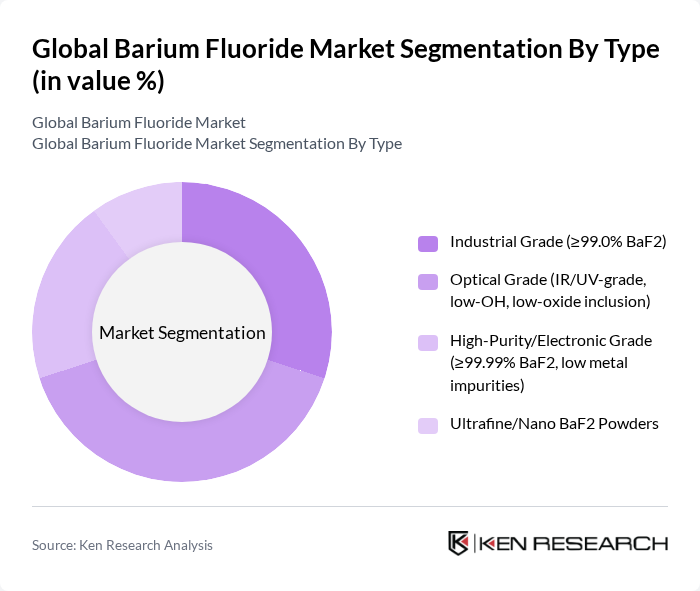
The barium fluoride market is segmented into four main types: Industrial Grade (?99.0% BaF2), Optical Grade (IR/UV-grade, low-OH, low-oxide inclusion), High-Purity/Electronic Grade (?99.99% BaF2, low metal impurities), and Ultrafine/Nano BaF2 Powders. Among these, the Optical Grade segment is currently leading the market due to its extensive use in optical components such as lenses and prisms for IR and UV transmission, and for scintillation detection in security and nuclear applications . The demand for high-quality optical materials in telecommunications, aerospace and defense, and scientific instrumentation drives this segment's growth . The Industrial Grade segment also holds a significant share, primarily used in aluminum metallurgy as a flux and in welding consumables and frits .
By Application:
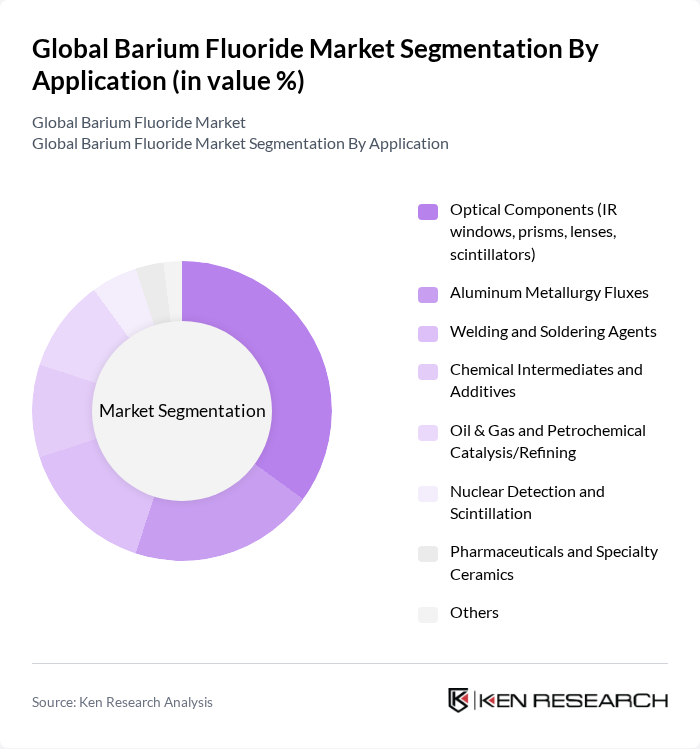
The applications of barium fluoride are diverse, including Optical Components (IR windows, prisms, lenses, scintillators), Aluminum Metallurgy Fluxes, Welding and Soldering Agents, Chemical Intermediates and Additives, Oil & Gas and Petrochemical Catalysis/Refining, Nuclear Detection and Scintillation, Pharmaceuticals and Specialty Ceramics, and Others. The Optical Components segment is the most dominant, driven by the increasing demand for high-performance optical materials across infrared imaging, spectroscopy, laser systems, and radiation detection . The Oil & Gas and petrochemical sector also contributes through usage in refining and catalytic environments, while aluminum metallurgy remains a core end-use due to BaF2’s role as a flux and process aid .
Global Barium Fluoride Market Competitive Landscape
The Global Barium Fluoride Market is characterized by a dynamic mix of regional and international players. Leading participants such as Solvay S.A., American Elements, Barium & Chemicals, Inc., Alfa Aesar (part of Thermo Fisher Scientific), Thermo Fisher Scientific Inc., Merck KGaA (including Sigma-Aldrich), Strem Chemicals, Inc. (a part of Ascensus Specialties), Tokyo Chemical Industry Co., Ltd. (TCI), GFS Chemicals, Inc., Materion Corporation, Jiangxi Tianxin Chemical Co., Ltd., Hubei Xinyuan Chemical Co., Ltd., Hunan Nonferrous Barium Technology Co., Ltd., Yunnan Fluorine Industry Group Co., Ltd., Sinochem Lantian Co., Ltd. contribute to innovation, geographic expansion, and service delivery in this space .
Global Barium Fluoride Market Industry Analysis
Growth Drivers
- Increasing Demand in Optical Applications:The optical industry is a significant growth driver for barium fluoride, with the global optical market projected to reach $1.3 trillion in future. Barium fluoride's unique properties, such as low refractive index and high transmission in the UV range, make it essential for lenses and windows in high-performance optical systems. The demand for advanced optical devices, including cameras and sensors, is expected to increase by 9% annually, further boosting barium fluoride consumption in this sector.
- Growth in the Electronics Industry:The electronics sector is anticipated to grow significantly, with global electronics sales expected to reach $2.6 trillion in future. Barium fluoride is increasingly used in the production of semiconductors and electronic components due to its excellent dielectric properties. The rise in consumer electronics, particularly smartphones and tablets, is projected to drive an 11% increase in demand for barium fluoride, as manufacturers seek materials that enhance performance and efficiency.
- Rising Use in Nuclear Applications:The nuclear industry is experiencing a resurgence, with global investments in nuclear energy projected to exceed $120 billion in future. Barium fluoride is utilized in radiation detection and shielding applications due to its effective neutron absorption capabilities. As countries seek to diversify energy sources and reduce carbon emissions, the demand for barium fluoride in nuclear applications is expected to grow, supporting its market presence in this critical sector.
Market Challenges
- Fluctuating Raw Material Prices:The barium fluoride market faces challenges from volatile raw material prices, particularly barium carbonate and hydrofluoric acid. In future, barium carbonate prices surged by 16% due to supply chain disruptions and increased demand from the chemical sector. Such fluctuations can impact production costs and profit margins for manufacturers, leading to potential instability in the barium fluoride market.
- Environmental Regulations and Compliance:Stringent environmental regulations are a significant challenge for the barium fluoride market. In future, compliance costs related to hazardous substance regulations are expected to rise by 22% as governments enforce stricter standards. This can lead to increased operational costs for manufacturers, potentially hindering market growth and limiting the entry of new players into the industry.
Global Barium Fluoride Market Future Outlook
The future of the barium fluoride market appears promising, driven by technological advancements and increasing applications across various industries. As manufacturers adopt sustainable production practices, the market is likely to witness a shift towards eco-friendly alternatives. Additionally, the growing demand for high-purity barium fluoride in specialized applications, such as medical imaging and laser technology, will further enhance market dynamics, creating new avenues for growth and innovation in the coming years.
Market Opportunities
- Expansion in Emerging Economies:Emerging economies, particularly in Asia-Pacific, are witnessing rapid industrialization and urbanization. This trend is expected to drive the demand for barium fluoride in various applications, including electronics and optical devices. In future, the Asia-Pacific region is projected to account for over 42% of global barium fluoride consumption, presenting significant growth opportunities for manufacturers.
- Technological Advancements in Production:Innovations in production technologies are creating opportunities for cost-effective and efficient manufacturing of barium fluoride. The adoption of advanced synthesis methods can enhance product quality and reduce environmental impact. As companies invest in R&D, the development of new production techniques is expected to increase market competitiveness and open new application areas for barium fluoride.
Scope of the Report
| Segment | Sub-Segments |
|---|---|
| By Type | Industrial Grade (?99.0% BaF2) Optical Grade (IR/UV-grade, low-OH, low-oxide inclusion) High-Purity/Electronic Grade (?99.99% BaF2, low metal impurities) Ultrafine/Nano BaF2 Powders |
| By Application | Optical Components (IR windows, prisms, lenses, scintillators) Aluminum Metallurgy Fluxes Welding and Soldering Agents Chemical Intermediates and Additives Oil & Gas and Petrochemical Catalysis/Refining Nuclear Detection and Scintillation Pharmaceuticals and Specialty Ceramics Others |
| By End-User | Optical and Photonics Manufacturers Aluminum and Metallurgical Industries Electronics and Semiconductor Oil & Gas / Refining Defense & Aerospace Healthcare & Medical Imaging Others |
| By Distribution Channel | Direct Sales (Manufacturers to OEMs) Distributors/Channel Partners Online/Direct-to-Lab Platforms Others |
| By Region | North America Europe Asia-Pacific Latin America Middle East & Africa |
| By Price Range | Commodity Grade Pricing (Industrial) Specialty Grade Pricing (Optical) Ultra-High-Purity Pricing (Electronic/Research) |
| By Packaging Type | Bulk Packaging (drums, supersacks) Small Packaging (bottles, jars for labs) Vacuum/Desiccant Packaging (moisture-protected) Custom Packaging |
Key Target Audience
Investors and Venture Capitalist Firms
Government and Regulatory Bodies (e.g., Environmental Protection Agency, Food and Drug Administration)
Manufacturers and Producers
Distributors and Retailers
Mining and Mineral Exploration Companies
Chemical Processing Companies
Industry Associations (e.g., American Chemical Society)
Financial Institutions
Players Mentioned in the Report:
Solvay S.A.
American Elements
Barium & Chemicals, Inc.
Alfa Aesar (part of Thermo Fisher Scientific)
Thermo Fisher Scientific Inc.
Merck KGaA (including Sigma-Aldrich)
Strem Chemicals, Inc. (a part of Ascensus Specialties)
Tokyo Chemical Industry Co., Ltd. (TCI)
GFS Chemicals, Inc.
Materion Corporation
Jiangxi Tianxin Chemical Co., Ltd.
Hubei Xinyuan Chemical Co., Ltd.
Hunan Nonferrous Barium Technology Co., Ltd.
Yunnan Fluorine Industry Group Co., Ltd.
Sinochem Lantian Co., Ltd.
Table of Contents
Market Assessment Phase
1. Executive Summary and Approach
2. Global Barium Fluoride Market Overview
2.1 Key Insights and Strategic Recommendations
2.2 Global Barium Fluoride Market Overview
2.3 Definition and Scope
2.4 Evolution of Market Ecosystem
2.5 Timeline of Key Regulatory Milestones
2.6 Value Chain & Stakeholder Mapping
2.7 Business Cycle Analysis
2.8 Policy & Incentive Landscape
3. Global Barium Fluoride Market Analysis
3.1 Growth Drivers
3.1.1 Increasing Demand in Optical Applications
3.1.2 Growth in the Electronics Industry
3.1.3 Rising Use in Nuclear Applications
3.1.4 Expanding Applications in Chemical Manufacturing
3.2 Market Challenges
3.2.1 Fluctuating Raw Material Prices
3.2.2 Environmental Regulations and Compliance
3.2.3 Limited Awareness in Emerging Markets
3.2.4 Competition from Alternative Materials
3.3 Market Opportunities
3.3.1 Expansion in Emerging Economies
3.3.2 Technological Advancements in Production
3.3.3 Increasing Investment in R&D
3.3.4 Growing Demand for High-Purity Barium Fluoride
3.4 Market Trends
3.4.1 Shift Towards Sustainable Production Practices
3.4.2 Increasing Use in Laser Technology
3.4.3 Development of New Applications in Medical Imaging
3.4.4 Rising Demand for Specialty Chemicals
3.5 Government Regulation
3.5.1 Restrictions on Hazardous Substances
3.5.2 Environmental Protection Standards
3.5.3 Trade Tariffs and Import Regulations
3.5.4 Safety Standards for Chemical Manufacturing
4. SWOT Analysis
5. Stakeholder Analysis
6. Porter's Five Forces Analysis
7. Global Barium Fluoride Market Market Size, 2019-2024
7.1 By Value
7.2 By Volume
7.3 By Average Selling Price
8. Global Barium Fluoride Market Segmentation
8.1 By Type
8.1.1 Industrial Grade (?99.0% BaF2)
8.1.2 Optical Grade (IR/UV-grade, low-OH, low-oxide inclusion)
8.1.3 High-Purity/Electronic Grade (?99.99% BaF2, low metal impurities)
8.1.4 Ultrafine/Nano BaF2 Powders
8.2 By Application
8.2.1 Optical Components (IR windows, prisms, lenses, scintillators)
8.2.2 Aluminum Metallurgy Fluxes
8.2.3 Welding and Soldering Agents
8.2.4 Chemical Intermediates and Additives
8.2.5 Oil & Gas and Petrochemical Catalysis/Refining
8.2.6 Nuclear Detection and Scintillation
8.2.7 Pharmaceuticals and Specialty Ceramics
8.2.8 Others
8.3 By End-User
8.3.1 Optical and Photonics Manufacturers
8.3.2 Aluminum and Metallurgical Industries
8.3.3 Electronics and Semiconductor
8.3.4 Oil & Gas / Refining
8.3.5 Defense & Aerospace
8.3.6 Healthcare & Medical Imaging
8.3.7 Others
8.4 By Distribution Channel
8.4.1 Direct Sales (Manufacturers to OEMs)
8.4.2 Distributors/Channel Partners
8.4.3 Online/Direct-to-Lab Platforms
8.4.4 Others
8.5 By Region
8.5.1 North America
8.5.2 Europe
8.5.3 Asia-Pacific
8.5.4 Latin America
8.5.5 Middle East & Africa
8.6 By Price Range
8.6.1 Commodity Grade Pricing (Industrial)
8.6.2 Specialty Grade Pricing (Optical)
8.6.3 Ultra-High-Purity Pricing (Electronic/Research)
8.7 By Packaging Type
8.7.1 Bulk Packaging (drums, supersacks)
8.7.2 Small Packaging (bottles, jars for labs)
8.7.3 Vacuum/Desiccant Packaging (moisture-protected)
8.7.4 Custom Packaging
9. Global Barium Fluoride Market Competitive Analysis
9.1 Market Share of Key Players
9.2 Cross Comparison of Key Players
9.2.1 Company Name
9.2.2 Production Capacity (tons/year)
9.2.3 Revenue from BaF2 (latest FY, USD)
9.2.4 Grade Portfolio Coverage (Industrial, Optical, Electronic)
9.2.5 Geographic Footprint (plants/regions served)
9.2.6 Customer/End-market Mix (%)
9.2.7 Long-term Supply Agreements Count
9.2.8 On-time Delivery Rate (%)
9.2.9 Average Selling Price by Grade (USD/kg)
9.2.10 R&D Intensity (% of revenue)
9.2.11 Quality Certifications (e.g., ISO 9001/14001)
9.2.12 Purity Consistency Yield (% lots meeting spec)
9.3 SWOT Analysis of Top Players
9.4 Pricing Analysis
9.5 Detailed Profile of Major Companies
9.5.1 Solvay S.A.
9.5.2 American Elements
9.5.3 Barium & Chemicals, Inc.
9.5.4 Alfa Aesar (part of Thermo Fisher Scientific)
9.5.5 Thermo Fisher Scientific Inc.
9.5.6 Merck KGaA (including Sigma-Aldrich)
9.5.7 Strem Chemicals, Inc. (a part of Ascensus Specialties)
9.5.8 Tokyo Chemical Industry Co., Ltd. (TCI)
9.5.9 GFS Chemicals, Inc.
9.5.10 Materion Corporation
9.5.11 Jiangxi Tianxin Chemical Co., Ltd.
9.5.12 Hubei Xinyuan Chemical Co., Ltd.
9.5.13 Hunan Nonferrous Barium Technology Co., Ltd.
9.5.14 Yunnan Fluorine Industry Group Co., Ltd.
9.5.15 Sinochem Lantian Co., Ltd.
10. Global Barium Fluoride Market End-User Analysis
10.1 Procurement Behavior of Key Ministries
10.1.1 Government Procurement Policies
10.1.2 Budget Allocations for Chemical Procurement
10.1.3 Evaluation Criteria for Suppliers
10.2 Corporate Spend on Infrastructure & Energy
10.2.1 Investment Trends in Chemical Infrastructure
10.2.2 Energy Consumption Patterns
10.2.3 Budgeting for Chemical Supplies
10.3 Pain Point Analysis by End-User Category
10.3.1 Supply Chain Disruptions
10.3.2 Quality Assurance Challenges
10.3.3 Cost Management Issues
10.4 User Readiness for Adoption
10.4.1 Awareness of Barium Fluoride Applications
10.4.2 Training and Support Needs
10.4.3 Adoption Barriers
10.5 Post-Deployment ROI and Use Case Expansion
10.5.1 Measurement of ROI
10.5.2 Case Studies of Successful Implementations
10.5.3 Future Use Case Opportunities
11. Global Barium Fluoride Market Future Size, 2025-2030
11.1 By Value
11.2 By Volume
11.3 By Average Selling Price
Go-To-Market Strategy Phase
1. Whitespace Analysis + Business Model Canvas
1.1 Market Gaps Identification
1.2 Business Model Framework
2. Marketing and Positioning Recommendations
2.1 Branding Strategies
2.2 Product USPs
3. Distribution Plan
3.1 Urban Retail Strategies
3.2 Rural NGO Tie-ups
4. Channel & Pricing Gaps
4.1 Underserved Routes
4.2 Pricing Bands
5. Unmet Demand & Latent Needs
5.1 Category Gaps
5.2 Consumer Segments
6. Customer Relationship
6.1 Loyalty Programs
6.2 After-sales Service
7. Value Proposition
7.1 Sustainability Initiatives
7.2 Integrated Supply Chains
8. Key Activities
8.1 Regulatory Compliance
8.2 Branding Efforts
8.3 Distribution Setup
9. Entry Strategy Evaluation
9.1 Domestic Market Entry Strategy
9.1.1 Product Mix Considerations
9.1.2 Pricing Band Strategy
9.1.3 Packaging Solutions
9.2 Export Entry Strategy
9.2.1 Target Countries
9.2.2 Compliance Roadmap
10. Entry Mode Assessment
10.1 Joint Ventures
10.2 Greenfield Investments
10.3 Mergers & Acquisitions
10.4 Distributor Model
11. Capital and Timeline Estimation
11.1 Capital Requirements
11.2 Timelines for Implementation
12. Control vs Risk Trade-Off
12.1 Ownership Considerations
12.2 Partnerships Evaluation
13. Profitability Outlook
13.1 Breakeven Analysis
13.2 Long-term Sustainability
14. Potential Partner List
14.1 Distributors
14.2 Joint Ventures
14.3 Acquisition Targets
15. Execution Roadmap
15.1 Phased Plan for Market Entry
15.1.1 Market Setup
15.1.2 Market Entry
15.1.3 Growth Acceleration
15.1.4 Scale & Stabilize
15.2 Key Activities and Milestones
15.2.1 Milestone Planning
15.2.2 Activity Tracking
Research Methodology
Phase 1: Approach1
Desk Research
- Analysis of industry reports from chemical associations and market research firms
- Review of academic publications and journals focusing on barium fluoride applications
- Examination of trade statistics and import-export data from government databases
Primary Research
- Interviews with industry experts and key opinion leaders in the chemical sector
- Surveys targeting manufacturers and end-users of barium fluoride
- Field visits to production facilities and laboratories utilizing barium fluoride
Validation & Triangulation
- Cross-referencing data from multiple sources to ensure consistency and accuracy
- Engagement with a panel of experts for qualitative insights and validation
- Utilization of historical data trends to confirm current market dynamics
Phase 2: Market Size Estimation1
Top-down Assessment
- Estimation of market size based on global demand for barium fluoride in various applications
- Segmentation analysis by end-use industries such as optics, electronics, and pharmaceuticals
- Incorporation of macroeconomic indicators influencing market growth
Bottom-up Modeling
- Collection of production data from key manufacturers of barium fluoride
- Estimation of market share based on sales volume and pricing strategies
- Analysis of regional production capacities and consumption patterns
Forecasting & Scenario Analysis
- Development of predictive models using historical growth rates and market trends
- Scenario planning based on potential regulatory changes and technological advancements
- Creation of multiple forecasts (baseline, optimistic, and pessimistic) through 2030
Phase 3: CATI Sample Composition1
| Scope Item/Segment | Sample Size | Target Respondent Profiles |
|---|---|---|
| Optical Glass Manufacturers | 100 | Production Managers, Quality Control Supervisors |
| Pharmaceutical Companies | 80 | Research Scientists, Regulatory Affairs Managers |
| Electronics Component Producers | 90 | Product Development Engineers, Supply Chain Managers |
| Academic Research Institutions | 70 | Research Professors, Laboratory Technicians |
| Industrial Chemical Suppliers | 60 | Sales Directors, Market Analysts |
Frequently Asked Questions
What is the current value of the Global Barium Fluoride Market?
The Global Barium Fluoride Market is valued at approximately USD 360 million, based on a five-year historical analysis. This valuation reflects the increasing demand for optical components and advancements in the electronics sector.
What are the primary applications of barium fluoride?
Which countries dominate the Global Barium Fluoride Market?
What are the growth drivers for the barium fluoride market?
Other Regional/Country Reports
Indonesia Barium Fluoride Market
Malaysia Barium Fluoride Market
APAC Barium Fluoride Market
SEA Barium Fluoride Market
Why Buy From Us?

What makes us stand out is that our consultants follow Robust, Refine and Result (RRR) methodology. Robust for clear definitions, approaches and sanity checking, Refine for differentiating respondents' facts and opinions, and Result for presenting data with story.

We have set a benchmark in the industry by offering our clients with syndicated and customized market research reports featuring coverage of entire market as well as meticulous research and analyst insights.

While we don't replace traditional research, we flip the method upside down. Our dual approach of Top Bottom & Bottom Top ensures quality deliverable by not just verifying company fundamentals but also looking at the sector and macroeconomic factors.

With one step in the future, our research team constantly tries to show you the bigger picture. We help with some of the tough questions you may encounter along the way: How is the industry positioned? Best marketing channel? KPI's of competitors? By aligning every element, we help maximize success.

Our report gives you instant access to the answers and sources that other companies might choose to hide. We elaborate each steps of research methodology we have used and showcase you the sample size to earn your trust.

If you need any support, we are here! We pride ourselves on universe strength, data quality, and quick, friendly, and professional service.