About the Report
Base Year 2024Global Bio Based Polyvinyl Chloride Market Overview
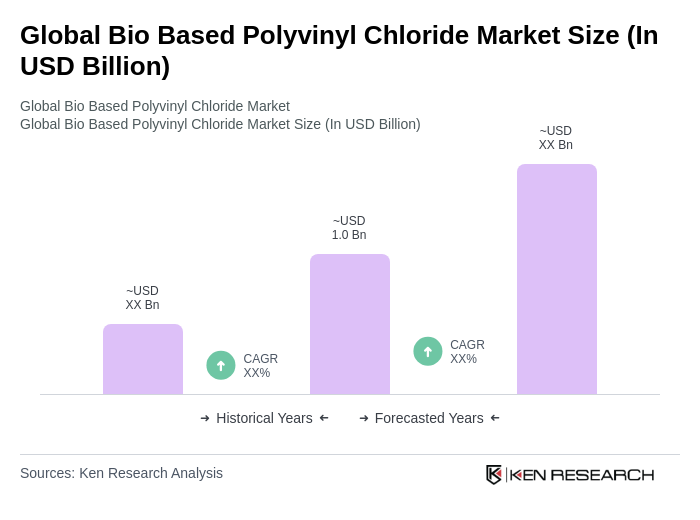
- The Global Bio Based Polyvinyl Chloride Market is valued at USD 1.0 billion, based on a five-year historical analysis. This reflects the maturation from a market size reported around the mid-hundreds of millions earlier in the period, supported by continued adoption of bio-attributed PVC and bio-based plasticizers in construction and consumer applications . Growth is primarily driven by increasing environmental awareness, regulatory support for sustainable materials, and rising demand for bio-based products across industries; bio-based PVC leverages renewable feedstocks and bio-based plasticizers to reduce dependence on fossil resources and lower carbon footprints . The shift toward eco-friendly alternatives in construction, automotive, and packaging continues to contribute to market expansion as end users replace conventional phthalate plasticizers and adopt mass-balance certified PVC grades .
- Key players in this market include countries like the United States, Germany, and China, which lead due to advanced PVC manufacturing ecosystems, R&D capacity, and policy support for low-carbon materials. These regions host major PVC resin and compounding producers and are focal markets for mass-balance certified (e.g., ISCC+) supply chains and bio-based plasticizers used in medical, wire & cable, and automotive applications .
- In 2023, the European Union advanced initiatives under the Circular Economy Action Plan, reinforcing market pull for sustainable, recycled, and bio-based plastics in construction and packaging via measures such as sustainable product requirements and waste reduction objectives that encourage uptake of mass-balance certified and bio-based materials, including PVC solutions aligned with ISCC+ certification frameworks .
Global Bio Based Polyvinyl Chloride Market Segmentation
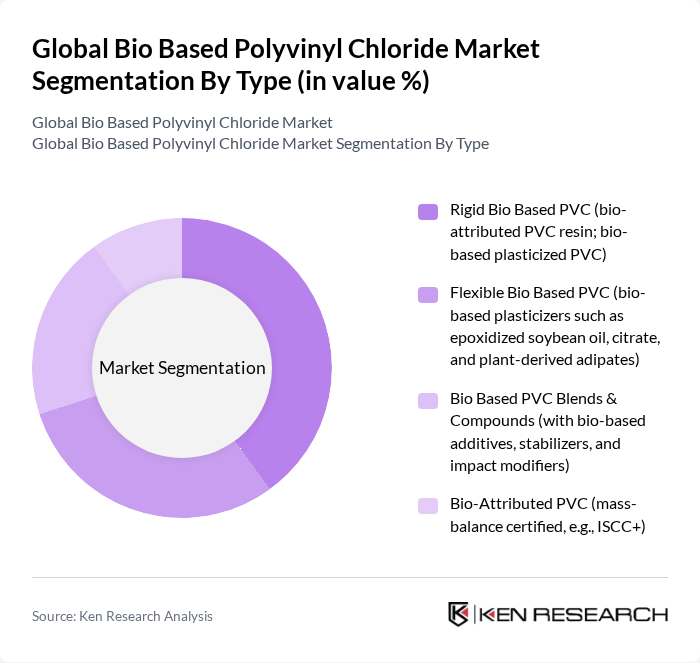
By Type:The bio-based PVC market is segmented into four main types: Rigid Bio Based PVC, Flexible Bio Based PVC, Bio Based PVC Blends & Compounds, and Bio-Attributed PVC. Rigid Bio Based PVC is widely used in construction applications due to durability and strength, particularly in profiles and pipes enabled by bio-attributed resin supply. Flexible Bio Based PVC is gaining traction in consumer goods, wire & cable, and automotive interiors by incorporating bio-based plasticizers such as epoxidized soybean oil and citrates. Bio Based PVC Blends & Compounds are increasingly used to tailor performance with bio-based additives and stabilizers, while Bio-Attributed PVC (via mass-balance certification such as ISCC+) is recognized for sustainability credentials and drop-in compatibility with existing converters .
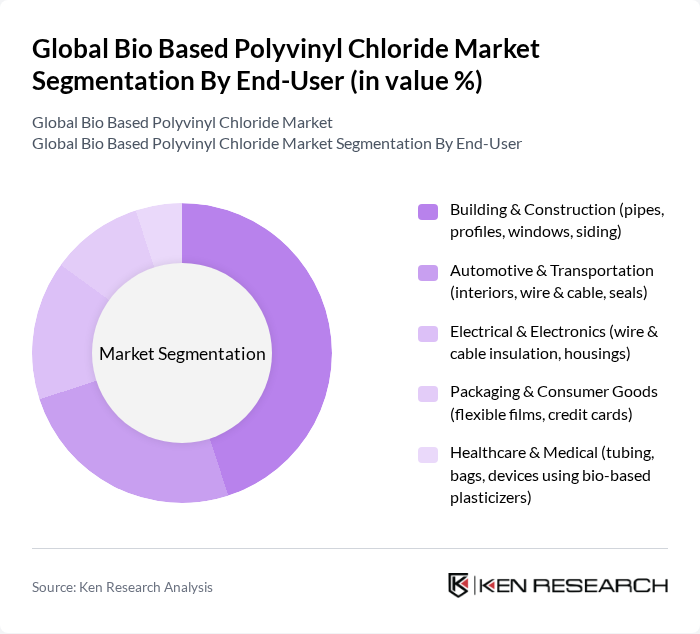
By End-User:The end-user segmentation of the bio-based PVC market includes Building & Construction, Automotive & Transportation, Electrical & Electronics, Packaging & Consumer Goods, and Healthcare & Medical. Building & Construction is the largest consumer through pipes, profiles, windows, and siding using rigid PVC grades from bio-attributed feedstocks. Automotive & Transportation leverages flexible PVC with bio-based plasticizers for interiors, seals, and wire & cable. Healthcare & Medical increasingly adopts bio-based plasticizer-containing PVC for tubing and bags to address regulatory and sustainability requirements, while Electrical & Electronics and Packaging & Consumer Goods use flexible PVC films, insulation, and cards .
Global Bio Based Polyvinyl Chloride Market Competitive Landscape
The Global Bio Based Polyvinyl Chloride Market is characterized by a dynamic mix of regional and international players. Leading participants such as Solvay S.A., INEOS Group Ltd., Teknor Apex Company, The Dow Chemical Company, Shin-Etsu Chemical Co., Ltd., Westlake Corporation, Vynova Group, Formosa Plastics Corporation, Mexichem, S.A.B. de C.V. (Orbia Advance Corporation, Vestolit), Kem One, Hanwha Solutions, LG Chem Ltd., Arkema S.A. (bio-based plasticizers and additives), Evonik Industries AG (bio-based plasticizers/intermediates), Kaneka Corporation contribute to innovation, geographic expansion, and service delivery in this space. Market activity includes mass-balance certified PVC value chains (ISCC+), development of bio-based plasticizers (e.g., citrate, epoxidized vegetable oils), and partnerships across converters and brand owners to integrate sustainable PVC formulations in construction, medical, and mobility applications .
Global Bio Based Polyvinyl Chloride Market Industry Analysis
Growth Drivers
- Increasing Demand for Sustainable Materials:The global shift towards sustainability is driving the demand for bio-based materials, including bio-based PVC. In the future, the global market for sustainable materials is projected to reach $1.5 trillion, with bio-based products accounting for a significant share. This trend is fueled by consumer preferences for eco-friendly options, as 70% of consumers express a willingness to pay more for sustainable products, according to a recent Nielsen report.
- Government Initiatives Promoting Bio-Based Products:Governments worldwide are implementing policies to promote bio-based products. For instance, the European Union's Green Deal aims to increase the share of bio-based materials in various industries, with a target of 25% by 2030. Additionally, the U.S. government allocated $1 billion in the future for research and development of sustainable materials, further supporting the growth of bio-based PVC in the market.
- Technological Advancements in Production Processes:Innovations in production technologies are enhancing the efficiency and cost-effectiveness of bio-based PVC manufacturing. In the future, advancements such as enzymatic processes and bioreactor technologies are expected to reduce production costs by up to 20%. This improvement is crucial as it allows manufacturers to compete with traditional PVC, which has dominated the market due to lower costs and established supply chains.
Market Challenges
- High Production Costs Compared to Conventional PVC:The production costs of bio-based PVC remain significantly higher than those of conventional PVC, with estimates indicating a difference of approximately $1,500 per ton. This cost disparity poses a challenge for manufacturers aiming to penetrate the market, as they must justify the higher prices to consumers who may not yet fully appreciate the environmental benefits of bio-based alternatives.
- Limited Availability of Raw Materials:The supply of raw materials for bio-based PVC production is constrained, with only 30% of the required biomass currently available for commercial use. This limitation is exacerbated by competition from other industries, such as food and feed, which also rely on these resources. As demand for bio-based products grows, securing a stable supply of raw materials will be critical for market players.
Global Bio Based Polyvinyl Chloride Market Future Outlook
The future of the bio-based PVC market appears promising, driven by increasing consumer demand for sustainable products and supportive government policies. As technological advancements continue to lower production costs, the market is likely to see a rise in adoption rates. Furthermore, the growing emphasis on circular economy practices will encourage manufacturers to innovate and develop new applications for bio-based PVC, enhancing its market presence and competitiveness against traditional PVC products.
Market Opportunities
- Expansion into Emerging Markets:Emerging markets, particularly in Asia-Pacific, present significant growth opportunities for bio-based PVC. With a projected increase in demand for sustainable materials in these regions, companies can tap into a market expected to grow by $500 million in the future, driven by rising environmental awareness and regulatory support.
- Development of New Applications for Bio Based PVC:The versatility of bio-based PVC allows for the exploration of new applications, particularly in construction and automotive sectors. With an estimated $300 million potential market for bio-based PVC in these industries in the future, companies can innovate to create products that meet specific sustainability criteria, enhancing their competitive edge.
Scope of the Report
| Segment | Sub-Segments |
|---|---|
| By Type | Rigid Bio Based PVC (bio-attributed PVC resin; bio-based plasticized PVC) Flexible Bio Based PVC (bio-based plasticizers such as epoxidized soybean oil, citrate, and plant-derived adipates) Bio Based PVC Blends & Compounds (with bio-based additives, stabilizers, and impact modifiers) Bio-Attributed PVC (mass-balance certified, e.g., ISCC+) |
| By End-User | Building & Construction (pipes, profiles, windows, siding) Automotive & Transportation (interiors, wire & cable, seals) Electrical & Electronics (wire & cable insulation, housings) Packaging & Consumer Goods (flexible films, credit cards) Healthcare & Medical (tubing, bags, devices using bio-based plasticizers) |
| By Application | Pipes & Fittings Profiles, Windows & Doors Flooring & Wall Coverings Wire & Cable Insulation Films, Sheets & Coatings |
| By Distribution Channel | Direct Sales (resin producers to converters/OEMs) Distributors & Compounders Online B2B Platforms Strategic Partnerships/Alliances |
| By Region | North America Europe Asia-Pacific Latin America Middle East & Africa |
| By Feedstock/Origin | Bio-ethanol route (e.g., sugarcane/corn ethanol to EDC/VCM) Bio-based plasticizers (citrate, epoxidized oils, plant-based adipates) Biomass/Cellulosic routes Mass balance bio-attribution (certified renewable content) |
| By Certification & Sustainability Attribute | ISCC+ / REDcert mass balance certification Life Cycle Assessment (LCA) verified products Recycled content blends (mechanical/chemical) Low-carbon/renewable energy production claims |
Key Target Audience
Investors and Venture Capitalist Firms
Government and Regulatory Bodies (e.g., Environmental Protection Agency, European Chemicals Agency)
Manufacturers and Producers of Bio Based PVC
Distributors and Retailers of Sustainable Materials
Raw Material Suppliers
Industry Associations (e.g., American Chemistry Council, European Plastics Converters)
Financial Institutions and Banks
Packaging and Construction Companies
Players Mentioned in the Report:
Solvay S.A.
INEOS Group Ltd.
Teknor Apex Company
The Dow Chemical Company
Shin-Etsu Chemical Co., Ltd.
Westlake Corporation
Vynova Group
Formosa Plastics Corporation
Mexichem, S.A.B. de C.V. (Orbia Advance Corporation, Vestolit)
Kem One
Hanwha Solutions
LG Chem Ltd.
Arkema S.A. (bio-based plasticizers and additives)
Evonik Industries AG (bio-based plasticizers/intermediates)
Kaneka Corporation
Table of Contents
Market Assessment Phase
1. Executive Summary and Approach
2. Global Bio Based Polyvinyl Chloride Market Overview
2.1 Key Insights and Strategic Recommendations
2.2 Global Bio Based Polyvinyl Chloride Market Overview
2.3 Definition and Scope
2.4 Evolution of Market Ecosystem
2.5 Timeline of Key Regulatory Milestones
2.6 Value Chain & Stakeholder Mapping
2.7 Business Cycle Analysis
2.8 Policy & Incentive Landscape
3. Global Bio Based Polyvinyl Chloride Market Analysis
3.1 Growth Drivers
3.1.1 Increasing Demand for Sustainable Materials
3.1.2 Government Initiatives Promoting Bio-Based Products
3.1.3 Technological Advancements in Production Processes
3.1.4 Rising Consumer Awareness of Environmental Issues
3.2 Market Challenges
3.2.1 High Production Costs Compared to Conventional PVC
3.2.2 Limited Availability of Raw Materials
3.2.3 Regulatory Hurdles in Different Regions
3.2.4 Competition from Traditional PVC Products
3.3 Market Opportunities
3.3.1 Expansion into Emerging Markets
3.3.2 Development of New Applications for Bio Based PVC
3.3.3 Collaborations with Eco-Friendly Brands
3.3.4 Investment in Research and Development
3.4 Market Trends
3.4.1 Shift Towards Circular Economy Practices
3.4.2 Increasing Use of Recycled Materials in Production
3.4.3 Growth of E-commerce in Bio-Based Products
3.4.4 Rising Popularity of Biodegradable Alternatives
3.5 Government Regulation
3.5.1 Regulations Promoting Bio-Based Product Standards
3.5.2 Incentives for Sustainable Manufacturing Practices
3.5.3 Restrictions on Conventional PVC Usage
3.5.4 Compliance Requirements for Environmental Impact
4. SWOT Analysis
5. Stakeholder Analysis
6. Porter's Five Forces Analysis
7. Global Bio Based Polyvinyl Chloride Market Market Size, 2019-2024
7.1 By Value
7.2 By Volume
7.3 By Average Selling Price
8. Global Bio Based Polyvinyl Chloride Market Segmentation
8.1 By Type
8.1.1 Rigid Bio Based PVC (bio-attributed PVC resin; bio-based plasticized PVC)
8.1.2 Flexible Bio Based PVC (bio-based plasticizers such as epoxidized soybean oil, citrate, and plant-derived adipates)
8.1.3 Bio Based PVC Blends & Compounds (with bio-based additives, stabilizers, and impact modifiers)
8.1.4 Bio-Attributed PVC (mass-balance certified, e.g., ISCC+)
8.2 By End-User
8.2.1 Building & Construction (pipes, profiles, windows, siding)
8.2.2 Automotive & Transportation (interiors, wire & cable, seals)
8.2.3 Electrical & Electronics (wire & cable insulation, housings)
8.2.4 Packaging & Consumer Goods (flexible films, credit cards)
8.2.5 Healthcare & Medical (tubing, bags, devices using bio-based plasticizers)
8.3 By Application
8.3.1 Pipes & Fittings
8.3.2 Profiles, Windows & Doors
8.3.3 Flooring & Wall Coverings
8.3.4 Wire & Cable Insulation
8.3.5 Films, Sheets & Coatings
8.4 By Distribution Channel
8.4.1 Direct Sales (resin producers to converters/OEMs)
8.4.2 Distributors & Compounders
8.4.3 Online B2B Platforms
8.4.4 Strategic Partnerships/Alliances
8.5 By Region
8.5.1 North America
8.5.2 Europe
8.5.3 Asia-Pacific
8.5.4 Latin America
8.5.5 Middle East & Africa
8.6 By Feedstock/Origin
8.6.1 Bio-ethanol route (e.g., sugarcane/corn ethanol to EDC/VCM)
8.6.2 Bio-based plasticizers (citrate, epoxidized oils, plant-based adipates)
8.6.3 Biomass/Cellulosic routes
8.6.4 Mass balance bio-attribution (certified renewable content)
8.7 By Certification & Sustainability Attribute
8.7.1 ISCC+ / REDcert mass balance certification
8.7.2 Life Cycle Assessment (LCA) verified products
8.7.3 Recycled content blends (mechanical/chemical)
8.7.4 Low-carbon/renewable energy production claims
9. Global Bio Based Polyvinyl Chloride Market Competitive Analysis
9.1 Market Share of Key Players(Micro, Small, Medium, Large Enterprises)
9.2 Cross Comparison of Key Players
9.2.1 Company Name (producer/compounder/OEM using bio-based or bio-attributed PVC)
9.2.2 Group Size (Large, Medium, or Small as per industry convention)
9.2.3 Bio-based PVC Revenue and Share of Product Mix
9.2.4 Capacity/Throughput for Bio-based or Mass-Balance PVC (ktpa)
9.2.5 Geographic Footprint and Certification Coverage (e.g., ISCC+ sites)
9.2.6 Application Breadth (pipes, wire & cable, medical, profiles)
9.2.7 Strategic Partnerships/Offtake Agreements in Bio-based Value Chain
9.2.8 R&D and Patent Activity in Bio-based PVC/Plasticizers
9.2.9 Scope 1/2 Emissions Intensity for PVC Production (tCO2e/ton) and Reduction Targets
9.2.10 Pricing Premium vs Conventional Grades and Contract Structure
9.2.11 Supply Chain Resilience (feedstock optionality, backward integration)
9.2.12 Regulatory/Compliance Readiness (REACH, medical approvals, LCA disclosures)
9.3 SWOT Analysis of Top Players
9.4 Pricing Analysis(By Class and Payload)
9.5 Detailed Profile of Major Companies
9.5.1 Solvay S.A.
9.5.2 INEOS Group Ltd.
9.5.3 Teknor Apex Company
9.5.4 The Dow Chemical Company
9.5.5 Shin-Etsu Chemical Co., Ltd.
9.5.6 Westlake Corporation
9.5.7 Vynova Group
9.5.8 Formosa Plastics Corporation
9.5.9 Mexichem, S.A.B. de C.V. (Orbia Advance Corporation, Vestolit)
9.5.10 Kem One
9.5.11 Hanwha Solutions
9.5.12 LG Chem Ltd.
9.5.13 Arkema S.A. (bio-based plasticizers and additives)
9.5.14 Evonik Industries AG (bio-based plasticizers/intermediates)
9.5.15 Kaneka Corporation
10. Global Bio Based Polyvinyl Chloride Market End-User Analysis
10.1 Procurement Behavior of Key Ministries
10.1.1 Government Procurement Policies
10.1.2 Budget Allocations for Sustainable Materials
10.1.3 Evaluation Criteria for Bio Based Products
10.2 Corporate Spend on Infrastructure & Energy
10.2.1 Investment Trends in Sustainable Infrastructure
10.2.2 Corporate Sustainability Goals
10.2.3 Energy Efficiency Initiatives
10.3 Pain Point Analysis by End-User Category
10.3.1 Cost Constraints
10.3.2 Quality Assurance Issues
10.3.3 Supply Chain Disruptions
10.4 User Readiness for Adoption
10.4.1 Awareness of Bio Based PVC Benefits
10.4.2 Training and Support Needs
10.4.3 Adoption Barriers
10.5 Post-Deployment ROI and Use Case Expansion
10.5.1 Measurement of ROI Metrics
10.5.2 Case Studies of Successful Deployments
10.5.3 Future Use Case Opportunities
11. Global Bio Based Polyvinyl Chloride Market Future Size, 2025-2030
11.1 By Value
11.2 By Volume
11.3 By Average Selling Price
Go-To-Market Strategy Phase
1. Whitespace Analysis + Business Model Canvas
1.1 Market Gaps Identification
1.2 Value Proposition Development
1.3 Revenue Streams Analysis
1.4 Cost Structure Evaluation
1.5 Key Partnerships Exploration
1.6 Customer Segmentation
1.7 Channels of Distribution
2. Marketing and Positioning Recommendations
2.1 Branding Strategies
2.2 Product USPs
2.3 Target Market Identification
2.4 Communication Strategies
2.5 Digital Marketing Approaches
3. Distribution Plan
3.1 Urban Retail Strategies
3.2 Rural NGO Tie-ups
3.3 E-commerce Integration
3.4 Logistics and Supply Chain Management
4. Channel & Pricing Gaps
4.1 Underserved Routes
4.2 Pricing Bands Analysis
4.3 Competitor Pricing Strategies
5. Unmet Demand & Latent Needs
5.1 Category Gaps Identification
5.2 Consumer Segments Analysis
5.3 Product Development Opportunities
6. Customer Relationship
6.1 Loyalty Programs
6.2 After-sales Service Enhancements
6.3 Customer Feedback Mechanisms
7. Value Proposition
7.1 Sustainability Initiatives
7.2 Integrated Supply Chains
7.3 Competitive Advantages
8. Key Activities
8.1 Regulatory Compliance
8.2 Branding Efforts
8.3 Distribution Setup
9. Entry Strategy Evaluation
9.1 Domestic Market Entry Strategy
9.1.1 Product Mix Considerations
9.1.2 Pricing Band Strategy
9.1.3 Packaging Innovations
9.2 Export Entry Strategy
9.2.1 Target Countries Analysis
9.2.2 Compliance Roadmap Development
10. Entry Mode Assessment
10.1 Joint Ventures
10.2 Greenfield Investments
10.3 Mergers & Acquisitions
10.4 Distributor Model Evaluation
11. Capital and Timeline Estimation
11.1 Capital Requirements
11.2 Timelines for Implementation
12. Control vs Risk Trade-Off
12.1 Ownership Considerations
12.2 Partnerships Evaluation
13. Profitability Outlook
13.1 Breakeven Analysis
13.2 Long-term Sustainability Strategies
14. Potential Partner List
14.1 Distributors
14.2 Joint Ventures
14.3 Acquisition Targets
15. Execution Roadmap
15.1 Phased Plan for Market Entry
15.1.1 Market Setup
15.1.2 Market Entry
15.1.3 Growth Acceleration
15.1.4 Scale & Stabilize
15.2 Key Activities and Milestones
15.2.1 Milestone Planning
15.2.2 Activity Tracking
Research Methodology
Phase 1: Approach1
Desk Research
- Analysis of industry reports from organizations such as the American Chemistry Council and European Bioplastics
- Review of academic journals and publications focusing on bio-based materials and PVC alternatives
- Examination of market trends and forecasts from trade associations and government publications
Primary Research
- Interviews with product development managers at leading bio-based PVC manufacturers
- Surveys targeting sustainability officers in construction and automotive sectors
- Field interviews with regulatory experts on bio-based materials compliance
Validation & Triangulation
- Cross-validation of findings through multiple data sources including market reports and expert opinions
- Triangulation of data from interviews, surveys, and secondary research to ensure consistency
- Sanity checks conducted through expert panel discussions to validate assumptions and projections
Phase 2: Market Size Estimation1
Top-down Assessment
- Estimation of market size based on global PVC consumption and bio-based material adoption rates
- Segmentation of market by application areas such as construction, automotive, and consumer goods
- Incorporation of government incentives and policies promoting bio-based materials
Bottom-up Modeling
- Collection of production data from key bio-based PVC manufacturers to establish volume benchmarks
- Cost analysis based on raw material prices and production processes for bio-based PVC
- Estimation of market size through volume x price calculations across different applications
Forecasting & Scenario Analysis
- Utilization of time-series analysis to project market growth based on historical data
- Scenario modeling based on varying levels of consumer demand and regulatory changes
- Development of baseline, optimistic, and pessimistic forecasts through 2030
Phase 3: CATI Sample Composition1
| Scope Item/Segment | Sample Size | Target Respondent Profiles |
|---|---|---|
| Construction Industry Applications | 120 | Project Managers, Sustainability Coordinators |
| Automotive Sector Innovations | 90 | Product Engineers, R&D Managers |
| Consumer Goods Packaging | 80 | Brand Managers, Packaging Engineers |
| Regulatory Compliance Insights | 60 | Compliance Officers, Environmental Managers |
| Market Trends in Bio-based Materials | 100 | Market Analysts, Industry Consultants |
Frequently Asked Questions
What is the current value of the Global Bio Based Polyvinyl Chloride Market?
The Global Bio Based Polyvinyl Chloride Market is valued at approximately USD 1.0 billion, reflecting significant growth from earlier market sizes in the mid-hundreds of millions, driven by increased adoption of sustainable materials in various applications.
What factors are driving the growth of the bio-based PVC market?
Which regions are leading in the bio-based PVC market?
What are the main types of bio-based PVC?
Other Regional/Country Reports
Indonesia Bio Based Polyvinyl Chloride Market
Malaysia Bio Based Polyvinyl Chloride Market
APAC Bio Based Polyvinyl Chloride Market
Why Buy From Us?

What makes us stand out is that our consultants follow Robust, Refine and Result (RRR) methodology. Robust for clear definitions, approaches and sanity checking, Refine for differentiating respondents' facts and opinions, and Result for presenting data with story.

We have set a benchmark in the industry by offering our clients with syndicated and customized market research reports featuring coverage of entire market as well as meticulous research and analyst insights.

While we don't replace traditional research, we flip the method upside down. Our dual approach of Top Bottom & Bottom Top ensures quality deliverable by not just verifying company fundamentals but also looking at the sector and macroeconomic factors.

With one step in the future, our research team constantly tries to show you the bigger picture. We help with some of the tough questions you may encounter along the way: How is the industry positioned? Best marketing channel? KPI's of competitors? By aligning every element, we help maximize success.

Our report gives you instant access to the answers and sources that other companies might choose to hide. We elaborate each steps of research methodology we have used and showcase you the sample size to earn your trust.

If you need any support, we are here! We pride ourselves on universe strength, data quality, and quick, friendly, and professional service.