Global Biodegradable Plastic Packaging Solutions Market

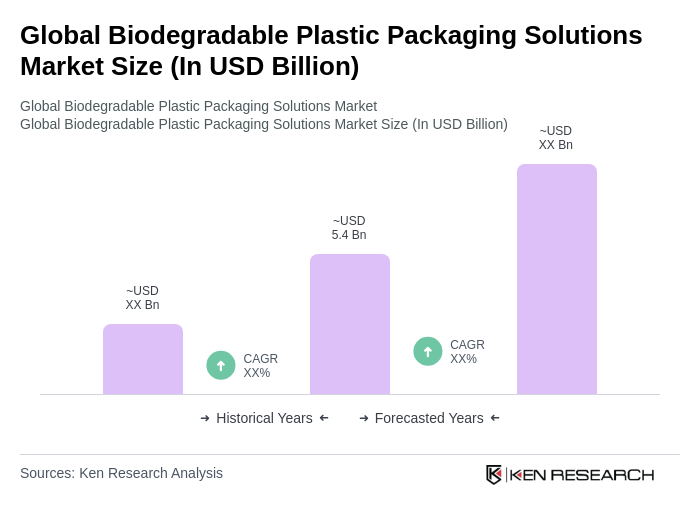
The global biodegradable plastic packaging solutions market, valued at $5.4 billion, is set to grow at 8.8% CAGR to $9.1 billion by 2033, fueled by eco-friendly demands and bans on single-use plastics.

Region:Global

Author(s):Dev

Product Code:KRAD0465

Pages:88

Published On:August 2025
About the Report

Base Year 2024

Global Biodegradable Plastic Packaging Solutions Market Overview

  • The Global Biodegradable Plastic Packaging Solutions Market is valued at approximately USD 5.4 billion, based on a five-year analysis. This valuation aligns with authoritative biodegradable plastics market assessments that place the broader biodegradable plastics market near this level, with packaging as the largest application segment.
  • Growth is driven by increasing consumer awareness of environmental sustainability and regulatory actions restricting conventional single-use plastics; packaging remains the largest use-case for biodegradable plastics due to brand and retailer shifts to lower-impact materials.
  • In the European Union, the Single-Use Plastics Directive targets the environmental impact of specific plastic items by requiring bans and consumption reductions for items like cutlery, plates, straws, and expanded polystyrene food containers, which has stimulated demand for alternatives including certified compostable and biodegradable packaging solutions.
Global Biodegradable Plastic Packaging Solutions Market Size

Global Biodegradable Plastic Packaging Solutions Market Segmentation

By Type:The biodegradable plastic packaging market is segmented into various types, including starch-based plastics, PLA (Polylactic Acid), PHA (Polyhydroxyalkanoates), cellulose-based plastics, and PBAT/PLA blends and other biodegradable plastics. PLA is widely used in packaging due to its processability and compostability under industrial conditions; however, blends (e.g., PLA/PBAT) are increasingly adopted to improve toughness and performance in flexible packaging.
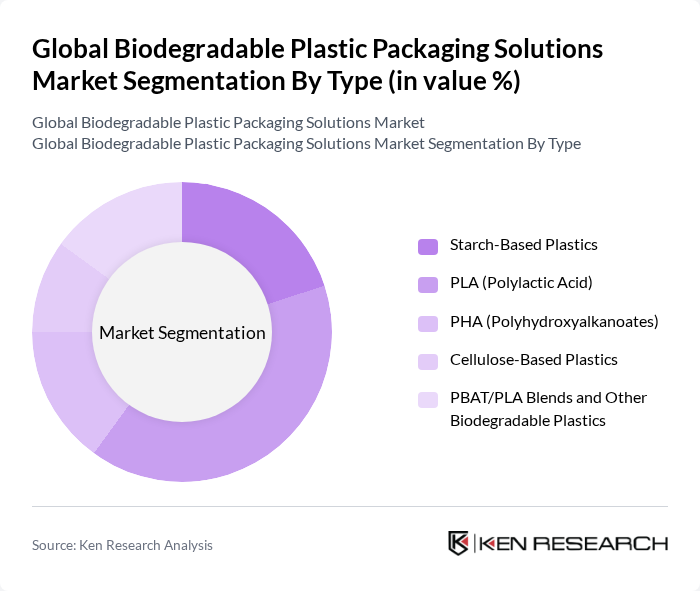
Global Biodegradable Plastic Packaging Solutions Market segmentation by Type.

By End-User:The end-user segmentation includes food and beverage, consumer goods and personal care, healthcare and pharmaceuticals, and retail and e-commerce. The food and beverage sector is the dominant segment as packaging is the leading application for biodegradable plastics, supported by retailer commitments, brand sustainability targets, and regulatory pressure across regions.
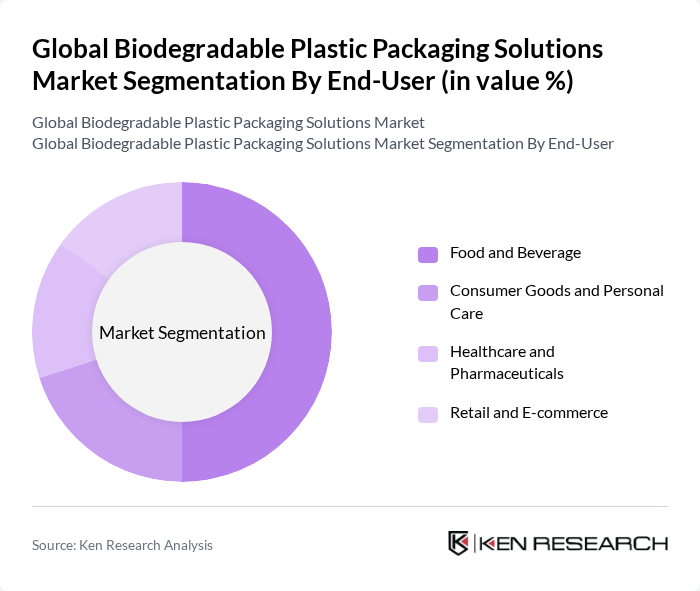
Global Biodegradable Plastic Packaging Solutions Market segmentation by End-User.

Global Biodegradable Plastic Packaging Solutions Market Competitive Landscape

The Global Biodegradable Plastic Packaging Solutions Market is characterized by a dynamic mix of regional and international players. Leading participants such as BASF SE, Novamont S.p.A., NatureWorks LLC, Biome Bioplastics Ltd., TotalEnergies Corbion PLA, Green Dot Bioplastics, Inc., TIPA Corp Ltd., BioBag International AS, Earthpak, Amcor plc, Sealed Air Corporation, Smurfit Kappa Group plc, Mondi plc, Huhtamäki Oyj, DS Smith Plc, Danimer Scientific, Inc., FKuR Kunststoff GmbH, TIPSA S.L. (TIPA Spain, if applicable), Avantium N.V., Coveris Group contribute to innovation, geographic expansion, and service delivery in this space.

BASF SE

1865

Ludwigshafen, Germany

Novamont S.p.A.

1989

Novara, Italy

NatureWorks LLC

2002

Plymouth, Minnesota, USA

Biome Bioplastics Ltd.

2006

Southampton, UK

TotalEnergies Corbion PLA

2017

Gorinchem, Netherlands

Company

Establishment Year

Headquarters

Company Size (by revenue and headcount)

Biodegradable Packaging Revenue (USD) and YoY Growth

Material Portfolio Mix (PLA, PHA, Starch, Cellulose, Blends)

Geographic Footprint (production sites and sales regions)

Market Penetration (end-use sectors served)

Product Innovation Pipeline (patents, launches per year)

Global Biodegradable Plastic Packaging Solutions Market Industry Analysis

Growth Drivers

  • Increasing Environmental Awareness:The global shift towards sustainability has led to a significant rise in environmental awareness among consumers. In future, approximately 70% of consumers in None are expected to prioritize eco-friendly products, driving demand for biodegradable packaging. This trend is supported by a report from the World Bank, which indicated that 65% of consumers are willing to pay a premium for sustainable packaging solutions, reflecting a growing commitment to environmental responsibility.
  • Government Regulations Promoting Biodegradable Solutions:Governments worldwide are implementing stringent regulations to reduce plastic waste. In None, legislation mandating the reduction of single-use plastics is projected to affect over 50% of packaging manufacturers in future. The International Monetary Fund (IMF) reported that countries enforcing such regulations have seen a 30% increase in biodegradable packaging adoption, highlighting the role of policy in shaping market dynamics and encouraging sustainable practices.
  • Rising Demand from Food and Beverage Industry:The food and beverage sector is a major driver of biodegradable packaging solutions, with an estimated market value of $1.2 billion in None for future. This demand is fueled by consumer preferences for sustainable packaging, as evidenced by an industry report indicating that 60% of food brands are shifting towards biodegradable options. This transition is expected to enhance brand loyalty and meet regulatory requirements, further propelling market growth.

Market Challenges

  • High Production Costs:One of the significant challenges facing the biodegradable plastic packaging market is the high production costs associated with biodegradable materials. In None, the average production cost of biodegradable plastics is approximately 20% higher than conventional plastics. This cost disparity can deter manufacturers from transitioning to sustainable options, especially in a price-sensitive market where profit margins are critical for survival.
  • Limited Availability of Raw Materials:The supply chain for biodegradable materials is often constrained by the limited availability of raw materials. In None, the production of bioplastics relies heavily on agricultural feedstocks, which are subject to fluctuations in availability and price. A report from the Food and Agriculture Organization (FAO) indicated that crop yields for key bioplastic feedstocks are projected to decline by 10% due to climate change, exacerbating supply challenges and impacting production capabilities.

Global Biodegradable Plastic Packaging Solutions Market Future Outlook

The future of biodegradable plastic packaging in None appears promising, driven by increasing consumer demand for sustainable solutions and supportive government policies. As environmental concerns continue to rise, innovations in biodegradable materials are expected to enhance product performance and reduce costs. Additionally, the growth of e-commerce is likely to accelerate the adoption of eco-friendly packaging solutions, as online retailers seek to meet consumer expectations for sustainability while navigating regulatory landscapes that favor biodegradable options.

Market Opportunities

  • Expansion in Emerging Markets:Emerging markets in None present significant opportunities for biodegradable packaging solutions. With a projected increase in disposable income and urbanization, the demand for sustainable packaging is expected to rise. In future, these markets could see a 25% increase in biodegradable packaging adoption, driven by consumer awareness and regulatory support.
  • Innovations in Product Development:Continuous innovations in biodegradable materials and packaging technologies are creating new market opportunities. Companies investing in R&D are likely to develop advanced biodegradable solutions that meet diverse consumer needs. In None, the introduction of new biodegradable materials is expected to increase market competitiveness, with an estimated 15% growth in product offerings in future.

Scope of the Report

SegmentSub-Segments
By Type

Starch-Based Plastics

PLA (Polylactic Acid)

PHA (Polyhydroxyalkanoates)

Cellulose-Based Plastics

PBAT/PLA Blends and Other Biodegradable Plastics

By End-User

Food and Beverage

Consumer Goods and Personal Care

Healthcare and Pharmaceuticals

Retail and E-commerce

By Application

Flexible Packaging Films and Wraps

Rigid Packaging (Trays, Clamshells, Bottles)

Bags, Pouches, and Liners

Containers, Cups, and Serviceware

By Distribution Channel

Online Retail

Supermarkets/Hypermarkets

Specialty Stores

Direct Sales (B2B)

By Region

North America

Europe

Asia-Pacific

Latin America

By Price Range

Economy

Mid-Range

Premium

By Others

Custom and Private-Label Solutions

Niche and Compostable-Certified Products

Key Target Audience

Investors and Venture Capitalist Firms

Government and Regulatory Bodies (e.g., Environmental Protection Agency, Food and Drug Administration)

Manufacturers and Producers of Biodegradable Plastics

Packaging Companies and Suppliers

Retail Chains and Supermarkets

Waste Management and Recycling Companies

Industry Associations (e.g., Biodegradable Products Institute)

Financial Institutions and Banks

Players Mentioned in the Report:

BASF SE

Novamont S.p.A.

NatureWorks LLC

Biome Bioplastics Ltd.

TotalEnergies Corbion PLA

Green Dot Bioplastics, Inc.

TIPA Corp Ltd.

BioBag International AS

Earthpak

Amcor plc

Sealed Air Corporation

Smurfit Kappa Group plc

Mondi plc

Huhtamaki Oyj

DS Smith Plc

Danimer Scientific, Inc.

FKuR Kunststoff GmbH

TIPSA S.L. (TIPA Spain, if applicable)

Avantium N.V.

Coveris Group

Table of Contents

Market Assessment Phase

1. Executive Summary and Approach


2. Global Biodegradable Plastic Packaging Solutions Market Overview

2.1 Key Insights and Strategic Recommendations

2.2 Global Biodegradable Plastic Packaging Solutions Market Overview

2.3 Definition and Scope

2.4 Evolution of Market Ecosystem

2.5 Timeline of Key Regulatory Milestones

2.6 Value Chain & Stakeholder Mapping

2.7 Business Cycle Analysis

2.8 Policy & Incentive Landscape


3. Global Biodegradable Plastic Packaging Solutions Market Analysis

3.1 Growth Drivers

3.1.1 Increasing Environmental Awareness
3.1.2 Government Regulations Promoting Biodegradable Solutions
3.1.3 Rising Demand from Food and Beverage Industry
3.1.4 Technological Advancements in Biodegradable Materials

3.2 Market Challenges

3.2.1 High Production Costs
3.2.2 Limited Availability of Raw Materials
3.2.3 Consumer Perception and Awareness Issues
3.2.4 Competition from Conventional Plastics

3.3 Market Opportunities

3.3.1 Expansion in Emerging Markets
3.3.2 Innovations in Product Development
3.3.3 Collaborations with Eco-Friendly Brands
3.3.4 Increased Investment in Sustainable Packaging Solutions

3.4 Market Trends

3.4.1 Shift Towards Circular Economy
3.4.2 Growth of E-commerce and Online Retail
3.4.3 Adoption of Smart Packaging Technologies
3.4.4 Rising Popularity of Compostable Packaging

3.5 Government Regulation

3.5.1 Plastic Ban Initiatives
3.5.2 Incentives for Biodegradable Material Production
3.5.3 Standards for Biodegradable Packaging
3.5.4 Labeling Requirements for Biodegradable Products

4. SWOT Analysis


5. Stakeholder Analysis


6. Porter's Five Forces Analysis


7. Global Biodegradable Plastic Packaging Solutions Market Market Size, 2019-2024

7.1 By Value

7.2 By Volume

7.3 By Average Selling Price


8. Global Biodegradable Plastic Packaging Solutions Market Segmentation

8.1 By Type

8.1.1 Starch-Based Plastics
8.1.2 PLA (Polylactic Acid)
8.1.3 PHA (Polyhydroxyalkanoates)
8.1.4 Cellulose-Based Plastics
8.1.5 PBAT/PLA Blends and Other Biodegradable Plastics

8.2 By End-User

8.2.1 Food and Beverage
8.2.2 Consumer Goods and Personal Care
8.2.3 Healthcare and Pharmaceuticals
8.2.4 Retail and E-commerce

8.3 By Application

8.3.1 Flexible Packaging Films and Wraps
8.3.2 Rigid Packaging (Trays, Clamshells, Bottles)
8.3.3 Bags, Pouches, and Liners
8.3.4 Containers, Cups, and Serviceware

8.4 By Distribution Channel

8.4.1 Online Retail
8.4.2 Supermarkets/Hypermarkets
8.4.3 Specialty Stores
8.4.4 Direct Sales (B2B)

8.5 By Region

8.5.1 North America
8.5.2 Europe
8.5.3 Asia-Pacific
8.5.4 Latin America

8.6 By Price Range

8.6.1 Economy
8.6.2 Mid-Range
8.6.3 Premium

8.7 Others

8.7.1 Custom and Private-Label Solutions
8.7.2 Niche and Compostable-Certified Products

9. Global Biodegradable Plastic Packaging Solutions Market Competitive Analysis

9.1 Market Share of Key Players

9.2 Cross Comparison of Key Players

9.2.1 Company Name
9.2.2 Company Size (by revenue and headcount)
9.2.3 Biodegradable Packaging Revenue (USD) and YoY Growth
9.2.4 Material Portfolio Mix (PLA, PHA, Starch, Cellulose, Blends)
9.2.5 Geographic Footprint (production sites and sales regions)
9.2.6 Market Penetration (end-use sectors served)
9.2.7 Product Innovation Pipeline (patents, launches per year)
9.2.8 Certification Coverage (EN 13432, ASTM D6400, OK compost)
9.2.9 Average Selling Price Band and Pricing Strategy
9.2.10 Distribution Reach (B2B channels, converter partnerships)
9.2.11 Sustainability KPIs (recycled/biobased content %, Scope 1–3 targets)
9.2.12 Strategic Alliances and OEM/Brand Partnerships

9.3 SWOT Analysis of Top Players

9.4 Pricing Analysis

9.5 Detailed Profile of Major Companies

9.5.1 BASF SE
9.5.2 Novamont S.p.A.
9.5.3 NatureWorks LLC
9.5.4 Biome Bioplastics Ltd.
9.5.5 TotalEnergies Corbion PLA
9.5.6 Green Dot Bioplastics, Inc.
9.5.7 TIPA Corp Ltd.
9.5.8 BioBag International AS
9.5.9 Earthpak
9.5.10 Amcor plc
9.5.11 Sealed Air Corporation
9.5.12 Smurfit Kappa Group plc
9.5.13 Mondi plc
9.5.14 Huhtamäki Oyj
9.5.15 DS Smith Plc
9.5.16 Danimer Scientific, Inc.
9.5.17 FKuR Kunststoff GmbH
9.5.18 TIPSA S.L. (TIPA Spain, if applicable)
9.5.19 Avantium N.V.
9.5.20 Coveris Group

10. Global Biodegradable Plastic Packaging Solutions Market End-User Analysis

10.1 Procurement Behavior of Key Ministries

10.1.1 Government Initiatives for Sustainable Packaging
10.1.2 Budget Allocations for Eco-Friendly Solutions
10.1.3 Collaboration with Private Sector

10.2 Corporate Spend on Infrastructure & Energy

10.2.1 Investment in Biodegradable Packaging Solutions
10.2.2 Funding for Research and Development
10.2.3 Partnerships with Environmental Organizations

10.3 Pain Point Analysis by End-User Category

10.3.1 Cost Constraints
10.3.2 Supply Chain Challenges
10.3.3 Quality and Performance Issues

10.4 User Readiness for Adoption

10.4.1 Awareness of Biodegradable Options
10.4.2 Willingness to Pay a Premium
10.4.3 Availability of Alternatives

10.5 Post-Deployment ROI and Use Case Expansion

10.5.1 Measurement of Environmental Impact
10.5.2 Long-term Cost Savings
10.5.3 Expansion into New Markets

11. Global Biodegradable Plastic Packaging Solutions Market Future Size, 2025-2030

11.1 By Value

11.2 By Volume

11.3 By Average Selling Price


Go-To-Market Strategy Phase

1. Whitespace Analysis + Business Model Canvas

1.1 Market Gaps Identification

1.2 Value Proposition Development

1.3 Revenue Streams Analysis

1.4 Cost Structure Evaluation

1.5 Key Partnerships

1.6 Customer Segments

1.7 Channels


2. Marketing and Positioning Recommendations

2.1 Branding Strategies

2.2 Product USPs

2.3 Target Audience Identification

2.4 Communication Strategy

2.5 Digital Marketing Approaches


3. Distribution Plan

3.1 Urban Retail Strategies

3.2 Rural NGO Tie-ups

3.3 E-commerce Integration

3.4 Direct-to-Consumer Models


4. Channel & Pricing Gaps

4.1 Underserved Routes

4.2 Pricing Bands Analysis

4.3 Competitor Pricing Strategies


5. Unmet Demand & Latent Needs

5.1 Category Gaps

5.2 Consumer Segments Analysis

5.3 Emerging Trends


6. Customer Relationship

6.1 Loyalty Programs

6.2 After-sales Service

6.3 Customer Feedback Mechanisms


7. Value Proposition

7.1 Sustainability Initiatives

7.2 Integrated Supply Chains

7.3 Competitive Advantages


8. Key Activities

8.1 Regulatory Compliance

8.2 Branding Efforts

8.3 Distribution Setup


9. Entry Strategy Evaluation

9.1 Domestic Market Entry Strategy

9.1.1 Product Mix
9.1.2 Pricing Band
9.1.3 Packaging Considerations

9.2 Export Entry Strategy

9.2.1 Target Countries
9.2.2 Compliance Roadmap

10. Entry Mode Assessment

10.1 Joint Ventures

10.2 Greenfield Investments

10.3 Mergers & Acquisitions

10.4 Distributor Model


11. Capital and Timeline Estimation

11.1 Capital Requirements

11.2 Timelines for Implementation


12. Control vs Risk Trade-Off

12.1 Ownership vs Partnerships


13. Profitability Outlook

13.1 Breakeven Analysis

13.2 Long-term Sustainability


14. Potential Partner List

14.1 Distributors

14.2 Joint Ventures

14.3 Acquisition Targets


15. Execution Roadmap

15.1 Phased Plan for Market Entry

15.1.1 Market Setup
15.1.2 Market Entry
15.1.3 Growth Acceleration
15.1.4 Scale & Stabilize

15.2 Key Activities and Milestones

15.2.1 Milestone Planning
15.2.2 Activity Tracking

Research Methodology

ApproachModellingSample

Phase 1: Approach1

Desk Research

  • Analysis of industry reports from environmental organizations and packaging associations
  • Review of academic journals focusing on biodegradable materials and their applications
  • Examination of government publications on sustainability initiatives and regulations

Primary Research

  • Interviews with product development managers at biodegradable plastic manufacturers
  • Surveys with sustainability officers in major retail chains
  • Focus groups with consumers to gauge perceptions of biodegradable packaging

Validation & Triangulation

  • Cross-referencing data from multiple industry sources to ensure accuracy
  • Engaging with a panel of experts for insights on market trends and forecasts
  • Sanity checks through comparison with historical market data and growth patterns

Phase 2: Market Size Estimation1

Top-down Assessment

  • Analysis of global plastic packaging market size and growth rates
  • Segmentation by application areas such as food, cosmetics, and pharmaceuticals
  • Incorporation of regional market dynamics and consumer behavior trends

Bottom-up Modeling

  • Estimation of production capacities of leading biodegradable plastic manufacturers
  • Cost analysis based on raw material prices and production processes
  • Volume estimates derived from sales data of biodegradable packaging products

Forecasting & Scenario Analysis

  • Utilization of time-series analysis to project future market trends
  • Scenario modeling based on varying levels of regulatory support and consumer adoption
  • Development of best-case, worst-case, and most-likely market scenarios through 2030

Phase 3: CATI Sample Composition1

Scope Item/SegmentSample SizeTarget Respondent Profiles
Food Packaging Sector140Packaging Engineers, Product Managers
Cosmetics and Personal Care100Brand Managers, Sustainability Coordinators
Pharmaceutical Packaging80Regulatory Affairs Specialists, Quality Assurance Managers
Retail and E-commerce Packaging120Supply Chain Managers, E-commerce Directors
Industrial Packaging Solutions70Operations Managers, Procurement Specialists

Frequently Asked Questions

What is the current value of the Global Biodegradable Plastic Packaging Solutions Market?

The Global Biodegradable Plastic Packaging Solutions Market is valued at approximately USD 5.4 billion, reflecting its position as the largest application segment within the broader biodegradable plastics market, which is experiencing significant growth due to environmental concerns.

What factors are driving the growth of the biodegradable plastic packaging market?

How does government regulation impact the biodegradable plastic packaging market?

What are the main types of biodegradable plastics used in packaging?

Other Regional/Country Reports

UAE Biodegradable Plastic Packaging Solutions MarketKSA Biodegradable Plastic Packaging Solutions Market

Indonesia Biodegradable Plastic Packaging Solutions Market

Malaysia Biodegradable Plastic Packaging Solutions Market

APAC Biodegradable Plastic Packaging Solutions Market

SEA Biodegradable Plastic Packaging Solutions Market

Why Buy From Us?

Refine Robust Result (RRR) Framework

What makes us stand out is that our consultants follow Robust, Refine and Result (RRR) methodology. Robust for clear definitions, approaches and sanity checking, Refine for differentiating respondents' facts and opinions, and Result for presenting data with story.

Our Reach Is Unmatched

We have set a benchmark in the industry by offering our clients with syndicated and customized market research reports featuring coverage of entire market as well as meticulous research and analyst insights.

Shifting the Research Paradigm

While we don't replace traditional research, we flip the method upside down. Our dual approach of Top Bottom & Bottom Top ensures quality deliverable by not just verifying company fundamentals but also looking at the sector and macroeconomic factors.

More Insights-Better Decisions

With one step in the future, our research team constantly tries to show you the bigger picture. We help with some of the tough questions you may encounter along the way: How is the industry positioned? Best marketing channel? KPI's of competitors? By aligning every element, we help maximize success.

Transparency and Trust

Our report gives you instant access to the answers and sources that other companies might choose to hide. We elaborate each steps of research methodology we have used and showcase you the sample size to earn your trust.

Round the Clock Support

If you need any support, we are here! We pride ourselves on universe strength, data quality, and quick, friendly, and professional service.

Why Clients Choose Us?

400000+
Reports in repository
150+
Consulting projects a year
100+
Analysts
8000+
Client Queries in 2022








