Global Bipolar Disorder Market

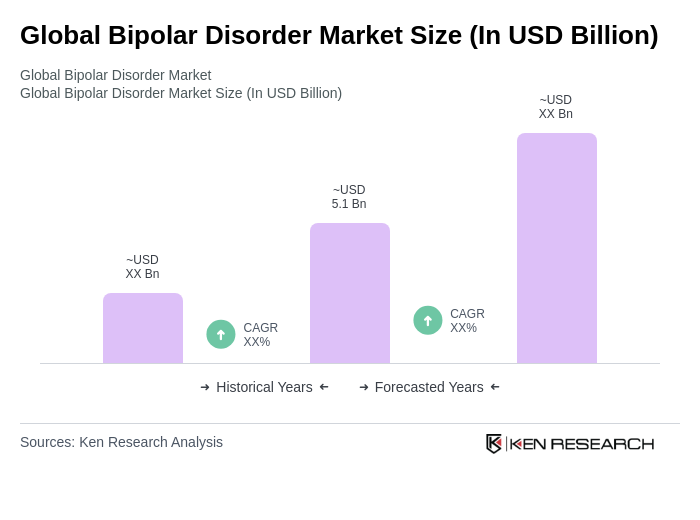
Global Bipolar Disorder Market, valued at USD 5.1 billion, is growing due to increasing awareness, prevalence, and innovations in pharmacotherapy and telehealth for better patient outcomes.

Region:Global

Author(s):Dev

Product Code:KRAD0445

Pages:99

Published On:August 2025
About the Report

Base Year 2024

Global Bipolar Disorder Market Overview

  • The Global Bipolar Disorder Market is valued at USD 5.1 billion, based on a five-year historical analysis. This growth is primarily driven by increasing awareness of mental health issues, advancements in treatment options, and the rising prevalence of bipolar disorder globally. The market is also supported by ongoing research and development efforts aimed at improving therapeutic outcomes for patients.
  • Key players in this market include the United States, Canada, Germany, and the United Kingdom. These countries dominate the market due to their robust healthcare infrastructure, high investment in mental health services, and a strong focus on research and development in psychiatric medications. Additionally, the presence of leading pharmaceutical companies in these regions contributes to their market leadership.
  • In 2023, the U.S. government implemented the Mental Health Parity and Addiction Equity Act, which mandates that mental health services, including treatments for bipolar disorder, must be covered by insurance plans at the same level as physical health services. This regulation aims to improve access to necessary treatments and reduce the stigma associated with mental health conditions.
Global Bipolar Disorder Market Size

Global Bipolar Disorder Market Segmentation

By Type:The bipolar disorder market is segmented into four main types: Bipolar I Disorder, Bipolar II Disorder, Cyclothymic Disorder, and Other Specified and Unspecified Bipolar and Related Disorders. Among these, Bipolar I Disorder is the most prevalent, characterized by manic episodes that can be severe and often require hospitalization. The increasing recognition of the disorder and its impact on individuals' lives has led to a growing demand for effective treatment options.
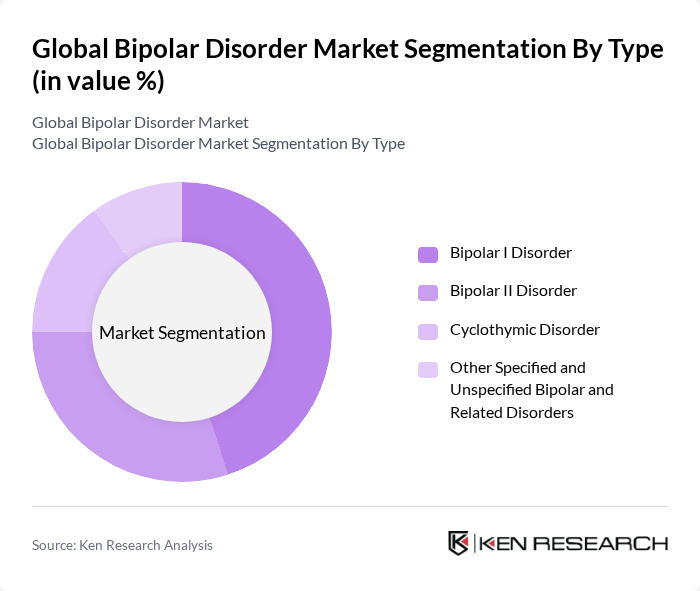
Global Bipolar Disorder Market segmentation by Type.

By Treatment Type:This market is also segmented by treatment type, which includes Pharmacotherapy (Drug Class), Psychotherapy, Neuromodulation, and Digital Therapeutics and Telepsychiatry Support. Pharmacotherapy is the leading treatment type, with mood stabilizers and atypical antipsychotics being the most commonly prescribed medications. The increasing acceptance of pharmacological treatments and the development of new drugs are driving this segment's growth. Common drug classes used include mood stabilizers (e.g., lithium, valproate), atypical antipsychotics (e.g., quetiapine, lurasidone, cariprazine), and adjunctive antidepressants with careful monitoring. ; ;
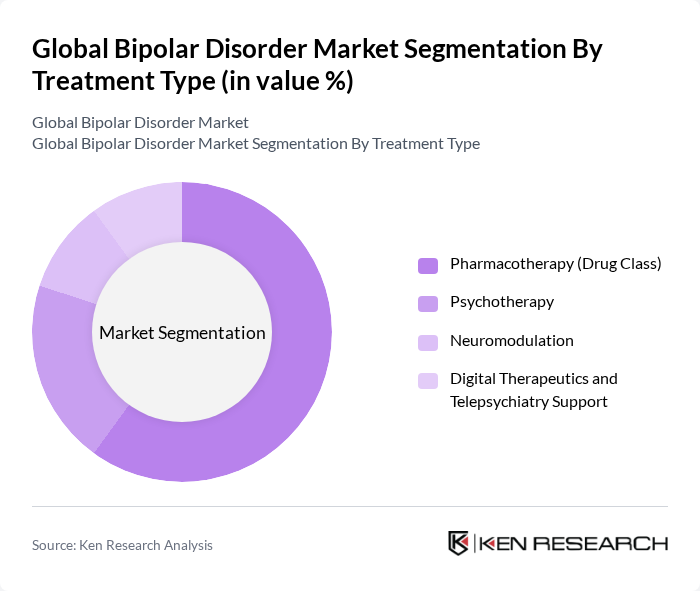
Global Bipolar Disorder Market segmentation by Treatment Type.

Global Bipolar Disorder Market Competitive Landscape

The Global Bipolar Disorder Market is characterized by a dynamic mix of regional and international players. Leading participants such as Johnson & Johnson (Janssen Pharmaceuticals), Pfizer Inc., Eli Lilly and Company, AstraZeneca PLC, Novartis AG, GlaxoSmithKline plc, Sanofi S.A., Otsuka Holdings Co., Ltd., H. Lundbeck A/S, Takeda Pharmaceutical Company Limited, Teva Pharmaceutical Industries Ltd., AbbVie Inc., Sumitomo Pharma Co., Ltd., Sunovion Pharmaceuticals Inc. (a Sumitomo Pharma company), Intra-Cellular Therapies, Inc. contribute to innovation, geographic expansion, and service delivery in this space.

Johnson & Johnson (Janssen Pharmaceuticals)

1886

New Brunswick, New Jersey, USA

Pfizer Inc.

1849

New York City, New York, USA

Eli Lilly and Company

1876

Indianapolis, Indiana, USA

AstraZeneca PLC

1999

Cambridge, England

Novartis AG

1996

Basel, Switzerland

Company

Establishment Year

Headquarters

Global Market Reach (countries/regions with commercial presence in bipolar treatments)

Bipolar-Related Revenue (USD, latest FY or segment estimate)

CAGR of Bipolar Franchise Revenue (3–5 year)

R&D Intensity for CNS/Bipolar (R&D spend as % of revenue; number of ongoing trials)

Pipeline Strength (phase II/III assets for bipolar mania/depression/maintenance)

Time-to-Market Velocity (average years from phase II to approval in CNS)

Global Bipolar Disorder Market Industry Analysis

Growth Drivers

  • Increasing Prevalence of Bipolar Disorder:The World Health Organization estimates that approximatelypeople globally suffer from bipolar disorder, with the prevalence rate in the United States alone reachingof the adult population. This growing number of diagnosed cases is expected to drive demand for treatment options, as healthcare systems increasingly prioritize mental health. The rising incidence is particularly notable among younger populations, with a significant increase in diagnoses among individuals aged 18-24, highlighting the urgent need for effective interventions.
  • Advancements in Treatment Options:Recent advancements in pharmacological treatments, including mood stabilizers and atypical antipsychotics, have significantly improved patient outcomes. For instance, the introduction of medications like lurasidone has shown efficacy in treating bipolar depression, with clinical trials indicating a reduction in depressive symptoms. Additionally, the development of long-acting injectable formulations is enhancing adherence rates, which is crucial given that approximatelyof patients struggle with treatment compliance, thus driving market growth.
  • Increased Funding for Mental Health Initiatives:In future, global spending on mental health is projected to exceed, reflecting a growing commitment from governments and organizations to address mental health issues. This funding is directed towards research, treatment accessibility, and public awareness campaigns. For example, the U.S. government allocatedto mental health services, which is expected to enhance the availability of resources for bipolar disorder treatment, thereby fostering market growth and improving patient care.

Market Challenges

  • Stigma Associated with Mental Health:Despite increasing awareness, stigma surrounding mental health issues remains a significant barrier to treatment. According to a survey by the National Alliance on Mental Illness,of individuals with bipolar disorder reported feeling ashamed of their condition, which often leads to delayed diagnosis and treatment. This societal stigma can deter patients from seeking help, ultimately hindering market growth and limiting the effectiveness of available treatment options.
  • High Cost of Treatment:The financial burden of bipolar disorder treatment can be substantial, with annual costs averagingper patient in the U.S. This includes expenses for medications, therapy, and hospitalizations. Many patients face challenges in affording these costs, particularly those without insurance coverage. The high cost of innovative treatments, such as long-acting injectables, further exacerbates this issue, limiting access to necessary care and posing a challenge to market expansion.

Global Bipolar Disorder Market Future Outlook

The future of the bipolar disorder market appears promising, driven by ongoing advancements in treatment modalities and increased public awareness. As mental health becomes a priority for healthcare systems worldwide, the integration of mental health services into primary care settings is expected to enhance accessibility. Furthermore, the rise of digital therapeutics and telehealth services will likely provide innovative solutions for patient engagement and adherence, ultimately improving treatment outcomes and expanding market reach in the coming years.

Market Opportunities

  • Development of Personalized Medicine:The shift towards personalized medicine presents a significant opportunity in the bipolar disorder market. Tailoring treatments based on genetic profiles can enhance efficacy and reduce side effects. With overof patients experiencing treatment-resistant symptoms, personalized approaches could lead to better management strategies, improving patient outcomes and satisfaction.
  • Expansion of Telehealth Services:The COVID-19 pandemic accelerated the adoption of telehealth, which is projected to grow byannually through future. This expansion offers a unique opportunity to reach underserved populations, particularly in rural areas where access to mental health professionals is limited. Telehealth can facilitate ongoing support and monitoring, significantly improving treatment adherence and patient engagement in bipolar disorder management.

Scope of the Report

SegmentSub-Segments
By Type

Bipolar I Disorder

Bipolar II Disorder

Cyclothymic Disorder

Other Specified and Unspecified Bipolar and Related Disorders

By Treatment Type

Pharmacotherapy (Drug Class)

Mood Stabilizers (e.g., lithium, valproate, lamotrigine)

Atypical Antipsychotics

Antidepressants (adjunctive, where appropriate)

Anxiolytics and Others

Psychotherapy (CBT, IPSRT, family-focused therapy)

Neuromodulation (ECT, rTMS)

Digital Therapeutics and Telepsychiatry Support

By Age Group

Children and Adolescents

Adults

Older Adults

By Care Setting

Hospital/Inpatient

Outpatient Specialty Clinics

Community Mental Health Centers

Home/Telehealth

By Distribution Channel (for Drugs)

Hospital Pharmacies

Retail Pharmacies

Online Pharmacies

By Region

North America

Europe

Asia Pacific

Latin America

Middle East & Africa

By Unmet Need/Severity

Acute Mania Management

Bipolar Depression Management

Maintenance/Relapse Prevention

Treatment-Resistant Cases

Key Target Audience

Investors and Venture Capitalist Firms

Government and Regulatory Bodies (e.g., Food and Drug Administration, European Medicines Agency)

Pharmaceutical Manufacturers

Biotechnology Companies

Healthcare Providers and Hospitals

Insurance Companies and Payers

Patient Advocacy Groups

Clinical Research Organizations

Players Mentioned in the Report:

Johnson & Johnson (Janssen Pharmaceuticals)

Pfizer Inc.

Eli Lilly and Company

AstraZeneca PLC

Novartis AG

GlaxoSmithKline plc

Sanofi S.A.

Otsuka Holdings Co., Ltd.

H. Lundbeck A/S

Takeda Pharmaceutical Company Limited

Teva Pharmaceutical Industries Ltd.

AbbVie Inc.

Sumitomo Pharma Co., Ltd.

Sunovion Pharmaceuticals Inc. (a Sumitomo Pharma company)

Intra-Cellular Therapies, Inc.

Table of Contents

Market Assessment Phase

1. Executive Summary and Approach


2. Global Bipolar Disorder Market Overview

2.1 Key Insights and Strategic Recommendations

2.2 Global Bipolar Disorder Market Overview

2.3 Definition and Scope

2.4 Evolution of Market Ecosystem

2.5 Timeline of Key Regulatory Milestones

2.6 Value Chain & Stakeholder Mapping

2.7 Business Cycle Analysis

2.8 Policy & Incentive Landscape


3. Global Bipolar Disorder Market Analysis

3.1 Growth Drivers

3.1.1 Increasing prevalence of bipolar disorder
3.1.2 Advancements in treatment options
3.1.3 Growing awareness and diagnosis rates
3.1.4 Increased funding for mental health initiatives

3.2 Market Challenges

3.2.1 Stigma associated with mental health
3.2.2 High cost of treatment
3.2.3 Limited access to mental health services
3.2.4 Variability in treatment adherence

3.3 Market Opportunities

3.3.1 Development of personalized medicine
3.3.2 Expansion of telehealth services
3.3.3 Increased investment in mental health research
3.3.4 Collaboration with technology firms for digital solutions

3.4 Market Trends

3.4.1 Rise of digital therapeutics
3.4.2 Integration of mental health into primary care
3.4.3 Focus on preventive care and early intervention
3.4.4 Shift towards holistic treatment approaches

3.5 Government Regulation

3.5.1 Mental health parity laws
3.5.2 Funding for mental health programs
3.5.3 Regulations on pharmaceutical marketing
3.5.4 Guidelines for telehealth services

4. SWOT Analysis


5. Stakeholder Analysis


6. Porter's Five Forces Analysis


7. Global Bipolar Disorder Market Market Size, 2019-2024

7.1 By Value

7.2 By Volume

7.3 By Average Selling Price


8. Global Bipolar Disorder Market Segmentation

8.1 By Type

8.1.1 Bipolar I Disorder
8.1.2 Bipolar II Disorder
8.1.3 Cyclothymic Disorder
8.1.4 Other Specified and Unspecified Bipolar and Related Disorders

8.2 By Treatment Type

8.2.1 Pharmacotherapy (Drug Class)
8.2.1.1 Mood Stabilizers (e.g., lithium, valproate, lamotrigine)
8.2.1.2 Atypical Antipsychotics
8.2.1.3 Antidepressants (adjunctive, where appropriate)
8.2.1.4 Anxiolytics and Others
8.2.2 Psychotherapy (CBT, IPSRT, family-focused therapy)
8.2.3 Neuromodulation (ECT, rTMS)
8.2.4 Digital Therapeutics and Telepsychiatry Support

8.3 By Age Group

8.3.1 Children and Adolescents
8.3.2 Adults
8.3.3 Older Adults

8.4 By Care Setting

8.4.1 Hospital/Inpatient
8.4.2 Outpatient Specialty Clinics
8.4.3 Community Mental Health Centers
8.4.4 Home/Telehealth

8.5 By Distribution Channel (for Drugs)

8.5.1 Hospital Pharmacies
8.5.2 Retail Pharmacies
8.5.3 Online Pharmacies

8.6 By Region

8.6.1 North America
8.6.2 Europe
8.6.3 Asia Pacific
8.6.4 Latin America
8.6.5 Middle East & Africa

8.7 By Unmet Need/Severity

8.7.1 Acute Mania Management
8.7.2 Bipolar Depression Management
8.7.3 Maintenance/Relapse Prevention
8.7.4 Treatment-Resistant Cases

9. Global Bipolar Disorder Market Competitive Analysis

9.1 Market Share of Key Players

9.2 Cross Comparison of Key Players

9.2.1 Therapeutic Portfolio Breadth (number of approved bipolar indications across drug classes)
9.2.2 Global Market Reach (countries/regions with commercial presence in bipolar treatments)
9.2.3 Bipolar-Related Revenue (USD, latest FY or segment estimate)
9.2.4 CAGR of Bipolar Franchise Revenue (3–5 year)
9.2.5 R&D Intensity for CNS/Bipolar (R&D spend as % of revenue; number of ongoing trials)
9.2.6 Pipeline Strength (phase II/III assets for bipolar mania/depression/maintenance)
9.2.7 Time-to-Market Velocity (average years from phase II to approval in CNS)
9.2.8 Geographic Access (formulary/listing rate in top 10 markets)
9.2.9 Pharmacovigilance and Safety Profile (label warnings, post-marketing commitments)
9.2.10 Patient Support and Adherence Programs (coverage, enrollment, digital tools)
9.2.11 Pricing and Contracting Leverage (net price trends, payer discounts, tender wins)
9.2.12 Manufacturing and Supply Resilience (API sources, shortage history, audits)

9.3 SWOT Analysis of Top Players

9.4 Pricing Analysis

9.5 Detailed Profile of Major Companies

9.5.1 Johnson & Johnson (Janssen Pharmaceuticals)
9.5.2 Pfizer Inc.
9.5.3 Eli Lilly and Company
9.5.4 AstraZeneca PLC
9.5.5 Novartis AG
9.5.6 GlaxoSmithKline plc
9.5.7 Sanofi S.A.
9.5.8 Otsuka Holdings Co., Ltd.
9.5.9 H. Lundbeck A/S
9.5.10 Takeda Pharmaceutical Company Limited
9.5.11 Teva Pharmaceutical Industries Ltd.
9.5.12 AbbVie Inc.
9.5.13 Sumitomo Pharma Co., Ltd.
9.5.14 Sunovion Pharmaceuticals Inc. (a Sumitomo Pharma company)
9.5.15 Intra-Cellular Therapies, Inc.

10. Global Bipolar Disorder Market End-User Analysis

10.1 Procurement Behavior of Key Ministries

10.1.1 Government funding allocations
10.1.2 Policy frameworks for mental health
10.1.3 Collaboration with NGOs

10.2 Corporate Spend on Infrastructure & Energy

10.2.1 Investment in mental health facilities
10.2.2 Funding for employee mental health programs

10.3 Pain Point Analysis by End-User Category

10.3.1 Access to treatment
10.3.2 Affordability of medications
10.3.3 Quality of care

10.4 User Readiness for Adoption

10.4.1 Awareness of treatment options
10.4.2 Acceptance of telehealth services

10.5 Post-Deployment ROI and Use Case Expansion

10.5.1 Long-term treatment outcomes
10.5.2 Cost savings from early intervention

11. Global Bipolar Disorder Market Future Size, 2025-2030

11.1 By Value

11.2 By Volume

11.3 By Average Selling Price


Go-To-Market Strategy Phase

1. Whitespace Analysis + Business Model Canvas

1.1 Market gaps identification

1.2 Value proposition development

1.3 Revenue model exploration

1.4 Key partnerships and resources

1.5 Customer segments analysis


2. Marketing and Positioning Recommendations

2.1 Branding strategies

2.2 Product USPs

2.3 Target audience engagement

2.4 Communication channels


3. Distribution Plan

3.1 Urban retail vs rural NGO tie-ups

3.2 Online vs offline distribution

3.3 Partnerships with healthcare providers


4. Channel & Pricing Gaps

4.1 Underserved routes

4.2 Pricing bands

4.3 Competitive pricing analysis


5. Unmet Demand & Latent Needs

5.1 Category gaps

5.2 Consumer segments

5.3 Emerging trends


6. Customer Relationship

6.1 Loyalty programs

6.2 After-sales service

6.3 Customer feedback mechanisms


7. Value Proposition

7.1 Sustainability

7.2 Integrated supply chains

7.3 Unique selling points


8. Key Activities

8.1 Regulatory compliance

8.2 Branding

8.3 Distribution setup


9. Entry Strategy Evaluation

9.1 Domestic Market Entry Strategy

9.1.1 Product mix
9.1.2 Pricing band
9.1.3 Packaging

9.2 Export Entry Strategy

9.2.1 Target countries
9.2.2 Compliance roadmap

10. Entry Mode Assessment

10.1 JV

10.2 Greenfield

10.3 M&A

10.4 Distributor Model


11. Capital and Timeline Estimation

11.1 Capital requirements

11.2 Timelines


12. Control vs Risk Trade-Off

12.1 Ownership vs Partnerships


13. Profitability Outlook

13.1 Breakeven analysis

13.2 Long-term sustainability


14. Potential Partner List

14.1 Distributors

14.2 JVs

14.3 Acquisition targets


15. Execution Roadmap

15.1 Phased Plan for Market Entry

15.1.1 Market Setup
15.1.2 Market Entry
15.1.3 Growth Acceleration
15.1.4 Scale & Stabilize

15.2 Key Activities and Milestones

15.2.1 Milestone tracking
15.2.2 Performance metrics

Research Methodology

ApproachModellingSample

Phase 1: Approach1

Desk Research

  • Analysis of published reports from mental health organizations and journals
  • Review of market data from healthcare databases and industry publications
  • Examination of government health statistics and policy documents related to bipolar disorder

Primary Research

  • Interviews with psychiatrists and mental health professionals specializing in bipolar disorder
  • Surveys conducted with patients diagnosed with bipolar disorder to understand treatment preferences
  • Focus groups with caregivers and family members of individuals with bipolar disorder

Validation & Triangulation

  • Cross-validation of findings through multiple expert interviews and patient surveys
  • Triangulation of data from clinical studies, market reports, and expert opinions
  • Sanity checks through peer reviews and feedback from mental health advocacy groups

Phase 2: Market Size Estimation1

Top-down Assessment

  • Estimation of the global bipolar disorder market size based on prevalence rates and treatment costs
  • Segmentation of the market by drug class, therapy type, and geographical region
  • Incorporation of trends in mental health awareness and access to treatment

Bottom-up Modeling

  • Analysis of sales data from pharmaceutical companies producing bipolar disorder medications
  • Estimation of market share based on prescription volume and patient demographics
  • Cost analysis of treatment regimens including medication, therapy, and hospitalization

Forecasting & Scenario Analysis

  • Multi-factor regression analysis considering factors such as healthcare spending and mental health policy changes
  • Scenario modeling based on potential advancements in treatment options and patient access
  • Development of baseline, optimistic, and pessimistic market forecasts through 2030

Phase 3: CATI Sample Composition1

Scope Item/SegmentSample SizeTarget Respondent Profiles
Psychiatric Treatment Facilities120Psychiatrists, Clinical Psychologists
Pharmaceutical Prescribers90General Practitioners, Nurse Practitioners
Patient Support Groups80Patients, Caregivers
Healthcare Policy Makers60Health Economists, Policy Analysts
Market Research Analysts70Healthcare Analysts, Market Strategists

Frequently Asked Questions

What is the current value of the Global Bipolar Disorder Market?

The Global Bipolar Disorder Market is valued at approximately USD 5.1 billion, driven by increased awareness of mental health issues, advancements in treatment options, and a rising prevalence of bipolar disorder worldwide.

Which countries dominate the Global Bipolar Disorder Market?

What recent legislation has impacted bipolar disorder treatment in the U.S.?

What are the main types of bipolar disorder?

Other Regional/Country Reports

UAE Bipolar Disorder MarketKSA Bipolar Disorder Market

Indonesia Bipolar Disorder Market

Malaysia Bipolar Disorder Market

APAC Bipolar Disorder Market

SEA Bipolar Disorder Market

Why Buy From Us?

Refine Robust Result (RRR) Framework

What makes us stand out is that our consultants follow Robust, Refine and Result (RRR) methodology. Robust for clear definitions, approaches and sanity checking, Refine for differentiating respondents' facts and opinions, and Result for presenting data with story.

Our Reach Is Unmatched

We have set a benchmark in the industry by offering our clients with syndicated and customized market research reports featuring coverage of entire market as well as meticulous research and analyst insights.

Shifting the Research Paradigm

While we don't replace traditional research, we flip the method upside down. Our dual approach of Top Bottom & Bottom Top ensures quality deliverable by not just verifying company fundamentals but also looking at the sector and macroeconomic factors.

More Insights-Better Decisions

With one step in the future, our research team constantly tries to show you the bigger picture. We help with some of the tough questions you may encounter along the way: How is the industry positioned? Best marketing channel? KPI's of competitors? By aligning every element, we help maximize success.

Transparency and Trust

Our report gives you instant access to the answers and sources that other companies might choose to hide. We elaborate each steps of research methodology we have used and showcase you the sample size to earn your trust.

Round the Clock Support

If you need any support, we are here! We pride ourselves on universe strength, data quality, and quick, friendly, and professional service.

Why Clients Choose Us?

400000+
Reports in repository
150+
Consulting projects a year
100+
Analysts
8000+
Client Queries in 2022








