About the Report
Base Year 2024Global Body Armor Market Overview
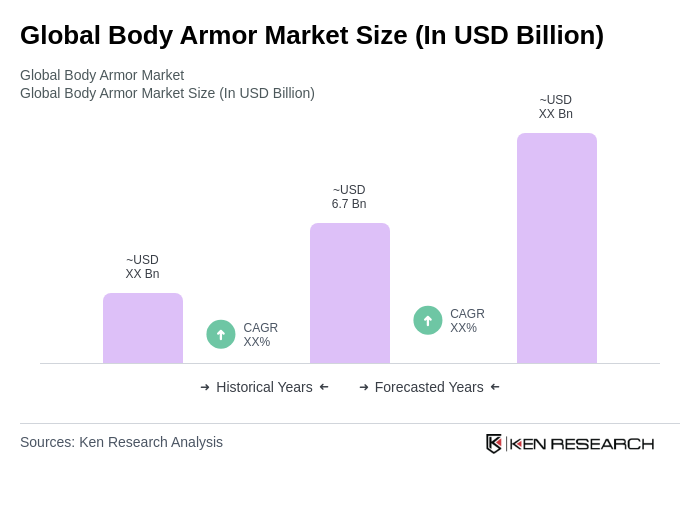
- The Global Body Armor Market is valued at USD 6.7 billion, based on a five-year historical analysis. This growth is primarily driven by increasing security concerns, rising military expenditures, and the growing demand for personal protective equipment among law enforcement agencies and civilians, alongside technological advances in lighter, higher-performance materials such as ultra-high-molecular-weight polyethylene and aramid fibers. The market has seen increased adoption of advanced materials and ergonomic designs that enhance protection, reduce weight, and improve comfort and mobility.
- Key players in this market include the United States, China, and several European nations. The U.S. leads due to its significant defense spending and continuous procurement programs for advanced protective equipment across the Department of Defense and law enforcement. China continues to expand defense capabilities with modernization initiatives, while European countries are investing in police protection and soldier modernization programs, supporting demand across law enforcement and defense.
- In 2023, the U.S. government did not implement a regulation titled Body Armor Safety Initiative that mandates all body armor sold to law enforcement meet NIJ standards. The National Institute of Justice maintains voluntary performance standards (e.g., NIJ Standard 0101 series), and the NIJ Compliance Testing Program certifies models; agencies often require NIJ-compliant armor through procurement policies rather than a new federal mandate in 2023.
Global Body Armor Market Segmentation
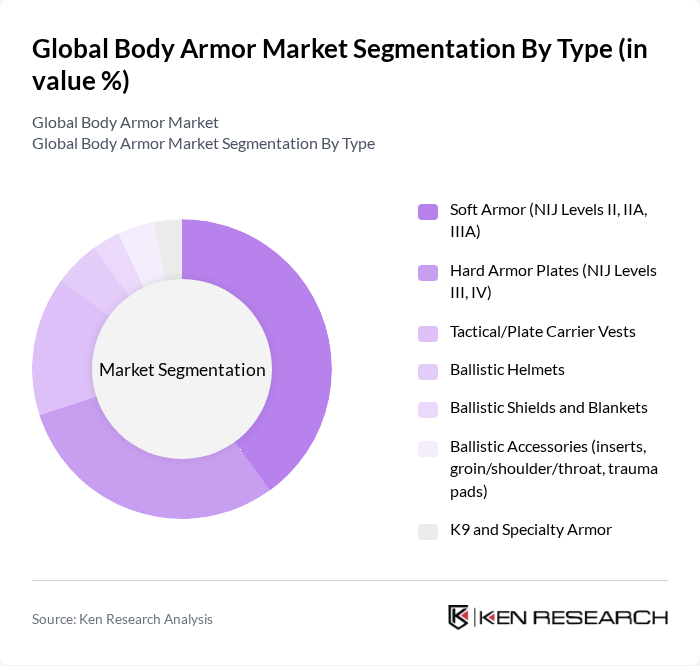
By Type:The body armor market is segmented into various types, including soft armor, hard armor plates, tactical vests, ballistic helmets, ballistic shields, ballistic accessories, and K9 and specialty armor. Soft armor is widely used for law enforcement and certain civilian applications due to its lightweight, flexible aramid and UHMWPE constructions and typical NIJ Levels II/IIA/IIIA protection against handgun threats. Hard armor plates, commonly ceramic-composite or polyethylene, are essential for higher-threat environments and military use, offering NIJ Levels III/IV rifle protection, often used within plate carriers.
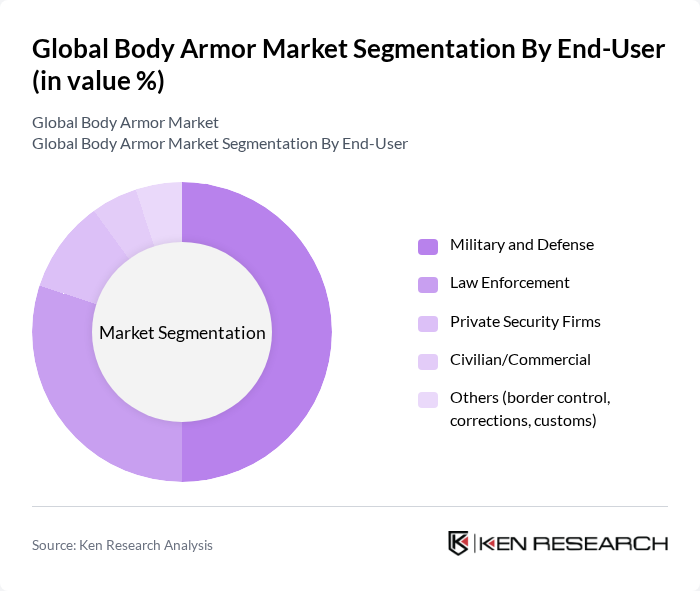
By End-User:The end-user segmentation includes military and defense, law enforcement, private security firms, civilian/commercial, and others. The military and defense sector is the largest consumer, supported by soldier modernization and sustained defense procurement in major markets; law enforcement demand is significant given ongoing replacement cycles and duty gear standards for officer safety.
Global Body Armor Market Competitive Landscape
The Global Body Armor Market is characterized by a dynamic mix of regional and international players. Leading participants such as DuPont de Nemours, Inc., Safariland, LLC, Armor Express, Inc., Point Blank Enterprises, Inc., BAE Systems plc, Honeywell International Inc., Rheinmetall AG, Morgan Advanced Materials plc, 3M Company, Armourshield Ltd., MKU Limited, Condor Outdoor Products, Inc., Craig International Ballistics Pty Ltd, United Shield International Ltd., TenCate Advanced Armor (Koninklijke TenCate B.V.) contribute to innovation, geographic expansion, and service delivery in this space.
Global Body Armor Market Industry Analysis
Growth Drivers
- Increasing Global Security Concerns:The global body armor market is significantly driven by escalating security concerns, with global terrorism incidents rising by 20% from 2020 to 2023, according to the Global Terrorism Index. Additionally, the global crime rate is projected to reach 6.5 billion incidents in the future, prompting governments and organizations to invest heavily in protective gear. This heightened awareness of personal safety is expected to boost demand for body armor across various sectors, including law enforcement and private security.
- Rising Demand from Law Enforcement Agencies:Law enforcement agencies worldwide are increasingly prioritizing officer safety, leading to a surge in body armor procurement. In the future, U.S. law enforcement agencies allocated approximately $1.2 billion for body armor purchases, reflecting a 15% increase from the previous year. This trend is mirrored globally, as countries enhance their police forces' capabilities in response to rising crime rates and civil unrest, further driving the body armor market's growth.
- Technological Advancements in Materials:Innovations in materials science are revolutionizing body armor, making it lighter and more effective. The introduction of advanced composites and nanomaterials has led to a 30% reduction in weight while maintaining or enhancing protective capabilities. For instance, the development of graphene-based materials is expected to increase armor effectiveness significantly. These advancements are attracting both military and civilian customers, propelling market growth as users seek superior protection without compromising mobility.
Market Challenges
- High Cost of Advanced Body Armor:The high cost associated with advanced body armor remains a significant barrier to market growth. Premium body armor can range from $1,000 to $3,000 per unit, making it less accessible for smaller law enforcement agencies and private security firms. This financial constraint limits the widespread adoption of advanced protective gear, particularly in regions with constrained budgets, thereby hindering overall market expansion.
- Stringent Regulatory Requirements:Compliance with stringent regulatory standards poses a challenge for body armor manufacturers. In the U.S., the National Institute of Justice (NIJ) sets rigorous testing protocols for body armor, which can delay product launches and increase costs. Additionally, international regulations vary significantly, complicating export processes. These regulatory hurdles can slow down innovation and market entry for new products, impacting overall market dynamics.
Global Body Armor Market Future Outlook
The future of the body armor market appears promising, driven by ongoing technological advancements and increasing security concerns. As military and law enforcement agencies continue to prioritize personnel safety, the demand for innovative and effective body armor solutions is expected to rise. Furthermore, the integration of smart technologies, such as wearable sensors, will likely enhance the functionality of body armor, making it more appealing to end-users. This evolving landscape presents significant opportunities for growth and innovation in the sector.
Market Opportunities
- Expansion in Emerging Markets:Emerging markets, particularly in Asia-Pacific and Africa, present substantial growth opportunities for body armor manufacturers. With increasing urbanization and rising crime rates, countries like India and Nigeria are investing in law enforcement capabilities, leading to a projected increase in body armor demand by 25% in the future. This trend offers manufacturers a chance to tap into new customer bases and expand their market presence.
- Increasing Adoption of Lightweight Materials:The shift towards lightweight materials in body armor is creating new market opportunities. As end-users prioritize mobility and comfort, manufacturers are focusing on developing lighter, more effective armor solutions. The global market for lightweight body armor materials is expected to grow by $500 million in the future, driven by innovations in materials science and increasing demand from military and law enforcement sectors.
Scope of the Report
| Segment | Sub-Segments |
|---|---|
| By Type | Soft Armor (NIJ Levels II, IIA, IIIA) Hard Armor Plates (NIJ Levels III, IV) Tactical/Plate Carrier Vests Ballistic Helmets Ballistic Shields and Blankets Ballistic Accessories (inserts, groin/shoulder/throat, trauma pads) K9 and Specialty Armor |
| By End-User | Military and Defense Law Enforcement Private Security Firms Civilian/Commercial Others (border control, corrections, customs) |
| By Application | Personal Protection/Patrol Tactical and Special Operations Riot Control/Public Order Military Combat and Peacekeeping Training and Non-lethal Scenarios |
| By Distribution Channel | Government Tenders/Direct Contracts OEM Direct Sales Authorized Distributors/Dealers E-commerce and Online Retail Surplus/Secondary Market |
| By Region | North America Europe Asia-Pacific Latin America Middle East & Africa |
| By Price Range | Entry-Level Mid-Range/Agency Grade Premium/Military Grade |
| By Material Type | Aramid Fibers (e.g., Kevlar, Twaron) Ultra-High Molecular Weight Polyethylene (UHMWPE/Dyneema) Ceramics (Alumina, Silicon Carbide, Boron Carbide) Metals (Steel, Titanium) Composites/Hybrids and Others |
Key Target Audience
Investors and Venture Capitalist Firms
Government and Regulatory Bodies (e.g., Department of Defense, Department of Homeland Security)
Manufacturers and Producers
Distributors and Retailers
Law Enforcement Agencies
Military Organizations
Private Security Firms
Insurance Companies
Players Mentioned in the Report:
DuPont de Nemours, Inc.
Safariland, LLC
Armor Express, Inc.
Point Blank Enterprises, Inc.
BAE Systems plc
Honeywell International Inc.
Rheinmetall AG
Morgan Advanced Materials plc
3M Company
Armourshield Ltd.
MKU Limited
Condor Outdoor Products, Inc.
Craig International Ballistics Pty Ltd
United Shield International Ltd.
TenCate Advanced Armor (Koninklijke TenCate B.V.)
Table of Contents
Market Assessment Phase
1. Executive Summary and Approach
2. Global Body Armor Market Overview
2.1 Key Insights and Strategic Recommendations
2.2 Global Body Armor Market Overview
2.3 Definition and Scope
2.4 Evolution of Market Ecosystem
2.5 Timeline of Key Regulatory Milestones
2.6 Value Chain & Stakeholder Mapping
2.7 Business Cycle Analysis
2.8 Policy & Incentive Landscape
3. Global Body Armor Market Analysis
3.1 Growth Drivers
3.1.1 Increasing global security concerns
3.1.2 Rising demand from law enforcement agencies
3.1.3 Technological advancements in materials
3.1.4 Growth in military expenditure
3.2 Market Challenges
3.2.1 High cost of advanced body armor
3.2.2 Stringent regulatory requirements
3.2.3 Competition from alternative protective solutions
3.2.4 Supply chain disruptions
3.3 Market Opportunities
3.3.1 Expansion in emerging markets
3.3.2 Increasing adoption of lightweight materials
3.3.3 Growing demand for customized solutions
3.3.4 Partnerships with technology firms
3.4 Market Trends
3.4.1 Shift towards modular body armor systems
3.4.2 Integration of smart technology in body armor
3.4.3 Rising popularity of personal protective equipment (PPE)
3.4.4 Focus on sustainability in manufacturing
3.5 Government Regulation
3.5.1 Compliance with international safety standards
3.5.2 Export control regulations
3.5.3 Procurement policies for government contracts
3.5.4 Environmental regulations on materials used
4. SWOT Analysis
5. Stakeholder Analysis
6. Porter's Five Forces Analysis
7. Global Body Armor Market Market Size, 2019-2024
7.1 By Value
7.2 By Volume
7.3 By Average Selling Price
8. Global Body Armor Market Segmentation
8.1 By Type
8.1.1 Soft Armor (NIJ Levels II, IIA, IIIA)
8.1.2 Hard Armor Plates (NIJ Levels III, IV)
8.1.3 Tactical/Plate Carrier Vests
8.1.4 Ballistic Helmets
8.1.5 Ballistic Shields and Blankets
8.1.6 Ballistic Accessories (inserts, groin/shoulder/throat, trauma pads)
8.1.7 K9 and Specialty Armor
8.2 By End-User
8.2.1 Military and Defense
8.2.2 Law Enforcement
8.2.3 Private Security Firms
8.2.4 Civilian/Commercial
8.2.5 Others (border control, corrections, customs)
8.3 By Application
8.3.1 Personal Protection/Patrol
8.3.2 Tactical and Special Operations
8.3.3 Riot Control/Public Order
8.3.4 Military Combat and Peacekeeping
8.3.5 Training and Non-lethal Scenarios
8.4 By Distribution Channel
8.4.1 Government Tenders/Direct Contracts
8.4.2 OEM Direct Sales
8.4.3 Authorized Distributors/Dealers
8.4.4 E-commerce and Online Retail
8.4.5 Surplus/Secondary Market
8.5 By Region
8.5.1 North America
8.5.2 Europe
8.5.3 Asia-Pacific
8.5.4 Latin America
8.5.5 Middle East & Africa
8.6 By Price Range
8.6.1 Entry-Level
8.6.2 Mid-Range/Agency Grade
8.6.3 Premium/Military Grade
8.7 By Material Type
8.7.1 Aramid Fibers (e.g., Kevlar, Twaron)
8.7.2 Ultra-High Molecular Weight Polyethylene (UHMWPE/Dyneema)
8.7.3 Ceramics (Alumina, Silicon Carbide, Boron Carbide)
8.7.4 Metals (Steel, Titanium)
8.7.5 Composites/Hybrids and Others
9. Global Body Armor Market Competitive Analysis
9.1 Market Share of Key Players
9.2 Cross Comparison of Key Players
9.2.1 Company Name
9.2.2 Installed Base/Units Deployed (military + law enforcement)
9.2.3 Revenue Growth Rate (Body armor segment)
9.2.4 Geographic Footprint (regions served, defense contracts)
9.2.5 Contract Wins and Backlog (active multi-year programs)
9.2.6 NIJ/VPAM Certification Coverage (levels, recency)
9.2.7 Product Mix (soft vs hard, helmets, shields, carriers)
9.2.8 Weight-to-Protection Ratio (average plate/vest weight by level)
9.2.9 Lead Times and On-Time Delivery (%)
9.2.10 R&D Intensity (R&D as % of revenue, patents)
9.2.11 Pricing Bands (agency vs retail, ASP trends)
9.2.12 Warranty/Service Terms (replacement cycles, recalls)
9.2.13 Supply Chain Resilience (material sourcing, in-house vs outsourced)
9.2.14 ESG and Compliance (ITAR/EAR, restricted-substance adherence)
9.3 SWOT Analysis of Top Players
9.4 Pricing Analysis
9.5 Detailed Profile of Major Companies
9.5.1 DuPont de Nemours, Inc.
9.5.2 Safariland, LLC
9.5.3 Armor Express, Inc.
9.5.4 Point Blank Enterprises, Inc.
9.5.5 BAE Systems plc
9.5.6 Honeywell International Inc.
9.5.7 Rheinmetall AG
9.5.8 Morgan Advanced Materials plc
9.5.9 3M Company
9.5.10 Armourshield Ltd.
9.5.11 MKU Limited
9.5.12 Condor Outdoor Products, Inc.
9.5.13 Craig International Ballistics Pty Ltd
9.5.14 United Shield International Ltd.
9.5.15 TenCate Advanced Armor (Koninklijke TenCate B.V.)
10. Global Body Armor Market End-User Analysis
10.1 Procurement Behavior of Key Ministries
10.1.1 Budget Allocation Trends
10.1.2 Decision-Making Processes
10.1.3 Preferred Suppliers
10.1.4 Compliance Requirements
10.2 Corporate Spend on Infrastructure & Energy
10.2.1 Investment Trends
10.2.2 Spending Priorities
10.2.3 Procurement Strategies
10.3 Pain Point Analysis by End-User Category
10.3.1 Cost Constraints
10.3.2 Quality Assurance Issues
10.3.3 Supply Chain Reliability
10.4 User Readiness for Adoption
10.4.1 Training and Support Needs
10.4.2 Awareness of Product Benefits
10.5 Post-Deployment ROI and Use Case Expansion
10.5.1 Performance Metrics
10.5.2 Feedback Mechanisms
10.5.3 Future Investment Plans
11. Global Body Armor Market Future Size, 2025-2030
11.1 By Value
11.2 By Volume
11.3 By Average Selling Price
Go-To-Market Strategy Phase
1. Whitespace Analysis + Business Model Canvas
1.1 Market Gaps Identification
1.2 Value Proposition Development
1.3 Revenue Streams Analysis
1.4 Cost Structure Evaluation
1.5 Key Partnerships Exploration
1.6 Customer Segmentation
1.7 Competitive Advantage Assessment
2. Marketing and Positioning Recommendations
2.1 Branding Strategies
2.2 Product USPs
2.3 Target Market Identification
2.4 Communication Strategies
2.5 Digital Marketing Approaches
3. Distribution Plan
3.1 Urban Retail Strategies
3.2 Rural NGO Tie-Ups
3.3 E-commerce Integration
3.4 Direct Sales Channels
4. Channel & Pricing Gaps
4.1 Underserved Routes
4.2 Pricing Bands Analysis
4.3 Competitor Pricing Comparison
5. Unmet Demand & Latent Needs
5.1 Category Gaps
5.2 Consumer Segments Analysis
5.3 Emerging Trends Identification
6. Customer Relationship
6.1 Loyalty Programs
6.2 After-sales Service
6.3 Customer Feedback Mechanisms
7. Value Proposition
7.1 Sustainability Initiatives
7.2 Integrated Supply Chains
7.3 Unique Selling Points
8. Key Activities
8.1 Regulatory Compliance
8.2 Branding Efforts
8.3 Distribution Setup
9. Entry Strategy Evaluation
9.1 Domestic Market Entry Strategy
9.1.1 Product Mix
9.1.2 Pricing Band
9.1.3 Packaging Considerations
9.2 Export Entry Strategy
9.2.1 Target Countries
9.2.2 Compliance Roadmap
10. Entry Mode Assessment
10.1 Joint Ventures
10.2 Greenfield Investments
10.3 Mergers & Acquisitions
10.4 Distributor Model
11. Capital and Timeline Estimation
11.1 Capital Requirements
11.2 Timelines for Implementation
12. Control vs Risk Trade-Off
12.1 Ownership vs Partnerships
13. Profitability Outlook
13.1 Breakeven Analysis
13.2 Long-term Sustainability
14. Potential Partner List
14.1 Distributors
14.2 Joint Ventures
14.3 Acquisition Targets
15. Execution Roadmap
15.1 Phased Plan for Market Entry
15.1.1 Market Setup
15.1.2 Market Entry
15.1.3 Growth Acceleration
15.1.4 Scale & Stabilize
15.2 Key Activities and Milestones
15.2.1 Milestone Planning
15.2.2 Activity Tracking
Research Methodology
Phase 1: Approach1
Desk Research
- Industry reports from defense and security organizations
- Market analysis from government publications and trade associations
- Academic journals focusing on materials science and protective gear
Primary Research
- Interviews with manufacturers of body armor and protective equipment
- Surveys with military procurement officers and law enforcement agencies
- Field interviews with end-users, including security personnel and military operatives
Validation & Triangulation
- Cross-validation of data from multiple industry sources and expert opinions
- Triangulation of market trends with historical sales data and forecasts
- Sanity checks through expert panel discussions and feedback sessions
Phase 2: Market Size Estimation1
Top-down Assessment
- Analysis of global defense budgets and spending on personal protective equipment
- Segmentation by application areas such as military, law enforcement, and civilian use
- Incorporation of regional market dynamics and growth drivers
Bottom-up Modeling
- Volume estimates based on production capacities of leading body armor manufacturers
- Cost analysis derived from material sourcing and manufacturing processes
- Sales data from distributors and retailers in the body armor market
Forecasting & Scenario Analysis
- Multi-variable regression analysis considering geopolitical factors and crime rates
- Scenario modeling based on technological advancements and regulatory changes
- Baseline, optimistic, and pessimistic forecasts through 2030
Phase 3: CATI Sample Composition1
| Scope Item/Segment | Sample Size | Target Respondent Profiles |
|---|---|---|
| Military Body Armor Procurement | 120 | Defense Procurement Officers, Military Logistics Managers |
| Law Enforcement Protective Gear | 100 | Police Equipment Buyers, Tactical Unit Leaders |
| Civilian Personal Protection | 60 | Security Consultants, Personal Defense Trainers |
| Body Armor Material Suppliers | 50 | Material Scientists, Supply Chain Managers |
| Market Trends in Body Armor | 90 | Industry Analysts, Market Research Professionals |
Frequently Asked Questions
What is the current value of the Global Body Armor Market?
The Global Body Armor Market is valued at approximately USD 6.7 billion, driven by increasing security concerns, military expenditures, and demand for personal protective equipment among law enforcement and civilians, alongside advancements in materials and design.
What factors are driving the growth of the body armor market?
Which countries are leading in the body armor market?
What types of body armor are available in the market?
Other Regional/Country Reports
Indonesia Body Armor Market
Malaysia Body Armor Market
APAC Body Armor Market
Why Buy From Us?

What makes us stand out is that our consultants follow Robust, Refine and Result (RRR) methodology. Robust for clear definitions, approaches and sanity checking, Refine for differentiating respondents' facts and opinions, and Result for presenting data with story.

We have set a benchmark in the industry by offering our clients with syndicated and customized market research reports featuring coverage of entire market as well as meticulous research and analyst insights.

While we don't replace traditional research, we flip the method upside down. Our dual approach of Top Bottom & Bottom Top ensures quality deliverable by not just verifying company fundamentals but also looking at the sector and macroeconomic factors.

With one step in the future, our research team constantly tries to show you the bigger picture. We help with some of the tough questions you may encounter along the way: How is the industry positioned? Best marketing channel? KPI's of competitors? By aligning every element, we help maximize success.

Our report gives you instant access to the answers and sources that other companies might choose to hide. We elaborate each steps of research methodology we have used and showcase you the sample size to earn your trust.

If you need any support, we are here! We pride ourselves on universe strength, data quality, and quick, friendly, and professional service.