About the Report
Base Year 2024Listen to the audio summary
Global Bovine Mastitis Market Overview
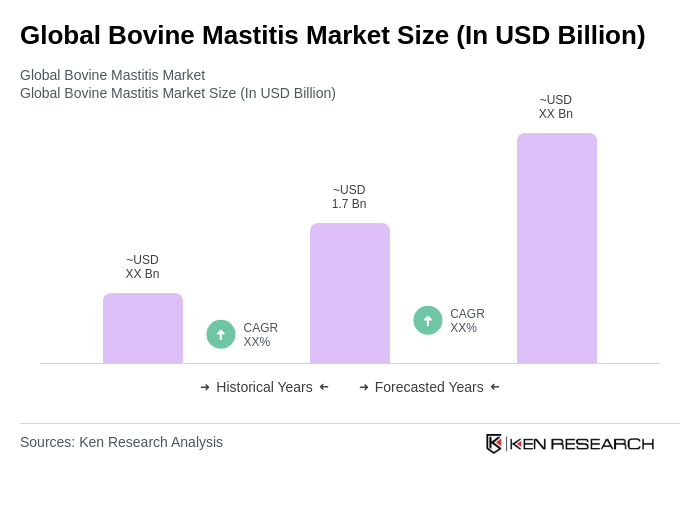
- The Global Bovine Mastitis Market is valued at approximately USD 1.7 billion, based on a five-year historical analysis. This level aligns with recent industry estimates placing the market near the upper USD 1.6–2.0 billion range in the latest period, driven by persistent disease incidence, intensifying dairy productivity goals, and steady product uptake across pharmaceuticals and diagnostics .
- Key players in this market include the United States, Germany, and India, which maintain prominence due to large dairy sectors and investments in veterinary healthcare; North America holds the largest regional share in recent assessments, supported by high dairy productivity, strong veterinary infrastructure, and rapid adoption of diagnostics and therapeutics .
- In 2023, the European Union implemented stricter rules on antimicrobial use in animals under the Veterinary Medicines Regulation, tightening controls on prophylactic/metaphylactic use and reserving certain antimicrobials for human medicine, which directly influences mastitis treatment practices and product approvals through rigorous benefit–risk evaluations by EU regulators .
Global Bovine Mastitis Market Segmentation
By Type:The market is segmented into various types of mastitis, including Clinical Mastitis, Subclinical Mastitis, Environmental Mastitis, Contagious Mastitis, and Dry Period Mastitis. Clinical Mastitis presents with visible udder inflammation and abnormal milk; Subclinical Mastitis lacks obvious signs but elevates somatic cell counts and reduces yield; Environmental Mastitis arises from pathogens in bedding/manure (e.g., E. coli, Streptococcus uberis); Contagious Mastitis spreads cow?to?cow during milking (e.g., Staphylococcus aureus, Streptococcus agalactiae); Dry Period Mastitis occurs during the non?lactating phase and is a key focus for preventive therapy using dry cow treatments and internal teat sealants .
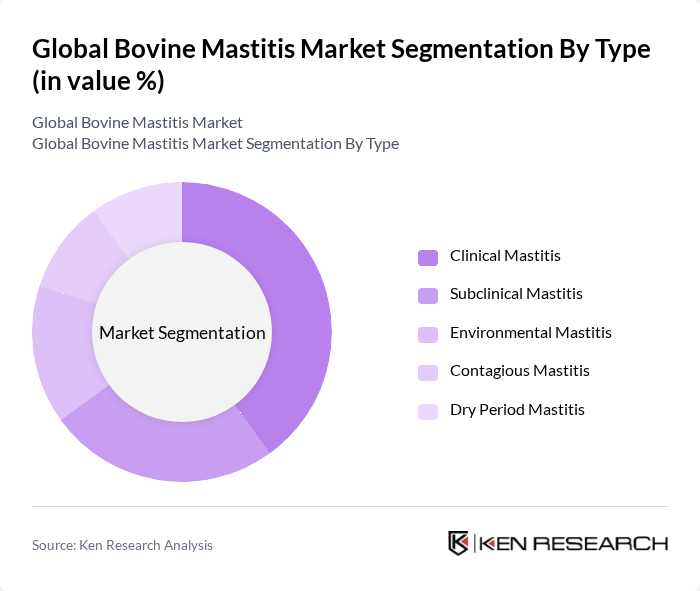
The Clinical Mastitis segment dominates due to visible symptoms prompting immediate intervention and higher direct economic losses per case; clinical cases drive higher utilization of intramammary antibiotics and supportive therapies, reinforcing demand for rapid treatment solutions and on?farm diagnostics in high?yield herds .
By Treatment Type:The treatment options for bovine mastitis include Antibiotics (intramammary and systemic), Anti-inflammatory/NSAIDs, Vaccines (e.g., E. coli, Staph aureus), Teat sealants and disinfectants, Diagnostics and culture kits, and Probiotics and alternative/adjunct therapies. Antibiotics remain first?line for bacterial mastitis; NSAIDs are used adjunctively to reduce inflammation and improve welfare; vaccines (e.g., E. coli J5 core-antigen, Staph aureus targets) are used as preventive tools; internal teat sealants are standard in dry?cow management; on?farm culture/rapid diagnostics guide selective therapy; probiotics and non?antibiotic adjuncts are being explored to reduce antimicrobial reliance .
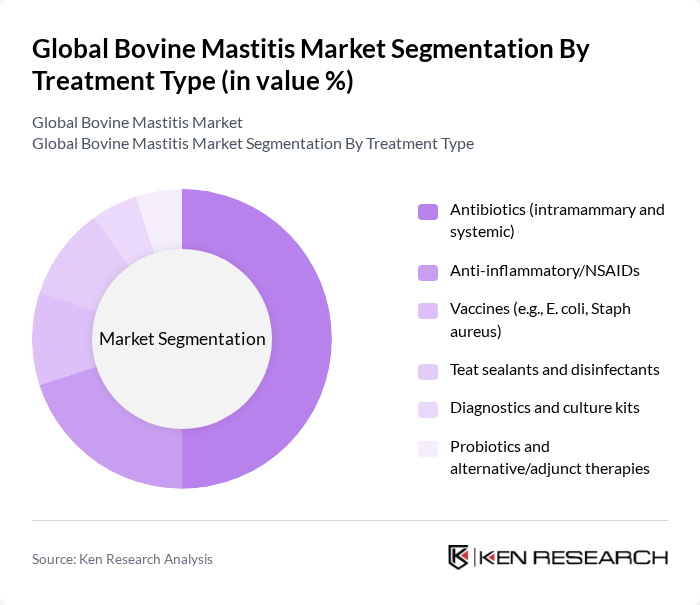
The Antibiotics segment leads the market due to established efficacy and regulatory-approved labels for clinical and dry-cow therapy; however, EU antimicrobial stewardship and global AMR initiatives are catalyzing adoption of selective dry cow therapy, vaccination, teat sealants, and culture?guided treatment to reduce unnecessary antibiotic use .
Global Bovine Mastitis Market Competitive Landscape
The Global Bovine Mastitis Market is characterized by a dynamic mix of regional and international players. Leading participants such as Zoetis Inc., Merck Animal Health (Merck & Co., Inc.), Elanco Animal Health Incorporated, Boehringer Ingelheim Animal Health, Ceva Santé Animale, HIPRA (Laboratorios Hipra, S.A.), Vetoquinol S.A., Dechra Pharmaceuticals PLC, Virbac, Neogen Corporation, IDEXX Laboratories, Inc., Phibro Animal Health Corporation, ImmuCell Corporation, Forte Healthcare Ltd, Huvepharma EOOD contribute to innovation, geographic expansion, and service delivery in this space .
Global Bovine Mastitis Market Industry Analysis
Growth Drivers
- Increasing Prevalence of Bovine Mastitis:The incidence of bovine mastitis is notably high, with estimates indicating that approximately 30% of dairy cows are affected at any given time. This condition leads to significant economic losses, with the dairy industry in the U.S. alone facing annual losses exceeding $2.1 billion due to mastitis-related issues. The rising prevalence drives demand for effective treatment solutions, thereby propelling market growth in the None region.
- Rising Demand for Dairy Products:The global demand for dairy products is projected to reach 1.6 billion metric tons in the future, driven by increasing population and dietary shifts towards protein-rich foods. In the None region, dairy consumption is expected to rise by 4.5% annually, necessitating improved herd health management practices. This surge in demand directly correlates with the need for effective mastitis management solutions, fostering market expansion.
- Advancements in Veterinary Medicine:The veterinary sector is witnessing rapid advancements, with investments in research and development reaching $1.3 billion in the future. Innovations such as new diagnostic tools and treatment protocols are enhancing the management of bovine mastitis. In the None region, the adoption of these advanced veterinary solutions is expected to improve treatment outcomes, thereby driving market growth and increasing the overall health of dairy herds.
Market Challenges
- High Treatment Costs:The financial burden of treating bovine mastitis can be substantial, with average treatment costs ranging from $210 to $310 per case. In the None region, many dairy farmers struggle to absorb these costs, particularly small-scale operations. This economic challenge can lead to delayed treatment and increased disease prevalence, ultimately hindering market growth and affecting overall herd productivity.
- Lack of Awareness in Rural Areas:In rural regions, awareness of effective mastitis management practices remains low, with studies indicating that over 45% of farmers lack knowledge about early detection and treatment options. This gap in understanding can lead to higher incidence rates and lower milk production. Addressing this challenge is crucial for improving herd health and fostering market growth in the None region.
Global Bovine Mastitis Market Future Outlook
The future of the bovine mastitis market in the None region appears promising, driven by increasing investments in veterinary healthcare and a growing emphasis on sustainable dairy farming practices. As farmers become more aware of the economic benefits of effective mastitis management, the adoption of advanced treatment options is expected to rise. Additionally, the integration of digital health solutions will likely enhance monitoring and prevention strategies, further supporting market growth and improving overall herd health outcomes.
Market Opportunities
- Development of New Treatment Options:The ongoing research into alternative therapies, such as immunotherapy and probiotics, presents significant opportunities for market players. With an estimated $600 million allocated for research in the future, these innovations could revolutionize mastitis treatment, offering more effective and sustainable solutions for dairy farmers in the None region.
- Expansion into Emerging Markets:Emerging markets in the None region are experiencing rapid growth in dairy production, with an expected increase of 7% annually. This growth presents opportunities for companies to introduce advanced mastitis management solutions tailored to local needs, potentially capturing a significant share of the market and enhancing overall dairy productivity.
Scope of the Report
| Segment | Sub-Segments |
|---|---|
| By Type | Clinical Mastitis Subclinical Mastitis Environmental Mastitis Contagious Mastitis Dry Period Mastitis |
| By Treatment Type | Antibiotics (intramammary and systemic) Anti-inflammatory/NSAIDs Vaccines (e.g., E. coli, Staph aureus) Teat sealants and disinfectants Diagnostics and culture kits Probiotics and alternative/adjunct therapies |
| By Route of Administration | Intramammary Systemic (parenteral) Topical |
| By Distribution Channel | Veterinary Clinics and Hospitals Online Veterinary Pharmacies Retail/Agri Pharmacies Distributor/Cooperative Supply |
| By Region | North America Europe Asia-Pacific Latin America Middle East & Africa |
| By End-User | Dairy Farms (commercial and smallholder) Veterinary Service Providers Research & Diagnostic Laboratories |
| By Product Formulation | Intramammary syringes/liquids Tablets/injectables Teat dips/sealants Powders and others |
Key Target Audience
Investors and Venture Capitalist Firms
Government and Regulatory Bodies (e.g., Food and Drug Administration, European Food Safety Authority)
Veterinary Pharmaceutical Manufacturers
Dairy Farm Operators
Animal Health Product Distributors
Biotechnology Firms
Livestock Health Associations
Insurance Companies Specializing in Livestock
Players Mentioned in the Report:
Zoetis Inc.
Merck Animal Health (Merck & Co., Inc.)
Elanco Animal Health Incorporated
Boehringer Ingelheim Animal Health
Ceva Sante Animale
HIPRA (Laboratorios Hipra, S.A.)
Vetoquinol S.A.
Dechra Pharmaceuticals PLC
Virbac
Neogen Corporation
IDEXX Laboratories, Inc.
Phibro Animal Health Corporation
ImmuCell Corporation
Forte Healthcare Ltd
Huvepharma EOOD
Table of Contents
Market Assessment Phase
1. Executive Summary and Approach
2. Global Bovine Mastitis Market Overview
2.1 Key Insights and Strategic Recommendations
2.2 Global Bovine Mastitis Market Overview
2.3 Definition and Scope
2.4 Evolution of Market Ecosystem
2.5 Timeline of Key Regulatory Milestones
2.6 Value Chain & Stakeholder Mapping
2.7 Business Cycle Analysis
2.8 Policy & Incentive Landscape
3. Global Bovine Mastitis Market Analysis
3.1 Growth Drivers
3.1.1 Increasing prevalence of bovine mastitis
3.1.2 Rising demand for dairy products
3.1.3 Advancements in veterinary medicine
3.1.4 Growing awareness of animal health
3.2 Market Challenges
3.2.1 High treatment costs
3.2.2 Lack of awareness in rural areas
3.2.3 Resistance to antibiotics
3.2.4 Regulatory hurdles
3.3 Market Opportunities
3.3.1 Development of new treatment options
3.3.2 Expansion into emerging markets
3.3.3 Increased investment in research and development
3.3.4 Collaborations with agricultural organizations
3.4 Market Trends
3.4.1 Shift towards organic dairy farming
3.4.2 Adoption of digital health solutions
3.4.3 Focus on preventive healthcare
3.4.4 Integration of AI in diagnostics
3.5 Government Regulation
3.5.1 Standards for antibiotic use
3.5.2 Animal welfare regulations
3.5.3 Guidelines for dairy product safety
3.5.4 Support for veterinary services
4. SWOT Analysis
5. Stakeholder Analysis
6. Porter's Five Forces Analysis
7. Global Bovine Mastitis Market Market Size, 2019-2024
7.1 By Value
7.2 By Volume
7.3 By Average Selling Price
8. Global Bovine Mastitis Market Segmentation
8.1 By Type
8.1.1 Clinical Mastitis
8.1.2 Subclinical Mastitis
8.1.3 Environmental Mastitis
8.1.4 Contagious Mastitis
8.1.5 Dry Period Mastitis
8.2 By Treatment Type
8.2.1 Antibiotics (intramammary and systemic)
8.2.2 Anti-inflammatory/NSAIDs
8.2.3 Vaccines (e.g., E. coli, Staph aureus)
8.2.4 Teat sealants and disinfectants
8.2.5 Diagnostics and culture kits
8.2.6 Probiotics and alternative/adjunct therapies
8.3 By Route of Administration
8.3.1 Intramammary
8.3.2 Systemic (parenteral)
8.3.3 Topical
8.4 By Distribution Channel
8.4.1 Veterinary Clinics and Hospitals
8.4.2 Online Veterinary Pharmacies
8.4.3 Retail/Agri Pharmacies
8.4.4 Distributor/Cooperative Supply
8.5 By Region
8.5.1 North America
8.5.2 Europe
8.5.3 Asia-Pacific
8.5.4 Latin America
8.5.5 Middle East & Africa
8.6 By End-User
8.6.1 Dairy Farms (commercial and smallholder)
8.6.2 Veterinary Service Providers
8.6.3 Research & Diagnostic Laboratories
8.7 By Product Formulation
8.7.1 Intramammary syringes/liquids
8.7.2 Tablets/injectables
8.7.3 Teat dips/sealants
8.7.4 Powders and others
9. Global Bovine Mastitis Market Competitive Analysis
9.1 Market Share of Key Players
9.2 Cross Comparison of Key Players
9.2.1 Company Name
9.2.2 Group Size (by animal health revenue)
9.2.3 Bovine mastitis portfolio breadth (number of SKUs/classes)
9.2.4 Geographic reach (countries with mastitis products)
9.2.5 Regulatory footprint (labels/approvals in US/EU/ROW)
9.2.6 Innovation intensity (R&D spend %, recent launches)
9.2.7 On?label withdrawal period advantage (days)
9.2.8 Distribution depth (distributor/co-op partnerships)
9.2.9 Pricing positioning (premium/mid/value by route)
9.2.10 Field support and stewardship programs (training reach)
9.2.11 Diagnostics integration (availability of POC culture/PCR)
9.2.12 Sustainability/AMR stewardship metrics (SBTi/antibiotic reduction)
9.3 SWOT Analysis of Top Players
9.4 Pricing Analysis
9.5 Detailed Profile of Major Companies
9.5.1 Zoetis Inc.
9.5.2 Merck Animal Health (Merck & Co., Inc.)
9.5.3 Elanco Animal Health Incorporated
9.5.4 Boehringer Ingelheim Animal Health
9.5.5 Ceva Santé Animale
9.5.6 HIPRA (Laboratorios Hipra, S.A.)
9.5.7 Vetoquinol S.A.
9.5.8 Dechra Pharmaceuticals PLC
9.5.9 Virbac
9.5.10 Neogen Corporation
9.5.11 IDEXX Laboratories, Inc.
9.5.12 Phibro Animal Health Corporation
9.5.13 ImmuCell Corporation
9.5.14 Forte Healthcare Ltd
9.5.15 Huvepharma EOOD
10. Global Bovine Mastitis Market End-User Analysis
10.1 Procurement Behavior of Key Ministries
10.1.1 Government funding for veterinary services
10.1.2 Policy support for dairy health initiatives
10.1.3 Collaboration with private sectors
10.2 Corporate Spend on Infrastructure & Energy
10.2.1 Investment in dairy farm technology
10.2.2 Budget allocation for veterinary care
10.2.3 Funding for research and development
10.3 Pain Point Analysis by End-User Category
10.3.1 Cost of treatment
10.3.2 Access to veterinary services
10.3.3 Knowledge gaps in mastitis management
10.4 User Readiness for Adoption
10.4.1 Awareness of mastitis prevention
10.4.2 Training programs for farmers
10.4.3 Availability of resources
10.5 Post-Deployment ROI and Use Case Expansion
10.5.1 Evaluation of treatment effectiveness
10.5.2 Long-term cost savings
10.5.3 Opportunities for scaling solutions
11. Global Bovine Mastitis Market Future Size, 2025-2030
11.1 By Value
11.2 By Volume
11.3 By Average Selling Price
Go-To-Market Strategy Phase
1. Whitespace Analysis + Business Model Canvas
1.1 Market gaps and opportunities
1.2 Value proposition development
1.3 Revenue model identification
1.4 Key partnerships and alliances
1.5 Customer segmentation
1.6 Cost structure analysis
1.7 Channels of distribution
2. Marketing and Positioning Recommendations
2.1 Branding strategies
2.2 Product USPs
2.3 Target audience identification
2.4 Communication strategies
2.5 Digital marketing initiatives
3. Distribution Plan
3.1 Urban retail vs rural NGO tie-ups
3.2 Logistics and supply chain management
3.3 Distribution channel optimization
4. Channel & Pricing Gaps
4.1 Underserved routes
4.2 Pricing bands
4.3 Competitive pricing analysis
5. Unmet Demand & Latent Needs
5.1 Category gaps
5.2 Consumer segments
5.3 Product development opportunities
6. Customer Relationship
6.1 Loyalty programs
6.2 After-sales service
6.3 Customer feedback mechanisms
7. Value Proposition
7.1 Sustainability
7.2 Integrated supply chains
7.3 Competitive advantages
8. Key Activities
8.1 Regulatory compliance
8.2 Branding
8.3 Distribution setup
9. Entry Strategy Evaluation
9.1 Domestic Market Entry Strategy
9.1.1 Product mix
9.1.2 Pricing band
9.1.3 Packaging
9.2 Export Entry Strategy
9.2.1 Target countries
9.2.2 Compliance roadmap
10. Entry Mode Assessment
10.1 JV
10.2 Greenfield
10.3 M&A
10.4 Distributor Model
11. Capital and Timeline Estimation
11.1 Capital requirements
11.2 Timelines
12. Control vs Risk Trade-Off
12.1 Ownership vs Partnerships
13. Profitability Outlook
13.1 Breakeven analysis
13.2 Long-term sustainability
14. Potential Partner List
14.1 Distributors
14.2 JVs
14.3 Acquisition targets
15. Execution Roadmap
15.1 Phased Plan for Market Entry
15.1.1 Market Setup
15.1.2 Market Entry
15.1.3 Growth Acceleration
15.1.4 Scale & Stabilize
15.2 Key Activities and Milestones
15.2.1 Milestone tracking
15.2.2 Performance metrics
Research Methodology
Phase 1: Approach1
Desk Research
- Analysis of industry reports from veterinary and dairy associations
- Review of academic journals focusing on bovine health and mastitis management
- Examination of market trends and statistics from agricultural departments and trade publications
Primary Research
- Interviews with veterinarians specializing in bovine health and mastitis treatment
- Surveys with dairy farm owners regarding mastitis prevalence and management practices
- Focus groups with dairy industry stakeholders, including feed suppliers and equipment manufacturers
Validation & Triangulation
- Cross-validation of findings through multiple expert interviews and industry reports
- Triangulation of data from primary research and secondary sources to ensure consistency
- Sanity checks conducted through expert panel reviews to validate market assumptions
Phase 2: Market Size Estimation1
Top-down Assessment
- Estimation of the global bovine mastitis market size based on dairy production statistics
- Segmentation analysis by geographical regions and dairy farming practices
- Incorporation of trends in veterinary care and treatment advancements
Bottom-up Modeling
- Collection of data on treatment costs and prevalence rates from veterinary clinics
- Estimation of market size based on the number of dairy cows and average treatment frequency
- Analysis of product sales data from leading pharmaceutical and veterinary supply companies
Forecasting & Scenario Analysis
- Multi-variable forecasting using factors such as dairy consumption trends and regulatory changes
- Scenario analysis based on potential outbreaks and advancements in mastitis prevention
- Development of baseline, optimistic, and pessimistic market projections through 2030
Phase 3: CATI Sample Composition1
| Scope Item/Segment | Sample Size | Target Respondent Profiles |
|---|---|---|
| Dairy Farm Management | 120 | Dairy Farmers, Farm Managers |
| Veterinary Practices | 100 | Veterinarians, Veterinary Technicians |
| Pharmaceutical Suppliers | 80 | Sales Representatives, Product Managers |
| Research Institutions | 60 | Researchers, Academics in Animal Health |
| Dairy Industry Associations | 70 | Policy Makers, Industry Analysts |
Frequently Asked Questions
What is the current value of the Global Bovine Mastitis Market?
The Global Bovine Mastitis Market is valued at approximately USD 1.7 billion, reflecting a five-year historical analysis. This valuation aligns with industry estimates that place the market within the USD 1.62.0 billion range, driven by disease incidence and dairy productivity goals.
Which regions are leading in the Global Bovine Mastitis Market?
What are the main types of bovine mastitis?
What are the primary treatment options for bovine mastitis?
Other Regional/Country Reports
Indonesia Bovine Mastitis Market
Malaysia Bovine Mastitis Market
APAC Bovine Mastitis Market
SEA Bovine Mastitis Market
Why Buy From Us?

What makes us stand out is that our consultants follow Robust, Refine and Result (RRR) methodology. Robust for clear definitions, approaches and sanity checking, Refine for differentiating respondents' facts and opinions, and Result for presenting data with story.

We have set a benchmark in the industry by offering our clients with syndicated and customized market research reports featuring coverage of entire market as well as meticulous research and analyst insights.

While we don't replace traditional research, we flip the method upside down. Our dual approach of Top Bottom & Bottom Top ensures quality deliverable by not just verifying company fundamentals but also looking at the sector and macroeconomic factors.

With one step in the future, our research team constantly tries to show you the bigger picture. We help with some of the tough questions you may encounter along the way: How is the industry positioned? Best marketing channel? KPI's of competitors? By aligning every element, we help maximize success.

Our report gives you instant access to the answers and sources that other companies might choose to hide. We elaborate each steps of research methodology we have used and showcase you the sample size to earn your trust.

If you need any support, we are here! We pride ourselves on universe strength, data quality, and quick, friendly, and professional service.