Global Business Jet Ground Handling Services Market

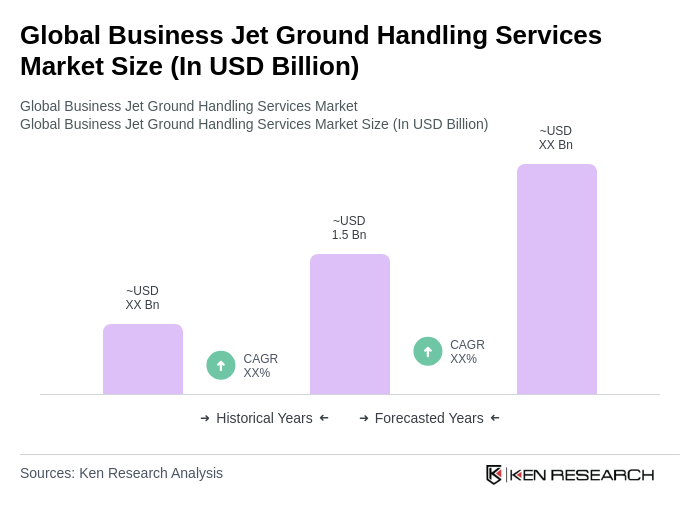
The global business jet ground handling services market, valued at USD 1.5 billion, is growing due to increased corporate travel, private jet fleet expansion, and technological innovations.

Region:Global

Author(s):Shubham

Product Code:KRAC0688

Pages:84

Published On:August 2025
About the Report

Base Year 2024

Global Business Jet Ground Handling Services Market Overview

  • The Global Business Jet Ground Handling Services Market is valued at USD 1.5 billion, based on a five-year historical analysis. This growth is primarily driven by the increasing demand for business aviation services, supported by a rise in high?net?worth individuals and sustained corporate travel in North America and Europe, as well as operational efficiencies from digitalization and real?time coordination tools at FBOs. The market is also influenced by advancements in technology—such as automated dispatching, tracking, and ramp safety systems—and the need for efficient ground operations to enhance customer experience across FBO networks.
  • Key players in this market are concentrated in regions such as North America and Europe, where established business aviation infrastructure, dense FBO networks, and high volumes of business jet movements contribute to regional dominance. Cities like New York and London serve as major hubs for business aviation traffic, while Dubai has grown as a Middle East hub for private jet operations, fostering a competitive environment for premium ground handling services.
  • In 2023, the Federal Aviation Administration did not introduce a single new rule specific only to “business jet ground handling”; however, U.S. ramp?safety oversight continued to emphasize training and safety management systems (SMS) for ground operations through FAA and OSHA guidance and programs, while many FBOs and handlers aligned with global best practices and IATA/ISAGO standards to enhance safety and training. Operators increasingly adopted structured training, human?factors programs, and standardized ramp procedures to reduce incidents and improve service quality.
Global Business Jet Ground Handling Services Market Size

Global Business Jet Ground Handling Services Market Segmentation

By Type:

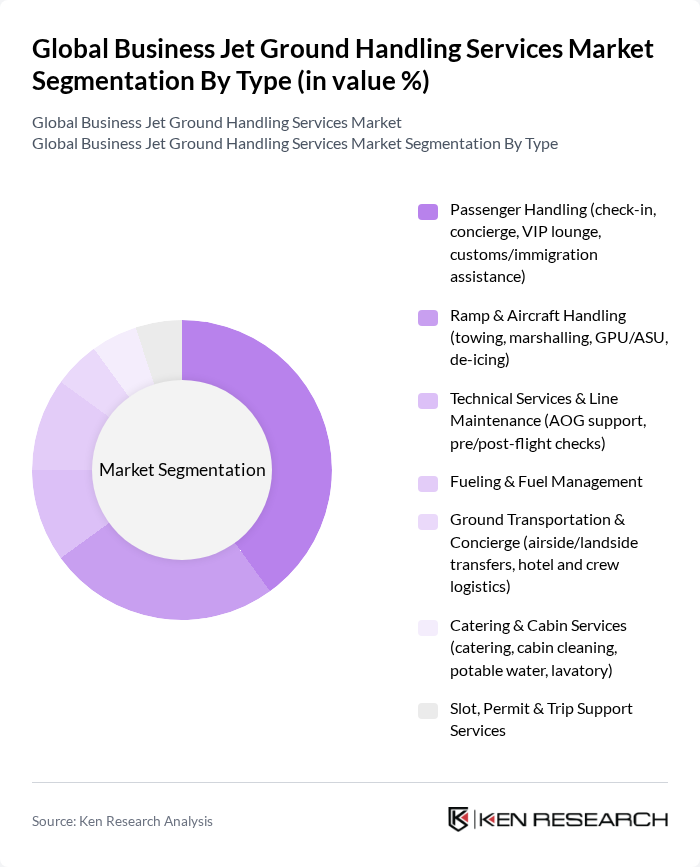
Global Business Jet Ground Handling Services Market segmentation by Type.

The market segmentation by type includes various subsegments such as Passenger Handling, Ramp & Aircraft Handling, Technical Services & Line Maintenance, Fueling & Fuel Management, Ground Transportation & Concierge, Catering & Cabin Services, and Slot, Permit & Trip Support Services. Among these, Passenger Handling is currently the leading subsegment, driven by the increasing expectations for personalized services and luxury experiences among business jet travelers. The demand for concierge services, VIP lounges, and customs assistance has surged, reflecting a trend towards enhanced customer service in the aviation sector.

By End-User:
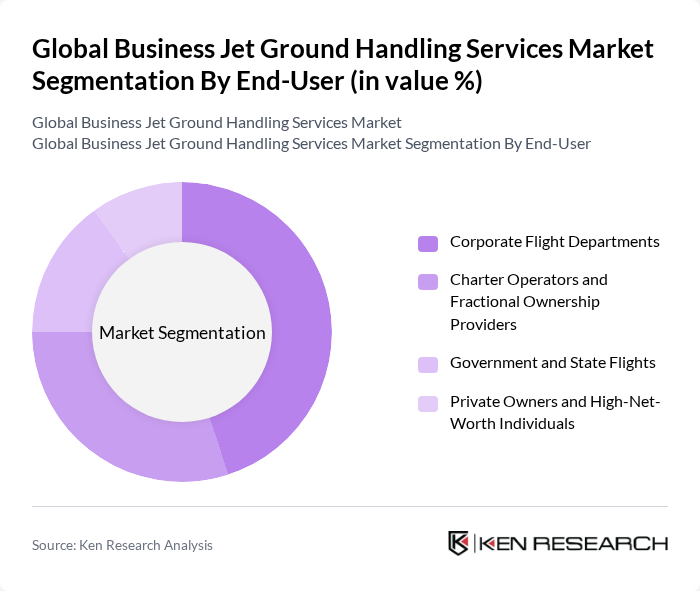
Global Business Jet Ground Handling Services Market segmentation by End-User.

This segmentation includes Corporate Flight Departments, Charter Operators and Fractional Ownership Providers, Government and State Flights, and Private Owners and High-Net-Worth Individuals. The Corporate Flight Departments segment is currently leading the market, as many corporations are investing in private aviation to enhance operational efficiency and reduce travel time. This trend is further supported by the growing number of high?net?worth individuals seeking personalized travel solutions, which drives demand for tailored ground handling services at FBOs worldwide.

Global Business Jet Ground Handling Services Market Competitive Landscape

The Global Business Jet Ground Handling Services Market is characterized by a dynamic mix of regional and international players. Leading participants such as Signature Aviation (Signature Flight Support), Jet Aviation, Universal Weather and Aviation, dnata, Swissport International AG, Atlantic Aviation, ExecuJet Aviation Group, TAG Aviation, Menzies Aviation, Luxaviation Group, Jetex, Skyservice Business Aviation, Abelag Aviation (Luxaviation Belgium), AEG Fuels, Avfuel Corporation contribute to innovation, geographic expansion, and service delivery in this space.

Signature Aviation

1998

London, UK

Jet Aviation

1967

Basel, Switzerland

Universal Weather and Aviation

1959

Houston, Texas, USA

dnata

1959

Dubai, UAE

Swissport International AG

1996

Zurich, Switzerland

Company

Establishment Year

Headquarters

Network Reach (number of FBOs/handled airports, global coverage)

Annual Business Jet Movements Handled

Revenue from Business Aviation Services

Fuel Uplift Volume (gallons/liters) and Fuel Program Breadth

Average Turnaround Time (TAT) for BizAv movements

On-Time Performance (% on-schedule departures)

Global Business Jet Ground Handling Services Market Industry Analysis

Growth Drivers

  • Increasing Demand for Business Travel:The global business travel market is projected to reach $1.7 trillion in future, driven by a resurgence in corporate travel post-pandemic. This surge is supported by a 6% annual increase in business jet flights, as reported by the National Business Aviation Association. The growing need for efficient travel solutions among executives and business leaders is propelling demand for specialized ground handling services, ensuring timely and seamless travel experiences.
  • Expansion of Private Jet Fleet:The global private jet fleet is expected to grow by approximately 3,000 aircraft in future, reaching a total of 25,000 jets. This expansion is fueled by increasing wealth among high-net-worth individuals and corporations, particularly in emerging markets. As the fleet grows, the demand for ground handling services will rise correspondingly, necessitating enhanced operational capabilities and infrastructure to accommodate the influx of private jets at airports.
  • Technological Advancements in Ground Handling:The integration of advanced technologies, such as AI and IoT, is revolutionizing ground handling operations. For instance, the global market for airport ground handling technology is projected to reach $10 billion in future. These innovations enhance efficiency, reduce turnaround times, and improve safety protocols, making ground handling services more attractive to business jet operators seeking competitive advantages in a rapidly evolving market.

Market Challenges

  • High Operational Costs:Ground handling services face significant operational costs, with estimates indicating that labor and equipment expenses can account for up to 60% of total costs. In future, the average hourly wage for ground handling staff is projected to rise to $25, driven by labor shortages and increased demand for skilled workers. These rising costs can pressure profit margins and challenge service providers in maintaining competitive pricing.
  • Regulatory Compliance Issues:The aviation industry is heavily regulated, with compliance costs estimated to reach $1.5 billion annually for ground handling companies. In future, new safety and environmental regulations are expected to be implemented, requiring significant investments in training and infrastructure. Failure to comply can result in hefty fines and operational disruptions, posing a substantial challenge for ground handling service providers striving to meet regulatory standards.

Global Business Jet Ground Handling Services Market Future Outlook

The future of the business jet ground handling services market appears promising, driven by increasing automation and a shift towards eco-friendly operations. As companies adopt advanced digital solutions for customer engagement, the demand for personalized services will rise. Additionally, the growth of on-demand services is expected to reshape the market landscape, allowing providers to offer tailored solutions that meet the evolving needs of business travelers, enhancing overall customer satisfaction and operational efficiency.

Market Opportunities

  • Growth in Emerging Markets:Emerging markets, particularly in Asia and Africa, are witnessing a rapid increase in business jet usage, with a projected growth rate of 8% annually. This trend presents significant opportunities for ground handling service providers to expand their operations and establish a foothold in these regions, catering to the rising demand for efficient and reliable services.
  • Adoption of Sustainable Practices:The aviation industry is increasingly focusing on sustainability, with a target to reduce carbon emissions by 50% by 2050. Ground handling services that adopt eco-friendly practices, such as electric ground support equipment, can attract environmentally conscious clients. This shift not only enhances brand reputation but also aligns with global sustainability goals, creating a competitive edge in the market.

Scope of the Report

SegmentSub-Segments
By Type

Passenger Handling (check-in, concierge, VIP lounge, customs/immigration assistance)

Ramp & Aircraft Handling (towing, marshalling, GPU/ASU, de-icing)

Technical Services & Line Maintenance (AOG support, pre/post-flight checks)

Fueling & Fuel Management

Ground Transportation & Concierge (airside/landside transfers, hotel and crew logistics)

Catering & Cabin Services (catering, cabin cleaning, potable water, lavatory)

Slot, Permit & Trip Support Services

By End-User

Corporate Flight Departments

Charter Operators and Fractional Ownership Providers

Government and State Flights

Private Owners and High-Net-Worth Individuals

By Service Model

Full-Service FBO Handling

Third-Party Ground Handler (non-FBO) Services

Self-Handling by Operator

By Aircraft Size

Very Light & Light Jets

Midsize & Super-Midsize Jets

Large Cabin & Ultra-Long-Range Jets

By Region

North America

Europe

Asia-Pacific

Latin America

Middle East & Africa

By Contracting Channel

Direct Contracts with FBOs/Ground Handlers

Trip Support Providers and Flight Planning Networks

Brokers and Third-Party Agents

By Pricing Model

Turnaround-Based Pricing (per movement)

Itemized Services (a la carte)

Membership/Program Pricing (loyalty, fuel programs, volume discounts)

Key Target Audience

Investors and Venture Capitalist Firms

Government and Regulatory Bodies (e.g., Federal Aviation Administration, European Union Aviation Safety Agency)

Business Jet Operators

Ground Handling Service Providers

Aviation Fuel Suppliers

Airport Authorities

Aircraft Manufacturers

Insurance Companies

Players Mentioned in the Report:

Signature Aviation (Signature Flight Support)

Jet Aviation

Universal Weather and Aviation

dnata

Swissport International AG

Atlantic Aviation

ExecuJet Aviation Group

TAG Aviation

Menzies Aviation

Luxaviation Group

Jetex

Skyservice Business Aviation

Abelag Aviation (Luxaviation Belgium)

AEG Fuels

Avfuel Corporation

Table of Contents

Market Assessment Phase

1. Executive Summary and Approach


2. Global Business Jet Ground Handling Services Market Overview

2.1 Key Insights and Strategic Recommendations

2.2 Global Business Jet Ground Handling Services Market Overview

2.3 Definition and Scope

2.4 Evolution of Market Ecosystem

2.5 Timeline of Key Regulatory Milestones

2.6 Value Chain & Stakeholder Mapping

2.7 Business Cycle Analysis

2.8 Policy & Incentive Landscape


3. Global Business Jet Ground Handling Services Market Analysis

3.1 Growth Drivers

3.1.1 Increasing Demand for Business Travel
3.1.2 Expansion of Private Jet Fleet
3.1.3 Technological Advancements in Ground Handling
3.1.4 Rising Focus on Customer Experience

3.2 Market Challenges

3.2.1 High Operational Costs
3.2.2 Regulatory Compliance Issues
3.2.3 Limited Infrastructure at Airports
3.2.4 Competition from Alternative Transport Modes

3.3 Market Opportunities

3.3.1 Growth in Emerging Markets
3.3.2 Strategic Partnerships with Airlines
3.3.3 Adoption of Sustainable Practices
3.3.4 Development of Advanced Ground Handling Technologies

3.4 Market Trends

3.4.1 Increasing Use of Automation
3.4.2 Shift Towards Eco-Friendly Operations
3.4.3 Enhanced Digital Solutions for Customer Engagement
3.4.4 Growth of On-Demand Services

3.5 Government Regulation

3.5.1 Safety and Security Regulations
3.5.2 Environmental Compliance Standards
3.5.3 Licensing and Certification Requirements
3.5.4 International Aviation Regulations

4. SWOT Analysis


5. Stakeholder Analysis


6. Porter's Five Forces Analysis


7. Global Business Jet Ground Handling Services Market Market Size, 2019-2024

7.1 By Value

7.2 By Volume

7.3 By Average Selling Price


8. Global Business Jet Ground Handling Services Market Segmentation

8.1 By Type

8.1.1 Passenger Handling (check-in, concierge, VIP lounge, customs/immigration assistance)
8.1.2 Ramp & Aircraft Handling (towing, marshalling, GPU/ASU, de-icing)
8.1.3 Technical Services & Line Maintenance (AOG support, pre/post-flight checks)
8.1.4 Fueling & Fuel Management
8.1.5 Ground Transportation & Concierge (airside/landside transfers, hotel and crew logistics)
8.1.6 Catering & Cabin Services (catering, cabin cleaning, potable water, lavatory)
8.1.7 Slot, Permit & Trip Support Services

8.2 By End-User

8.2.1 Corporate Flight Departments
8.2.2 Charter Operators and Fractional Ownership Providers
8.2.3 Government and State Flights
8.2.4 Private Owners and High-Net-Worth Individuals

8.3 By Service Model

8.3.1 Full-Service FBO Handling
8.3.2 Third-Party Ground Handler (non-FBO) Services
8.3.3 Self-Handling by Operator

8.4 By Aircraft Size

8.4.1 Very Light & Light Jets
8.4.2 Midsize & Super-Midsize Jets
8.4.3 Large Cabin & Ultra-Long-Range Jets

8.5 By Region

8.5.1 North America
8.5.2 Europe
8.5.3 Asia-Pacific
8.5.4 Latin America
8.5.5 Middle East & Africa

8.6 By Contracting Channel

8.6.1 Direct Contracts with FBOs/Ground Handlers
8.6.2 Trip Support Providers and Flight Planning Networks
8.6.3 Brokers and Third-Party Agents

8.7 By Pricing Model

8.7.1 Turnaround-Based Pricing (per movement)
8.7.2 Itemized Services (a la carte)
8.7.3 Membership/Program Pricing (loyalty, fuel programs, volume discounts)

9. Global Business Jet Ground Handling Services Market Competitive Analysis

9.1 Market Share of Key Players

9.2 Cross Comparison of Key Players

9.2.1 Company Name (FBO/handler/trip support)
9.2.2 Network Reach (number of FBOs/handled airports, global coverage)
9.2.3 Annual Business Jet Movements Handled
9.2.4 Revenue from Business Aviation Services
9.2.5 Fuel Uplift Volume (gallons/liters) and Fuel Program Breadth
9.2.6 Average Turnaround Time (TAT) for BizAv movements
9.2.7 On-Time Performance (% on-schedule departures)
9.2.8 Safety & Quality Certifications (IS-BAH Stage, NATA Safety 1st, ISO)
9.2.9 Service Portfolio Depth (ramp, concierge, maintenance, de-icing, trip/permits)
9.2.10 Customer Satisfaction/NPS (BizAv clients)
9.2.11 Digital Capabilities (online booking, real-time ops visibility, e-invoicing)
9.2.12 Sustainability KPIs (SAF availability, GPU electrification, emissions/TAT)

9.3 SWOT Analysis of Top Players

9.4 Pricing Analysis

9.5 Detailed Profile of Major Companies

9.5.1 Signature Aviation (Signature Flight Support)
9.5.2 Jet Aviation
9.5.3 Universal Weather and Aviation
9.5.4 dnata
9.5.5 Swissport International AG
9.5.6 Atlantic Aviation
9.5.7 ExecuJet Aviation Group
9.5.8 TAG Aviation
9.5.9 Menzies Aviation
9.5.10 Luxaviation Group
9.5.11 Jetex
9.5.12 Skyservice Business Aviation
9.5.13 Abelag Aviation (Luxaviation Belgium)
9.5.14 AEG Fuels
9.5.15 Avfuel Corporation

10. Global Business Jet Ground Handling Services Market End-User Analysis

10.1 Procurement Behavior of Key Ministries

10.1.1 Government Contracting Processes
10.1.2 Budget Allocation Trends
10.1.3 Decision-Making Criteria

10.2 Corporate Spend on Infrastructure & Energy

10.2.1 Investment in Ground Handling Facilities
10.2.2 Expenditure on Technology Upgrades
10.2.3 Budget for Training and Development

10.3 Pain Point Analysis by End-User Category

10.3.1 Delays in Service Delivery
10.3.2 High Costs of Ground Services
10.3.3 Lack of Customization Options

10.4 User Readiness for Adoption

10.4.1 Awareness of Available Services
10.4.2 Willingness to Invest in Premium Services
10.4.3 Feedback Mechanisms

10.5 Post-Deployment ROI and Use Case Expansion

10.5.1 Measurement of Service Efficiency
10.5.2 Long-Term Cost Savings
10.5.3 Opportunities for Service Diversification

11. Global Business Jet Ground Handling Services Market Future Size, 2025-2030

11.1 By Value

11.2 By Volume

11.3 By Average Selling Price


Go-To-Market Strategy Phase

1. Whitespace Analysis + Business Model Canvas

1.1 Market Gaps Identification

1.2 Value Proposition Development

1.3 Revenue Streams Analysis

1.4 Cost Structure Evaluation

1.5 Key Partnerships Exploration

1.6 Customer Segmentation

1.7 Channels of Distribution


2. Marketing and Positioning Recommendations

2.1 Branding Strategies

2.2 Product USPs

2.3 Target Market Identification

2.4 Communication Strategies

2.5 Digital Marketing Approaches


3. Distribution Plan

3.1 Urban Retail Strategies

3.2 Rural NGO Tie-Ups

3.3 Online Distribution Channels

3.4 Partnerships with Travel Agencies


4. Channel & Pricing Gaps

4.1 Underserved Routes Analysis

4.2 Pricing Bands Evaluation

4.3 Competitor Pricing Comparison


5. Unmet Demand & Latent Needs

5.1 Category Gaps Identification

5.2 Consumer Segments Analysis

5.3 Service Customization Opportunities


6. Customer Relationship

6.1 Loyalty Programs Development

6.2 After-Sales Service Strategies

6.3 Customer Feedback Mechanisms


7. Value Proposition

7.1 Sustainability Initiatives

7.2 Integrated Supply Chains

7.3 Customer-Centric Approaches


8. Key Activities

8.1 Regulatory Compliance

8.2 Branding Initiatives

8.3 Distribution Setup


9. Entry Strategy Evaluation

9.1 Domestic Market Entry Strategy

9.1.1 Product Mix Considerations
9.1.2 Pricing Band Strategy
9.1.3 Packaging Options

9.2 Export Entry Strategy

9.2.1 Target Countries Identification
9.2.2 Compliance Roadmap Development

10. Entry Mode Assessment

10.1 Joint Ventures

10.2 Greenfield Investments

10.3 Mergers & Acquisitions

10.4 Distributor Model Evaluation


11. Capital and Timeline Estimation

11.1 Capital Requirements Analysis

11.2 Timelines for Implementation


12. Control vs Risk Trade-Off

12.1 Ownership vs Partnerships

12.2 Risk Management Strategies


13. Profitability Outlook

13.1 Breakeven Analysis

13.2 Long-Term Sustainability Strategies


14. Potential Partner List

14.1 Distributors Identification

14.2 Joint Ventures Opportunities

14.3 Acquisition Targets


15. Execution Roadmap

15.1 Phased Plan for Market Entry

15.1.1 Market Setup
15.1.2 Market Entry
15.1.3 Growth Acceleration
15.1.4 Scale & Stabilize

15.2 Key Activities and Milestones

15.2.1 Milestone Planning
15.2.2 Activity Tracking

Research Methodology

ApproachModellingSample

Phase 1: Approach1

Desk Research

  • Industry reports from aviation authorities and global aviation organizations
  • Market analysis publications from leading aviation consultancy firms
  • Regulatory frameworks and compliance guidelines from international aviation bodies

Primary Research

  • Interviews with ground handling service providers and airport authorities
  • Surveys targeting business jet operators and flight departments
  • Field interviews with logistics and operations managers at major airports

Validation & Triangulation

  • Cross-validation of data through multiple industry sources and expert opinions
  • Triangulation of findings from primary interviews and secondary data
  • Sanity checks through expert panel discussions and feedback loops

Phase 2: Market Size Estimation1

Top-down Assessment

  • Analysis of global business jet market size and growth trends
  • Segmentation of ground handling services by region and service type
  • Incorporation of economic indicators affecting business jet travel

Bottom-up Modeling

  • Volume estimates based on the number of business jet movements at key airports
  • Cost analysis derived from service pricing models of ground handling firms
  • Revenue projections based on service demand and operational capacity

Forecasting & Scenario Analysis

  • Multi-variable regression analysis incorporating economic growth and travel trends
  • Scenario modeling based on potential regulatory changes and market disruptions
  • Baseline, optimistic, and pessimistic forecasts through 2030

Phase 3: CATI Sample Composition1

Scope Item/SegmentSample SizeTarget Respondent Profiles
Business Jet Ground Handling Services120Ground Operations Managers, Airport Authority Officials
Airport Logistics and Support Services100Logistics Coordinators, Service Quality Managers
Customer Experience in Ground Handling80Customer Service Representatives, Flight Operations Directors
Regulatory Compliance in Ground Handling70Compliance Officers, Safety Managers
Technological Innovations in Ground Handling90IT Managers, Operations Technology Specialists

Frequently Asked Questions

What is the current value of the Global Business Jet Ground Handling Services Market?

The Global Business Jet Ground Handling Services Market is valued at approximately USD 1.5 billion, reflecting a significant growth driven by increasing demand for business aviation services and advancements in technology for efficient ground operations.

What factors are driving the growth of the business jet ground handling services market?

Which regions dominate the Global Business Jet Ground Handling Services Market?

What are the main types of services offered in business jet ground handling?

Other Regional/Country Reports

UAE Business Jet Ground Handling Services MarketKSA Business Jet Ground Handling Services Market

Indonesia Business Jet Ground Handling Services Market

Malaysia Business Jet Ground Handling Services Market

APAC Business Jet Ground Handling Services Market

SEA Business Jet Ground Handling Services Market

Why Buy From Us?

Refine Robust Result (RRR) Framework

What makes us stand out is that our consultants follow Robust, Refine and Result (RRR) methodology. Robust for clear definitions, approaches and sanity checking, Refine for differentiating respondents' facts and opinions, and Result for presenting data with story.

Our Reach Is Unmatched

We have set a benchmark in the industry by offering our clients with syndicated and customized market research reports featuring coverage of entire market as well as meticulous research and analyst insights.

Shifting the Research Paradigm

While we don't replace traditional research, we flip the method upside down. Our dual approach of Top Bottom & Bottom Top ensures quality deliverable by not just verifying company fundamentals but also looking at the sector and macroeconomic factors.

More Insights-Better Decisions

With one step in the future, our research team constantly tries to show you the bigger picture. We help with some of the tough questions you may encounter along the way: How is the industry positioned? Best marketing channel? KPI's of competitors? By aligning every element, we help maximize success.

Transparency and Trust

Our report gives you instant access to the answers and sources that other companies might choose to hide. We elaborate each steps of research methodology we have used and showcase you the sample size to earn your trust.

Round the Clock Support

If you need any support, we are here! We pride ourselves on universe strength, data quality, and quick, friendly, and professional service.

Why Clients Choose Us?

400000+
Reports in repository
150+
Consulting projects a year
100+
Analysts
8000+
Client Queries in 2022