Global Business Jet Mro Market

The global Business Jet MRO market, valued at USD 24 Bn, is growing due to increasing business travel, tech advancements like AI and IoT, and expanding jet fleets, focusing on safety and efficiency.

Region:Global

Author(s):Dev

Product Code:KRAC0407

Pages:100

Published On:August 2025

About the Report

Base Year 2024

Global Business Jet Mro Market Overview

  • The Global Business Jet MRO market is valued at USD 24 billion, based on a five-year historical analysis. This aligns with multiple industry sources placing the market in the low-to-mid tens of billions for maintenance, repair, and overhaul serving the global business jet fleet . This growth is primarily driven by the increasing demand for business aviation services, rising global wealth, and the need for efficient maintenance solutions to ensure safety and compliance. The market is also supported by advancements in technology, such as predictive maintenance, digital twins, and connected avionics, which improve turnaround times and reduce unscheduled downtime .
  • Key players in this market are concentrated in regions such as North America and Europe, where the presence of major business jet manufacturers and a high density of private jet ownership drive demand. The United States, in particular, stands out due to its extensive network of MRO facilities and a large fleet of business jets, making it a dominant player in the global market .
  • In 2023, the Federal Aviation Administration (FAA) implemented new regulations requiring enhanced safety protocols for MRO services, mandating that all maintenance providers adhere to stricter guidelines for inspections and repairs. This regulation aims to improve safety standards across the industry and ensure that all aircraft meet the highest operational standards. While no single omnibus “MRO regulation” was issued, the FAA continued strengthening part 145 repair station oversight and issued safety directives and policy updates that increased scrutiny on maintenance data, quality systems, and compliance—affecting business jet MRO providers across the United States .
Global Business Jet Mro Market Size

Global Business Jet Mro Market Segmentation

By Type:The market is segmented into various types of maintenance services, including airframe maintenance, engine maintenance, component maintenance, line maintenance, heavy maintenance, modifications and upgrades, and mobile/AOG support services. Each of these subsegments plays a crucial role in ensuring the operational efficiency and safety of business jets. Industry coverage of business jet MRO commonly distinguishes airframe, engine, components/avionics, and line/base maintenance, with retrofit and connectivity upgrades rising in share as operators pursue cabin, avionics, and connectivity modernization .

Global Business Jet Mro Market segmentation by Type.

By End-User:The end-user segmentation includes corporate flight departments, charter and fractional operators, government and state operators, and private owners/high-net-worth individuals. Each segment has unique requirements and preferences that influence the type of MRO services they seek. Corporate and fractional operators drive consistent base and heavy maintenance demand, while private owners often emphasize upgrades and interiors; charter operators require high dispatch reliability supported by line maintenance and rapid AOG response .
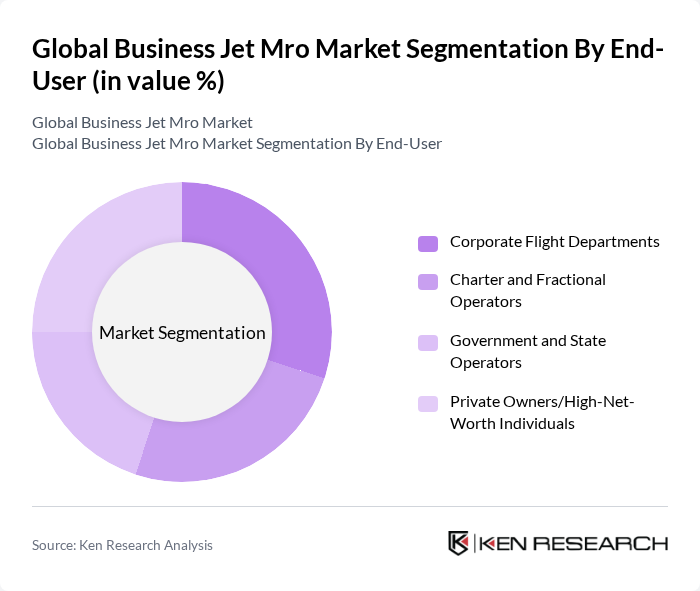
Global Business Jet Mro Market segmentation by End-User.

Global Business Jet Mro Market Competitive Landscape

The Global Business Jet MRO market is characterized by a dynamic mix of regional and international players. Leading participants such as Bombardier Aviation (Bombardier Service Centers), Gulfstream Aerospace Corporation, Dassault Aviation (Dassault Falcon Service), Embraer S.A. (Embraer Executive Jets Services), Textron Aviation Inc. (Cessna & Beechcraft Service), Honeywell International Inc. (Avionics & APU Services), Pratt & Whitney Canada Corp., Rolls-Royce Holdings plc, Lufthansa Technik AG, StandardAero, AAR CORP., Jet Aviation (a General Dynamics company), STS Aviation Group, Air France Industries KLM Engineering & Maintenance, Delta TechOps, SR Technics, Duncan Aviation, West Star Aviation, JETMS (Avia Solutions Group), ExecuJet MRO Services contribute to innovation, geographic expansion, and service delivery in this space .

Bombardier Aviation

1942

Montreal, Canada

Gulfstream Aerospace Corporation

1958

Savannah, Georgia, USA

Dassault Aviation

1929

Paris, France

Embraer S.A.

1969

São José dos Campos, Brazil

Textron Aviation Inc.

2014

Wichita, Kansas, USA

Company

Establishment Year

Headquarters

Group Size (Global, Regional, Niche)

Business Jet MRO Revenue (latest FY, USD)

Revenue Growth Rate (YoY, %)

Fleet Coverage (models/engine types supported)

Service Network Footprint (sites, countries)

Average Turnaround Time (TAT) by Service (days)

Global Business Jet Mro Market Industry Analysis

Growth Drivers

  • Increasing Demand for Business Travel:The global business travel market is projected to reach $1.8 trillion in future, driven by a resurgence in corporate travel post-pandemic. This surge is expected to increase the operational hours of business jets, leading to a higher demand for maintenance, repair, and overhaul (MRO) services. As companies prioritize efficiency and productivity, the reliance on business jets for quick travel solutions will further bolster the MRO sector, necessitating robust support services.
  • Technological Advancements in Aircraft Maintenance:The integration of advanced technologies such as IoT and AI in aircraft maintenance is revolutionizing the MRO landscape. In future, the global aviation maintenance market is anticipated to exceed $120 billion, with a significant portion attributed to innovative MRO solutions. These technologies enhance predictive maintenance capabilities, reduce downtime, and improve safety, thereby driving demand for sophisticated MRO services tailored to modern business jets.
  • Rising Number of Business Jets in Operation:The global fleet of business jets is expected to surpass 30,000 units in future, reflecting a steady growth trajectory. This increase is primarily fueled by the expanding wealth of high-net-worth individuals and corporations seeking private travel options. As the number of operational jets rises, the corresponding demand for MRO services will escalate, creating a lucrative market for service providers to cater to this growing fleet.

Market Challenges

  • High Operational Costs:The operational costs associated with maintaining business jets can be substantial, often exceeding $1.2 million annually per aircraft. These costs encompass fuel, maintenance, and regulatory compliance, which can deter potential buyers and operators. As a result, MRO service providers must navigate these financial constraints while offering competitive pricing and value-added services to attract clients in a cost-sensitive environment.
  • Shortage of Skilled Workforce:The aviation industry is currently facing a significant skills gap, with an estimated shortage of 250,000 skilled technicians in future. This deficit poses a challenge for MRO providers, as the demand for qualified personnel to perform maintenance and repairs on increasingly complex aircraft systems continues to rise. Addressing this workforce challenge is critical for ensuring the quality and reliability of MRO services in the business jet sector.

Global Business Jet Mro Market Future Outlook

The future of the business jet MRO market appears promising, driven by technological advancements and an increasing focus on sustainability. As digital MRO solutions gain traction, operators will benefit from enhanced efficiency and reduced operational costs. Furthermore, the integration of predictive maintenance technologies will likely lead to improved aircraft reliability. These trends, coupled with a growing emphasis on eco-friendly practices, will shape the MRO landscape, fostering innovation and collaboration among industry stakeholders.

Market Opportunities

  • Growth in Emerging Markets:Emerging markets, particularly in Asia-Pacific and Latin America, are witnessing a surge in business jet acquisitions. This trend presents significant opportunities for MRO providers to establish operations in these regions, catering to the increasing demand for maintenance services. By capitalizing on this growth, companies can expand their market presence and enhance service offerings tailored to local needs.
  • Increased Focus on Sustainability:The aviation industry is increasingly prioritizing sustainability, with many operators seeking eco-friendly MRO solutions. This shift presents opportunities for MRO providers to develop and implement green technologies, such as sustainable aviation fuels and waste reduction practices. By aligning with sustainability goals, companies can attract environmentally conscious clients and differentiate themselves in a competitive market.

Scope of the Report

SegmentSub-Segments
By Type

Airframe Maintenance (A/B/C/D checks, corrosion control, structural repairs)

Engine Maintenance (inspection, hot section, overhaul)

Component Maintenance (avionics, landing gear, APU, interiors)

Line Maintenance (turnaround checks, defect rectification)

Heavy Maintenance (base checks, major structural work)

Modifications and Upgrades (avionics retrofits, connectivity, cabin refits, paint)

Mobile/AOG Support Services

By End-User

Corporate Flight Departments

Charter and Fractional Operators

Government and State Operators

Private Owners/High-Net-Worth Individuals

By Service Type

Scheduled Maintenance

Unscheduled/AOG Maintenance

Overhaul and Refurbishment

By Region

North America

Europe

Asia-Pacific

Latin America

Middle East and Africa

By Distribution Channel

Direct Contracts with MRO Providers

OEM Service Networks and Portals

Brokered/Maintenance Management Providers

By Maintenance Provider Type

OEM MROs (airframe, engine, avionics)

Independent MROs

In-House/Operator-Managed Maintenance

By Pricing Model

Fixed-Price Event

Time-and-Materials (T&M)

Hourly Cost Maintenance Programs (PBH/Power-by-the-Hour)

Key Target Audience

Investors and Venture Capitalist Firms

Government and Regulatory Bodies (e.g., Federal Aviation Administration, European Union Aviation Safety Agency)

Aircraft Manufacturers

MRO Service Providers

Airline Operators

Business Jet Operators

Aircraft Leasing Companies

Insurance Companies

Players Mentioned in the Report:

Bombardier Aviation (Bombardier Service Centers)

Gulfstream Aerospace Corporation

Dassault Aviation (Dassault Falcon Service)

Embraer S.A. (Embraer Executive Jets Services)

Textron Aviation Inc. (Cessna & Beechcraft Service)

Honeywell International Inc. (Avionics & APU Services)

Pratt & Whitney Canada Corp.

Rolls-Royce Holdings plc

Lufthansa Technik AG

StandardAero

AAR CORP.

Jet Aviation (a General Dynamics company)

STS Aviation Group

Air France Industries KLM Engineering & Maintenance

Delta TechOps

SR Technics

Duncan Aviation

West Star Aviation

JETMS (Avia Solutions Group)

ExecuJet MRO Services

Table of Contents

Market Assessment Phase

1. Executive Summary and Approach


2. Global Business Jet Mro Market Overview

2.1 Key Insights and Strategic Recommendations

2.2 Global Business Jet Mro Market Overview

2.3 Definition and Scope

2.4 Evolution of Market Ecosystem

2.5 Timeline of Key Regulatory Milestones

2.6 Value Chain & Stakeholder Mapping

2.7 Business Cycle Analysis

2.8 Policy & Incentive Landscape


3. Global Business Jet Mro Market Analysis

3.1 Growth Drivers

3.1.1 Increasing Demand for Business Travel
3.1.2 Technological Advancements in Aircraft Maintenance
3.1.3 Rising Number of Business Jets in Operation
3.1.4 Expansion of MRO Service Providers

3.2 Market Challenges

3.2.1 High Operational Costs
3.2.2 Regulatory Compliance Issues
3.2.3 Shortage of Skilled Workforce
3.2.4 Economic Uncertainties

3.3 Market Opportunities

3.3.1 Growth in Emerging Markets
3.3.2 Increased Focus on Sustainability
3.3.3 Development of Advanced MRO Technologies
3.3.4 Strategic Partnerships and Collaborations

3.4 Market Trends

3.4.1 Shift Towards Digital MRO Solutions
3.4.2 Increasing Use of Predictive Maintenance
3.4.3 Growing Demand for Customized MRO Services
3.4.4 Integration of AI and Automation in MRO Processes

3.5 Government Regulation

3.5.1 Enhanced Safety Regulations
3.5.2 Environmental Compliance Standards
3.5.3 Certification Requirements for MRO Facilities
3.5.4 Import and Export Regulations for Aircraft Parts

4. SWOT Analysis


5. Stakeholder Analysis


6. Porter's Five Forces Analysis


7. Global Business Jet Mro Market Market Size, 2019-2024

7.1 By Value

7.2 By Volume

7.3 By Average Selling Price


8. Global Business Jet Mro Market Segmentation

8.1 By Type

8.1.1 Airframe Maintenance (A/B/C/D checks, corrosion control, structural repairs)
8.1.2 Engine Maintenance (inspection, hot section, overhaul)
8.1.3 Component Maintenance (avionics, landing gear, APU, interiors)
8.1.4 Line Maintenance (turnaround checks, defect rectification)
8.1.5 Heavy Maintenance (base checks, major structural work)
8.1.6 Modifications and Upgrades (avionics retrofits, connectivity, cabin refits, paint)
8.1.7 Mobile/AOG Support Services

8.2 By End-User

8.2.1 Corporate Flight Departments
8.2.2 Charter and Fractional Operators
8.2.3 Government and State Operators
8.2.4 Private Owners/High-Net-Worth Individuals

8.3 By Service Type

8.3.1 Scheduled Maintenance
8.3.2 Unscheduled/AOG Maintenance
8.3.3 Overhaul and Refurbishment

8.4 By Region

8.4.1 North America
8.4.2 Europe
8.4.3 Asia-Pacific
8.4.4 Latin America
8.4.5 Middle East and Africa

8.5 By Distribution Channel

8.5.1 Direct Contracts with MRO Providers
8.5.2 OEM Service Networks and Portals
8.5.3 Brokered/Maintenance Management Providers

8.6 By Maintenance Provider Type

8.6.1 OEM MROs (airframe, engine, avionics)
8.6.2 Independent MROs
8.6.3 In-House/Operator-Managed Maintenance

8.7 By Pricing Model

8.7.1 Fixed-Price Event
8.7.2 Time-and-Materials (T&M)
8.7.3 Hourly Cost Maintenance Programs (PBH/Power-by-the-Hour)

9. Global Business Jet Mro Market Competitive Analysis

9.1 Market Share of Key Players

9.2 Cross Comparison of Key Players

9.2.1 Company Name
9.2.2 Group Size (Global, Regional, Niche)
9.2.3 Business Jet MRO Revenue (latest FY, USD)
9.2.4 Revenue Growth Rate (YoY, %)
9.2.5 Fleet Coverage (models/engine types supported)
9.2.6 Service Network Footprint (sites, countries)
9.2.7 Average Turnaround Time (TAT) by Service (days)
9.2.8 Contract Mix (% fixed/T&M/PBH)
9.2.9 Customer Retention/Repeat Business Rate (%)
9.2.10 On-Time Delivery Rate (%)
9.2.11 Certifications (EASA Part-145, FAA, other)
9.2.12 Digital Capability (predictive maintenance, paperless, IoT usage)
9.2.13 AOG Response SLA (avg. response time, hours)
9.2.14 Warranty Claim Rate (% of events)
9.2.15 Safety/Compliance KPIs (audit findings per check)

9.3 SWOT Analysis of Top Players

9.4 Pricing Analysis

9.5 Detailed Profile of Major Companies

9.5.1 Bombardier Aviation (Bombardier Service Centers)
9.5.2 Gulfstream Aerospace Corporation
9.5.3 Dassault Aviation (Dassault Falcon Service)
9.5.4 Embraer S.A. (Embraer Executive Jets Services)
9.5.5 Textron Aviation Inc. (Cessna & Beechcraft Service)
9.5.6 Honeywell International Inc. (Avionics & APU Services)
9.5.7 Pratt & Whitney Canada Corp.
9.5.8 Rolls-Royce Holdings plc
9.5.9 Lufthansa Technik AG
9.5.10 StandardAero
9.5.11 AAR CORP.
9.5.12 Jet Aviation (a General Dynamics company)
9.5.13 STS Aviation Group
9.5.14 Air France Industries KLM Engineering & Maintenance
9.5.15 Delta TechOps
9.5.16 SR Technics
9.5.17 Duncan Aviation
9.5.18 West Star Aviation
9.5.19 JETMS (Avia Solutions Group)
9.5.20 ExecuJet MRO Services

10. Global Business Jet Mro Market End-User Analysis

10.1 Procurement Behavior of Key Ministries

10.1.1 Budget Allocation Trends
10.1.2 Decision-Making Processes
10.1.3 Preferred MRO Providers

10.2 Corporate Spend on Infrastructure & Energy

10.2.1 Investment in MRO Facilities
10.2.2 Spending on Technology Upgrades
10.2.3 Budget for Training and Development

10.3 Pain Point Analysis by End-User Category

10.3.1 Delays in Service Delivery
10.3.2 High Maintenance Costs
10.3.3 Quality of Service Issues

10.4 User Readiness for Adoption

10.4.1 Awareness of MRO Solutions
10.4.2 Willingness to Invest in New Technologies
10.4.3 Training Needs Assessment

10.5 Post-Deployment ROI and Use Case Expansion

10.5.1 Measurement of ROI
10.5.2 Expansion of Service Offerings
10.5.3 Customer Feedback Mechanisms

11. Global Business Jet Mro Market Future Size, 2025-2030

11.1 By Value

11.2 By Volume

11.3 By Average Selling Price


Go-To-Market Strategy Phase

1. Whitespace Analysis + Business Model Canvas

1.1 Market Gaps Identification

1.2 Value Proposition Development

1.3 Revenue Streams Analysis

1.4 Customer Segmentation

1.5 Key Partnerships

1.6 Cost Structure Analysis

1.7 Channels of Distribution


2. Marketing and Positioning Recommendations

2.1 Branding Strategies

2.2 Product USPs

2.3 Target Market Identification

2.4 Communication Strategies

2.5 Digital Marketing Approaches


3. Distribution Plan

3.1 Urban Retail Strategies

3.2 Rural NGO Tie-Ups

3.3 Online Distribution Channels

3.4 Direct Sales Approaches


4. Channel & Pricing Gaps

4.1 Underserved Routes

4.2 Pricing Bands Analysis

4.3 Competitor Pricing Strategies


5. Unmet Demand & Latent Needs

5.1 Category Gaps

5.2 Consumer Segments Analysis

5.3 Emerging Trends Identification


6. Customer Relationship

6.1 Loyalty Programs

6.2 After-Sales Service Strategies

6.3 Customer Engagement Initiatives


7. Value Proposition

7.1 Sustainability Initiatives

7.2 Integrated Supply Chains

7.3 Competitive Advantages


8. Key Activities

8.1 Regulatory Compliance

8.2 Branding Initiatives

8.3 Distribution Setup


9. Entry Strategy Evaluation

9.1 Domestic Market Entry Strategy

9.1.1 Product Mix Considerations
9.1.2 Pricing Band Strategies
9.1.3 Packaging Options

9.2 Export Entry Strategy

9.2.1 Target Countries
9.2.2 Compliance Roadmap

10. Entry Mode Assessment

10.1 Joint Ventures

10.2 Greenfield Investments

10.3 Mergers & Acquisitions

10.4 Distributor Model


11. Capital and Timeline Estimation

11.1 Capital Requirements

11.2 Timelines for Implementation


12. Control vs Risk Trade-Off

12.1 Ownership vs Partnerships


13. Profitability Outlook

13.1 Breakeven Analysis

13.2 Long-Term Sustainability


14. Potential Partner List

14.1 Distributors

14.2 Joint Ventures

14.3 Acquisition Targets


15. Execution Roadmap

15.1 Phased Plan for Market Entry

15.1.1 Market Setup
15.1.2 Market Entry
15.1.3 Growth Acceleration
15.1.4 Scale & Stabilize

15.2 Key Activities and Milestones

15.2.1 Milestone Planning
15.2.2 Activity Tracking

Research Methodology

ApproachModellingSample

Phase 1: Approach1

Desk Research

  • Industry reports from aviation authorities and global aviation organizations
  • Market analysis publications from aerospace and defense think tanks
  • Statistical data from international aviation databases and trade associations

Primary Research

  • Interviews with maintenance, repair, and overhaul (MRO) executives in the business jet sector
  • Surveys with operators and owners of business jets regarding maintenance practices
  • Field interviews with technicians and engineers involved in MRO services

Validation & Triangulation

  • Cross-validation of findings through multiple industry reports and expert opinions
  • Triangulation of data from primary interviews and secondary research sources
  • Sanity checks through expert panel discussions and feedback sessions

Phase 2: Market Size Estimation1

Top-down Assessment

  • Analysis of global business jet fleet size and growth trends
  • Estimation of MRO spending as a percentage of total fleet value
  • Incorporation of regional growth rates and economic indicators affecting MRO demand

Bottom-up Modeling

  • Data collection on service pricing and operational costs from leading MRO providers
  • Volume estimates based on historical maintenance records and service frequency
  • Calculation of total addressable market (TAM) based on firm-level data

Forecasting & Scenario Analysis

  • Multi-variable forecasting using economic growth, fuel prices, and regulatory changes
  • Scenario modeling based on potential technological advancements in MRO processes
  • Baseline, optimistic, and pessimistic forecasts through 2030

Phase 3: CATI Sample Composition1

Scope Item/SegmentSample SizeTarget Respondent Profiles
Business Jet Operators140Fleet Managers, Operations Directors
MRO Service Providers100Service Line Managers, Technical Directors
Aviation Regulatory Bodies50Policy Makers, Compliance Officers
Business Jet Manufacturers80Product Development Managers, Sales Executives
Industry Analysts and Consultants60Aviation Analysts, Market Research Consultants

Frequently Asked Questions

What is the current value of the Global Business Jet MRO market?

The Global Business Jet MRO market is valued at approximately USD 24 billion, reflecting a robust demand for maintenance, repair, and overhaul services driven by increasing business aviation needs and advancements in technology.

What factors are driving the growth of the Business Jet MRO market?

What are the main types of services offered in the Business Jet MRO market?

Who are the key players in the Global Business Jet MRO market?

Other Regional/Country Reports

Indonesia Global Business Jet Mro Market

Malaysia Global Business Jet Mro Market

KSA Global Business Jet Mro Market

APAC Global Business Jet Mro Market

SEA Global Business Jet Mro Market

Vietnam Global Business Jet Mro Market

Why Buy From Us?

Refine Robust Result (RRR) Framework

What makes us stand out is that our consultants follow Robust, Refine and Result (RRR) methodology. Robust for clear definitions, approaches and sanity checking, Refine for differentiating respondents' facts and opinions, and Result for presenting data with story.

Our Reach Is Unmatched

We have set a benchmark in the industry by offering our clients with syndicated and customized market research reports featuring coverage of entire market as well as meticulous research and analyst insights.

Shifting the Research Paradigm

While we don't replace traditional research, we flip the method upside down. Our dual approach of Top Bottom & Bottom Top ensures quality deliverable by not just verifying company fundamentals but also looking at the sector and macroeconomic factors.

More Insights-Better Decisions

With one step in the future, our research team constantly tries to show you the bigger picture. We help with some of the tough questions you may encounter along the way: How is the industry positioned? Best marketing channel? KPI's of competitors? By aligning every element, we help maximize success.

Transparency and Trust

Our report gives you instant access to the answers and sources that other companies might choose to hide. We elaborate each steps of research methodology we have used and showcase you the sample size to earn your trust.

Round the Clock Support

If you need any support, we are here! We pride ourselves on universe strength, data quality, and quick, friendly, and professional service.

Why Clients Choose Us?

400000+
Reports in repository
150+
Consulting projects a year
100+
Analysts
8000+
Client Queries in 2022








