About the Report
Base Year 2024Global Cable Connector Market Overview
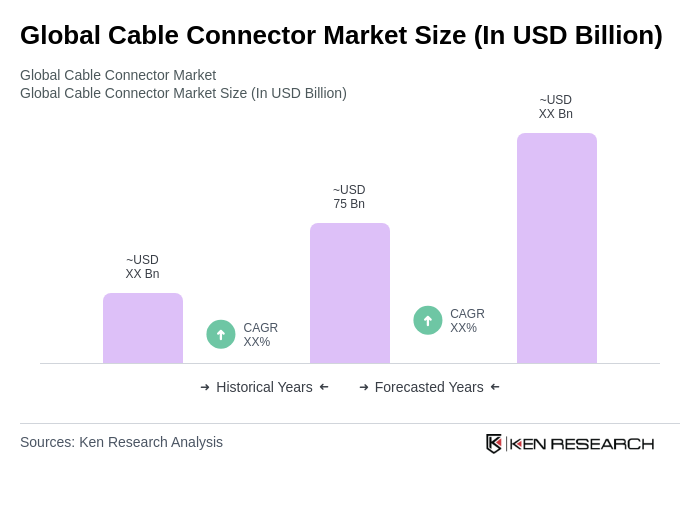
- The Global Cable Connector Market is valued at USD 75 billion, based on a five-year historical analysis. This growth is primarily driven by the increasing demand for connectivity solutions across telecommunications, automotive, and consumer electronics, with strong momentum from high-speed data transmission and 5G deployment supporting connector uptake .
- Key players in this market are concentrated in regions such as North America, Europe, and Asia-Pacific. Asia-Pacific leads by share on the back of manufacturing scale and electronics supply chains, while North America is cited among the fastest-growing regions; leadership countries include the United States, Germany, and China due to advanced infrastructure, R&D intensity, and the presence of major OEMs and connector manufacturers .
- In 2023, the European Union advanced sustainability requirements via the Ecodesign for Sustainable Products Regulation (ESPR) framework and related eco-design measures, which expand ecodesign principles beyond energy-related products to more product categories and promote circularity; while connectors are not singled out, electrical and electronic equipment placed on the EU market is increasingly subject to durability, reparability, and environmental performance criteria that influence connector design and compliance practices .
Global Cable Connector Market Segmentation
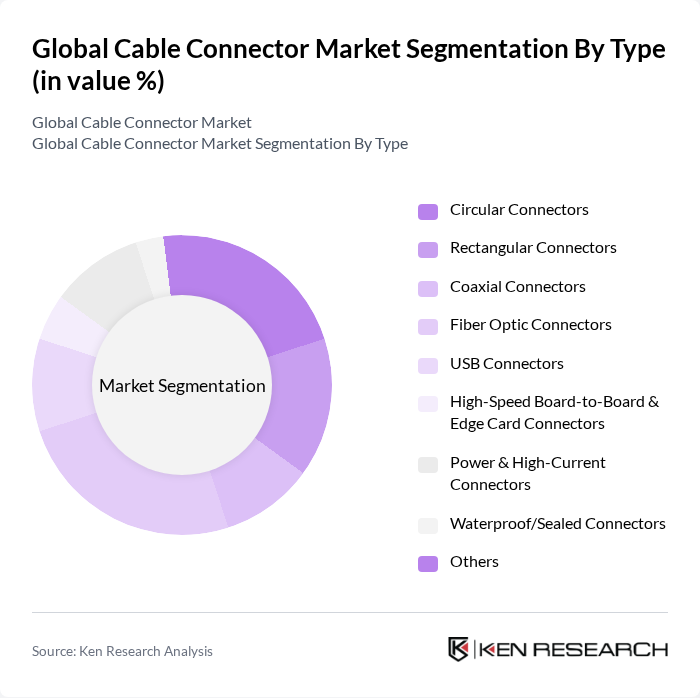
By Type:The market is segmented into various types of connectors, each serving specific applications and industries. The primary types include Circular Connectors, Rectangular Connectors, Coaxial Connectors, Fiber Optic Connectors, USB Connectors, High-Speed Board-to-Board & Edge Card Connectors, Power & High-Current Connectors, Waterproof/Sealed Connectors, and Others. Each type has unique features and benefits that cater to different market needs. Recent demand catalysts include rising adoption of high-speed board-to-board and edge-card interconnects for servers and data centers, broader USB-C standardization in consumer/PC ecosystems, resilient demand for circular and sealed connectors in industrial/EV environments, and accelerating use of fiber connectors in 5G fronthaul/backhaul and FTTx deployments .
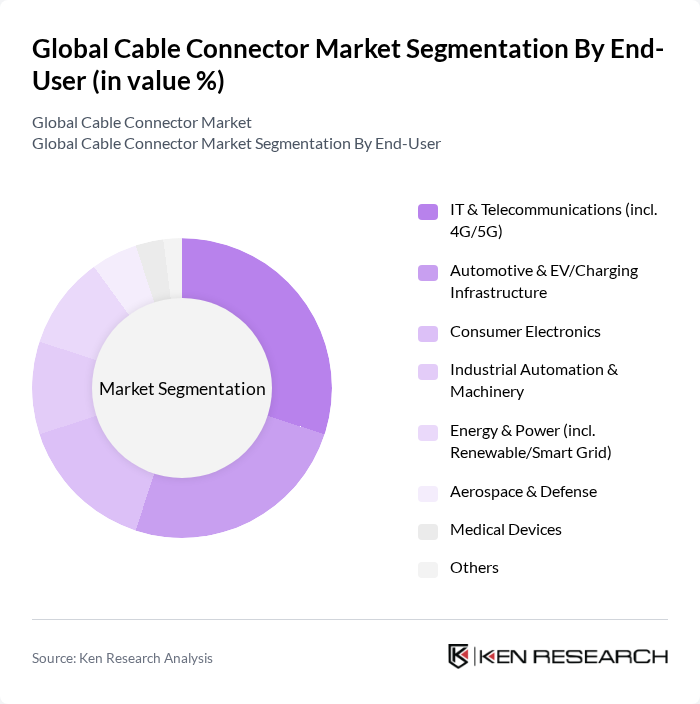
By End-User:The market is also segmented based on end-users, which include IT & Telecommunications, Automotive & EV/Charging Infrastructure, Consumer Electronics, Industrial Automation & Machinery, Energy & Power, Aerospace & Defense, Medical Devices, and Others. Each end-user segment has distinct requirements and growth drivers that influence the demand for cable connectors. Notable drivers include 4G/5G rollouts and fiber deepening in telecom, advanced driver-assistance systems and electrification in automotive/EV charging, miniaturization and high-speed I/O in consumer devices and computing, and Industry 4.0 upgrades in industrial automation .
Global Cable Connector Market Competitive Landscape
The Global Cable Connector Market is characterized by a dynamic mix of regional and international players. Leading participants such as TE Connectivity Ltd., Amphenol Corporation, Molex LLC (a Koch Company), Aptiv PLC, 3M Company, Samtec, Inc., Hirose Electric Co., Ltd., Japan Aviation Electronics Industry, Ltd. (JAE), Phoenix Contact GmbH & Co. KG, HARTING Technology Group, Belden Inc., L-com (Infinite Electronics), Rosenberger Hochfrequenztechnik GmbH & Co. KG, Amphenol ICC (Interconnect, Cable & Components), Yazaki Corporation, J.S.T. Mfg. Co., Ltd. (JST), Würth Elektronik GmbH & Co. KG, Smiths Interconnect, Radiall, Fischer Connectors (Hexatronic Group) contribute to innovation, geographic expansion, and service delivery in this space.
Global Cable Connector Market Industry Analysis
Growth Drivers
- Increasing Demand for High-Speed Data Transmission:The global demand for high-speed data transmission is projected to reach 4.5 billion gigabytes per month in future, driven by the proliferation of cloud computing and streaming services. This surge necessitates advanced cable connectors capable of supporting higher bandwidths. The International Telecommunication Union (ITU) reported that global internet traffic is expected to grow by 25% annually, further fueling the need for efficient and reliable cable connectors in telecommunications and data centers.
- Expansion of Telecommunications Infrastructure:As of future, global investments in telecommunications infrastructure are estimated to exceed $2 trillion, with significant contributions from emerging markets. This expansion includes the rollout of 5G networks, which require advanced cable connectors to ensure optimal performance. The World Bank indicates that improved connectivity can increase GDP by up to 2% in developing regions, highlighting the critical role of cable connectors in supporting this growth.
- Rising Adoption of Electric Vehicles:The electric vehicle (EV) market is projected to grow to 40 million units in future, necessitating robust cable connectors for charging infrastructure. According to the International Energy Agency (IEA), the number of public charging points is expected to reach 3 million globally, creating a substantial demand for specialized connectors. This trend is further supported by government incentives aimed at reducing carbon emissions, which are projected to increase EV adoption rates significantly.
Market Challenges
- Intense Competition and Price Pressure:The cable connector market is characterized by intense competition, with over 300 manufacturers globally. This saturation leads to significant price pressure, with average prices declining by approximately 3% annually. According to industry reports, companies are compelled to innovate continuously to maintain market share, which can strain resources and impact profitability. The need for cost-effective solutions is paramount, challenging manufacturers to balance quality and pricing.
- Supply Chain Disruptions:The cable connector industry faces ongoing supply chain disruptions, exacerbated by geopolitical tensions and the COVID-19 pandemic. In future, it is estimated that 50% of manufacturers will experience delays in raw material procurement, impacting production timelines. The World Trade Organization (WTO) has noted that such disruptions can lead to a 15% increase in lead times, affecting the ability to meet market demand and maintain customer satisfaction.
Global Cable Connector Market Future Outlook
The future of the cable connector market appears promising, driven by technological advancements and increasing demand across various sectors. The integration of IoT technologies is expected to enhance connectivity solutions, while the shift towards sustainable materials will likely reshape product offerings. Additionally, as industries increasingly adopt smart grid technologies, the need for innovative connectors will grow, presenting opportunities for manufacturers to develop cutting-edge solutions that meet evolving market needs.
Market Opportunities
- Development of Smart Grids:The global smart grid market is projected to reach $150 billion in future, creating significant opportunities for cable connector manufacturers. Smart grids require advanced connectors that can handle increased data flow and energy management. This demand is driven by the need for efficient energy distribution and integration of renewable energy sources, positioning manufacturers to capitalize on this growing trend.
- Innovations in Connector Design:The push for miniaturization and enhanced performance in electronic devices is driving innovations in connector design. In future, the demand for compact and high-performance connectors is expected to increase, particularly in consumer electronics and automotive applications. Manufacturers that invest in R&D to create innovative designs will likely gain a competitive edge in this rapidly evolving market.
Scope of the Report
| Segment | Sub-Segments |
|---|---|
| By Type | Circular Connectors Rectangular Connectors Coaxial Connectors Fiber Optic Connectors USB Connectors High-Speed Board-to-Board & Edge Card (e.g., PCIe, mezzanine) Power & High-Current Connectors Waterproof/Sealed (IP67/IP68) Connectors Others |
| By End-User | IT & Telecommunications (incl. 4G/5G) Automotive & EV/Charging Infrastructure Consumer Electronics Industrial Automation & Machinery Energy & Power (incl. Renewable/Smart Grid) Aerospace & Defense Medical Devices Others |
| By Application | Data Centers & Cloud Infrastructure Networking & Telecom Equipment Power Transmission & Distribution Audio/Video & Broadcast Industrial Fieldbus & Robotics EV Powertrain & Charging Others |
| By Distribution Channel | Direct Sales (OEM) Authorized Distributors Online (eCommerce/Mouser/Digi-Key) Retail Stores Others |
| By Material | Plastics/Polymers (e.g., PBT, LCP) Metals (e.g., Copper Alloys, Aluminum) Composite & High-Temperature Materials Others |
| By Region | North America Europe Asia-Pacific Latin America Middle East & Africa |
| By Price Range | Low-End Connectors Mid-Range Connectors High-End/Mil-Aero & Ruggedized Others |
Key Target Audience
Investors and Venture Capitalist Firms
Government and Regulatory Bodies (e.g., Federal Communications Commission, International Telecommunication Union)
Manufacturers and Producers
Distributors and Retailers
Telecommunications Service Providers
Utility Companies
Industry Associations (e.g., National Electrical Manufacturers Association)
Financial Institutions
Players Mentioned in the Report:
TE Connectivity Ltd.
Amphenol Corporation
Molex LLC (a Koch Company)
Aptiv PLC
3M Company
Samtec, Inc.
Hirose Electric Co., Ltd.
Japan Aviation Electronics Industry, Ltd. (JAE)
Phoenix Contact GmbH & Co. KG
HARTING Technology Group
Belden Inc.
L-com (Infinite Electronics)
Rosenberger Hochfrequenztechnik GmbH & Co. KG
Amphenol ICC (Interconnect, Cable & Components)
Yazaki Corporation
J.S.T. Mfg. Co., Ltd. (JST)
Wurth Elektronik GmbH & Co. KG
Smiths Interconnect
Radiall
Fischer Connectors (Hexatronic Group)
Table of Contents
Market Assessment Phase
1. Executive Summary and Approach
2. Global Cable Connector Market Overview
2.1 Key Insights and Strategic Recommendations
2.2 Global Cable Connector Market Overview
2.3 Definition and Scope
2.4 Evolution of Market Ecosystem
2.5 Timeline of Key Regulatory Milestones
2.6 Value Chain & Stakeholder Mapping
2.7 Business Cycle Analysis
2.8 Policy & Incentive Landscape
3. Global Cable Connector Market Analysis
3.1 Growth Drivers
3.1.1 Increasing Demand for High-Speed Data Transmission
3.1.2 Expansion of Telecommunications Infrastructure
3.1.3 Rising Adoption of Electric Vehicles
3.1.4 Growth in Consumer Electronics
3.2 Market Challenges
3.2.1 Intense Competition and Price Pressure
3.2.2 Rapid Technological Changes
3.2.3 Supply Chain Disruptions
3.2.4 Regulatory Compliance Issues
3.3 Market Opportunities
3.3.1 Development of Smart Grids
3.3.2 Innovations in Connector Design
3.3.3 Expansion into Emerging Markets
3.3.4 Increased Focus on Renewable Energy Solutions
3.4 Market Trends
3.4.1 Miniaturization of Connectors
3.4.2 Integration of IoT in Cable Connectors
3.4.3 Shift Towards Sustainable Materials
3.4.4 Customization and Personalization of Products
3.5 Government Regulation
3.5.1 Environmental Compliance Standards
3.5.2 Safety Regulations for Electrical Components
3.5.3 Import and Export Tariffs
3.5.4 Incentives for Renewable Energy Projects
4. SWOT Analysis
5. Stakeholder Analysis
6. Porter's Five Forces Analysis
7. Global Cable Connector Market Market Size, 2019-2024
7.1 By Value
7.2 By Volume
7.3 By Average Selling Price
8. Global Cable Connector Market Segmentation
8.1 By Type
8.1.1 Circular Connectors
8.1.2 Rectangular Connectors
8.1.3 Coaxial Connectors
8.1.4 Fiber Optic Connectors
8.1.5 USB Connectors
8.1.6 High-Speed Board-to-Board & Edge Card (e.g., PCIe, mezzanine)
8.1.7 Power & High-Current Connectors
8.1.8 Waterproof/Sealed (IP67/IP68) Connectors
8.1.9 Others
8.2 By End-User
8.2.1 IT & Telecommunications (incl. 4G/5G)
8.2.2 Automotive & EV/Charging Infrastructure
8.2.3 Consumer Electronics
8.2.4 Industrial Automation & Machinery
8.2.5 Energy & Power (incl. Renewable/Smart Grid)
8.2.6 Aerospace & Defense
8.2.7 Medical Devices
8.2.8 Others
8.3 By Application
8.3.1 Data Centers & Cloud Infrastructure
8.3.2 Networking & Telecom Equipment
8.3.3 Power Transmission & Distribution
8.3.4 Audio/Video & Broadcast
8.3.5 Industrial Fieldbus & Robotics
8.3.6 EV Powertrain & Charging
8.3.7 Others
8.4 By Distribution Channel
8.4.1 Direct Sales (OEM)
8.4.2 Authorized Distributors
8.4.3 Online (eCommerce/Mouser/Digi-Key)
8.4.4 Retail Stores
8.4.5 Others
8.5 By Material
8.5.1 Plastics/Polymers (e.g., PBT, LCP)
8.5.2 Metals (e.g., Copper Alloys, Aluminum)
8.5.3 Composite & High-Temperature Materials
8.5.4 Others
8.6 By Region
8.6.1 North America
8.6.2 Europe
8.6.3 Asia-Pacific
8.6.4 Latin America
8.6.5 Middle East & Africa
8.7 By Price Range
8.7.1 Low-End Connectors
8.7.2 Mid-Range Connectors
8.7.3 High-End/Mil-Aero & Ruggedized
8.7.4 Others
9. Global Cable Connector Market Competitive Analysis
9.1 Market Share of Key Players
9.2 Cross Comparison of Key Players
9.2.1 Company Name (entity-level and connector division where applicable)
9.2.2 Group Size (Global revenue tier: Large >$5B, Mid $1–5B, Small <$1B)
9.2.3 Connector Segment Revenue and Share of Total Sales
9.2.4 3-year CAGR in Connector Revenues
9.2.5 Geographic Revenue Mix (APAC/NA/Europe %)
9.2.6 End-Market Exposure Mix (Auto, IT/Telecom, Industrial, Consumer, A&D, Medical %)
9.2.7 New Design Wins per Year (Tier-1 OEMs and key platforms)
9.2.8 R&D Intensity (% of sales) and Patent Filings
9.2.9 Portfolio Breadth (power, signal, high-speed, fiber, rugged, sealed) index
9.2.10 Average Lead Time and On-Time Delivery (OTD %)
9.2.11 Quality Metrics (PPM, field failure rate, returns %)
9.2.12 Pricing Positioning (value, mid, premium) and ASP trend
9.2.13 Channel Strength (distributor coverage, e-commerce availability)
9.2.14 ESG & Compliance (RoHS/REACH, conflict minerals, sustainability targets)
9.3 SWOT Analysis of Top Players
9.4 Pricing Analysis
9.5 Detailed Profile of Major Companies
9.5.1 TE Connectivity Ltd.
9.5.2 Amphenol Corporation
9.5.3 Molex LLC (a Koch Company)
9.5.4 Aptiv PLC
9.5.5 3M Company
9.5.6 Samtec, Inc.
9.5.7 Hirose Electric Co., Ltd.
9.5.8 Japan Aviation Electronics Industry, Ltd. (JAE)
9.5.9 Phoenix Contact GmbH & Co. KG
9.5.10 HARTING Technology Group
9.5.11 Belden Inc.
9.5.12 L-com (Infinite Electronics)
9.5.13 Rosenberger Hochfrequenztechnik GmbH & Co. KG
9.5.14 Amphenol ICC (Interconnect, Cable & Components)
9.5.15 Yazaki Corporation
9.5.16 J.S.T. Mfg. Co., Ltd. (JST)
9.5.17 Würth Elektronik GmbH & Co. KG
9.5.18 Smiths Interconnect
9.5.19 Radiall
9.5.20 Fischer Connectors (Hexatronic Group)
10. Global Cable Connector Market End-User Analysis
10.1 Procurement Behavior of Key Ministries
10.1.1 Government Contracts and Tenders
10.1.2 Budget Allocation for Infrastructure Projects
10.1.3 Evaluation Criteria for Supplier Selection
10.2 Corporate Spend on Infrastructure & Energy
10.2.1 Investment Trends in Telecommunications
10.2.2 Spending on Renewable Energy Projects
10.2.3 Budgeting for Smart City Initiatives
10.3 Pain Point Analysis by End-User Category
10.3.1 Quality and Reliability Issues
10.3.2 Supply Chain Delays
10.3.3 Cost Management Challenges
10.4 User Readiness for Adoption
10.4.1 Awareness of New Technologies
10.4.2 Training and Support Needs
10.4.3 Integration with Existing Systems
10.5 Post-Deployment ROI and Use Case Expansion
10.5.1 Performance Metrics Tracking
10.5.2 Case Studies of Successful Implementations
10.5.3 Future Expansion Opportunities
11. Global Cable Connector Market Future Size, 2025-2030
11.1 By Value
11.2 By Volume
11.3 By Average Selling Price
Go-To-Market Strategy Phase
1. Whitespace Analysis + Business Model Canvas
1.1 Market Gaps Identification
1.2 Value Proposition Development
1.3 Revenue Streams Analysis
1.4 Cost Structure Evaluation
1.5 Key Partnerships Exploration
1.6 Customer Segmentation
1.7 Channels to Market
2. Marketing and Positioning Recommendations
2.1 Branding Strategies
2.2 Product USPs
2.3 Target Market Identification
2.4 Communication Strategy
2.5 Digital Marketing Tactics
3. Distribution Plan
3.1 Urban Retail Strategy
3.2 Rural NGO Tie-ups
3.3 E-commerce Integration
3.4 Logistics and Supply Chain Management
4. Channel & Pricing Gaps
4.1 Underserved Routes
4.2 Pricing Bands Analysis
4.3 Competitor Pricing Comparison
5. Unmet Demand & Latent Needs
5.1 Category Gaps Identification
5.2 Consumer Segments Analysis
5.3 Future Trends Forecasting
6. Customer Relationship
6.1 Loyalty Programs
6.2 After-sales Service Enhancements
6.3 Customer Feedback Mechanisms
7. Value Proposition
7.1 Sustainability Initiatives
7.2 Integrated Supply Chains
7.3 Competitive Advantages
8. Key Activities
8.1 Regulatory Compliance
8.2 Branding Initiatives
8.3 Distribution Setup
9. Entry Strategy Evaluation
9.1 Domestic Market Entry Strategy
9.1.1 Product Mix Considerations
9.1.2 Pricing Band Strategy
9.1.3 Packaging Innovations
9.2 Export Entry Strategy
9.2.1 Target Countries Identification
9.2.2 Compliance Roadmap Development
10. Entry Mode Assessment
10.1 Joint Ventures
10.2 Greenfield Investments
10.3 Mergers & Acquisitions
10.4 Distributor Model Evaluation
11. Capital and Timeline Estimation
11.1 Capital Requirements Analysis
11.2 Timelines for Market Entry
12. Control vs Risk Trade-Off
12.1 Ownership vs Partnerships
13. Profitability Outlook
13.1 Breakeven Analysis
13.2 Long-term Sustainability Strategies
14. Potential Partner List
14.1 Distributors
14.2 Joint Ventures
14.3 Acquisition Targets
15. Execution Roadmap
15.1 Phased Plan for Market Entry
15.1.1 Market Setup
15.1.2 Market Entry
15.1.3 Growth Acceleration
15.1.4 Scale & Stabilize
15.2 Key Activities and Milestones
15.2.1 Milestone Planning
15.2.2 Activity Tracking
Research Methodology
Phase 1: Approach1
Desk Research
- Industry reports from global market research firms focusing on cable connectors
- Trade publications and white papers detailing technological advancements in cable connector designs
- Statistical data from international trade organizations and government agencies on cable production and consumption
Primary Research
- Interviews with product managers at leading cable manufacturing companies
- Surveys targeting electrical engineers and designers in various industries
- Field interviews with installation technicians and contractors to gather insights on usage trends
Validation & Triangulation
- Cross-validation of findings through multiple data sources including market reports and expert opinions
- Triangulation of data from primary interviews and secondary research to ensure consistency
- Sanity checks conducted through expert panel reviews to validate market assumptions
Phase 2: Market Size Estimation1
Top-down Assessment
- Analysis of global cable market size to estimate the share attributed to cable connectors
- Segmentation by application areas such as telecommunications, automotive, and industrial sectors
- Incorporation of growth trends in renewable energy and electric vehicles impacting connector demand
Bottom-up Modeling
- Volume estimates based on production data from major cable connector manufacturers
- Cost analysis derived from pricing models of various connector types and materials
- Estimation of market size based on projected sales volumes and average selling prices
Forecasting & Scenario Analysis
- Multi-variable regression analysis incorporating factors such as technological advancements and regulatory changes
- Scenario planning based on potential shifts in consumer preferences and industry standards
- Development of baseline, optimistic, and pessimistic forecasts through 2030
Phase 3: CATI Sample Composition1
| Scope Item/Segment | Sample Size | Target Respondent Profiles |
|---|---|---|
| Telecommunications Cable Connectors | 120 | Network Engineers, Telecom Project Managers |
| Automotive Electrical Connectors | 90 | Automotive Engineers, Procurement Specialists |
| Industrial Cable Connectors | 80 | Manufacturing Managers, Safety Compliance Officers |
| Consumer Electronics Connectors | 100 | Product Designers, Quality Assurance Managers |
| Renewable Energy Connectors | 60 | Energy Engineers, Project Developers |
Frequently Asked Questions
What is the current value of the Global Cable Connector Market?
The Global Cable Connector Market is valued at approximately USD 75 billion, driven by increasing demand for connectivity solutions across various sectors, including telecommunications, automotive, and consumer electronics.
What factors are driving the growth of the cable connector market?
Which regions are leading in the cable connector market?
What types of connectors are included in the market segmentation?
Other Regional/Country Reports
Indonesia Cable Connector Market
Malaysia Cable Connector Market
APAC Cable Connector Market
SEA Cable Connector Market
Why Buy From Us?

What makes us stand out is that our consultants follow Robust, Refine and Result (RRR) methodology. Robust for clear definitions, approaches and sanity checking, Refine for differentiating respondents' facts and opinions, and Result for presenting data with story.

We have set a benchmark in the industry by offering our clients with syndicated and customized market research reports featuring coverage of entire market as well as meticulous research and analyst insights.

While we don't replace traditional research, we flip the method upside down. Our dual approach of Top Bottom & Bottom Top ensures quality deliverable by not just verifying company fundamentals but also looking at the sector and macroeconomic factors.

With one step in the future, our research team constantly tries to show you the bigger picture. We help with some of the tough questions you may encounter along the way: How is the industry positioned? Best marketing channel? KPI's of competitors? By aligning every element, we help maximize success.

Our report gives you instant access to the answers and sources that other companies might choose to hide. We elaborate each steps of research methodology we have used and showcase you the sample size to earn your trust.

If you need any support, we are here! We pride ourselves on universe strength, data quality, and quick, friendly, and professional service.