About the Report
Base Year 2024Global Cafe And Bars Market Overview
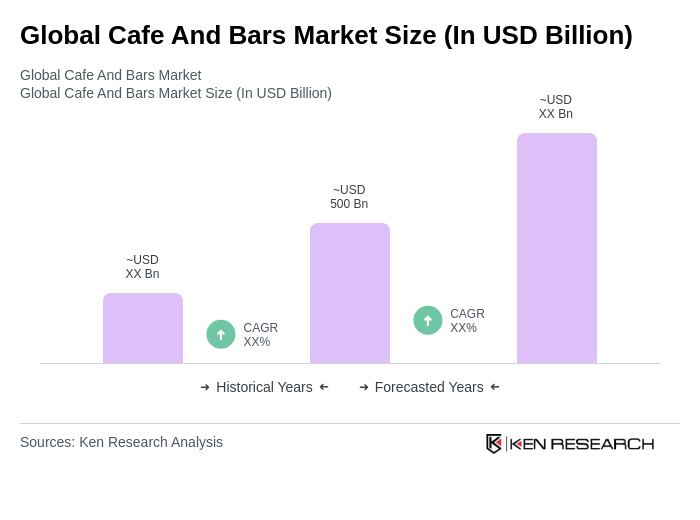
- The Global Cafe and Bars Market is valued at approximately USD 500 billion, based on a five-year historical analysis. This growth is primarily driven by the increasing consumer preference for coffee and alcoholic beverages, along with the rising trend of socializing in cafes and bars. Demand is further supported by rising disposable incomes and the proliferation of experiential formats, including specialty coffee and craft cocktail concepts.
- Key players in this market include the United States, China, and the United Kingdom. The United States dominates due to its strong coffee culture and a high number of cafes and bars per capita, with the national cafes and bars market estimated in the tens of billions of USD. China has witnessed rapid growth in coffee consumption and expansion of branded coffee chains, while the UK’s entrenched pub culture continues to underpin out-of-home alcohol consumption and socializing.
- In 2023, the European Union implemented regulations aimed at promoting sustainable practices in the cafe and bar industry. This includes guidelines for reducing single-use plastics and encouraging the use of recyclable materials in packaging, through measures such as the Single-Use Plastics Directive and waste-reduction obligations under the Packaging and Packaging Waste framework. Such regulations are designed to enhance environmental sustainability and align with consumer preferences for eco-friendly practices.
Global Cafe And Bars Market Segmentation
By Type:The market is segmented into various types, including Cafés/Coffee Shops, Bars & Pubs, Specialty Coffee Shops, Café-Bars (Hybrid Concepts), and Others (Tea houses, dessert cafés). Each of these segments caters to different consumer preferences and occasions, contributing to the overall market dynamics.

The Cafés/Coffee Shops segment is the leading sub-segment, driven by the growing coffee culture and the increasing number of consumers seeking premium coffee experiences. This segment has seen a surge in demand for specialty coffee and unique café atmospheres, appealing to both individual consumers and social gatherings. The trend of remote working has also contributed to the popularity of coffee shops as alternative workspaces, further solidifying their market dominance.
By Customer Type:The market is segmented by customer type into Individual Consumers, Corporate/Business Customers, Tourists and Travelers, and Event/Group Bookings. Each customer type has distinct needs and preferences that influence their choice of cafes and bars.

The Individual Consumers segment holds the largest market share, reflecting the increasing trend of coffee consumption and socializing among individuals. This segment benefits from the rise of coffee culture, where consumers seek unique experiences and high-quality beverages. Additionally, the growing trend of remote work has led to more individuals frequenting cafes for both leisure and work purposes, further enhancing this segment's prominence.
Global Cafe And Bars Market Competitive Landscape
The Global Cafe And Bars Market is characterized by a dynamic mix of regional and international players. Leading participants such as Starbucks Corporation, Dunkin' (Inspire Brands), Costa Coffee (The Coca-Cola Company), Peet's Coffee (JDE Peet's), Tim Hortons (RBI – Restaurant Brands International), JDE Peet's N.V., McDonald's Corporation (McCafé), Panera Bread (JAB Holding), The Coffee Bean & Tea Leaf, Blue Bottle Coffee (Nestlé), Dutch Bros Inc., Lavazza S.p.A., Barista Coffee Company, Gloria Jean's Coffees, Caffè Nero, Pret A Manger, Greggs plc, Luckin Coffee Inc., Café de Coral Group, Whitbread plc (formerly Costa owner; bar concepts) contribute to innovation, geographic expansion, and service delivery in this space.
Global Cafe And Bars Market Industry Analysis
Growth Drivers
- Increasing Consumer Preference for Specialty Coffee:The global specialty coffee market is projected to reach $83 billion in the future, driven by a growing consumer inclination towards high-quality, artisanal coffee. In the future, approximately 60% of coffee drinkers in None reported a preference for specialty coffee over regular options, reflecting a shift in consumer behavior. This trend is supported by the rise of coffee culture, with 30% of millennials visiting cafes at least once a week, indicating a robust demand for unique coffee experiences.
- Rise in Socializing Culture Among Millennials:In None, millennials represent a significant demographic, with over 40% of this group frequently engaging in social activities at cafes and bars. The future consumer spending report indicates that millennials are expected to spend an average of $1,200 annually on dining out, which includes cafes and bars. This socializing trend is further fueled by the desire for community spaces, leading to increased foot traffic and sales in these establishments.
- Expansion of Café Chains in Urban Areas:Urbanization continues to drive the growth of café chains, with over 1,500 new café locations opening in None in the future alone. This expansion is supported by a 15% increase in urban population, leading to higher demand for convenient dining options. Major chains are investing heavily in urban areas, with an average of $500,000 per location, enhancing brand visibility and accessibility, which is crucial for capturing the growing consumer base.
Market Challenges
- High Competition Among Local and International Players:The café and bar industry in None is characterized by intense competition, with over 10,000 establishments vying for market share. This saturation leads to price wars and reduced profit margins, as businesses strive to attract customers. In the future, the average profit margin for cafes was reported at only 5%, highlighting the challenges faced by operators in maintaining profitability amidst fierce competition.
- Fluctuating Raw Material Prices:The café industry is significantly impacted by the volatility of raw material prices, particularly coffee and dairy products. In the future, coffee prices surged by 20% due to adverse weather conditions affecting major coffee-producing regions. This fluctuation poses a challenge for cafes, as they must balance cost increases with consumer price sensitivity, often leading to difficult decisions regarding menu pricing and product offerings.
Global Cafe And Bars Market Future Outlook
The future of the café and bar industry in None appears promising, driven by evolving consumer preferences and technological advancements. The integration of digital platforms for ordering and delivery is expected to enhance customer convenience, while the demand for sustainable and organic products will likely shape menu offerings. As urban populations continue to grow, cafes that adapt to these trends will thrive, creating a dynamic environment for innovation and customer engagement in the future.
Market Opportunities
- Expansion into Emerging Markets:There is significant potential for café chains to expand into emerging markets within None, where urbanization is rapidly increasing. With a projected growth rate of 10% in these regions, cafes can tap into a new customer base eager for modern dining experiences, thus driving revenue growth and brand recognition.
- Introduction of Innovative Beverage Offerings:The introduction of unique beverage options, such as cold brews and plant-based alternatives, presents a lucrative opportunity. In the future, 25% of consumers expressed interest in trying new beverage types, indicating a market ripe for innovation. This trend can enhance customer loyalty and attract new clientele, boosting overall sales.
Scope of the Report
| Segment | Sub-Segments |
|---|---|
| By Type | Cafés/Coffee Shops Bars & Pubs Specialty Coffee Shops Café-Bars (Hybrid Concepts) Others (Tea houses, dessert cafés) |
| By Customer Type | Individual Consumers Corporate/Business Customers Tourists and Travelers Event/Group Bookings |
| By Service Mode | On-premise (Dine-in) Takeaway Delivery (Own app/Third-party) Catering & Events |
| By Product Offering | Coffee & Espresso-based Drinks Tea & Other Non-alcoholic Beverages Alcoholic Beverages (Beer, Wine, Spirits, Cocktails) Food (Snacks, Pastries, Light Meals) Ready-to-Drink/Bottled Beverages & Retail Merchandise |
| By Pricing Tier | Premium Mid-range Budget/Value |
| By Location | High Street/Urban Core Suburban/Neighborhood Transit & Travel Hubs (Airports, Stations) University/Corporate Campuses |
| By Ownership Model | Chain/Franchise Independent |
| By Channel | On-trade Off-trade (RTD, beans/grounds, capsules sold in-store) |
Key Target Audience
Investors and Venture Capitalist Firms
Government and Regulatory Bodies (e.g., Food and Drug Administration, Alcohol and Tobacco Tax and Trade Bureau)
Manufacturers and Producers
Distributors and Retailers
Hospitality Management Companies
Franchise Operators
Industry Associations (e.g., National Restaurant Association)
Financial Institutions
Players Mentioned in the Report:
Starbucks Corporation
Dunkin' (Inspire Brands)
Costa Coffee (The Coca-Cola Company)
Peet's Coffee (JDE Peet's)
Tim Hortons (RBI Restaurant Brands International)
JDE Peet's N.V.
McDonald's Corporation (McCafe)
Panera Bread (JAB Holding)
The Coffee Bean & Tea Leaf
Blue Bottle Coffee (Nestle)
Dutch Bros Inc.
Lavazza S.p.A.
Barista Coffee Company
Gloria Jean's Coffees
Caffe Nero
Pret A Manger
Greggs plc
Luckin Coffee Inc.
Cafe de Coral Group
Whitbread plc (formerly Costa owner; bar concepts)
Table of Contents
Market Assessment Phase
1. Executive Summary and Approach
2. Global Cafe And Bars Market Overview
2.1 Key Insights and Strategic Recommendations
2.2 Global Cafe And Bars Market Overview
2.3 Definition and Scope
2.4 Evolution of Market Ecosystem
2.5 Timeline of Key Regulatory Milestones
2.6 Value Chain & Stakeholder Mapping
2.7 Business Cycle Analysis
2.8 Policy & Incentive Landscape
3. Global Cafe And Bars Market Analysis
3.1 Growth Drivers
3.1.1 Increasing consumer preference for specialty coffee
3.1.2 Rise in socializing culture among millennials
3.1.3 Expansion of café chains in urban areas
3.1.4 Growth in disposable income and spending on leisure
3.2 Market Challenges
3.2.1 High competition among local and international players
3.2.2 Fluctuating raw material prices
3.2.3 Regulatory compliance and health standards
3.2.4 Impact of economic downturns on consumer spending
3.3 Market Opportunities
3.3.1 Expansion into emerging markets
3.3.2 Introduction of innovative beverage offerings
3.3.3 Collaborations with local food producers
3.3.4 Growth of online ordering and delivery services
3.4 Market Trends
3.4.1 Increasing demand for organic and sustainable products
3.4.2 Rise of plant-based beverage options
3.4.3 Integration of technology in customer service
3.4.4 Focus on health and wellness in menu offerings
3.5 Government Regulation
3.5.1 Food safety regulations
3.5.2 Labor laws affecting service industry
3.5.3 Environmental regulations on waste management
3.5.4 Licensing requirements for alcohol sales
4. SWOT Analysis
5. Stakeholder Analysis
6. Porter's Five Forces Analysis
7. Global Cafe And Bars Market Market Size, 2019-2024
7.1 By Value
7.2 By Volume
7.3 By Average Selling Price
8. Global Cafe And Bars Market Segmentation
8.1 By Type
8.1.1 Cafés/Coffee Shops
8.1.2 Bars & Pubs
8.1.3 Specialty Coffee Shops
8.1.4 Café-Bars (Hybrid Concepts)
8.1.5 Others (Tea houses, dessert cafés)
8.2 By Customer Type
8.2.1 Individual Consumers
8.2.2 Corporate/Business Customers
8.2.3 Tourists and Travelers
8.2.4 Event/Group Bookings
8.3 By Service Mode
8.3.1 On-premise (Dine-in)
8.3.2 Takeaway
8.3.3 Delivery (Own app/Third-party)
8.3.4 Catering & Events
8.4 By Product Offering
8.4.1 Coffee & Espresso-based Drinks
8.4.2 Tea & Other Non-alcoholic Beverages
8.4.3 Alcoholic Beverages (Beer, Wine, Spirits, Cocktails)
8.4.4 Food (Snacks, Pastries, Light Meals)
8.4.5 Ready-to-Drink/Bottled Beverages & Retail Merchandise
8.5 By Pricing Tier
8.5.1 Premium
8.5.2 Mid-range
8.5.3 Budget/Value
8.6 By Location
8.6.1 High Street/Urban Core
8.6.2 Suburban/Neighborhood
8.6.3 Transit & Travel Hubs (Airports, Stations)
8.6.4 University/Corporate Campuses
8.7 By Ownership Model
8.7.1 Chain/Franchise
8.7.2 Independent
8.8 By Channel
8.8.1 On-trade
8.8.2 Off-trade (RTD, beans/grounds, capsules sold in-store)
9. Global Cafe And Bars Market Competitive Analysis
9.1 Market Share of Key Players
9.2 Cross Comparison of Key Players
9.2.1 Company Name
9.2.2 Group Size (Global, Regional, Local)
9.2.3 Systemwide Sales (Latest FY, USD)
9.2.4 Store Count (Owned + Franchised)
9.2.5 Same-Store Sales Growth (SSSG)
9.2.6 Average Unit Volume (AUV)
9.2.7 Revenue Mix (% Beverage / % Food / % Alcohol)
9.2.8 Digital Sales Mix (% of Sales via App/Delivery)
9.2.9 Loyalty Program Members (Active)
9.2.10 Geographic Footprint (Countries/Regions)
9.2.11 Franchise vs. Company-operated Mix (%)
9.2.12 Price Positioning (Premium/Mid/Value)
9.2.13 Unit Economics: Payback Period/EBITDA Margin
9.2.14 ESG Metrics (Reusable adoption, renewable energy, sourcing)
9.3 SWOT Analysis of Top Players
9.4 Pricing Analysis
9.5 Detailed Profile of Major Companies
9.5.1 Starbucks Corporation
9.5.2 Dunkin' (Inspire Brands)
9.5.3 Costa Coffee (The Coca-Cola Company)
9.5.4 Peet's Coffee (JDE Peet's)
9.5.5 Tim Hortons (RBI – Restaurant Brands International)
9.5.6 JDE Peet's N.V.
9.5.7 McDonald's Corporation (McCafé)
9.5.8 Panera Bread (JAB Holding)
9.5.9 The Coffee Bean & Tea Leaf
9.5.10 Blue Bottle Coffee (Nestlé)
9.5.11 Dutch Bros Inc.
9.5.12 Lavazza S.p.A.
9.5.13 Barista Coffee Company
9.5.14 Gloria Jean's Coffees
9.5.15 Caffè Nero
9.5.16 Pret A Manger
9.5.17 Greggs plc
9.5.18 Luckin Coffee Inc.
9.5.19 Café de Coral Group
9.5.20 Whitbread plc (formerly Costa owner; bar concepts)
10. Global Cafe And Bars Market End-User Analysis
10.1 Procurement Behavior of Key Ministries
10.1.1 Government Contracts for Events
10.1.2 Bulk Purchase Agreements
10.1.3 Compliance with Health Standards
10.2 Corporate Spend on Infrastructure & Energy
10.2.1 Investment in Café Infrastructure
10.2.2 Energy Efficiency Initiatives
10.2.3 Budget Allocation for Employee Welfare
10.3 Pain Point Analysis by End-User Category
10.3.1 Quality of Service
10.3.2 Pricing Concerns
10.3.3 Availability of Desired Products
10.4 User Readiness for Adoption
10.4.1 Awareness of New Offerings
10.4.2 Willingness to Experiment with New Products
10.4.3 Feedback Mechanisms
10.5 Post-Deployment ROI and Use Case Expansion
10.5.1 Measurement of Customer Engagement
10.5.2 Analysis of Repeat Business
10.5.3 Expansion of Menu Offerings
11. Global Cafe And Bars Market Future Size, 2025-2030
11.1 By Value
11.2 By Volume
11.3 By Average Selling Price
Go-To-Market Strategy Phase
1. Whitespace Analysis + Business Model Canvas
1.1 Identification of Market Gaps
1.2 Business Model Framework
2. Marketing and Positioning Recommendations
2.1 Branding Strategies
2.2 Product USPs
3. Distribution Plan
3.1 Urban Retail Strategies
3.2 Rural NGO Tie-ups
4. Channel & Pricing Gaps
4.1 Underserved Routes
4.2 Pricing Bands
5. Unmet Demand & Latent Needs
5.1 Category Gaps
5.2 Consumer Segments
6. Customer Relationship
6.1 Loyalty Programs
6.2 After-sales Service
7. Value Proposition
7.1 Sustainability Initiatives
7.2 Integrated Supply Chains
8. Key Activities
8.1 Regulatory Compliance
8.2 Branding Efforts
8.3 Distribution Setup
9. Entry Strategy Evaluation
9.1 Domestic Market Entry Strategy
9.1.1 Product Mix Considerations
9.1.2 Pricing Band Analysis
9.1.3 Packaging Strategies
9.2 Export Entry Strategy
9.2.1 Target Countries
9.2.2 Compliance Roadmap
10. Entry Mode Assessment
10.1 Joint Ventures
10.2 Greenfield Investments
10.3 Mergers & Acquisitions
10.4 Distributor Model
11. Capital and Timeline Estimation
11.1 Capital Requirements
11.2 Timelines for Implementation
12. Control vs Risk Trade-Off
12.1 Ownership Considerations
12.2 Partnerships Evaluation
13. Profitability Outlook
13.1 Breakeven Analysis
13.2 Long-term Sustainability
14. Potential Partner List
14.1 Distributors
14.2 Joint Ventures
14.3 Acquisition Targets
15. Execution Roadmap
15.1 Phased Plan for Market Entry
15.1.1 Market Setup
15.1.2 Market Entry
15.1.3 Growth Acceleration
15.1.4 Scale & Stabilize
15.2 Key Activities and Milestones
15.2.1 Milestone Planning
15.2.2 Activity Tracking
Research Methodology
Phase 1: Approach1
Desk Research
- Industry reports from global market research firms focusing on cafes and bars
- Statistical data from government publications and trade associations related to food and beverage
- Market trends and consumer behavior studies published in academic journals and industry magazines
Primary Research
- Interviews with owners and managers of cafes and bars across various regions
- Surveys targeting customers to understand preferences and spending habits
- Focus groups with industry experts and stakeholders to gather insights on market dynamics
Validation & Triangulation
- Cross-validation of findings through multiple data sources including sales data and consumer surveys
- Triangulation of qualitative insights from interviews with quantitative data from surveys
- Sanity checks conducted through expert panel reviews to ensure data reliability
Phase 2: Market Size Estimation1
Top-down Assessment
- Analysis of total revenue generated by the global cafe and bar industry
- Segmentation of market size by region, type of establishment, and consumer demographics
- Incorporation of macroeconomic factors influencing consumer spending in the food and beverage sector
Bottom-up Modeling
- Estimation of average revenue per cafe and bar based on operational data from surveyed establishments
- Calculation of total number of cafes and bars operating in key markets
- Volume x average spend per customer to derive total market value
Forecasting & Scenario Analysis
- Multi-factor regression analysis incorporating economic indicators, consumer trends, and demographic shifts
- Scenario planning based on potential impacts of regulatory changes and health trends on the industry
- Baseline, optimistic, and pessimistic forecasts through 2030 to account for market volatility
Phase 3: CATI Sample Composition1
| Scope Item/Segment | Sample Size | Target Respondent Profiles |
|---|---|---|
| Urban Cafe Market | 150 | Cafe Owners, Managers, and Baristas |
| Rural Bar Market | 100 | Bar Owners, Local Distributors, and Customers |
| Franchise vs. Independent Establishments | 80 | Franchise Owners, Independent Operators, and Industry Analysts |
| Consumer Preferences in Beverage Choices | 120 | Regular Customers, Occasional Visitors, and Trendsetters |
| Impact of Health Trends on Cafe Offerings | 90 | Nutritionists, Cafe Menu Developers, and Health-Conscious Consumers |
Frequently Asked Questions
What is the current value of the Global Cafe and Bars Market?
The Global Cafe and Bars Market is valued at approximately USD 500 billion, driven by increasing consumer preferences for coffee and alcoholic beverages, along with a growing trend of socializing in cafes and bars.
Which countries are the key players in the Global Cafe and Bars Market?
What are the main segments of the Global Cafe and Bars Market?
How has the European Union influenced the cafe and bar industry?
Other Regional/Country Reports
Indonesia Cafe And Bars Market
Malaysia Cafe And Bars Market
APAC Cafe And Bars Market
SEA Cafe And Bars Market
Why Buy From Us?

What makes us stand out is that our consultants follow Robust, Refine and Result (RRR) methodology. Robust for clear definitions, approaches and sanity checking, Refine for differentiating respondents' facts and opinions, and Result for presenting data with story.

We have set a benchmark in the industry by offering our clients with syndicated and customized market research reports featuring coverage of entire market as well as meticulous research and analyst insights.

While we don't replace traditional research, we flip the method upside down. Our dual approach of Top Bottom & Bottom Top ensures quality deliverable by not just verifying company fundamentals but also looking at the sector and macroeconomic factors.

With one step in the future, our research team constantly tries to show you the bigger picture. We help with some of the tough questions you may encounter along the way: How is the industry positioned? Best marketing channel? KPI's of competitors? By aligning every element, we help maximize success.

Our report gives you instant access to the answers and sources that other companies might choose to hide. We elaborate each steps of research methodology we have used and showcase you the sample size to earn your trust.

If you need any support, we are here! We pride ourselves on universe strength, data quality, and quick, friendly, and professional service.