Global Calcineurin Inhibitors Market

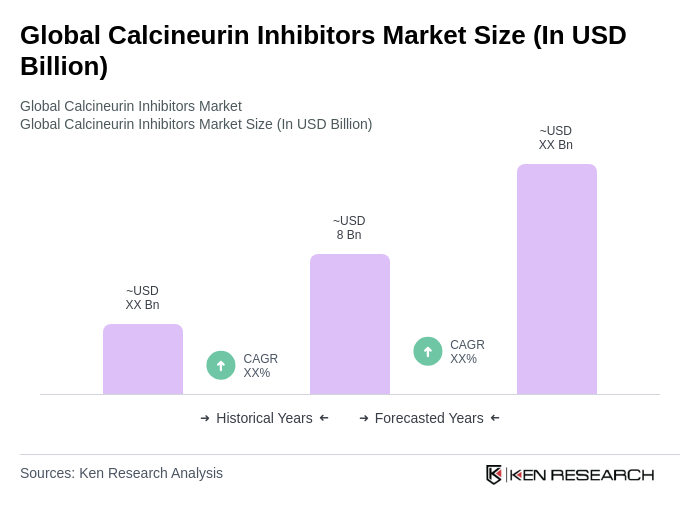
The Global Calcineurin Inhibitors market, valued at USD 8 billion, is driven by increasing transplants and autoimmune conditions, with key segments in tacrolimus and organ transplantation.

Region:Global

Author(s):Shubham

Product Code:KRAC0750

Pages:83

Published On:August 2025
About the Report

Base Year 2024

Global Calcineurin Inhibitors Market Overview

  • The Global Calcineurin Inhibitors Market is valued at USD 8 billion, based on a five?year historical analysis. Growth is primarily driven by increasing solid?organ transplants and the continued burden of autoimmune and inflammatory diseases where calcineurin inhibitors remain standard of care, especially tacrolimus and cyclosporine in transplant and topical pimecrolimus/tacrolimus in dermatology .
  • Key players and commercial activity are concentrated in North America and Europe, with the United States and Germany among leading markets due to advanced transplant programs, robust specialty pharmacy channels, and strong R&D and regulatory systems that support lifecycle management and generics/biosimilars uptake .
Global Calcineurin Inhibitors Market Size

Global Calcineurin Inhibitors Market Segmentation

By Type:The calcineurin inhibitors market is segmented into Tacrolimus, Cyclosporine, Pimecrolimus, Voclosporin, and Others. Tacrolimus and Cyclosporine are the most widely used owing to established efficacy and guideline inclusion in organ transplantation; tacrolimus is widely reported as the leading drug class share by revenue, supported by its role as first?line in many transplant regimens. Pimecrolimus and topical tacrolimus are key in atopic dermatitis, while voclosporin addresses lupus nephritis as a differentiated option .
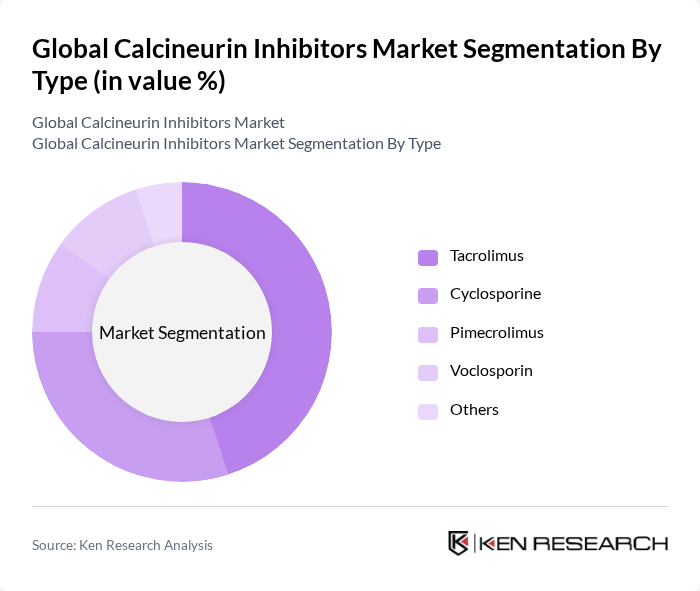
Global Calcineurin Inhibitors Market segmentation by Type.

By Application:The applications of calcineurin inhibitors include organ transplantation (kidney, liver, heart, lung), postoperative immunosuppression, atopic dermatitis, psoriasis, ulcerative colitis/Crohn’s disease, ophthalmic indications (vernal/atopic keratoconjunctivitis, dry eye), and other autoimmune diseases. The organ transplantation segment holds a significant share owing to the sustained volume of transplant surgeries globally and long?term maintenance immunosuppression needs where CNIs are foundational .
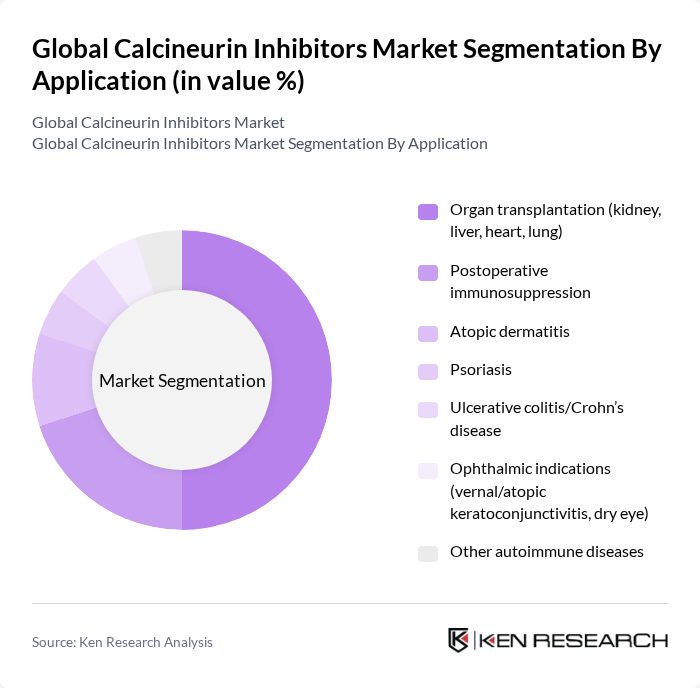
Global Calcineurin Inhibitors Market segmentation by Application.

Global Calcineurin Inhibitors Market Competitive Landscape

The Global Calcineurin Inhibitors Market is characterized by a dynamic mix of regional and international players. Leading participants such as Novartis AG, Astellas Pharma Inc., Bristol Myers Squibb Company, Sanofi S.A., Pfizer Inc., Aurinia Pharmaceuticals Inc., F. Hoffmann-La Roche Ltd, Sandoz Group AG, Teva Pharmaceutical Industries Ltd., Dr. Reddy’s Laboratories Ltd., Mylan N.V. (Viatris Inc.), Sun Pharmaceutical Industries Ltd., Lupin Limited, Chiesi Farmaceutici S.p.A., Otsuka Pharmaceutical Co., Ltd. contribute to innovation, geographic expansion, and service delivery in this space .

Novartis AG

1996

Basel, Switzerland

Astellas Pharma Inc.

2005

Tokyo, Japan

Bristol Myers Squibb Company

1887

New York, USA

Sanofi S.A.

2004

Paris, France

Pfizer Inc.

1849

New York, USA

Company

Establishment Year

Headquarters

Portfolio focus (transplant, dermatology, ophthalmology, nephrology)

Calcineurin inhibitor revenue (latest FY) and CAGR

Geographic revenue mix (% North America/Europe/APAC)

Market penetration (countries with approvals/registrations)

Share of branded vs. generic/biosimilar CNIs

Pipeline strength (CNI lifecycle mgmt., new indications, formulations)

  • Enhancements and validation notes (context for decision?makers):

Global Calcineurin Inhibitors Market Industry Analysis

Growth Drivers

  • Increasing Prevalence of Autoimmune Diseases:The global incidence of autoimmune diseases is rising, with estimates suggesting that around 60 million people in the U.S. alone are affected. This growing patient population drives demand for calcineurin inhibitors, which are essential in managing conditions like rheumatoid arthritis and lupus. The World Health Organization reported that autoimmune diseases are among the top ten leading causes of death in women, highlighting the urgent need for effective treatments and therapies.
  • Rising Demand for Organ Transplantation:In future, approximately 50,000 organ transplants are expected to occur in the U.S., reflecting a significant increase in demand for immunosuppressive therapies, including calcineurin inhibitors. The United Network for Organ Sharing reported a 12% rise in transplant procedures over the past year. This trend is driven by advancements in surgical techniques and increased organ donation rates, necessitating effective immunosuppressive treatments to prevent organ rejection.
  • Advancements in Drug Formulations:The development of novel formulations of calcineurin inhibitors, such as extended-release and combination therapies, is enhancing treatment efficacy. For instance, the introduction of new delivery systems has improved patient compliance, with studies indicating a 35% increase in adherence rates. The pharmaceutical industry is investing heavily in R&D, with global spending projected to reach $250 billion in future, fostering innovation in drug formulations that cater to diverse patient needs.

Market Challenges

  • High Cost of Treatment:The financial burden of calcineurin inhibitors remains a significant challenge, with annual treatment costs exceeding $40,000 per patient in some cases. This high cost can limit access for many patients, particularly in low-income regions. According to the National Institutes of Health, approximately 30% of patients report financial distress due to medication costs, which can lead to non-adherence and poorer health outcomes.
  • Risk of Adverse Effects:Calcineurin inhibitors are associated with various adverse effects, including nephrotoxicity and increased risk of infections. The FDA reported that nearly 20% of patients experience serious side effects, which can deter both patients and healthcare providers from utilizing these therapies. This risk necessitates careful monitoring and management, complicating treatment protocols and potentially limiting the market's growth.

Global Calcineurin Inhibitors Market Future Outlook

The future of the calcineurin inhibitors market is poised for significant transformation, driven by the increasing integration of personalized medicine and digital health technologies. As healthcare systems evolve, there is a growing emphasis on tailoring treatments to individual patient profiles, enhancing efficacy and safety. Additionally, the rise of telemedicine and digital health platforms is expected to facilitate better patient monitoring and adherence, ultimately improving treatment outcomes and expanding market reach in underserved areas.

Market Opportunities

  • Expansion in Emerging Markets:Emerging markets present substantial growth opportunities for calcineurin inhibitors, with healthcare expenditure in these regions projected to increase by 12% annually. Countries like India and Brazil are investing in healthcare infrastructure, which will enhance access to immunosuppressive therapies, potentially increasing patient populations and market penetration.
  • Development of Novel Formulations:The ongoing research into novel formulations of calcineurin inhibitors, including biosimilars, is expected to create new market segments. With the global biosimilars market projected to reach $70 billion by future, the introduction of cost-effective alternatives can significantly enhance patient access and drive market growth, particularly in price-sensitive regions.

Scope of the Report

SegmentSub-Segments
By Type

Tacrolimus

Cyclosporine

Pimecrolimus

Voclosporin

Others

By Application

Organ transplantation (kidney, liver, heart, lung)

Postoperative immunosuppression

Atopic dermatitis

Psoriasis

Ulcerative colitis/Crohn’s disease

Ophthalmic indications (vernal/atopic keratoconjunctivitis, dry eye)

Other autoimmune diseases

By Route of Administration

Oral

Parenteral (injectable/IV)

Topical (dermatology)

Ophthalmic (eye drops/ophthalmic emulsions)

By End-User

Hospitals & transplant centers

Specialty clinics (dermatology, gastroenterology, ophthalmology)

Home healthcare

Academic and research institutes

By Distribution Channel

Hospital pharmacies

Retail pharmacies

Online pharmacies

Direct/wholesale distribution

By Region

North America

Europe

Asia-Pacific

Latin America

Middle East & Africa

By Price Range

Branded

Generic

Biosimilar

Key Target Audience

Investors and Venture Capitalist Firms

Government and Regulatory Bodies (e.g., U.S. Food and Drug Administration, European Medicines Agency)

Pharmaceutical Manufacturers

Biotechnology Companies

Healthcare Providers and Hospitals

Pharmacy Benefit Managers

Insurance Companies

Clinical Research Organizations

Players Mentioned in the Report:

Novartis AG

Astellas Pharma Inc.

Bristol Myers Squibb Company

Sanofi S.A.

Pfizer Inc.

Aurinia Pharmaceuticals Inc.

F. Hoffmann-La Roche Ltd

Sandoz Group AG

Teva Pharmaceutical Industries Ltd.

Dr. Reddys Laboratories Ltd.

Mylan N.V. (Viatris Inc.)

Sun Pharmaceutical Industries Ltd.

Lupin Limited

Chiesi Farmaceutici S.p.A.

Otsuka Pharmaceutical Co., Ltd.

Table of Contents

Market Assessment Phase

1. Executive Summary and Approach


2. Global Calcineurin Inhibitors Market Overview

2.1 Key Insights and Strategic Recommendations

2.2 Global Calcineurin Inhibitors Market Overview

2.3 Definition and Scope

2.4 Evolution of Market Ecosystem

2.5 Timeline of Key Regulatory Milestones

2.6 Value Chain & Stakeholder Mapping

2.7 Business Cycle Analysis

2.8 Policy & Incentive Landscape


3. Global Calcineurin Inhibitors Market Analysis

3.1 Growth Drivers

3.1.1 Increasing prevalence of autoimmune diseases
3.1.2 Rising demand for organ transplantation
3.1.3 Advancements in drug formulations
3.1.4 Growing awareness of immunosuppressive therapies

3.2 Market Challenges

3.2.1 High cost of treatment
3.2.2 Risk of adverse effects
3.2.3 Stringent regulatory requirements
3.2.4 Competition from alternative therapies

3.3 Market Opportunities

3.3.1 Expansion in emerging markets
3.3.2 Development of novel formulations
3.3.3 Strategic partnerships and collaborations
3.3.4 Increased investment in R&D

3.4 Market Trends

3.4.1 Shift towards personalized medicine
3.4.2 Growing focus on combination therapies
3.4.3 Rise in biosimilars
3.4.4 Digital health integration in treatment plans

3.5 Government Regulation

3.5.1 Approval processes for new drugs
3.5.2 Guidelines for immunosuppressive therapy
3.5.3 Monitoring and reporting of adverse effects
3.5.4 Pricing regulations for pharmaceuticals

4. SWOT Analysis


5. Stakeholder Analysis


6. Porter's Five Forces Analysis


7. Global Calcineurin Inhibitors Market Market Size, 2019-2024

7.1 By Value

7.2 By Volume

7.3 By Average Selling Price


8. Global Calcineurin Inhibitors Market Segmentation

8.1 By Type

8.1.1 Tacrolimus
8.1.2 Cyclosporine
8.1.3 Pimecrolimus
8.1.4 Voclosporin
8.1.5 Others

8.2 By Application

8.2.1 Organ transplantation (kidney, liver, heart, lung)
8.2.2 Postoperative immunosuppression
8.2.3 Atopic dermatitis
8.2.4 Psoriasis
8.2.5 Ulcerative colitis/Crohn’s disease
8.2.6 Ophthalmic indications (vernal/atopic keratoconjunctivitis, dry eye)
8.2.7 Other autoimmune diseases

8.3 By Route of Administration

8.3.1 Oral
8.3.2 Parenteral (injectable/IV)
8.3.3 Topical (dermatology)
8.3.4 Ophthalmic (eye drops/ophthalmic emulsions)

8.4 By End-User

8.4.1 Hospitals & transplant centers
8.4.2 Specialty clinics (dermatology, gastroenterology, ophthalmology)
8.4.3 Home healthcare
8.4.4 Academic and research institutes

8.5 By Distribution Channel

8.5.1 Hospital pharmacies
8.5.2 Retail pharmacies
8.5.3 Online pharmacies
8.5.4 Direct/wholesale distribution

8.6 By Region

8.6.1 North America
8.6.2 Europe
8.6.3 Asia-Pacific
8.6.4 Latin America
8.6.5 Middle East & Africa

8.7 By Price Range

8.7.1 Branded
8.7.2 Generic
8.7.3 Biosimilar

9. Global Calcineurin Inhibitors Market Competitive Analysis

9.1 Market Share of Key Players

9.2 Cross Comparison of Key Players

9.2.1 Company Name
9.2.2 Portfolio focus (transplant, dermatology, ophthalmology, nephrology)
9.2.3 Calcineurin inhibitor revenue (latest FY) and CAGR
9.2.4 Geographic revenue mix (% North America/Europe/APAC)
9.2.5 Market penetration (countries with approvals/registrations)
9.2.6 Share of branded vs. generic/biosimilar CNIs
9.2.7 Pipeline strength (CNI lifecycle mgmt., new indications, formulations)
9.2.8 R&D intensity (% of revenue; CNI-related trials count)
9.2.9 Pricing and access (tender wins, formulary listings, ASP trends)
9.2.10 Manufacturing footprint (API to finished dose; GMP sites)
9.2.11 Strategic partnerships/licensing (co-promote, distribution, in-licensing)
9.2.12 Pharmacovigilance/safety profile (boxed warnings, REMS, signal history)

9.3 SWOT Analysis of Top Players

9.4 Pricing Analysis

9.5 Detailed Profile of Major Companies

9.5.1 Novartis AG
9.5.2 Astellas Pharma Inc.
9.5.3 Bristol Myers Squibb Company
9.5.4 Sanofi S.A.
9.5.5 Pfizer Inc.
9.5.6 Aurinia Pharmaceuticals Inc.
9.5.7 F. Hoffmann-La Roche Ltd
9.5.8 Sandoz Group AG
9.5.9 Teva Pharmaceutical Industries Ltd.
9.5.10 Dr. Reddy’s Laboratories Ltd.
9.5.11 Mylan N.V. (Viatris Inc.)
9.5.12 Sun Pharmaceutical Industries Ltd.
9.5.13 Lupin Limited
9.5.14 Chiesi Farmaceutici S.p.A.
9.5.15 Otsuka Pharmaceutical Co., Ltd.

10. Global Calcineurin Inhibitors Market End-User Analysis

10.1 Procurement Behavior of Key Ministries

10.1.1 Budget allocation for healthcare
10.1.2 Decision-making processes
10.1.3 Evaluation criteria for procurement

10.2 Corporate Spend on Infrastructure & Energy

10.2.1 Investment in healthcare infrastructure
10.2.2 Funding for research and development
10.2.3 Expenditure on training and education

10.3 Pain Point Analysis by End-User Category

10.3.1 Access to medications
10.3.2 Affordability of treatments
10.3.3 Availability of specialized care

10.4 User Readiness for Adoption

10.4.1 Awareness of calcineurin inhibitors
10.4.2 Willingness to adopt new therapies
10.4.3 Training needs for healthcare providers

10.5 Post-Deployment ROI and Use Case Expansion

10.5.1 Measurement of treatment outcomes
10.5.2 Long-term cost savings analysis
10.5.3 Expansion into new therapeutic areas

11. Global Calcineurin Inhibitors Market Future Size, 2025-2030

11.1 By Value

11.2 By Volume

11.3 By Average Selling Price


Go-To-Market Strategy Phase

1. Whitespace Analysis + Business Model Canvas

1.1 Market gaps identification

1.2 Value proposition development

1.3 Revenue model exploration

1.4 Customer segmentation analysis

1.5 Competitive landscape overview


2. Marketing and Positioning Recommendations

2.1 Branding strategies

2.2 Product USPs

2.3 Target audience identification

2.4 Communication strategies


3. Distribution Plan

3.1 Urban retail strategies

3.2 Rural NGO tie-ups

3.3 Online distribution channels


4. Channel & Pricing Gaps

4.1 Underserved routes

4.2 Pricing bands analysis

4.3 Competitor pricing strategies


5. Unmet Demand & Latent Needs

5.1 Category gaps identification

5.2 Consumer segments analysis

5.3 Future demand forecasting


6. Customer Relationship

6.1 Loyalty programs

6.2 After-sales service

6.3 Customer feedback mechanisms


7. Value Proposition

7.1 Sustainability initiatives

7.2 Integrated supply chains

7.3 Unique selling points


8. Key Activities

8.1 Regulatory compliance

8.2 Branding efforts

8.3 Distribution setup


9. Entry Strategy Evaluation

9.1 Domestic Market Entry Strategy

9.1.1 Product mix considerations
9.1.2 Pricing band strategies
9.1.3 Packaging innovations

9.2 Export Entry Strategy

9.2.1 Target countries selection
9.2.2 Compliance roadmap development

10. Entry Mode Assessment

10.1 Joint Ventures

10.2 Greenfield investments

10.3 Mergers & Acquisitions

10.4 Distributor Model


11. Capital and Timeline Estimation

11.1 Capital requirements analysis

11.2 Timelines for market entry


12. Control vs Risk Trade-Off

12.1 Ownership considerations

12.2 Partnerships evaluation


13. Profitability Outlook

13.1 Breakeven analysis

13.2 Long-term sustainability strategies


14. Potential Partner List

14.1 Distributors identification

14.2 Joint Ventures opportunities

14.3 Acquisition targets


15. Execution Roadmap

15.1 Phased Plan for Market Entry

15.1.1 Market Setup
15.1.2 Market Entry
15.1.3 Growth Acceleration
15.1.4 Scale & Stabilize

15.2 Key Activities and Milestones

15.2.1 Activity timelines
15.2.2 Milestone tracking

Research Methodology

ApproachModellingSample

Phase 1: Approach1

Desk Research

  • Analysis of market reports from pharmaceutical and biotechnology associations
  • Review of academic journals and publications on calcineurin inhibitors
  • Examination of regulatory documents from health authorities and drug approval agencies

Primary Research

  • Interviews with clinical researchers specializing in immunosuppressive therapies
  • Surveys with healthcare professionals prescribing calcineurin inhibitors
  • Focus groups with patients using calcineurin inhibitors for various conditions

Validation & Triangulation

  • Cross-validation of data from multiple healthcare databases and registries
  • Triangulation of findings from primary and secondary research sources
  • Sanity checks through expert panels comprising industry veterans and researchers

Phase 2: Market Size Estimation1

Top-down Assessment

  • Estimation of total market size based on global pharmaceutical sales data
  • Segmentation by therapeutic area, including organ transplantation and dermatology
  • Incorporation of trends in healthcare expenditure and patient demographics

Bottom-up Modeling

  • Volume estimates derived from prescription data and treatment guidelines
  • Cost analysis based on pricing strategies of leading manufacturers
  • Calculation of market share based on sales volume and revenue figures

Forecasting & Scenario Analysis

  • Multi-variable forecasting using historical growth rates and market drivers
  • Scenario analysis based on potential regulatory changes and market entry of generics
  • Development of baseline, optimistic, and pessimistic market projections through 2030

Phase 3: CATI Sample Composition1

Scope Item/SegmentSample SizeTarget Respondent Profiles
Organ Transplantation Specialists120Transplant Surgeons, Nephrologists
Dermatology Clinics90Dermatologists, Nurse Practitioners
Pharmaceutical Distributors75Distribution Managers, Sales Representatives
Patient Advocacy Groups60Patient Coordinators, Community Outreach Managers
Healthcare Policy Makers50Health Economists, Policy Analysts

Frequently Asked Questions

What are calcineurin inhibitors and their primary uses?

Calcineurin inhibitors are immunosuppressive drugs primarily used to prevent organ rejection in transplant patients and to treat autoimmune diseases. Key examples include tacrolimus and cyclosporine, which are essential in managing conditions like rheumatoid arthritis and lupus.

What is the current market size of the global calcineurin inhibitors market?

Which regions dominate the calcineurin inhibitors market?

What are the main types of calcineurin inhibitors available?

Other Regional/Country Reports

UAE Calcineurin Inhibitors MarketKSA Calcineurin Inhibitors Market

Indonesia Calcineurin Inhibitors Market

Malaysia Calcineurin Inhibitors Market

APAC Calcineurin Inhibitors Market

SEA Calcineurin Inhibitors Market

Why Buy From Us?

Refine Robust Result (RRR) Framework

What makes us stand out is that our consultants follow Robust, Refine and Result (RRR) methodology. Robust for clear definitions, approaches and sanity checking, Refine for differentiating respondents' facts and opinions, and Result for presenting data with story.

Our Reach Is Unmatched

We have set a benchmark in the industry by offering our clients with syndicated and customized market research reports featuring coverage of entire market as well as meticulous research and analyst insights.

Shifting the Research Paradigm

While we don't replace traditional research, we flip the method upside down. Our dual approach of Top Bottom & Bottom Top ensures quality deliverable by not just verifying company fundamentals but also looking at the sector and macroeconomic factors.

More Insights-Better Decisions

With one step in the future, our research team constantly tries to show you the bigger picture. We help with some of the tough questions you may encounter along the way: How is the industry positioned? Best marketing channel? KPI's of competitors? By aligning every element, we help maximize success.

Transparency and Trust

Our report gives you instant access to the answers and sources that other companies might choose to hide. We elaborate each steps of research methodology we have used and showcase you the sample size to earn your trust.

Round the Clock Support

If you need any support, we are here! We pride ourselves on universe strength, data quality, and quick, friendly, and professional service.

Why Clients Choose Us?

400000+
Reports in repository
150+
Consulting projects a year
100+
Analysts
8000+
Client Queries in 2022








