About the Report
Base Year 2024Global Camera Straps Market Overview
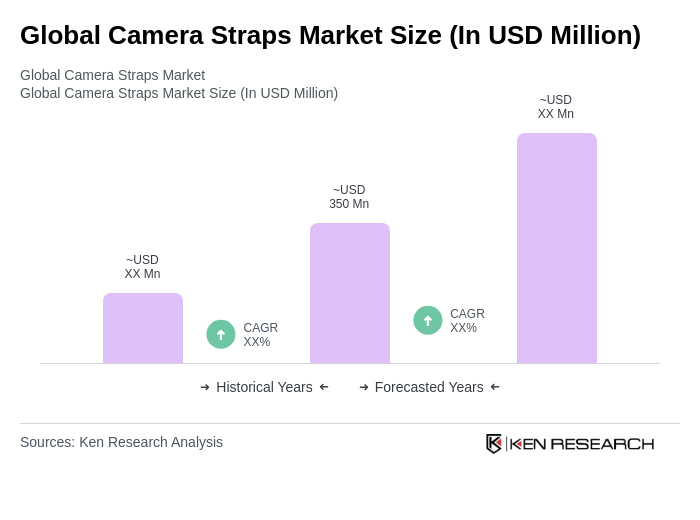
- The Global Camera Straps Market is valued at USD 350 million, based on a five-year historical analysis. Growth is primarily driven by the increasing popularity of photography and videography among both professionals and amateurs, as well as rising demand for high-quality camera accessories. The surge in social media content creation and influencer marketing has further contributed to market expansion, with users seeking reliable, ergonomic, and stylish camera straps to enhance their shooting experience.
- Key markets for camera straps include the United States, Japan, Germany, and the United Kingdom. The dominance of these countries is attributed to their strong photography culture, high disposable income, and the presence of major camera manufacturers and retailers. Additionally, the growing trend of content creation on platforms such as Instagram, YouTube, and TikTok has further fueled demand in these regions, with North America alone accounting for over 30% of global market revenue.
- In 2023, the European Union implemented Regulation (EU) 2019/1020 on market surveillance and compliance of products, issued by the European Parliament and the Council. This regulation mandates that all camera straps and related accessories sold within the EU must undergo rigorous testing to ensure compliance with safety, durability, and material standards, including REACH and CE marking requirements. These measures enhance consumer confidence and promote higher quality products in the market by requiring manufacturers and importers to maintain conformity documentation and facilitate product recalls if necessary.
Global Camera Straps Market Segmentation
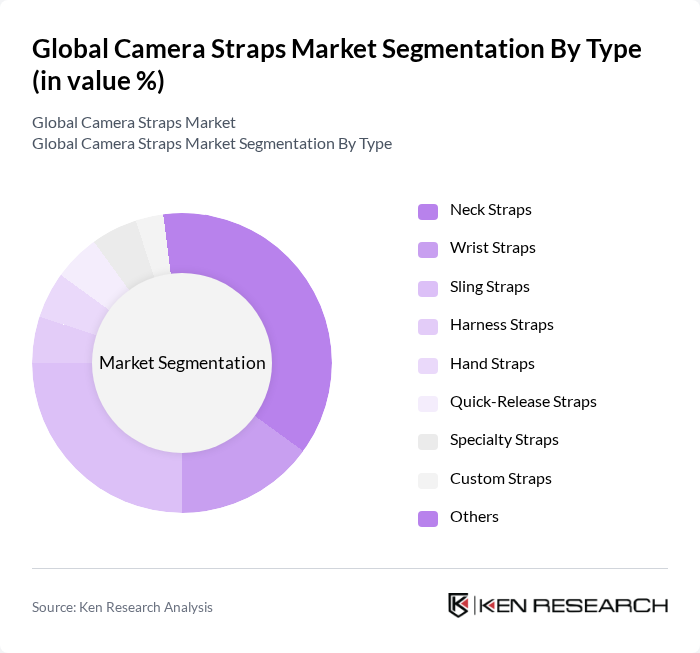
By Type:The camera straps market is segmented into Neck Straps, Wrist Straps, Sling Straps, Harness Straps, Hand Straps, Quick-Release Straps, Specialty Straps, Custom Straps, and Others. Neck Straps remain the most popular due to their versatility, comfort, and widespread compatibility with various camera models, making them a preferred choice for both professional and amateur photographers. Demand for Sling Straps is rising, driven by their ergonomic design, ease of access, and quick adjustments, which appeal to active users and travel photographers seeking mobility and convenience. Specialty and custom straps are also gaining traction among content creators and enthusiasts who prioritize personalization and style.
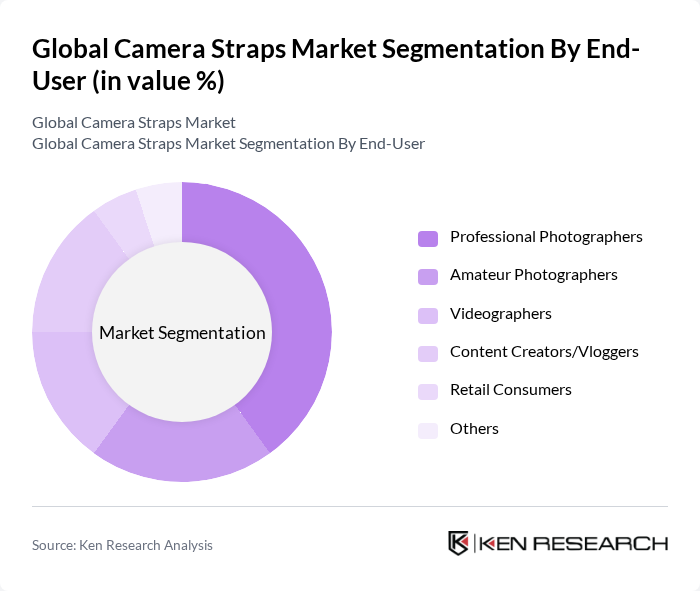
By End-User:The end-user segmentation includes Professional Photographers, Amateur Photographers, Videographers, Content Creators/Vloggers, Retail Consumers, and Others. Professional Photographers dominate the market due to their need for high-quality, durable straps that can withstand extensive use and provide ergonomic support during long shoots. The rise of content creators and vloggers has significantly impacted demand, as these users seek stylish, functional, and customizable straps to enhance their workflow and on-camera presence. Retail consumers and hobbyists also contribute to market growth, driven by increased interest in travel, wildlife, and event photography.
Global Camera Straps Market Competitive Landscape
The Global Camera Straps Market is characterized by a dynamic mix of regional and international players. Leading participants such as Canon Inc., Nikon Corporation, Sony Corporation, Manfrotto, Peak Design, BlackRapid, OP/TECH USA, Lowepro, Tamrac, Joby, Think Tank Photo, Targus, Slinger, Evecase, Vello, Custom SLR, Art Tribute, Tarion, Altura Photo, WANDRD contribute to innovation, geographic expansion, and service delivery in this space.
Global Camera Straps Market Industry Analysis
Growth Drivers
- Increasing Demand for Photography and Videography:The global photography market is projected to reach $110 billion in future, driven by a surge in both amateur and professional photographers. This growth is fueled by the rise of high-quality smartphone cameras and affordable DSLR options, leading to increased camera strap sales. Additionally, the videography sector is expected to grow at a rate of 8% annually, further boosting demand for camera accessories, including straps, which enhance user experience and safety.
- Rise in Outdoor Activities and Travel:In future, global tourism is expected to generate $1.7 trillion, with outdoor activities becoming increasingly popular. This trend is leading to a higher demand for camera straps as travelers seek to capture their experiences. The Adventure Travel Market is projected to grow by 20% over the next five years, indicating a strong correlation between travel and the need for reliable camera accessories, including durable and comfortable straps.
- Growth of Social Media and Content Creation:The number of social media users is projected to reach 5 billion in future, driving demand for high-quality content creation. As influencers and content creators prioritize professional-looking visuals, the need for reliable camera straps increases. The rise of platforms like Instagram and TikTok has led to a 15% increase in camera accessory sales, including straps, as users invest in tools that enhance their content quality and presentation.
Market Challenges
- Intense Competition Among Manufacturers:The camera strap market is characterized by numerous players, leading to fierce competition. In future, over 150 brands are expected to compete globally, resulting in price wars and reduced profit margins. This saturation makes it challenging for new entrants to establish a foothold, as established brands dominate market share with their extensive distribution networks and brand loyalty, complicating market dynamics for emerging companies.
- Price Sensitivity Among Consumers:With the average consumer spending on camera accessories projected to be around $150 in future, price sensitivity remains a significant challenge. Many consumers prioritize budget-friendly options, leading to a preference for lower-cost straps. This trend pressures manufacturers to balance quality and affordability, often resulting in compromises that can affect product durability and performance, ultimately impacting brand reputation and customer satisfaction.
Global Camera Straps Market Future Outlook
The future of the camera straps market appears promising, driven by technological advancements and evolving consumer preferences. As smart technology integration becomes more prevalent, manufacturers are likely to innovate with features that enhance usability and safety. Additionally, the growth of e-commerce platforms will facilitate wider distribution, making camera straps more accessible. Companies that adapt to these trends and focus on sustainability will likely capture a larger market share, positioning themselves favorably in a competitive landscape.
Market Opportunities
- Expansion into Emerging Markets:Emerging markets, particularly in Asia and Africa, are witnessing a rise in disposable income, leading to increased spending on photography equipment. In future, these regions are expected to contribute significantly to global camera strap sales, presenting manufacturers with opportunities to tailor products to local preferences and enhance brand visibility through targeted marketing strategies.
- Development of Eco-Friendly Camera Straps:With growing consumer awareness regarding sustainability, the demand for eco-friendly products is on the rise. In future, the market for sustainable camera accessories is projected to grow by 25%. Manufacturers can capitalize on this trend by developing camera straps made from recycled materials, appealing to environmentally conscious consumers and differentiating their products in a crowded market.
Scope of the Report
| Segment | Sub-Segments |
|---|---|
| By Type | Neck Straps Wrist Straps Sling Straps Harness Straps Hand Straps Quick-Release Straps Specialty Straps Custom Straps Others |
| By End-User | Professional Photographers Amateur Photographers Videographers Content Creators/Vloggers Retail Consumers Others |
| By Sales Channel | Online Retail/E-commerce Specialty Camera Stores Department Stores Direct Sales (Brand Websites) Others |
| By Material | Nylon Leather Cotton Polyester Neoprene Others |
| By Design | Adjustable Straps Fixed Length Straps Padded Straps Fashion/Designer Straps Ergonomic Straps Others |
| By Brand | Premium Brands Mid-Range Brands Budget Brands Others |
| By Price Range | Below $20 $20 - $50 $50 - $100 Above $100 Others |
Key Target Audience
Investors and Venture Capitalist Firms
Government and Regulatory Bodies (e.g., Federal Trade Commission, Consumer Product Safety Commission)
Manufacturers and Producers
Distributors and Retailers
Photography Equipment Rental Services
Online Marketplaces and E-commerce Platforms
Industry Associations (e.g., Professional Photographers of America)
Financial Institutions
Players Mentioned in the Report:
Canon Inc.
Nikon Corporation
Sony Corporation
Manfrotto
Peak Design
BlackRapid
OP/TECH USA
Lowepro
Tamrac
Joby
Think Tank Photo
Targus
Slinger
Evecase
Vello
Custom SLR
Art Tribute
Tarion
Altura Photo
WANDRD
Table of Contents
Market Assessment Phase
1. Executive Summary and Approach
2. Global Camera Straps Market Overview
2.1 Key Insights and Strategic Recommendations
2.2 Global Camera Straps Market Overview
2.3 Definition and Scope
2.4 Evolution of Market Ecosystem
2.5 Timeline of Key Regulatory Milestones
2.6 Value Chain & Stakeholder Mapping
2.7 Business Cycle Analysis
2.8 Policy & Incentive Landscape
3. Global Camera Straps Market Analysis
3.1 Growth Drivers
3.1.1 Increasing demand for photography and videography
3.1.2 Rise in outdoor activities and travel
3.1.3 Growth of social media and content creation
3.1.4 Technological advancements in camera equipment
3.2 Market Challenges
3.2.1 Intense competition among manufacturers
3.2.2 Price sensitivity among consumers
3.2.3 Rapid changes in consumer preferences
3.2.4 Supply chain disruptions
3.3 Market Opportunities
3.3.1 Expansion into emerging markets
3.3.2 Development of eco-friendly camera straps
3.3.3 Collaborations with camera manufacturers
3.3.4 Customization and personalization trends
3.4 Market Trends
3.4.1 Increasing use of smart technology in camera accessories
3.4.2 Growth of online retail channels
3.4.3 Rising popularity of multifunctional camera straps
3.4.4 Focus on ergonomic designs and comfort
3.5 Government Regulation
3.5.1 Compliance with safety standards
3.5.2 Environmental regulations on materials used
3.5.3 Import/export regulations affecting trade
3.5.4 Tax incentives for sustainable products
4. SWOT Analysis
5. Stakeholder Analysis
6. Porter's Five Forces Analysis
7. Global Camera Straps Market Market Size, 2019-2024
7.1 By Value
7.2 By Volume
7.3 By Average Selling Price
8. Global Camera Straps Market Segmentation
8.1 By Type
8.1.1 Neck Straps
8.1.2 Wrist Straps
8.1.3 Sling Straps
8.1.4 Harness Straps
8.1.5 Hand Straps
8.1.6 Quick-Release Straps
8.1.7 Specialty Straps
8.1.8 Custom Straps
8.1.9 Others
8.2 By End-User
8.2.1 Professional Photographers
8.2.2 Amateur Photographers
8.2.3 Videographers
8.2.4 Content Creators/Vloggers
8.2.5 Retail Consumers
8.2.6 Others
8.3 By Sales Channel
8.3.1 Online Retail/E-commerce
8.3.2 Specialty Camera Stores
8.3.3 Department Stores
8.3.4 Direct Sales (Brand Websites)
8.3.5 Others
8.4 By Material
8.4.1 Nylon
8.4.2 Leather
8.4.3 Cotton
8.4.4 Polyester
8.4.5 Neoprene
8.4.6 Others
8.5 By Design
8.5.1 Adjustable Straps
8.5.2 Fixed Length Straps
8.5.3 Padded Straps
8.5.4 Fashion/Designer Straps
8.5.5 Ergonomic Straps
8.5.6 Others
8.6 By Brand
8.6.1 Premium Brands
8.6.2 Mid-Range Brands
8.6.3 Budget Brands
8.6.4 Others
8.7 By Price Range
8.7.1 Below $20
8.7.2 $20 - $50
8.7.3 $50 - $100
8.7.4 Above $100
8.7.5 Others
9. Global Camera Straps Market Competitive Analysis
9.1 Market Share of Key Players
9.2 Cross Comparison of Key Players
9.2.1 Company Name
9.2.2 Company Size (Large, Medium, Small)
9.2.3 Annual Revenue from Camera Straps
9.2.4 Global Market Share (%)
9.2.5 Geographic Presence (Regions/Countries)
9.2.6 Product Portfolio Breadth (Number of Strap Types/Materials)
9.2.7 Innovation Index (Patents, New Product Launches)
9.2.8 Distribution Channel Strength (Online/Offline Penetration)
9.2.9 Average Customer Rating (Major Retail Platforms)
9.2.10 Warranty/After-Sales Support
9.3 SWOT Analysis of Top Players
9.4 Pricing Analysis
9.5 Detailed Profile of Major Companies
9.5.1 Canon Inc.
9.5.2 Nikon Corporation
9.5.3 Sony Corporation
9.5.4 Manfrotto
9.5.5 Peak Design
9.5.6 BlackRapid
9.5.7 OP/TECH USA
9.5.8 Lowepro
9.5.9 Tamrac
9.5.10 Joby
9.5.11 Think Tank Photo
9.5.12 Targus
9.5.13 Slinger
9.5.14 Evecase
9.5.15 Vello
9.5.16 Custom SLR
9.5.17 Art Tribute
9.5.18 Tarion
9.5.19 Altura Photo
9.5.20 WANDRD
10. Global Camera Straps Market End-User Analysis
10.1 Procurement Behavior of Key Ministries
10.1.1 Budget Allocation Trends
10.1.2 Decision-Making Processes
10.1.3 Supplier Selection Criteria
10.1.4 Contract Management Practices
10.2 Corporate Spend on Infrastructure & Energy
10.2.1 Investment Trends in Camera Accessories
10.2.2 Budgeting for Photography Equipment
10.2.3 Spending on Marketing and Branding
10.3 Pain Point Analysis by End-User Category
10.3.1 Quality and Durability Concerns
10.3.2 Price Sensitivity Issues
10.3.3 Availability of Customization Options
10.4 User Readiness for Adoption
10.4.1 Awareness of New Products
10.4.2 Willingness to Pay for Quality
10.4.3 Adoption of Online Purchasing
10.5 Post-Deployment ROI and Use Case Expansion
10.5.1 Measurement of User Satisfaction
10.5.2 Analysis of Repeat Purchases
10.5.3 Expansion into New User Segments
11. Global Camera Straps Market Future Size, 2025-2030
11.1 By Value
11.2 By Volume
11.3 By Average Selling Price
Go-To-Market Strategy Phase
1. Whitespace Analysis + Business Model Canvas
1.1 Market Gaps Identification
1.2 Value Proposition Development
1.3 Revenue Streams Analysis
1.4 Customer Segmentation
1.5 Key Partnerships
1.6 Cost Structure Analysis
1.7 Channels of Distribution
2. Marketing and Positioning Recommendations
2.1 Branding Strategies
2.2 Product USPs
2.3 Target Audience Identification
2.4 Marketing Channels
2.5 Promotional Strategies
3. Distribution Plan
3.1 Urban Retail Strategies
3.2 Rural NGO Tie-Ups
3.3 E-commerce Strategies
3.4 Direct Sales Approaches
4. Channel & Pricing Gaps
4.1 Underserved Routes
4.2 Pricing Bands Analysis
4.3 Competitor Pricing Strategies
5. Unmet Demand & Latent Needs
5.1 Category Gaps
5.2 Consumer Segments Analysis
5.3 Product Development Opportunities
6. Customer Relationship
6.1 Loyalty Programs
6.2 After-sales Service
6.3 Customer Feedback Mechanisms
7. Value Proposition
7.1 Sustainability Initiatives
7.2 Integrated Supply Chains
7.3 Unique Selling Points
8. Key Activities
8.1 Regulatory Compliance
8.2 Branding Efforts
8.3 Distribution Setup
9. Entry Strategy Evaluation
9.1 Domestic Market Entry Strategy
9.1.1 Product Mix Considerations
9.1.2 Pricing Band Strategy
9.1.3 Packaging Innovations
9.2 Export Entry Strategy
9.2.1 Target Countries Identification
9.2.2 Compliance Roadmap Development
10. Entry Mode Assessment
10.1 Joint Ventures
10.2 Greenfield Investments
10.3 Mergers & Acquisitions
10.4 Distributor Model Evaluation
11. Capital and Timeline Estimation
11.1 Capital Requirements
11.2 Timelines for Market Entry
12. Control vs Risk Trade-Off
12.1 Ownership vs Partnerships
13. Profitability Outlook
13.1 Breakeven Analysis
13.2 Long-term Sustainability
14. Potential Partner List
14.1 Distributors
14.2 Joint Ventures
14.3 Acquisition Targets
15. Execution Roadmap
15.1 Phased Plan for Market Entry
15.1.1 Market Setup
15.1.2 Market Entry
15.1.3 Growth Acceleration
15.1.4 Scale & Stabilize
15.2 Key Activities and Milestones
15.2.1 Milestone Planning
15.2.2 Activity Tracking
Research Methodology
Phase 1: Approach1
Desk Research
- Market reports from industry associations such as the Camera and Imaging Products Association (CIPA)
- Analysis of consumer behavior trends through online photography forums and social media platforms
- Review of sales data from major e-commerce platforms and retail outlets specializing in camera accessories
Primary Research
- Interviews with product managers at leading camera strap manufacturers
- Surveys conducted with professional photographers and videographers regarding their preferences
- Focus groups with amateur photographers to understand emerging trends and needs
Validation & Triangulation
- Cross-validation of findings through multiple data sources including sales figures and consumer feedback
- Triangulation of insights from industry experts, market analysts, and consumer surveys
- Sanity checks through expert panel discussions to ensure data reliability
Phase 2: Market Size Estimation1
Top-down Assessment
- Estimation of total market size based on global camera sales and accessory attachment rates
- Segmentation by type of camera strap (e.g., neck straps, wrist straps, and specialty straps)
- Incorporation of trends in photography and videography that influence strap demand
Bottom-up Modeling
- Volume estimates derived from sales data of leading camera strap brands
- Cost analysis based on manufacturing and distribution expenses of camera straps
- Calculation of market size using unit sales multiplied by average selling price (ASP) of camera straps
Forecasting & Scenario Analysis
- Multi-variable forecasting model incorporating factors such as technological advancements and consumer preferences
- Scenario analysis based on potential market disruptions, such as economic downturns or shifts in photography trends
- Development of baseline, optimistic, and pessimistic market growth projections through 2030
Phase 3: CATI Sample Composition1
| Scope Item/Segment | Sample Size | Target Respondent Profiles |
|---|---|---|
| Professional Photographers | 100 | Wedding Photographers, Event Photographers |
| Amateur Photographers | 80 | Hobbyists, Social Media Influencers |
| Retailers of Camera Accessories | 50 | Store Managers, Product Buyers |
| Camera Strap Manufacturers | 40 | Product Development Managers, Marketing Directors |
| Photography Enthusiast Groups | 60 | Community Leaders, Workshop Organizers |
Frequently Asked Questions
What is the current value of the Global Camera Straps Market?
The Global Camera Straps Market is valued at approximately USD 350 million, reflecting a growing demand driven by the increasing popularity of photography and videography among both professionals and amateurs.
Which regions are the key markets for camera straps?
What factors are driving the growth of the camera straps market?
What types of camera straps are available in the market?
Other Regional/Country Reports
Indonesia Camera Straps Market
Malaysia Camera Straps Market
KSA Camera Straps Market
APAC Camera Straps Market
SEA Camera Straps Market
Vietnam Camera Straps Market
Other Adjacent Reports
Japan Camera Bags Market
Egypt Tripods Market
Malaysia Lens Filters Market
Brazil Camera Lenses Market
Mexico Photography Lighting Equipment Market
Singapore Memory Cards Market
KSA Camera Batteries Market
South Africa Drone Accessories Market
Oman Smartphone Photography Accessories Market
Indonesia Gimbal Stabilizers Market
Why Buy From Us?

What makes us stand out is that our consultants follow Robust, Refine and Result (RRR) methodology. Robust for clear definitions, approaches and sanity checking, Refine for differentiating respondents' facts and opinions, and Result for presenting data with story.

We have set a benchmark in the industry by offering our clients with syndicated and customized market research reports featuring coverage of entire market as well as meticulous research and analyst insights.

While we don't replace traditional research, we flip the method upside down. Our dual approach of Top Bottom & Bottom Top ensures quality deliverable by not just verifying company fundamentals but also looking at the sector and macroeconomic factors.

With one step in the future, our research team constantly tries to show you the bigger picture. We help with some of the tough questions you may encounter along the way: How is the industry positioned? Best marketing channel? KPI's of competitors? By aligning every element, we help maximize success.

Our report gives you instant access to the answers and sources that other companies might choose to hide. We elaborate each steps of research methodology we have used and showcase you the sample size to earn your trust.

If you need any support, we are here! We pride ourselves on universe strength, data quality, and quick, friendly, and professional service.