Region:Global
Author(s):Geetanshi
Product Code:KRAB1095
Pages:98
Published On:January 2026
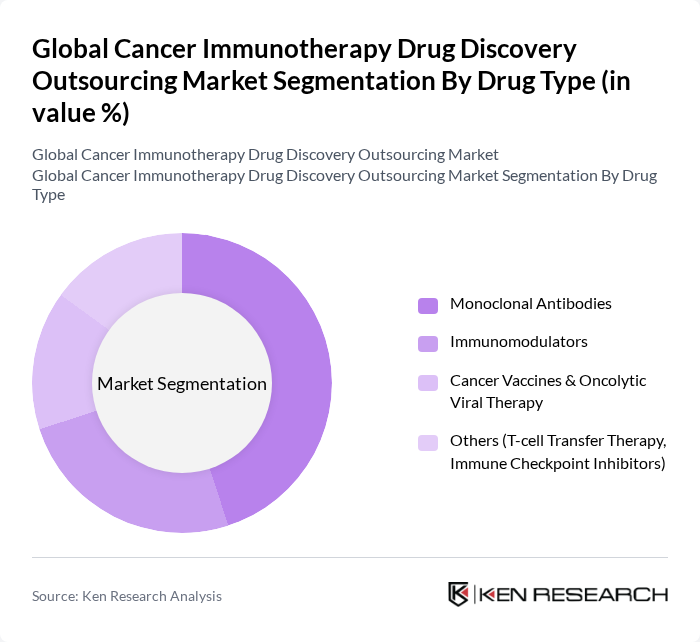
By Drug Type:The drug type segmentation includes various categories such as monoclonal antibodies, immunomodulators, cancer vaccines & oncolytic viral therapy, and others, which encompass T-cell transfer therapy and immune checkpoint inhibitors. Monoclonal antibodies are currently the leading subsegment due to their widespread application in treating various cancers, their established efficacy in clinical settings, and their high specificity in targeting cancer cells or specific markers. The demand for these therapies is driven by their targeted action and the increasing number of approvals for new monoclonal antibody drugs.
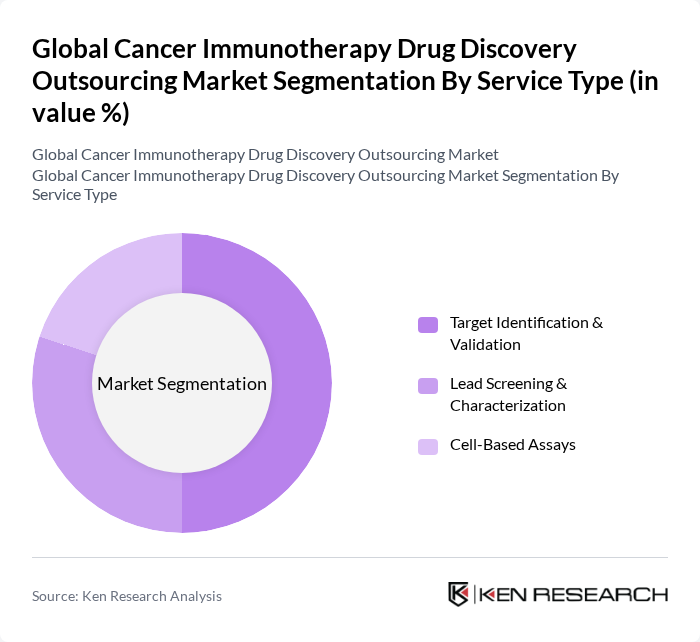
By Service Type:The service type segmentation includes target identification & validation, lead screening & characterization, and cell-based assays. Among these, target identification & validation is the most significant subsegment, as it lays the foundation for successful drug discovery by ensuring that the right targets are selected for therapeutic intervention. The increasing complexity of cancer biology necessitates robust target identification processes, driving demand for specialized services in this area.
The Global Cancer Immunotherapy Drug Discovery Outsourcing Market is characterized by a dynamic mix of regional and international players. Leading participants such as Bristol-Myers Squibb, Merck & Co., Roche, Novartis, Amgen, Gilead Sciences, AstraZeneca, Pfizer, Eli Lilly and Company, Sanofi, Regeneron Pharmaceuticals, AbbVie, Takeda Pharmaceutical Company, Celgene Corporation, and Johnson & Johnson contribute to innovation, geographic expansion, and service delivery in this space.
The future of the cancer immunotherapy drug discovery outsourcing market appears promising, driven by the integration of emerging technologies such as AI and machine learning. These advancements are expected to streamline drug discovery processes, enhancing efficiency and accuracy. Additionally, the global expansion of outsourcing networks, particularly in the Asia-Pacific region, is likely to provide cost-effective solutions for pharmaceutical companies, further fueling market growth. As these trends continue, the outsourcing landscape will evolve, presenting new opportunities for innovation and collaboration.
| Segment | Sub-Segments |
|---|---|
| By Drug Type | Monoclonal Antibodies Immunomodulators Cancer Vaccines & Oncolytic Viral Therapy Others (T-cell Transfer Therapy, Immune Checkpoint Inhibitors) |
| By Service Type | Target Identification & Validation Lead Screening & Characterization Cell-Based Assays |
| By Cancer Type | Lung Cancer Breast Cancer Colorectal Cancer Melanoma Prostate Cancer Pancreatic Cancer Head & Neck Cancer Ovarian Cancer |
| By Region | North America Europe Asia-Pacific Latin America Middle East & Africa |
| Scope Item/Segment | Sample Size | Target Respondent Profiles |
|---|---|---|
| Oncology Drug Development | 120 | Oncologists, Clinical Researchers |
| Immunotherapy Clinical Trials | 95 | Clinical Trial Managers, Regulatory Affairs Specialists |
| Pharmaceutical Outsourcing Decisions | 75 | Pharmaceutical Executives, R&D Directors |
| Biotech Innovations in Cancer Treatment | 65 | Biotech Researchers, Product Development Managers |
| Market Trends in Cancer Immunotherapy | 85 | Market Analysts, Business Development Managers |
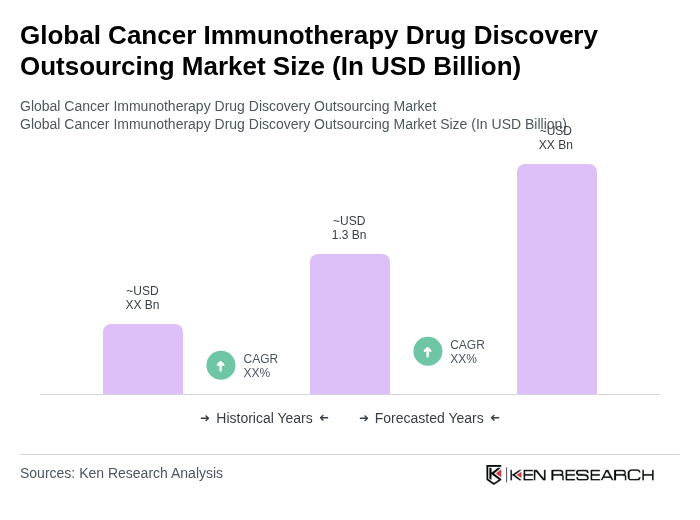
The global cancer immunotherapy drug discovery outsourcing market is valued at approximately USD 1.3 billion, driven by rising R&D costs, increasing cancer prevalence, and the complexity of immunotherapy pipelines, prompting pharmaceutical companies to seek cost-effective outsourcing solutions.

What makes us stand out is that our consultants follow Robust, Refine and Result (RRR) methodology. Robust for clear definitions, approaches and sanity checking, Refine for differentiating respondents' facts and opinions, and Result for presenting data with story.

We have set a benchmark in the industry by offering our clients with syndicated and customized market research reports featuring coverage of entire market as well as meticulous research and analyst insights.

While we don't replace traditional research, we flip the method upside down. Our dual approach of Top Bottom & Bottom Top ensures quality deliverable by not just verifying company fundamentals but also looking at the sector and macroeconomic factors.

With one step in the future, our research team constantly tries to show you the bigger picture. We help with some of the tough questions you may encounter along the way: How is the industry positioned? Best marketing channel? KPI's of competitors? By aligning every element, we help maximize success.

Our report gives you instant access to the answers and sources that other companies might choose to hide. We elaborate each steps of research methodology we have used and showcase you the sample size to earn your trust.

If you need any support, we are here! We pride ourselves on universe strength, data quality, and quick, friendly, and professional service.













