Region:Global
Author(s):Shubham
Product Code:KRAC0760
Pages:86
Published On:August 2025
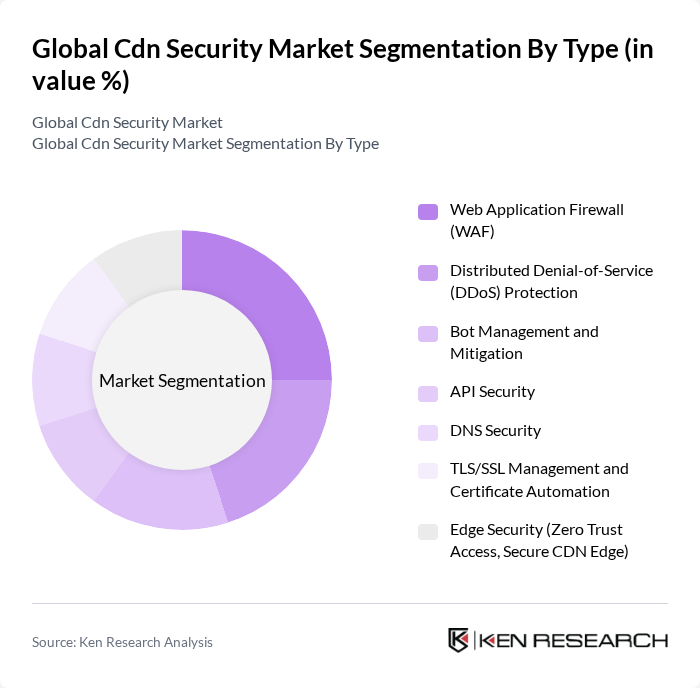
By Type:The market is segmented into various types of CDN security solutions, including Web Application Firewall (WAF), Distributed Denial-of-Service (DDoS) Protection, Bot Management and Mitigation, API Security, DNS Security, TLS/SSL Management and Certificate Automation, and Edge Security (Zero Trust Access, Secure CDN Edge). Each of these sub-segments plays a crucial role in addressing specific security challenges faced by organizations.
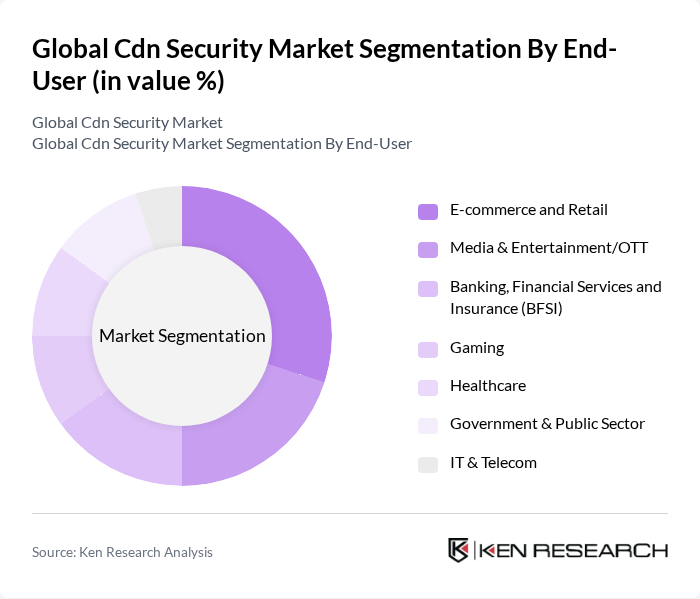
By End-User:The end-user segmentation includes various industries such as E-commerce and Retail, Media & Entertainment/OTT, Banking, Financial Services and Insurance (BFSI), Gaming, Healthcare, Government & Public Sector, and IT & Telecom. Each sector has unique security requirements, driving the demand for tailored CDN security solutions.
The Global CDN Security Market is characterized by a dynamic mix of regional and international players. Leading participants such as Akamai Technologies, Inc., Cloudflare, Inc., Amazon Web Services, Inc. (AWS CloudFront), Google LLC (Cloud CDN and Cloud Armor), Microsoft Corporation (Azure Front Door and Azure WAF), Fastly, Inc., Imperva, Inc., Radware Ltd., F5, Inc. (including NGINX), Verizon Digital Media Services (Edgecast, now Edgio), Edgio, Inc. (formerly Limelight Networks and Edgecast), Fortinet, Inc. (FortiWeb, FortiDDoS at edge), Check Point Software Technologies Ltd., Palo Alto Networks, Inc. (Prisma Access at the edge), Tencent Cloud (Tencent Cloud CDN and security) contribute to innovation, geographic expansion, and service delivery in this space.
The future of CDN security in the None region is poised for significant transformation, driven by technological advancements and evolving threat landscapes. As organizations increasingly adopt managed security services and zero trust models, the demand for innovative solutions will rise. Additionally, the integration of AI-driven security technologies will enhance threat detection and response capabilities, ensuring that businesses remain resilient against cyber threats. This proactive approach will shape the market dynamics, fostering a more secure digital environment.
| Segment | Sub-Segments |
|---|---|
| By Type | Web Application Firewall (WAF) Distributed Denial-of-Service (DDoS) Protection Bot Management and Mitigation API Security DNS Security TLS/SSL Management and Certificate Automation Edge Security (Zero Trust Access, Secure CDN Edge) |
| By End-User | E-commerce and Retail Media & Entertainment/OTT Banking, Financial Services and Insurance (BFSI) Gaming Healthcare Government & Public Sector IT & Telecom |
| By Region | North America Europe Asia-Pacific Latin America Middle East and Africa Rest of World |
| By Deployment Model | Cloud-Delivered CDN Security (SaaS) Managed/Hybrid CDN Security On-Premises/Appliance-Integrated Edge Security |
| By Application | Website and Application Protection API and Microservices Protection Bot and Fraud Prevention (Account Takeover, Scraping) DDoS Resilience and Traffic Scrubbing CDN Security Analytics, Reporting, and Compliance |
| By Customer Segment | Large Enterprises Small and Medium Enterprises (SMEs) Digital-Native Platforms and Startups |
| By Pricing/Commercial Model | Usage-Based (Bandwidth/Request) Tiered Subscription (Feature-Based) Enterprise License and Custom SLAs |
| Scope Item/Segment | Sample Size | Target Respondent Profiles |
|---|---|---|
| Financial Services CDN Security | 110 | IT Security Managers, Compliance Officers |
| E-commerce CDN Security Solutions | 90 | Web Operations Managers, Digital Security Analysts |
| Healthcare Data Protection via CDN | 80 | Healthcare IT Directors, Data Privacy Officers |
| Media & Entertainment CDN Security | 70 | Content Delivery Managers, Cybersecurity Specialists |
| Government CDN Security Initiatives | 60 | Public Sector IT Managers, Cybersecurity Policy Advisors |
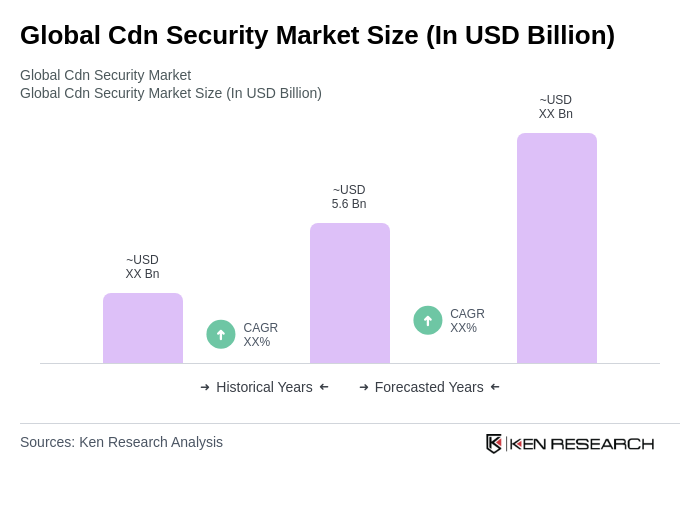
The Global CDN Security Market is valued at approximately USD 5.6 billion, reflecting significant growth driven by increasing cyber threats, the rise in online transactions, and the demand for secure content delivery networks.

What makes us stand out is that our consultants follow Robust, Refine and Result (RRR) methodology. Robust for clear definitions, approaches and sanity checking, Refine for differentiating respondents' facts and opinions, and Result for presenting data with story.

We have set a benchmark in the industry by offering our clients with syndicated and customized market research reports featuring coverage of entire market as well as meticulous research and analyst insights.

While we don't replace traditional research, we flip the method upside down. Our dual approach of Top Bottom & Bottom Top ensures quality deliverable by not just verifying company fundamentals but also looking at the sector and macroeconomic factors.

With one step in the future, our research team constantly tries to show you the bigger picture. We help with some of the tough questions you may encounter along the way: How is the industry positioned? Best marketing channel? KPI's of competitors? By aligning every element, we help maximize success.

Our report gives you instant access to the answers and sources that other companies might choose to hide. We elaborate each steps of research methodology we have used and showcase you the sample size to earn your trust.

If you need any support, we are here! We pride ourselves on universe strength, data quality, and quick, friendly, and professional service.













