About the Report
Base Year 2024Global Cephalosporin Drugs Market Overview
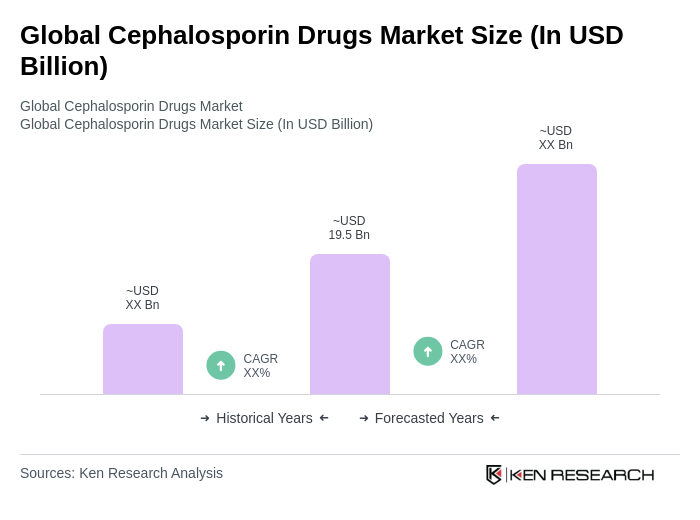
- The Global Cephalosporin Drugs Market is valued at USD 19.5 billion, based on a five-year historical analysis. This level is consistent with multiple industry datasets reporting market sizes around USD 19–20 billion in the latest audited year and reflects steady demand driven by broad clinical use across community and hospital settings .
- Growth is primarily driven by the increasing prevalence of bacterial infections, rising geriatric population with higher infection risk, and sustained demand for effective broad-spectrum antibiotics in both inpatient and outpatient care. Recent approvals of newer agents (e.g., ceftobiprole/Zevtera in the U.S.) and expanded use in surgical prophylaxis support utilization .
- Key players in this market include the United States, Germany, and China, underpinned by robust healthcare infrastructure, significant pharmaceutical R&D and manufacturing bases, and high antibiotic consumption. North America is frequently cited as the largest regional market, with strong reimbursement and hospital demand, while Asia (including China) shows high volume usage, supporting these countries’ pivotal roles .
- In 2023, the U.S. Food and Drug Administration updated and clarified several anti-infective development and labeling guidances (e.g., pathogen-focused antibacterial therapy, multiple-indication labeling, and streamlined clinical endpoints), facilitating efficient development pathways for antibiotics while maintaining safety and efficacy standards; this environment supports innovative cephalosporin programs and access .
Global Cephalosporin Drugs Market Segmentation
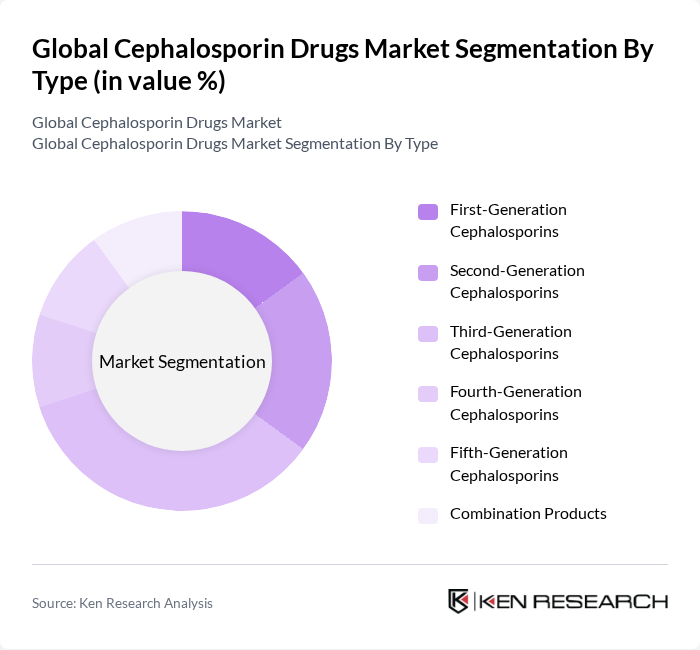
By Type:The cephalosporin drugs market is segmented into various types, including first-generation, second-generation, third-generation, fourth-generation, fifth-generation, and combination products. Each generation of cephalosporins has distinct characteristics and applications, catering to different bacterial infections. The third-generation cephalosporins are particularly prominent in clinical use because of their broad-spectrum activity, including enhanced gram-negative coverage, and their role as standards of care for serious infections (e.g., ceftriaxone), making them a frequent choice among healthcare providers .
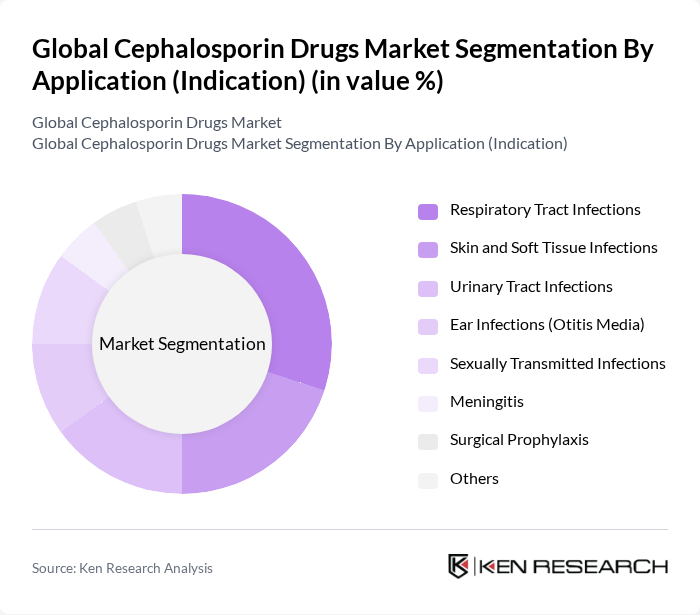
By Application (Indication):The applications of cephalosporin drugs are diverse, including treatment for respiratory tract infections, skin and soft tissue infections, urinary tract infections, ear infections, sexually transmitted infections, meningitis, surgical prophylaxis, and others. Respiratory tract infections are a leading application area due to the high incidence of community-acquired pneumonia and acute bacterial exacerbations requiring guideline-supported agents such as ceftriaxone and cefuroxime; cephalosporins are also widely used for UTIs, SSTIs, otitis media, gonorrhea, and perioperative prophylaxis in hospitals .
Global Cephalosporin Drugs Market Competitive Landscape
The Global Cephalosporin Drugs Market is characterized by a dynamic mix of regional and international players. Leading participants such as Pfizer Inc., Merck & Co., Inc., GlaxoSmithKline plc, Sandoz Group AG, Viatris Inc., Lupin Limited, Aurobindo Pharma Limited, Glenmark Pharmaceuticals Ltd., Alembic Pharmaceuticals Limited, Teva Pharmaceutical Industries Ltd., Sun Pharmaceutical Industries Ltd., Shanghai Fosun Pharmaceutical (Group) Co., Ltd., CSPC Pharmaceutical Group Limited, Hikma Pharmaceuticals plc, Shionogi & Co., Ltd. contribute to innovation, geographic expansion, and service delivery in this space.
Global Cephalosporin Drugs Market Industry Analysis
Growth Drivers
- Increasing Prevalence of Bacterial Infections:The World Health Organization reported that bacterial infections account for approximately 1.27 million deaths annually, with projections suggesting this could rise to 10 million by future. This alarming trend drives the demand for effective antibiotics, including cephalosporins, as healthcare systems strive to manage rising infection rates. The increasing incidence of hospital-acquired infections, which affect around 1 in 31 hospital patients in the U.S., further emphasizes the urgent need for these drugs.
- Rising Demand for Broad-Spectrum Antibiotics:The global market for broad-spectrum antibiotics is projected to reach $45 billion by future, driven by the need for effective treatments against a wide range of pathogens. Cephalosporins, known for their efficacy against both Gram-positive and Gram-negative bacteria, are increasingly favored in clinical settings. The growing awareness among healthcare providers about the importance of broad-spectrum antibiotics in treating complex infections is significantly boosting their demand in various healthcare facilities.
- Advancements in Pharmaceutical Research and Development:In future, pharmaceutical R&D spending is expected to exceed $200 billion globally, with a significant portion allocated to antibiotic development. Innovations in drug formulation and delivery systems are enhancing the effectiveness of cephalosporins. For instance, the introduction of extended-release formulations is improving patient compliance and therapeutic outcomes. These advancements are crucial in addressing the challenges posed by resistant bacterial strains and ensuring the continued relevance of cephalosporins in modern medicine.
Market Challenges
- High Cost of Drug Development:The average cost to develop a new antibiotic is estimated at $1.5 billion, which poses a significant barrier for pharmaceutical companies. This high financial burden is exacerbated by the lengthy approval processes and the need for extensive clinical trials. As a result, many companies are hesitant to invest in cephalosporin development, leading to a slowdown in innovation and a limited pipeline of new drugs to combat bacterial infections effectively.
- Emergence of Antibiotic Resistance:The Centers for Disease Control and Prevention (CDC) estimates that at least 2.8 million antibiotic-resistant infections occur annually in the U.S., leading to over 35,000 deaths. This growing resistance undermines the effectiveness of existing cephalosporins and complicates treatment protocols. The urgent need for new antibiotics to combat resistant strains is a significant challenge, as it requires substantial investment in research and development, which is often not financially viable for many companies.
Global Cephalosporin Drugs Market Future Outlook
The future of the cephalosporin drugs market appears promising, driven by ongoing advancements in pharmaceutical research and a heightened focus on combating antibiotic resistance. As healthcare systems increasingly prioritize effective infection management, the demand for innovative cephalosporin formulations is expected to rise. Additionally, strategic partnerships between pharmaceutical companies and research institutions will likely accelerate the development of new antibiotics, ensuring that cephalosporins remain a vital component of treatment regimens in the face of evolving bacterial threats.
Market Opportunities
- Expansion into Emerging Markets:Emerging markets, particularly in Asia and Africa, are experiencing a surge in healthcare investments, with spending projected to reach $1 trillion by future. This growth presents significant opportunities for cephalosporin manufacturers to penetrate these markets, addressing the rising demand for effective antibiotics in regions with increasing bacterial infection rates and limited access to healthcare.
- Development of Novel Cephalosporin Formulations:The introduction of novel cephalosporin formulations, such as those targeting resistant strains, is a key opportunity for growth. With antibiotic resistance on the rise, developing drugs that can effectively combat these strains will not only meet urgent medical needs but also position companies as leaders in the antibiotic market, potentially increasing their market share significantly.
Scope of the Report
| Segment | Sub-Segments |
|---|---|
| By Type | First-Generation Cephalosporins Second-Generation Cephalosporins Third-Generation Cephalosporins Fourth-Generation Cephalosporins Fifth-Generation Cephalosporins Combination Products (e.g., ceftazidime/avibactam, ceftolozane/tazobactam) |
| By Application (Indication) | Respiratory Tract Infections Skin and Soft Tissue Infections Urinary Tract Infections Ear Infections (Otitis Media) Sexually Transmitted Infections (e.g., gonorrhea) Meningitis Surgical Prophylaxis Others |
| By Route of Administration | Oral Injection (Intravenous/Intramuscular) Others |
| By Distribution Channel | Hospital Pharmacies Retail Pharmacies Online Pharmacies Others |
| By End-User | Hospitals Ambulatory Surgery Centers Clinics Home Healthcare Others |
| By Region | North America Europe Asia-Pacific Latin America Middle East & Africa |
| By Price Range | Low Price Medium Price High Price Others |
Key Target Audience
Investors and Venture Capitalist Firms
Government and Regulatory Bodies (e.g., U.S. Food and Drug Administration, European Medicines Agency)
Pharmaceutical Manufacturers and Producers
Wholesale Distributors and Retail Pharmacies
Healthcare Providers and Hospitals
Biotechnology Firms
Pharmaceutical Supply Chain Managers
Health Insurance Companies
Players Mentioned in the Report:
Pfizer Inc.
Merck & Co., Inc.
GlaxoSmithKline plc
Sandoz Group AG
Viatris Inc.
Lupin Limited
Aurobindo Pharma Limited
Glenmark Pharmaceuticals Ltd.
Alembic Pharmaceuticals Limited
Teva Pharmaceutical Industries Ltd.
Sun Pharmaceutical Industries Ltd.
Shanghai Fosun Pharmaceutical (Group) Co., Ltd.
CSPC Pharmaceutical Group Limited
Hikma Pharmaceuticals plc
Shionogi & Co., Ltd.
Table of Contents
Market Assessment Phase
1. Executive Summary and Approach
2. Global Cephalosporin Drugs Market Overview
2.1 Key Insights and Strategic Recommendations
2.2 Global Cephalosporin Drugs Market Overview
2.3 Definition and Scope
2.4 Evolution of Market Ecosystem
2.5 Timeline of Key Regulatory Milestones
2.6 Value Chain & Stakeholder Mapping
2.7 Business Cycle Analysis
2.8 Policy & Incentive Landscape
3. Global Cephalosporin Drugs Market Analysis
3.1 Growth Drivers
3.1.1 Increasing prevalence of bacterial infections
3.1.2 Rising demand for broad-spectrum antibiotics
3.1.3 Advancements in pharmaceutical research and development
3.1.4 Growing geriatric population
3.2 Market Challenges
3.2.1 High cost of drug development
3.2.2 Stringent regulatory requirements
3.2.3 Emergence of antibiotic resistance
3.2.4 Market saturation with generic drugs
3.3 Market Opportunities
3.3.1 Expansion into emerging markets
3.3.2 Development of novel cephalosporin formulations
3.3.3 Strategic partnerships and collaborations
3.3.4 Increased investment in healthcare infrastructure
3.4 Market Trends
3.4.1 Shift towards personalized medicine
3.4.2 Growing focus on antibiotic stewardship programs
3.4.3 Rise in online pharmaceutical sales
3.4.4 Integration of technology in drug development
3.5 Government Regulation
3.5.1 Regulatory frameworks for antibiotic approval
3.5.2 Guidelines for antibiotic usage
3.5.3 Policies promoting antibiotic research
3.5.4 Initiatives to combat antibiotic resistance
4. SWOT Analysis
5. Stakeholder Analysis
6. Porter's Five Forces Analysis
7. Global Cephalosporin Drugs Market Market Size, 2019-2024
7.1 By Value
7.2 By Volume
7.3 By Average Selling Price
8. Global Cephalosporin Drugs Market Segmentation
8.1 By Type
8.1.1 First-Generation Cephalosporins
8.1.2 Second-Generation Cephalosporins
8.1.3 Third-Generation Cephalosporins
8.1.4 Fourth-Generation Cephalosporins
8.1.5 Fifth-Generation Cephalosporins
8.1.6 Combination Products (e.g., ceftazidime/avibactam, ceftolozane/tazobactam)
8.2 By Application (Indication)
8.2.1 Respiratory Tract Infections
8.2.2 Skin and Soft Tissue Infections
8.2.3 Urinary Tract Infections
8.2.4 Ear Infections (Otitis Media)
8.2.5 Sexually Transmitted Infections (e.g., gonorrhea)
8.2.6 Meningitis
8.2.7 Surgical Prophylaxis
8.2.8 Others
8.3 By Route of Administration
8.3.1 Oral
8.3.2 Injection (Intravenous/Intramuscular)
8.3.3 Others
8.4 By Distribution Channel
8.4.1 Hospital Pharmacies
8.4.2 Retail Pharmacies
8.4.3 Online Pharmacies
8.4.4 Others
8.5 By End-User
8.5.1 Hospitals
8.5.2 Ambulatory Surgery Centers
8.5.3 Clinics
8.5.4 Home Healthcare
8.5.5 Others
8.6 By Region
8.6.1 North America
8.6.2 Europe
8.6.3 Asia-Pacific
8.6.4 Latin America
8.6.5 Middle East & Africa
8.7 By Price Range
8.7.1 Low Price
8.7.2 Medium Price
8.7.3 High Price
8.7.4 Others
9. Global Cephalosporin Drugs Market Competitive Analysis
9.1 Market Share of Key Players
9.2 Cross Comparison of Key Players
9.2.1 Company Name
9.2.2 Group Size (Large, Medium, or Small as per industry convention)
9.2.3 Cephalosporin Revenue (latest FY)
9.2.4 Cephalosporin Revenue Growth Rate (YoY)
9.2.5 Portfolio Breadth by Generation (count of 1st–5th gen SKUs)
9.2.6 Share of Injectables vs. Oral (% of cephalosporin sales)
9.2.7 Geographic Footprint (countries with marketing authorization)
9.2.8 WHO Prequalification/US FDA/EMA Approvals (count)
9.2.9 Manufacturing Footprint (own plants vs. CMOs; GMP certifications)
9.2.10 R&D Investment Ratio (antibiotics R&D as % of total R&D)
9.2.11 ANDA/DMF Filings for Cephalosporins (cumulative)
9.2.12 Pricing Positioning (low/mid/high vs. regional benchmarks)
9.2.13 Key Hospital Tender Wins (last 12–24 months)
9.2.14 Pharmacovigilance/Quality Recalls (count, last 3 years)
9.2.15 Distribution Network Coverage (hospital/retail/online reach index)
9.3 SWOT Analysis of Top Players
9.4 Pricing Analysis
9.5 Detailed Profile of Major Companies
9.5.1 Pfizer Inc.
9.5.2 Merck & Co., Inc.
9.5.3 GlaxoSmithKline plc
9.5.4 Sandoz Group AG
9.5.5 Viatris Inc.
9.5.6 Lupin Limited
9.5.7 Aurobindo Pharma Limited
9.5.8 Glenmark Pharmaceuticals Ltd.
9.5.9 Alembic Pharmaceuticals Limited
9.5.10 Teva Pharmaceutical Industries Ltd.
9.5.11 Sun Pharmaceutical Industries Ltd.
9.5.12 Shanghai Fosun Pharmaceutical (Group) Co., Ltd.
9.5.13 CSPC Pharmaceutical Group Limited
9.5.14 Hikma Pharmaceuticals plc
9.5.15 Shionogi & Co., Ltd.
10. Global Cephalosporin Drugs Market End-User Analysis
10.1 Procurement Behavior of Key Ministries
10.1.1 Government procurement policies
10.1.2 Budget allocation for healthcare
10.1.3 Preference for local vs. international suppliers
10.1.4 Evaluation criteria for drug procurement
10.2 Corporate Spend on Infrastructure & Energy
10.2.1 Investment in healthcare infrastructure
10.2.2 Spending on pharmaceutical research
10.2.3 Budget for antibiotic procurement
10.3 Pain Point Analysis by End-User Category
10.3.1 Access to affordable medications
10.3.2 Availability of essential drugs
10.3.3 Quality assurance challenges
10.4 User Readiness for Adoption
10.4.1 Awareness of cephalosporin benefits
10.4.2 Training and education needs
10.4.3 Infrastructure readiness
10.5 Post-Deployment ROI and Use Case Expansion
10.5.1 Evaluation of treatment outcomes
10.5.2 Cost-effectiveness analysis
10.5.3 Opportunities for expanding use cases
11. Global Cephalosporin Drugs Market Future Size, 2025-2030
11.1 By Value
11.2 By Volume
11.3 By Average Selling Price
Go-To-Market Strategy Phase
1. Whitespace Analysis + Business Model Canvas
1.1 Market gaps identification
1.2 Value proposition development
1.3 Revenue model exploration
1.4 Customer segmentation analysis
1.5 Competitive landscape overview
2. Marketing and Positioning Recommendations
2.1 Branding strategies
2.2 Product USPs
2.3 Target audience identification
2.4 Communication strategies
3. Distribution Plan
3.1 Urban retail strategies
3.2 Rural NGO tie-ups
3.3 Online distribution channels
4. Channel & Pricing Gaps
4.1 Underserved routes
4.2 Pricing bands analysis
4.3 Competitor pricing strategies
5. Unmet Demand & Latent Needs
5.1 Category gaps identification
5.2 Consumer segments analysis
5.3 Emerging trends exploration
6. Customer Relationship
6.1 Loyalty programs
6.2 After-sales service
6.3 Customer feedback mechanisms
7. Value Proposition
7.1 Sustainability initiatives
7.2 Integrated supply chains
7.3 Competitive advantages
8. Key Activities
8.1 Regulatory compliance
8.2 Branding efforts
8.3 Distribution setup
9. Entry Strategy Evaluation
9.1 Domestic Market Entry Strategy
9.1.1 Product mix considerations
9.1.2 Pricing band strategies
9.1.3 Packaging innovations
9.2 Export Entry Strategy
9.2.1 Target countries analysis
9.2.2 Compliance roadmap development
10. Entry Mode Assessment
10.1 Joint Ventures
10.2 Greenfield investments
10.3 Mergers & Acquisitions
10.4 Distributor Model
11. Capital and Timeline Estimation
11.1 Capital requirements analysis
11.2 Timelines for market entry
12. Control vs Risk Trade-Off
12.1 Ownership considerations
12.2 Partnerships evaluation
13. Profitability Outlook
13.1 Breakeven analysis
13.2 Long-term sustainability strategies
14. Potential Partner List
14.1 Distributors
14.2 Joint Ventures
14.3 Acquisition targets
15. Execution Roadmap
15.1 Phased Plan for Market Entry
15.1.1 Market Setup
15.1.2 Market Entry
15.1.3 Growth Acceleration
15.1.4 Scale & Stabilize
15.2 Key Activities and Milestones
15.2.1 Milestone identification
15.2.2 Activity scheduling
Research Methodology
Phase 1: Approach1
Desk Research
- Analysis of market reports from pharmaceutical industry associations and regulatory bodies
- Review of published articles and journals focusing on cephalosporin drug developments and trends
- Examination of sales data and market share reports from leading pharmaceutical companies
Primary Research
- Interviews with key opinion leaders in the pharmaceutical sector, including R&D heads and regulatory affairs specialists
- Surveys conducted with healthcare professionals to understand prescribing patterns and market needs
- Focus group discussions with pharmacists to gather insights on cephalosporin usage and patient feedback
Validation & Triangulation
- Cross-validation of findings through multiple data sources, including sales figures and expert opinions
- Triangulation of market trends with historical data and future projections
- Sanity checks performed through expert panel reviews to ensure data accuracy and relevance
Phase 2: Market Size Estimation1
Top-down Assessment
- Estimation of the global cephalosporin market size based on overall pharmaceutical market growth rates
- Segmentation of the market by region, product type, and therapeutic application
- Incorporation of trends in antibiotic resistance and its impact on cephalosporin demand
Bottom-up Modeling
- Collection of sales data from major cephalosporin manufacturers to establish baseline figures
- Analysis of prescription data from healthcare databases to gauge market penetration
- Volume and pricing analysis to derive revenue estimates for different cephalosporin products
Forecasting & Scenario Analysis
- Utilization of time-series analysis to project future market growth based on historical trends
- Scenario modeling based on potential regulatory changes and market entry of new competitors
- Development of best-case, worst-case, and most-likely scenarios through 2030
Phase 3: CATI Sample Composition1
| Scope Item/Segment | Sample Size | Target Respondent Profiles |
|---|---|---|
| Hospital Pharmacists | 120 | Clinical Pharmacists, Pharmacy Directors |
| General Practitioners | 110 | Family Medicine Physicians, Internal Medicine Specialists |
| Infectious Disease Specialists | 80 | Infectious Disease Physicians, Clinical Researchers |
| Pharmaceutical Sales Representatives | 90 | Sales Managers, Territory Representatives |
| Regulatory Affairs Experts | 60 | Regulatory Managers, Compliance Officers |
Frequently Asked Questions
What is the current value of the Global Cephalosporin Drugs Market?
The Global Cephalosporin Drugs Market is valued at approximately USD 19.5 billion, reflecting steady demand driven by the clinical use of these antibiotics in both community and hospital settings.
What factors are driving the growth of the Cephalosporin Drugs Market?
Which regions are key players in the Cephalosporin Drugs Market?
What are the main applications of Cephalosporin drugs?
Other Regional/Country Reports
Malaysia Cephalosporin Drugs Market
APAC Cephalosporin Drugs Market
SEA Cephalosporin Drugs Market
Why Buy From Us?

What makes us stand out is that our consultants follow Robust, Refine and Result (RRR) methodology. Robust for clear definitions, approaches and sanity checking, Refine for differentiating respondents' facts and opinions, and Result for presenting data with story.

We have set a benchmark in the industry by offering our clients with syndicated and customized market research reports featuring coverage of entire market as well as meticulous research and analyst insights.

While we don't replace traditional research, we flip the method upside down. Our dual approach of Top Bottom & Bottom Top ensures quality deliverable by not just verifying company fundamentals but also looking at the sector and macroeconomic factors.

With one step in the future, our research team constantly tries to show you the bigger picture. We help with some of the tough questions you may encounter along the way: How is the industry positioned? Best marketing channel? KPI's of competitors? By aligning every element, we help maximize success.

Our report gives you instant access to the answers and sources that other companies might choose to hide. We elaborate each steps of research methodology we have used and showcase you the sample size to earn your trust.

If you need any support, we are here! We pride ourselves on universe strength, data quality, and quick, friendly, and professional service.