About the Report
Base Year 2024Global Charcoal Market Overview
- The Global Charcoal Market is valued at approximately USD 6.0–6.4 billion, based on a five-year analysis of recent industry sources and segment triangulation across BBQ charcoal, briquettes, and broader wood charcoal categories. The market is supported by rising outdoor cooking and grilling activity and continued use in industrial, metallurgical, and activated carbon applications.
- Countries such as the United States and Brazil are leading producers and exporters of wood charcoal, while Germany stands out as a major importer and premium retail market for certified and eco-labeled charcoal for BBQ consumption. The U.S. market has strong brand and product innovation in briquettes and lump segments for grilling, Brazil benefits from abundant plantation hardwood supply and export orientation, and Germany’s retail channels emphasize sustainability certifications for BBQ charcoal.
- Within the European Union, sustainability requirements on charcoal have tightened via due-diligence and legality/sustainability measures affecting wood-based products placed on the EU market, including requirements around legal sourcing and deforestation-free supply chains; these frameworks have strengthened retailer demand for certified sustainable wood charcoal.
Global Charcoal Market Segmentation
By Type:The market is segmented into various types of charcoal, including Lump Charcoal, Charcoal Briquettes, Activated Charcoal (Activated Carbon), Extruded/Pressed Charcoal (Including Sawdust Briquettes), and Specialty Charcoal (e.g., Binchotan/Japanese Charcoal, Sugar Charcoal). Each type serves different consumer needs and preferences, influencing market dynamics.
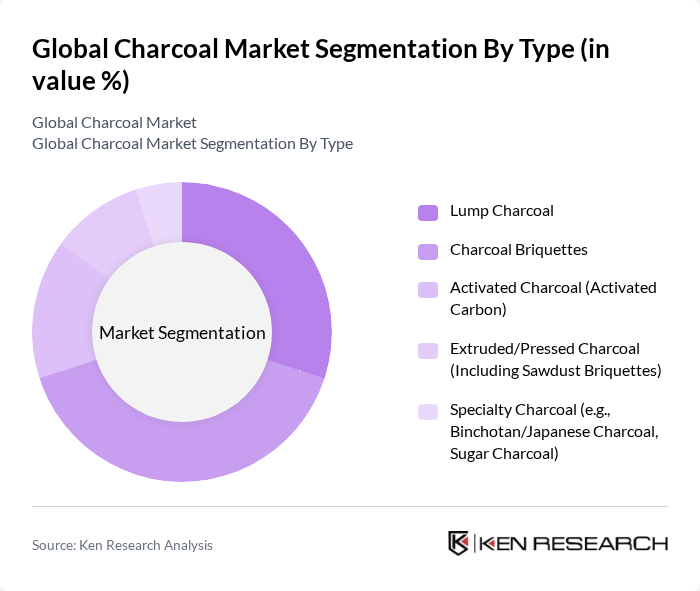
The Charcoal Briquettes segment is currently dominating the market due to its convenience and consistent burning properties, making it a preferred choice for both residential and commercial grilling. The growing trend of outdoor cooking and barbecuing has further fueled the demand for briquettes, as they are easy to use and provide a longer burn time compared to lump charcoal. Additionally, the availability of various brands and flavors has attracted a diverse consumer base, solidifying its market leadership.
By End-User:The market is segmented based on end-users, including Households (Residential Cooking & Grilling), HoReCa & Catering (Commercial Foodservice), Metallurgical & Industrial (Iron/Steel, Non-ferrous, Cement, Power), Water & Air Treatment (Activated Carbon Applications), and Shisha/Hookah Lounges and Retail. Each segment has unique requirements and consumption patterns that influence market trends.
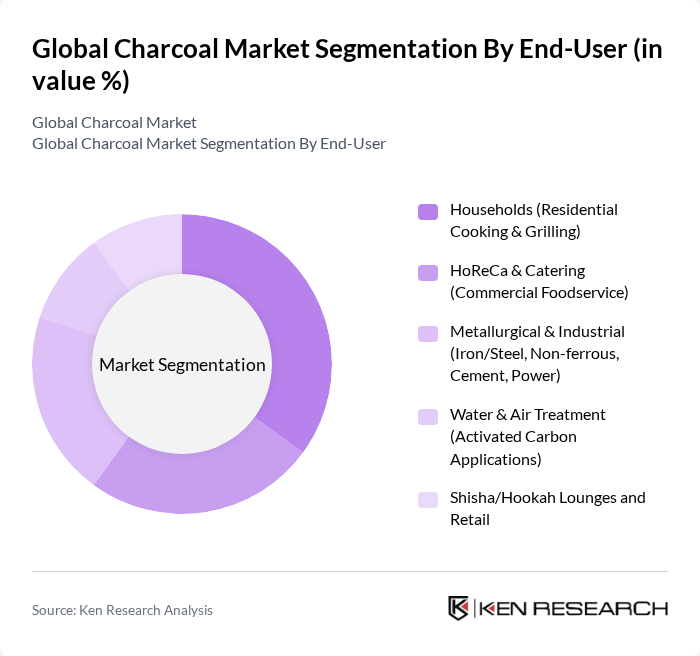
The Households segment is the leading end-user category, driven by the increasing popularity of outdoor cooking and grilling activities. The rise in home-based gatherings and barbecues has significantly boosted the demand for charcoal among consumers. Additionally, the convenience and ease of use associated with charcoal products have made them a staple in many households, further solidifying their market dominance.
Global Charcoal Market Competitive Landscape
The Global Charcoal Market is characterized by a dynamic mix of regional and international players. Leading participants such as The Kingsford Products Company (The Clorox Company), Royal Oak Enterprises, LLC, Duraflame, Inc., FOGO Charcoal, Inc., B&B Charcoal, Inc., Jealous Devil, LLC, Big Green Egg, Inc., Kamado Joe (Middleby Outdoor Living), Weber-Stephen Products LLC, Gryfskand Sp. z o.o., Bricapar S.A. (Brazil), Maurobera S.A. (Uruguay), The Dorset Charcoal Company Ltd. (UK), Rancher Charcoal Company, Mesjaya Abadi Sdn Bhd (Malaysia) contribute to innovation, geographic expansion, and service delivery in this space.
Global Charcoal Market Industry Analysis
Growth Drivers
- Increasing Demand for Sustainable Energy Sources:The global shift towards sustainable energy is driving charcoal demand, particularly in regions where traditional fuels are being phased out. In future, the renewable energy sector is projected to grow by $1.5 trillion, with charcoal being a key player in this transition. Countries like Brazil and India are investing heavily in sustainable charcoal production, with Brazil's production reaching 3 million tons, highlighting the increasing reliance on eco-friendly energy sources.
- Growth in Outdoor Cooking and Grilling Activities:The outdoor cooking market is expected to reach $5 billion in future, significantly boosting charcoal sales. The rise in backyard grilling and camping activities, particularly in North America and Europe, has led to a surge in charcoal consumption, with sales increasing by 20% in the last year alone. This trend is supported by a growing culture of outdoor dining, which is expected to continue driving demand for charcoal products.
- Rising Awareness of Environmental Benefits:As consumers become more environmentally conscious, the demand for charcoal, especially from sustainable sources, is increasing. In future, 60% of consumers in developed markets are expected to prefer eco-friendly charcoal options. This shift is supported by educational campaigns highlighting the carbon-neutral potential of sustainably sourced charcoal, which is projected to increase market share by 15% in the next year, reflecting a significant change in consumer preferences.
Market Challenges
- Environmental Regulations on Charcoal Production:Stricter environmental regulations are posing challenges for charcoal producers. In future, the European Union is expected to implement new emission standards that could increase production costs by up to 30%. Compliance with these regulations may lead to reduced production capacity, particularly for small-scale producers who may struggle to meet the new requirements, impacting overall market supply.
- Competition from Alternative Fuels:The charcoal market faces significant competition from alternative fuels such as propane and natural gas, which are gaining popularity due to their convenience and lower emissions. In future, the market for alternative fuels is projected to grow by 10%, potentially diverting consumers away from charcoal. This competition could lead to a stagnation in charcoal sales, particularly in urban areas where consumers prioritize convenience over traditional grilling methods.
Global Charcoal Market Future Outlook
The future of the charcoal market appears promising, driven by innovations in production technologies and a growing emphasis on sustainability. As consumer preferences shift towards eco-friendly products, the market is likely to see an increase in demand for sustainably sourced charcoal. Additionally, the expansion of e-commerce platforms is expected to facilitate greater access to charcoal products, enhancing market reach and consumer engagement. These trends indicate a dynamic market landscape poised for growth in the coming years.
Market Opportunities
- Innovations in Charcoal Production Technologies:Advancements in production technologies, such as carbonization and briquetting, present significant opportunities for efficiency improvements. These innovations can reduce production costs by up to 25%, making sustainable charcoal more competitive against alternative fuels, thus attracting a broader consumer base.
- Expansion into Untapped Geographical Markets:Emerging markets in Africa and Asia represent untapped potential for charcoal sales. With a projected increase in urbanization rates of 3% annually, these regions are likely to see a rise in demand for charcoal for cooking and heating, creating new avenues for market expansion and revenue growth.
Scope of the Report
| Segment | Sub-Segments |
|---|---|
| By Type | Lump Charcoal Charcoal Briquettes Activated Charcoal (Activated Carbon) Extruded/Pressed Charcoal (Including Sawdust Briquettes) Specialty Charcoal (e.g., Binchotan/Japanese Charcoal, Sugar Charcoal) |
| By End-User | Households (Residential Cooking & Grilling) HoReCa & Catering (Commercial Foodservice) Metallurgical & Industrial (Iron/Steel, Non-ferrous, Cement, Power) Water & Air Treatment (Activated Carbon Applications) Shisha/Hookah Lounges and Retail |
| By Application | Barbecue & Cooking Residential & Commercial Heating Metallurgy & Foundry (Reducing Agent/Carburizer) Water and Wastewater Filtration (Activated Carbon) Air Purification & Gas Processing (Activated Carbon) |
| By Distribution Channel | Offline Retail (Grocery, DIY, Hardware, Specialty Stores) Online Retail & Marketplaces Wholesale/B2B (Foodservice, Industrial) Direct Sales & Private Label |
| By Region | North America Europe Asia-Pacific Middle East & Africa South America |
| By Price Range | Value/Economy Mid-range Premium/Professional |
| By Packaging Type | Paper/Poly Bags (2–20 kg) Boxes/Cartons Bulk/IBC/Super Sacks (500–1,000 kg) Retail-ready Pouches (Small Packs) |
Key Target Audience
Investors and Venture Capitalist Firms
Government and Regulatory Bodies (e.g., Environmental Protection Agency, Food and Drug Administration)
Manufacturers and Producers
Distributors and Retailers
Export and Import Agencies
Industry Associations (e.g., International Charcoal Association)
Financial Institutions
Non-Governmental Organizations (NGOs) focused on sustainability
Players Mentioned in the Report:
The Kingsford Products Company (The Clorox Company)
Royal Oak Enterprises, LLC
Duraflame, Inc.
FOGO Charcoal, Inc.
B&B Charcoal, Inc.
Jealous Devil, LLC
Big Green Egg, Inc.
Kamado Joe (Middleby Outdoor Living)
Weber-Stephen Products LLC
Gryfskand Sp. z o.o.
Bricapar S.A. (Brazil)
Maurobera S.A. (Uruguay)
The Dorset Charcoal Company Ltd. (UK)
Rancher Charcoal Company
Mesjaya Abadi Sdn Bhd (Malaysia)
Table of Contents
Market Assessment Phase
1. Executive Summary and Approach
2. Global Charcoal Market Overview
2.1 Key Insights and Strategic Recommendations
2.2 Global Charcoal Market Overview
2.3 Definition and Scope
2.4 Evolution of Market Ecosystem
2.5 Timeline of Key Regulatory Milestones
2.6 Value Chain & Stakeholder Mapping
2.7 Business Cycle Analysis
2.8 Policy & Incentive Landscape
3. Global Charcoal Market Analysis
3.1 Growth Drivers
3.1.1 Increasing Demand for Sustainable Energy Sources
3.1.2 Growth in Outdoor Cooking and Grilling Activities
3.1.3 Rising Awareness of Environmental Benefits
3.1.4 Expansion of Charcoal-Based Products in Emerging Markets
3.2 Market Challenges
3.2.1 Environmental Regulations on Charcoal Production
3.2.2 Competition from Alternative Fuels
3.2.3 Supply Chain Disruptions
3.2.4 Price Volatility of Raw Materials
3.3 Market Opportunities
3.3.1 Innovations in Charcoal Production Technologies
3.3.2 Growing Market for Activated Charcoal Products
3.3.3 Expansion into Untapped Geographical Markets
3.3.4 Increasing Use in Industrial Applications
3.4 Market Trends
3.4.1 Shift Towards Eco-Friendly Charcoal Products
3.4.2 Rise in E-commerce for Charcoal Sales
3.4.3 Development of Charcoal Briquettes
3.4.4 Increased Focus on Carbon Footprint Reduction
3.5 Government Regulation
3.5.1 Emission Standards for Charcoal Production
3.5.2 Import Tariffs on Charcoal Products
3.5.3 Subsidies for Sustainable Charcoal Production
3.5.4 Regulations on Deforestation and Land Use
4. SWOT Analysis
5. Stakeholder Analysis
6. Porter's Five Forces Analysis
7. Global Charcoal Market Market Size, 2019-2024
7.1 By Value
7.2 By Volume
7.3 By Average Selling Price
8. Global Charcoal Market Segmentation
8.1 By Type
8.1.1 Lump Charcoal
8.1.2 Charcoal Briquettes
8.1.3 Activated Charcoal (Activated Carbon)
8.1.4 Extruded/Pressed Charcoal (Including Sawdust Briquettes)
8.1.5 Specialty Charcoal (e.g., Binchotan/Japanese Charcoal, Sugar Charcoal)
8.2 By End-User
8.2.1 Households (Residential Cooking & Grilling)
8.2.2 HoReCa & Catering (Commercial Foodservice)
8.2.3 Metallurgical & Industrial (Iron/Steel, Non-ferrous, Cement, Power)
8.2.4 Water & Air Treatment (Activated Carbon Applications)
8.2.5 Shisha/Hookah Lounges and Retail
8.3 By Application
8.3.1 Barbecue & Cooking
8.3.2 Residential & Commercial Heating
8.3.3 Metallurgy & Foundry (Reducing Agent/Carburizer)
8.3.4 Water and Wastewater Filtration (Activated Carbon)
8.3.5 Air Purification & Gas Processing (Activated Carbon)
8.4 By Distribution Channel
8.4.1 Offline Retail (Grocery, DIY, Hardware, Specialty Stores)
8.4.2 Online Retail & Marketplaces
8.4.3 Wholesale/B2B (Foodservice, Industrial)
8.4.4 Direct Sales & Private Label
8.5 By Region
8.5.1 North America
8.5.2 Europe
8.5.3 Asia-Pacific
8.5.4 Middle East & Africa
8.5.5 South America
8.6 By Price Range
8.6.1 Value/Economy
8.6.2 Mid-range
8.6.3 Premium/Professional
8.7 By Packaging Type
8.7.1 Paper/Poly Bags (2–20 kg)
8.7.2 Boxes/Cartons
8.7.3 Bulk/IBC/Super Sacks (500–1,000 kg)
8.7.4 Retail-ready Pouches (Small Packs)
9. Global Charcoal Market Competitive Analysis
9.1 Market Share of Key Players
9.2 Cross Comparison of Key Players
9.2.1 Company Name
9.2.2 Production Capacity (kTPA) and Utilization Rate
9.2.3 Geographic Footprint (Manufacturing Sites and Export Markets)
9.2.4 Product Mix (% Lump, % Briquettes, % Activated, % Specialty)
9.2.5 Sourcing Model (Hardwood, Coconut Shell, Sawdust/Agro-waste; % Certified Sustainable)
9.2.6 Revenue and Revenue Growth Rate (Charcoal/Activated Segment)
9.2.7 EBITDA Margin / Unit Economics (per kg)
9.2.8 Average Realized Price (ARPPU) by Product Grade
9.2.9 On-time Delivery and Fill Rate (B2B KPIs)
9.2.10 Distribution Reach (Retail Doors, Countries Served, Key B2B Accounts)
9.2.11 Brand Equity Metrics (Aided Awareness/Share of Voice in BBQ Category)
9.2.12 Innovation/Certification Score (New SKUs, Patents, FSC/PEFC/ISO/REACH)
9.2.13 Sustainability KPIs (Scope 1–3 Intensity, Reforestation/Offset per tonne)
9.3 SWOT Analysis of Top Players
9.4 Pricing Analysis
9.5 Detailed Profile of Major Companies
9.5.1 The Kingsford Products Company (The Clorox Company)
9.5.2 Royal Oak Enterprises, LLC
9.5.3 Duraflame, Inc.
9.5.4 FOGO Charcoal, Inc.
9.5.5 B&B Charcoal, Inc.
9.5.6 Jealous Devil, LLC
9.5.7 Big Green Egg, Inc.
9.5.8 Kamado Joe (Middleby Outdoor Living)
9.5.9 Weber-Stephen Products LLC
9.5.10 Gryfskand Sp. z o.o.
9.5.11 Bricapar S.A. (Brazil)
9.5.12 Maurobera S.A. (Uruguay)
9.5.13 The Dorset Charcoal Company Ltd. (UK)
9.5.14 Rancher Charcoal Company
9.5.15 Mesjaya Abadi Sdn Bhd (Malaysia)
10. Global Charcoal Market End-User Analysis
10.1 Procurement Behavior of Key Ministries
10.1.1 Government Procurement Policies
10.1.2 Budget Allocations for Charcoal Products
10.1.3 Supplier Selection Criteria
10.1.4 Contracting Processes
10.2 Corporate Spend on Infrastructure & Energy
10.2.1 Investment in Charcoal-Based Energy Solutions
10.2.2 Budget Trends for Charcoal Procurement
10.2.3 Corporate Sustainability Initiatives
10.3 Pain Point Analysis by End-User Category
10.3.1 Supply Chain Reliability
10.3.2 Quality Consistency
10.3.3 Pricing Fluctuations
10.4 User Readiness for Adoption
10.4.1 Awareness of Charcoal Benefits
10.4.2 Training and Support Needs
10.4.3 Infrastructure Readiness
10.5 Post-Deployment ROI and Use Case Expansion
10.5.1 Measurement of ROI
10.5.2 Expansion Opportunities
10.5.3 User Feedback Mechanisms
11. Global Charcoal Market Future Size, 2025-2030
11.1 By Value
11.2 By Volume
11.3 By Average Selling Price
Go-To-Market Strategy Phase
1. Whitespace Analysis + Business Model Canvas
1.1 Market Gaps Identification
1.2 Value Proposition Development
1.3 Revenue Streams Analysis
1.4 Key Partnerships Exploration
1.5 Cost Structure Assessment
1.6 Customer Segmentation
1.7 Channels of Distribution
2. Marketing and Positioning Recommendations
2.1 Branding Strategies
2.2 Product USPs
2.3 Target Market Identification
2.4 Communication Strategies
2.5 Digital Marketing Approaches
3. Distribution Plan
3.1 Urban Retail Strategies
3.2 Rural NGO Tie-ups
3.3 Logistics and Supply Chain Management
3.4 Distribution Partnerships
4. Channel & Pricing Gaps
4.1 Underserved Routes
4.2 Pricing Bands Analysis
4.3 Competitor Pricing Strategies
5. Unmet Demand & Latent Needs
5.1 Category Gaps Identification
5.2 Consumer Segments Analysis
5.3 Product Development Opportunities
6. Customer Relationship
6.1 Loyalty Programs
6.2 After-sales Service
6.3 Customer Feedback Mechanisms
7. Value Proposition
7.1 Sustainability Initiatives
7.2 Integrated Supply Chains
7.3 Competitive Advantages
8. Key Activities
8.1 Regulatory Compliance
8.2 Branding Initiatives
8.3 Distribution Setup
9. Entry Strategy Evaluation
9.1 Domestic Market Entry Strategy
9.1.1 Product Mix Considerations
9.1.2 Pricing Band Strategy
9.1.3 Packaging Solutions
9.2 Export Entry Strategy
9.2.1 Target Countries Identification
9.2.2 Compliance Roadmap Development
10. Entry Mode Assessment
10.1 Joint Ventures
10.2 Greenfield Investments
10.3 Mergers & Acquisitions
10.4 Distributor Model Evaluation
11. Capital and Timeline Estimation
11.1 Capital Requirements
11.2 Timelines for Market Entry
12. Control vs Risk Trade-Off
12.1 Ownership vs Partnerships
13. Profitability Outlook
13.1 Breakeven Analysis
13.2 Long-term Sustainability Strategies
14. Potential Partner List
14.1 Distributors
14.2 Joint Ventures
14.3 Acquisition Targets
15. Execution Roadmap
15.1 Phased Plan for Market Entry
15.1.1 Market Setup
15.1.2 Market Entry
15.1.3 Growth Acceleration
15.1.4 Scale & Stabilize
15.2 Key Activities and Milestones
15.2.1 Milestone Planning
15.2.2 Activity Tracking
Research Methodology
Phase 1: Approach1
Desk Research
- Analysis of global charcoal production statistics from FAO and other agricultural databases
- Review of market reports and white papers from industry associations such as the International Charcoal Association
- Examination of trade data and import/export statistics from national customs agencies
Primary Research
- Interviews with key stakeholders in the charcoal supply chain, including manufacturers and distributors
- Surveys targeting end-users such as restaurants, hotels, and retail outlets that utilize charcoal products
- Field visits to charcoal production facilities to gather insights on operational practices and challenges
Validation & Triangulation
- Cross-validation of findings through multiple data sources, including trade publications and market surveys
- Triangulation of qualitative insights from interviews with quantitative data from market reports
- Sanity checks conducted through expert panel reviews comprising industry veterans and market analysts
Phase 2: Market Size Estimation1
Top-down Assessment
- Estimation of the global charcoal market size based on overall wood product consumption trends
- Segmentation of the market by application, including industrial, residential, and food service sectors
- Incorporation of regional growth rates and demand forecasts from emerging markets
Bottom-up Modeling
- Collection of production volume data from leading charcoal manufacturers across key regions
- Analysis of pricing trends based on product type, quality, and regional market dynamics
- Calculation of market size using volume x price methodology for each segment
Forecasting & Scenario Analysis
- Multi-factor regression analysis incorporating variables such as population growth, urbanization, and energy trends
- Scenario modeling based on potential regulatory changes affecting charcoal production and usage
- Development of baseline, optimistic, and pessimistic forecasts through 2030
Phase 3: CATI Sample Composition1
| Scope Item/Segment | Sample Size | Target Respondent Profiles |
|---|---|---|
| Charcoal Production Facilities | 95 | Plant Managers, Production Supervisors |
| Retail Charcoal Distributors | 85 | Sales Managers, Distribution Coordinators |
| Food Service Industry Users | 70 | Restaurant Owners, Catering Managers |
| Export Market Stakeholders | 55 | Export Managers, Trade Compliance Officers |
| Environmental Regulatory Bodies | 45 | Policy Analysts, Environmental Compliance Officers |
Frequently Asked Questions
What is the current value of the Global Charcoal Market?
The Global Charcoal Market is valued at approximately USD 6.06.4 billion, driven by increased outdoor cooking, grilling activities, and industrial applications. This valuation reflects a comprehensive analysis of various charcoal segments, including BBQ charcoal and briquettes.
Which countries are the leading producers of wood charcoal?
What are the main types of charcoal in the market?
What is driving the demand for charcoal in the market?
Other Regional/Country Reports
Indonesia Charcoal Market
Malaysia Charcoal Market
APAC Charcoal Market
Why Buy From Us?

What makes us stand out is that our consultants follow Robust, Refine and Result (RRR) methodology. Robust for clear definitions, approaches and sanity checking, Refine for differentiating respondents' facts and opinions, and Result for presenting data with story.

We have set a benchmark in the industry by offering our clients with syndicated and customized market research reports featuring coverage of entire market as well as meticulous research and analyst insights.

While we don't replace traditional research, we flip the method upside down. Our dual approach of Top Bottom & Bottom Top ensures quality deliverable by not just verifying company fundamentals but also looking at the sector and macroeconomic factors.

With one step in the future, our research team constantly tries to show you the bigger picture. We help with some of the tough questions you may encounter along the way: How is the industry positioned? Best marketing channel? KPI's of competitors? By aligning every element, we help maximize success.

Our report gives you instant access to the answers and sources that other companies might choose to hide. We elaborate each steps of research methodology we have used and showcase you the sample size to earn your trust.

If you need any support, we are here! We pride ourselves on universe strength, data quality, and quick, friendly, and professional service.