About the Report
Base Year 2024Global Child Care Market Overview
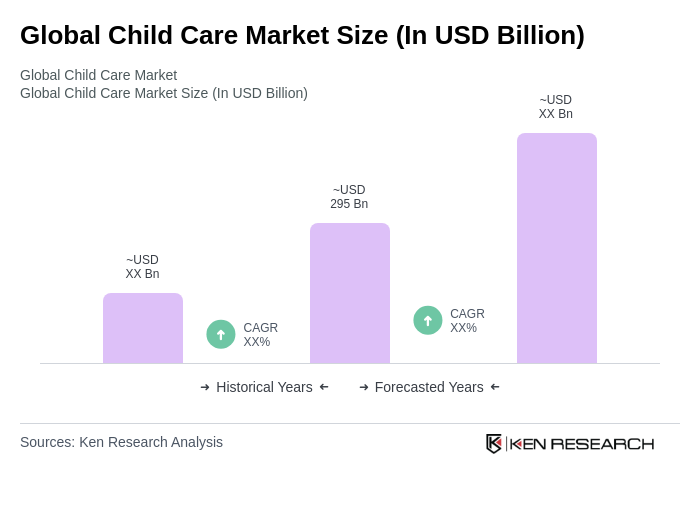
- The Global Child Care Market is valued at USD 295 billion, based on a five-year historical analysis. This growth is primarily driven by the rising participation of women in the workforce, an increase in dual-income and single-parent households, heightened awareness of early childhood education, and government initiatives promoting child care services. The demand for quality child care solutions has surged as parents seek reliable options to balance work and family responsibilities. Technology integration and curriculum enhancements are also shaping service delivery and parent-provider engagement .
- Key players in this market include the United States, Canada, and several European countries, which dominate due to their established infrastructure, high disposable incomes, and a strong emphasis on early childhood education. These regions have a well-developed network of child care services, making them attractive for parents seeking quality care for their children .
- The U.S. government continues to support the Child Care and Development Block Grant (CCDBG) program, which allocates approximately USD 5.8 billion annually to support child care services. This initiative aims to improve access to affordable child care for low-income families, thereby enhancing the overall quality and availability of child care services across the nation .
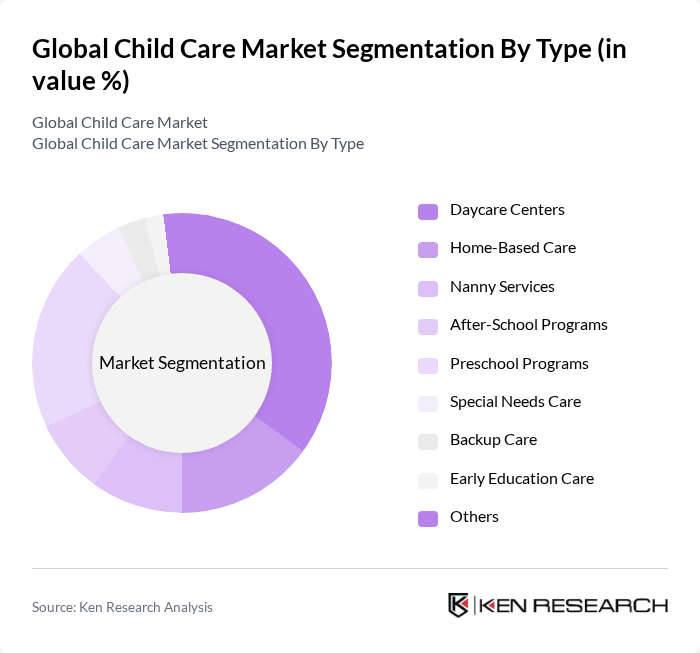
Global Child Care Market Segmentation
By Type:The child care market is segmented into various types, including daycare centers, home-based care, nanny services, after-school programs, preschool programs, special needs care, backup care, early education care, and others. Among these, daycare centers and preschool programs are particularly dominant due to their structured environments, educational focus, and ability to provide comprehensive care solutions that support early learning and social development. The market is also witnessing growth in specialized services such as backup care and special needs care, driven by evolving parental preferences and the need for flexible, inclusive solutions .
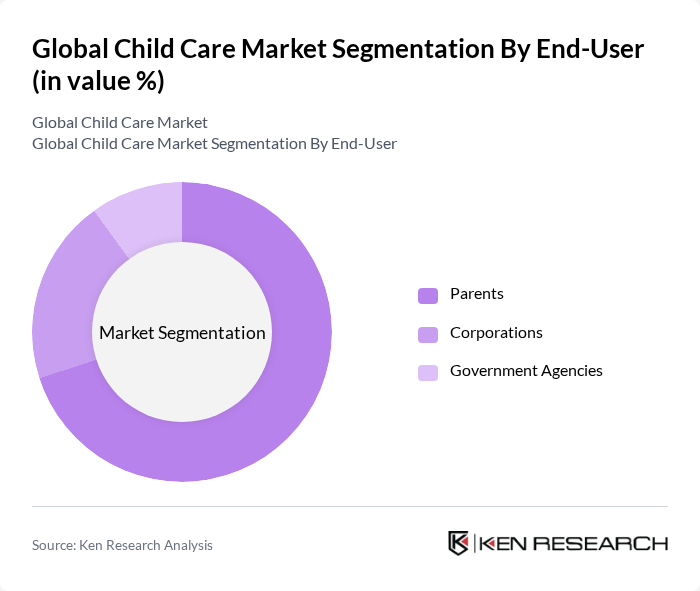
By End-User:The end-user segmentation includes parents, corporations, and government agencies. Parents are the primary end-users, driving demand for child care services as they seek reliable and quality care for their children. Corporations are increasingly offering child care benefits to attract and retain talent, while government agencies play a crucial role in funding, regulating, and expanding access to child care services, particularly for underserved populations .
Global Child Care Market Competitive Landscape
The Global Child Care Market is characterized by a dynamic mix of regional and international players. Leading participants such as Bright Horizons Family Solutions Inc., KinderCare Learning Centers LLC, Learning Care Group, Inc., The Goddard School (Goddard Franchisor LLC), Primrose School Franchising SPE, LLC, Childtime Learning Centers, YMCA Child Care Services, Kids 'R' Kids Learning Academies, Tutor Time Child Care/Learning Centers, La Petite Academy, Busy Bees Daycare, G8 Education Ltd., Cadence Education, Spring Education Group, The Learning Experience, Founding Years Learning Solutions Pvt Ltd. (KLAY), KU Children's Services, Sunshine House Early Learning Academy, Tiny Hoppers Corp., Global Childrens Center contribute to innovation, geographic expansion, and service delivery in this space .
Global Child Care Market Industry Analysis
Growth Drivers
- Increasing Demand for Quality Child Care Services:The demand for quality child care services is surging, driven by a growing recognition of the importance of early childhood development. In future, the global expenditure on child care services is projected to reach approximately $600 billion, reflecting a significant increase from previous years. This trend is supported by studies indicating that quality early education can enhance cognitive and social skills, leading to better long-term outcomes for children, thus driving parents to seek premium services.
- Rising Dual-Income Households:The rise in dual-income households is a major growth driver for the child care market. In future, it is estimated that over 70% of families with children under the age of six will have both parents working. This demographic shift necessitates reliable child care solutions, as parents increasingly seek services that accommodate their busy schedules. The demand for flexible and accessible child care options is expected to grow, further propelling market expansion in this sector.
- Government Initiatives Supporting Child Care:Government initiatives aimed at enhancing child care accessibility and affordability are significantly influencing market growth. In future, various countries are expected to allocate over $120 billion towards child care subsidies and infrastructure improvements. These initiatives are designed to support working families and improve child care quality, thereby increasing the number of available facilities and services. Such investments are crucial for fostering a robust child care ecosystem that meets the needs of modern families.
Market Challenges
- High Operational Costs for Child Care Providers:One of the primary challenges facing child care providers is the high operational costs associated with running facilities. In future, average operational costs are projected to exceed $250,000 annually for small to medium-sized centers. These costs include staffing, facility maintenance, and compliance with health regulations. Such financial burdens can limit the ability of providers to offer competitive pricing, ultimately affecting service availability and quality in the market.
- Regulatory Compliance Complexities:Navigating the complex landscape of regulatory compliance poses significant challenges for child care providers. In future, it is estimated that over 80% of child care facilities will face difficulties in meeting local and national regulations, which can vary widely. Compliance with licensing requirements, health and safety standards, and staff-to-child ratio mandates can be resource-intensive, diverting attention from core educational services and impacting overall operational efficiency.
Global Child Care Market Future Outlook
The future of the child care market appears promising, driven by evolving family dynamics and increasing awareness of early childhood education. As more parents seek quality care, the demand for innovative solutions, including digital platforms and flexible service models, is expected to rise. Additionally, ongoing government support and investment in child care infrastructure will likely enhance service availability. The market is poised for transformation, with a focus on integrating technology and improving accessibility for diverse family needs.
Market Opportunities
- Expansion of Digital Child Care Solutions:The rise of digital child care solutions presents a significant opportunity for market growth. In future, the digital child care sector is expected to attract investments exceeding $15 billion, driven by the demand for remote learning and virtual engagement tools. This trend allows providers to reach a broader audience and offer flexible options that cater to modern family lifestyles.
- Development of Specialized Child Care Programs:There is a growing opportunity for the development of specialized child care programs tailored to specific needs, such as bilingual education or care for children with disabilities. In future, the demand for such programs is projected to increase by 20%, as parents seek services that align with their children's unique requirements. This focus on specialization can enhance service differentiation and attract a wider client base.
Scope of the Report
| Segment | Sub-Segments |
|---|---|
| By Type | Daycare Centers Home-Based Care Nanny Services After-School Programs Preschool Programs Special Needs Care Backup Care Early Education Care Others |
| By End-User | Parents Corporations Government Agencies |
| By Service Model | Full-Time Care Part-Time Care Drop-In Care |
| By Age Group | Infants (0-12 months) Toddlers (1-3 years) Preschoolers (3-5 years) School-Aged Children (5-12 years) |
| By Pricing Model | Hourly Rates Monthly Packages Annual Subscriptions |
| By Location | Urban Areas Suburban Areas Rural Areas |
| By Quality Certification | Accredited Programs Non-Accredited Programs Government-Approved Programs |
| By Geography | North America (United States, Canada, Mexico) Europe (Germany, United Kingdom, France, Italy, Spain, Rest of Europe) Asia Pacific (China, Japan, India, Australia, South Korea, Rest of Asia Pacific) Middle East and Africa (GCC, South Africa, Rest of Middle East and Africa) South America (Brazil, Argentina, Rest of South America) |
Key Target Audience
Investors and Venture Capitalist Firms
Government and Regulatory Bodies (e.g., Child Care and Development Fund, Office of Child Care)
Manufacturers and Producers of Child Care Products
Distributors and Retailers of Child Care Services
Child Care Service Providers
Technology Providers for Child Care Solutions
Industry Associations (e.g., National Association for the Education of Young Children)
Financial Institutions and Banks specializing in Child Care Financing
Players Mentioned in the Report:
Bright Horizons Family Solutions Inc.
KinderCare Learning Centers LLC
Learning Care Group, Inc.
The Goddard School (Goddard Franchisor LLC)
Primrose School Franchising SPE, LLC
Childtime Learning Centers
YMCA Child Care Services
Kids 'R' Kids Learning Academies
Tutor Time Child Care/Learning Centers
La Petite Academy
Busy Bees Daycare
G8 Education Ltd.
Cadence Education
Spring Education Group
The Learning Experience
Founding Years Learning Solutions Pvt Ltd. (KLAY)
KU Children's Services
Sunshine House Early Learning Academy
Tiny Hoppers Corp.
Global Childrens Center
Table of Contents
Market Assessment Phase
1. Executive Summary and Approach
2. Global Child Care Market Overview
2.1 Key Insights and Strategic Recommendations
2.2 Global Child Care Market Overview
2.3 Definition and Scope
2.4 Evolution of Market Ecosystem
2.5 Timeline of Key Regulatory Milestones
2.6 Value Chain & Stakeholder Mapping
2.7 Business Cycle Analysis
2.8 Policy & Incentive Landscape
3. Global Child Care Market Analysis
3.1 Growth Drivers
3.1.1 Increasing demand for quality child care services
3.1.2 Rising dual-income households
3.1.3 Government initiatives supporting child care
3.1.4 Growing awareness of early childhood education
3.2 Market Challenges
3.2.1 High operational costs for child care providers
3.2.2 Regulatory compliance complexities
3.2.3 Limited availability of qualified staff
3.2.4 Variability in demand across regions
3.3 Market Opportunities
3.3.1 Expansion of digital child care solutions
3.3.2 Increasing investment in child care infrastructure
3.3.3 Partnerships with educational institutions
3.3.4 Development of specialized child care programs
3.4 Market Trends
3.4.1 Shift towards flexible child care options
3.4.2 Integration of technology in child care services
3.4.3 Emphasis on health and safety standards
3.4.4 Growing focus on inclusive child care practices
3.5 Government Regulation
3.5.1 Licensing requirements for child care facilities
3.5.2 Health and safety regulations
3.5.3 Funding and subsidy programs
3.5.4 Staff-to-child ratio mandates
4. SWOT Analysis
5. Stakeholder Analysis
6. Porter's Five Forces Analysis
7. Global Child Care Market Market Size, 2019-2024
7.1 By Value
7.2 By Volume
7.3 By Average Selling Price
8. Global Child Care Market Segmentation
8.1 By Type
8.1.1 Daycare Centers
8.1.2 Home-Based Care
8.1.3 Nanny Services
8.1.4 After-School Programs
8.1.5 Preschool Programs
8.1.6 Special Needs Care
8.1.7 Backup Care
8.1.8 Early Education Care
8.1.9 Others
8.2 By End-User
8.2.1 Parents
8.2.2 Corporations
8.2.3 Government Agencies
8.3 By Service Model
8.3.1 Full-Time Care
8.3.2 Part-Time Care
8.3.3 Drop-In Care
8.4 By Age Group
8.4.1 Infants (0-12 months)
8.4.2 Toddlers (1-3 years)
8.4.3 Preschoolers (3-5 years)
8.4.4 School-Aged Children (5-12 years)
8.5 By Pricing Model
8.5.1 Hourly Rates
8.5.2 Monthly Packages
8.5.3 Annual Subscriptions
8.6 By Location
8.6.1 Urban Areas
8.6.2 Suburban Areas
8.6.3 Rural Areas
8.7 By Quality Certification
8.7.1 Accredited Programs
8.7.2 Non-Accredited Programs
8.7.3 Government-Approved Programs
8.8 By Geography
8.8.1 North America (United States, Canada, Mexico)
8.8.2 Europe (Germany, United Kingdom, France, Italy, Spain, Rest of Europe)
8.8.3 Asia Pacific (China, Japan, India, Australia, South Korea, Rest of Asia Pacific)
8.8.4 Middle East and Africa (GCC, South Africa, Rest of Middle East and Africa)
8.8.5 South America (Brazil, Argentina, Rest of South America)
9. Global Child Care Market Competitive Analysis
9.1 Market Share of Key Players
9.2 Cross Comparison of Key Players
9.2.1 Company Name
9.2.2 Group Size (Large, Medium, or Small as per industry convention)
9.2.3 Revenue (USD, latest fiscal year)
9.2.4 Revenue Growth Rate (YoY %)
9.2.5 Number of Centers/Facilities
9.2.6 Number of Enrolled Children
9.2.7 Average Revenue per User (ARPU)
9.2.8 Market Penetration Rate (by geography or segment)
9.2.9 Customer Retention Rate
9.2.10 Service Quality Rating (external or internal benchmarks)
9.2.11 Employee Turnover Rate
9.2.12 Customer Satisfaction Score (NPS or equivalent)
9.2.13 Pricing Strategy (premium, value, etc.)
9.2.14 Digital Adoption/Technology Integration Level
9.3 SWOT Analysis of Top Players
9.4 Pricing Analysis
9.5 Detailed Profile of Major Companies
9.5.1 Bright Horizons Family Solutions Inc.
9.5.2 KinderCare Learning Centers LLC
9.5.3 Learning Care Group, Inc.
9.5.4 The Goddard School (Goddard Franchisor LLC)
9.5.5 Primrose School Franchising SPE, LLC
9.5.6 Childtime Learning Centers
9.5.7 YMCA Child Care Services
9.5.8 Kids 'R' Kids Learning Academies
9.5.9 Tutor Time Child Care/Learning Centers
9.5.10 La Petite Academy
9.5.11 Busy Bees Daycare
9.5.12 G8 Education Ltd.
9.5.13 Cadence Education
9.5.14 Spring Education Group
9.5.15 The Learning Experience
9.5.16 Founding Years Learning Solutions Pvt Ltd. (KLAY)
9.5.17 KU Children's Services
9.5.18 Sunshine House Early Learning Academy
9.5.19 Tiny Hoppers Corp.
9.5.20 Global Childrens Center
10. Global Child Care Market End-User Analysis
10.1 Procurement Behavior of Key Ministries
10.1.1 Budget Allocation for Child Care Services
10.1.2 Evaluation Criteria for Service Providers
10.1.3 Partnership Opportunities with NGOs
10.2 Corporate Spend on Infrastructure & Energy
10.2.1 Investment in Child Care Facilities
10.2.2 Funding for Employee Child Care Programs
10.3 Pain Point Analysis by End-User Category
10.3.1 Affordability of Child Care Services
10.3.2 Accessibility of Quality Care
10.3.3 Availability of Flexible Options
10.4 User Readiness for Adoption
10.4.1 Awareness of Child Care Options
10.4.2 Willingness to Pay for Quality Care
10.5 Post-Deployment ROI and Use Case Expansion
10.5.1 Measurement of Child Development Outcomes
10.5.2 Feedback Mechanisms for Service Improvement
11. Global Child Care Market Future Size, 2025-2030
11.1 By Value
11.2 By Volume
11.3 By Average Selling Price
Go-To-Market Strategy Phase
1. Whitespace Analysis + Business Model Canvas
1.1 Identification of Market Gaps
1.2 Value Proposition Development
1.3 Revenue Streams Analysis
1.4 Cost Structure Evaluation
1.5 Key Partnerships Identification
1.6 Customer Segmentation
1.7 Channels of Distribution
2. Marketing and Positioning Recommendations
2.1 Branding Strategies
2.2 Product USPs
3. Distribution Plan
3.1 Urban Retail vs Rural NGO Tie-Ups
4. Channel & Pricing Gaps
4.1 Underserved Routes
4.2 Pricing Bands
5. Unmet Demand & Latent Needs
5.1 Category Gaps
5.2 Consumer Segments
6. Customer Relationship
6.1 Loyalty Programs
6.2 After-Sales Service
7. Value Proposition
7.1 Sustainability
7.2 Integrated Supply Chains
8. Key Activities
8.1 Regulatory Compliance
8.2 Branding
8.3 Distribution Setup
9. Entry Strategy Evaluation
9.1 Domestic Market Entry Strategy
9.1.1 Product Mix
9.1.2 Pricing Band
9.1.3 Packaging
9.2 Export Entry Strategy
9.2.1 Target Countries
9.2.2 Compliance Roadmap
10. Entry Mode Assessment
10.1 JV
10.2 Greenfield
10.3 M&A
10.4 Distributor Model
11. Capital and Timeline Estimation
11.1 Capital Requirements
11.2 Timelines
12. Control vs Risk Trade-Off
12.1 Ownership vs Partnerships
13. Profitability Outlook
13.1 Breakeven Analysis
13.2 Long-Term Sustainability
14. Potential Partner List
14.1 Distributors
14.2 JVs
14.3 Acquisition Targets
15. Execution Roadmap
15.1 Phased Plan for Market Entry
15.1.1 Market Setup
15.1.2 Market Entry
15.1.3 Growth Acceleration
15.1.4 Scale & Stabilize
15.2 Key Activities and Milestones
15.2.1 Activity Planning
15.2.2 Milestone Tracking
Research Methodology
Phase 1: Approach1
Desk Research
- Analysis of global child care market reports from industry associations and government publications
- Review of demographic data and trends from the United Nations and World Bank
- Examination of existing literature on child care services, including academic journals and market studies
Primary Research
- Interviews with child care center directors and administrators to gather insights on operational challenges
- Surveys with parents to understand preferences and satisfaction levels regarding child care services
- Focus groups with early childhood educators to discuss trends and innovations in child care practices
Validation & Triangulation
- Cross-validation of findings through comparison with national child care statistics and enrollment data
- Triangulation of insights from primary research with secondary data sources to ensure consistency
- Sanity checks conducted through expert panel reviews involving child care policy makers and industry experts
Phase 2: Market Size Estimation1
Top-down Assessment
- Estimation of market size based on national expenditure on child care services and education
- Segmentation of the market by type of child care services (e.g., daycare, preschool, after-school programs)
- Incorporation of government funding and subsidies for child care into market size calculations
Bottom-up Modeling
- Collection of data on the number of child care facilities and their average enrollment figures
- Analysis of pricing structures for various child care services across different regions
- Volume x price calculations to derive revenue estimates for each segment of the market
Forecasting & Scenario Analysis
- Multi-factor regression analysis incorporating demographic shifts, economic conditions, and policy changes
- Scenario modeling based on potential changes in parental employment rates and child care regulations
- Development of baseline, optimistic, and pessimistic forecasts through 2030
Phase 3: CATI Sample Composition1
| Scope Item/Segment | Sample Size | Target Respondent Profiles |
|---|---|---|
| Daycare Centers | 150 | Center Directors, Administrators |
| Preschool Programs | 100 | Teachers, Program Coordinators |
| After-School Care Services | 80 | Program Managers, Activity Coordinators |
| Parental Insights | 120 | Parents of children aged 0-5 |
| Child Care Policy Experts | 40 | Policy Makers, Child Development Specialists |
Frequently Asked Questions
What is the current value of the Global Child Care Market?
The Global Child Care Market is valued at approximately USD 295 billion, reflecting significant growth driven by factors such as increased workforce participation among women, dual-income households, and heightened awareness of early childhood education.
What are the main drivers of growth in the child care market?
Which regions dominate the Global Child Care Market?
How does government support impact the child care market?
Other Regional/Country Reports
Indonesia Child Care Market
Malaysia Child Care Market
APAC Child Care Market
SEA Child Care Market
Why Buy From Us?

What makes us stand out is that our consultants follow Robust, Refine and Result (RRR) methodology. Robust for clear definitions, approaches and sanity checking, Refine for differentiating respondents' facts and opinions, and Result for presenting data with story.

We have set a benchmark in the industry by offering our clients with syndicated and customized market research reports featuring coverage of entire market as well as meticulous research and analyst insights.

While we don't replace traditional research, we flip the method upside down. Our dual approach of Top Bottom & Bottom Top ensures quality deliverable by not just verifying company fundamentals but also looking at the sector and macroeconomic factors.

With one step in the future, our research team constantly tries to show you the bigger picture. We help with some of the tough questions you may encounter along the way: How is the industry positioned? Best marketing channel? KPI's of competitors? By aligning every element, we help maximize success.

Our report gives you instant access to the answers and sources that other companies might choose to hide. We elaborate each steps of research methodology we have used and showcase you the sample size to earn your trust.

If you need any support, we are here! We pride ourselves on universe strength, data quality, and quick, friendly, and professional service.