About the Report
Base Year 2024Listen to the audio summary
Global Clinical Trials Site Management Organizations (SMO) Market Overview
- The Global Clinical Trials Site Management Organizations (SMO) Market is valued at USD 6.6 billion, based on a five-year historical analysis. This growth is primarily driven by the increasing number of clinical trials, the rising demand for efficient site management, and the growing complexity of clinical studies. The need for specialized services to streamline trial processes and enhance patient recruitment has further propelled market expansion. Additional growth drivers include the surge in drug discovery activities, the prevalence of chronic diseases, and the trend toward outsourcing clinical trial operations to SMOs for operational efficiency and regulatory compliance .
- Key regions dominating the market include North America and Europe, primarily due to their advanced healthcare infrastructure, high investment in research and development, and a large number of pharmaceutical and biotechnology companies. The presence of established regulatory frameworks and a skilled workforce also contribute to their market leadership. North America, in particular, leads the market owing to its extensive clinical trial activity and robust network of clinical research sites .
- In 2023, the U.S. Food and Drug Administration (FDA) implemented the “Modernization of Clinical Trials Conduct and Reporting” guidance under the authority of the Food and Drug Administration (FDA), United States Department of Health and Human Services. This guidance focuses on streamlining the approval process for clinical trial protocols, enhancing patient safety measures, and promoting the use of innovative trial designs, thereby encouraging more organizations to engage in clinical research and expand their operational capabilities .
 Market.png "Global Clinical Trials Site Management Organizations (SMO) Market Size")
Global Clinical Trials Site Management Organizations (SMO) Market Segmentation
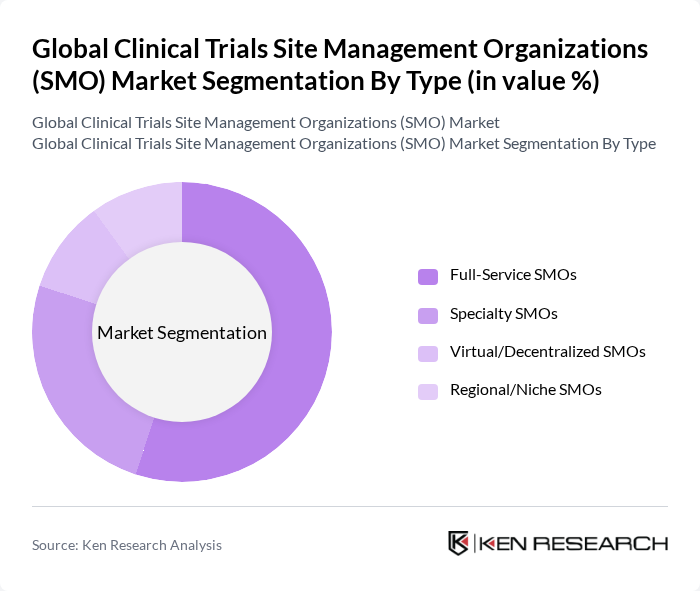
By Type:The market is segmented into Full-Service SMOs, Specialty SMOs, Virtual/Decentralized SMOs, and Regional/Niche SMOs. Full-Service SMOs dominate the market due to their comprehensive offerings that cover all aspects of clinical trial management, making them a preferred choice for pharmaceutical companies seeking efficiency and expertise. Specialty SMOs are also gaining traction as they focus on specific therapeutic areas, catering to the unique needs of clients. The growing complexity of clinical trials, particularly in oncology, neurology, and rare diseases, is driving demand for both full-service and specialty SMOs .
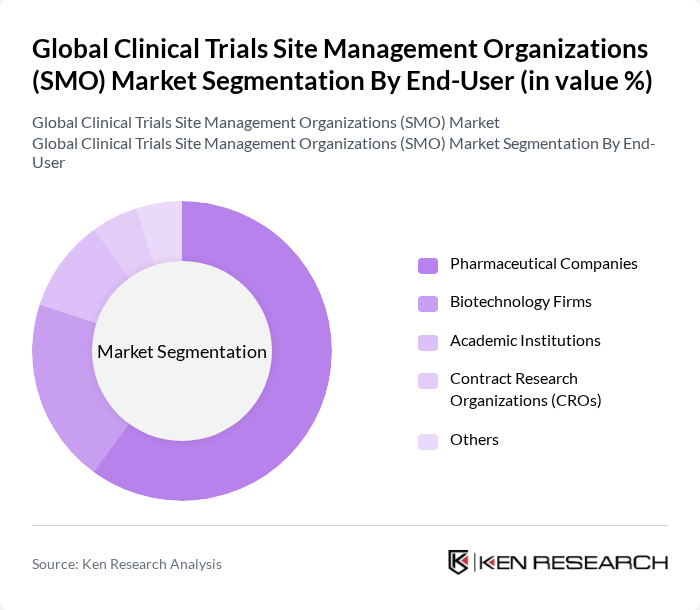
By End-User:The end-user segmentation includes Pharmaceutical Companies, Biotechnology Firms, Academic Institutions, Contract Research Organizations (CROs), and Others. Pharmaceutical Companies are the leading end-users, driven by their need for extensive clinical trials to bring new drugs to market. The increasing collaboration between pharmaceutical companies and SMOs for efficient trial management is a significant trend in this segment. Biotechnology firms and CROs are also notable end-users, leveraging SMO expertise for specialized and outsourced trial support .
Global Clinical Trials Site Management Organizations (SMO) Market Competitive Landscape
The Global Clinical Trials Site Management Organizations (SMO) Market is characterized by a dynamic mix of regional and international players. Leading participants such as ICON plc, Covance Inc., PPD, Inc., Syneos Health, Medpace, Inc., PRA Health Sciences, Charles River Laboratories, Parexel International Corporation, Clinedge, WCG (WIRB-Copernicus Group), ClinChoice, Access Clinical Research, FOMAT Medical Research Inc., SGS, KV Clinical, SMO-Pharmina, Xylem Clinical Research, Aurum Clinical Research, Sarah Cannon, EthosExcel, Grand Pacific CRO, PANACRO, Worldwide Clinical Trials, Clinipace, Celerion, Veristat, BioClinica, ERT contribute to innovation, geographic expansion, and service delivery in this space .
Global Clinical Trials Site Management Organizations (SMO) Market Industry Analysis
Growth Drivers
- Increasing Demand for Clinical Trials:The global clinical trials market is projected to reach $65 billion, driven by a surge in demand for innovative therapies. The World Health Organization reported that over 1.5 million clinical trials were registered globally, reflecting a growing need for effective treatments. This demand is further fueled by the increasing prevalence of diseases, necessitating more extensive research and development efforts, particularly in oncology and rare diseases, which are expected to dominate the clinical trial landscape.
- Rise in Chronic Diseases:Chronic diseases, such as diabetes and cardiovascular conditions, are on the rise, with the World Health Organization estimating that 60% of the global population will be living with at least one chronic condition. This alarming trend is driving the need for clinical trials focused on long-term treatment solutions. In future, the global expenditure on chronic disease management reached $8 trillion, highlighting the urgent need for innovative clinical research to address these health challenges effectively.
- Technological Advancements in Trial Management:The integration of advanced technologies in clinical trial management is revolutionizing the industry. In future, investments in clinical trial technology reached $15 billion, with significant advancements in data analytics, patient monitoring, and trial management systems. These technologies enhance efficiency, reduce costs, and improve patient engagement, making clinical trials more attractive to sponsors. As a result, the adoption of these technologies is expected to accelerate, further driving the growth of SMOs in the coming years.
Market Challenges
- Regulatory Complexities:Navigating the regulatory landscape remains a significant challenge for SMOs. In future, the average time for regulatory approval of clinical trials was approximately 12 months, with variations across regions. The increasing complexity of regulations, particularly in emerging markets, adds to the burden on SMOs. Compliance with Good Clinical Practice (GCP) guidelines and local regulations requires substantial resources, which can hinder the timely execution of clinical trials and increase operational costs.
- Recruitment and Retention of Trial Participants:The recruitment and retention of participants in clinical trials pose ongoing challenges. In future, it was reported that nearly 30% of clinical trials failed to meet their enrollment targets, leading to delays and increased costs. Factors such as stringent eligibility criteria, participant awareness, and logistical issues contribute to these challenges. As the competition for participants intensifies, SMOs must develop innovative strategies to enhance recruitment and retention rates to ensure successful trial outcomes.
Global Clinical Trials Site Management Organizations (SMO) Market Future Outlook
The future of the clinical trials site management organizations market appears promising, driven by the increasing adoption of decentralized clinical trials and the integration of artificial intelligence in trial processes. As regulatory bodies adapt to new methodologies, SMOs are expected to leverage technology to enhance patient engagement and streamline operations. Furthermore, the growing emphasis on real-world evidence will likely shape trial designs, making them more relevant to patient needs and improving overall trial efficiency in the coming years.
Market Opportunities
- Expansion into Emerging Markets:Emerging markets present significant opportunities for SMOs, with a projected growth rate of 15% in clinical trials. Countries like India and Brazil are becoming attractive destinations due to their large patient populations and lower operational costs. This expansion can enhance trial diversity and accelerate the development of new therapies tailored to diverse populations.
- Adoption of Decentralized Clinical Trials:The shift towards decentralized clinical trials is creating new avenues for SMOs. In future, it is estimated that 40% of clinical trials will adopt decentralized methodologies, improving patient access and engagement. This trend not only reduces geographical barriers but also enhances data collection efficiency, making it a lucrative opportunity for SMOs to innovate and expand their service offerings.
Scope of the Report
| Segment | Sub-Segments |
|---|---|
| By Type | Full-Service SMOs Specialty SMOs Virtual/Decentralized SMOs Regional/Niche SMOs |
| By End-User | Pharmaceutical Companies Biotechnology Firms Academic Institutions Contract Research Organizations (CROs) Others |
| By Phase of Clinical Trials | Phase I Phase II Phase III Phase IV |
| By Therapeutic Area | Oncology Cardiovascular Neurology Endocrine/Metabolic Infectious Diseases Respiratory Diseases Pain & Anesthesia Others |
| By Geographical Presence | North America Europe Asia-Pacific Latin America Middle East & Africa Others |
| By Service Offered | Patient Recruitment & Retention Site Management & Monitoring Regulatory Document Preparation Data Management & Reporting Site Initiation & Close-Out Others |
| By Funding Source | Government Funding Private Investments Non-Profit Organizations Industry-Sponsored Trials Others |
Key Target Audience
Investors and Venture Capitalist Firms
Government and Regulatory Bodies (e.g., Food and Drug Administration, European Medicines Agency)
Pharmaceutical and Biotechnology Companies
Clinical Research Organizations (CROs)
Healthcare Providers and Hospitals
Insurance Companies and Payers
Technology Providers for Clinical Trials
Industry Associations and Advocacy Groups
Players Mentioned in the Report:
ICON plc
Covance Inc.
PPD, Inc.
Syneos Health
Medpace, Inc.
PRA Health Sciences
Charles River Laboratories
Parexel International Corporation
Clinedge
WCG (WIRB-Copernicus Group)
ClinChoice
Access Clinical Research
FOMAT Medical Research Inc.
SGS
KV Clinical
SMO-Pharmina
Xylem Clinical Research
Aurum Clinical Research
Sarah Cannon
EthosExcel
Grand Pacific CRO
PANACRO
Worldwide Clinical Trials
Clinipace
Celerion
Veristat
BioClinica
ERT
Table of Contents
Market Assessment Phase
1. Executive Summary and Approach
2. Global Clinical Trials Site Management Organizations (SMO) Market Overview
2.1 Key Insights and Strategic Recommendations
2.2 Global Clinical Trials Site Management Organizations (SMO) Market Overview
2.3 Definition and Scope
2.4 Evolution of Market Ecosystem
2.5 Timeline of Key Regulatory Milestones
2.6 Value Chain & Stakeholder Mapping
2.7 Business Cycle Analysis
2.8 Policy & Incentive Landscape
3. Global Clinical Trials Site Management Organizations (SMO) Market Analysis
3.1 Growth Drivers
3.1.1 Increasing demand for clinical trials
3.1.2 Rise in chronic diseases
3.1.3 Technological advancements in trial management
3.1.4 Growing focus on patient-centric trials
3.2 Market Challenges
3.2.1 Regulatory complexities
3.2.2 High operational costs
3.2.3 Recruitment and retention of trial participants
3.2.4 Data privacy concerns
3.3 Market Opportunities
3.3.1 Expansion into emerging markets
3.3.2 Adoption of decentralized clinical trials
3.3.3 Collaborations with technology firms
3.3.4 Increased funding for research and development
3.4 Market Trends
3.4.1 Shift towards virtual trials
3.4.2 Integration of AI and machine learning
3.4.3 Emphasis on real-world evidence
3.4.4 Focus on personalized medicine
3.5 Government Regulation
3.5.1 Clinical trial registration requirements
3.5.2 Good Clinical Practice (GCP) guidelines
3.5.3 Data protection regulations
3.5.4 Ethical review board approvals
4. SWOT Analysis
5. Stakeholder Analysis
6. Porter's Five Forces Analysis
7. Global Clinical Trials Site Management Organizations (SMO) Market Market Size, 2019-2024
7.1 By Value
7.2 By Volume
7.3 By Average Selling Price
8. Global Clinical Trials Site Management Organizations (SMO) Market Segmentation
8.1 By Type
8.1.1 Full-Service SMOs
8.1.2 Specialty SMOs
8.1.3 Virtual/Decentralized SMOs
8.1.4 Regional/Niche SMOs
8.2 By End-User
8.2.1 Pharmaceutical Companies
8.2.2 Biotechnology Firms
8.2.3 Academic Institutions
8.2.4 Contract Research Organizations (CROs)
8.2.5 Others
8.3 By Phase of Clinical Trials
8.3.1 Phase I
8.3.2 Phase II
8.3.3 Phase III
8.3.4 Phase IV
8.4 By Therapeutic Area
8.4.1 Oncology
8.4.2 Cardiovascular
8.4.3 Neurology
8.4.4 Endocrine/Metabolic
8.4.5 Infectious Diseases
8.4.6 Respiratory Diseases
8.4.7 Pain & Anesthesia
8.4.8 Others
8.5 By Geographical Presence
8.5.1 North America
8.5.2 Europe
8.5.3 Asia-Pacific
8.5.4 Latin America
8.5.5 Middle East & Africa
8.5.6 Others
8.6 By Service Offered
8.6.1 Patient Recruitment & Retention
8.6.2 Site Management & Monitoring
8.6.3 Regulatory Document Preparation
8.6.4 Data Management & Reporting
8.6.5 Site Initiation & Close-Out
8.6.6 Others
8.7 By Funding Source
8.7.1 Government Funding
8.7.2 Private Investments
8.7.3 Non-Profit Organizations
8.7.4 Industry-Sponsored Trials
8.7.5 Others
9. Global Clinical Trials Site Management Organizations (SMO) Market Competitive Analysis
9.1 Market Share of Key Players(Micro, Small, Medium, Large Enterprises)
9.2 KPIs for Cross Comparison of Key Players
9.2.1 Company Name
9.2.2 Group Size (Large, Medium, or Small as per industry convention)
9.2.3 Annual Revenue
9.2.4 Revenue Growth Rate (YoY)
9.2.5 Number of Clinical Trial Sites Managed
9.2.6 Geographic Coverage (Number of Countries/Regions)
9.2.7 Therapeutic Area Specialization
9.2.8 Client Retention Rate
9.2.9 Market Penetration Rate
9.2.10 Pricing Strategy
9.2.11 Average Trial Duration
9.2.12 Patient Enrollment Rate
9.2.13 Regulatory Compliance Rate
9.2.14 Technology Adoption Index (e.g., use of eSource, remote monitoring)
9.2.15 Innovation Index
9.3 SWOT Analysis of Top Players
9.4 Pricing Analysis(By Class and Payload)
9.5 Detailed Profile of Major Companies
9.5.1 ICON plc
9.5.2 Covance Inc.
9.5.3 PPD, Inc.
9.5.4 Syneos Health
9.5.5 Medpace, Inc.
9.5.6 PRA Health Sciences
9.5.7 Charles River Laboratories
9.5.8 Parexel International Corporation
9.5.9 Clinedge
9.5.10 WCG (WIRB-Copernicus Group)
9.5.11 ClinChoice
9.5.12 Access Clinical Research
9.5.13 FOMAT Medical Research Inc.
9.5.14 SGS
9.5.15 KV Clinical
9.5.16 SMO-Pharmina
9.5.17 Xylem Clinical Research
9.5.18 Aurum Clinical Research
9.5.19 Sarah Cannon
9.5.20 EthosExcel
9.5.21 Grand Pacific CRO
9.5.22 PANACRO
9.5.23 Worldwide Clinical Trials
9.5.24 Clinipace
9.5.25 Celerion
9.5.26 Veristat
9.5.27 BioClinica
9.5.28 ERT
10. Global Clinical Trials Site Management Organizations (SMO) Market End-User Analysis
10.1 Procurement Behavior of Key Ministries
10.1.1 Budget Allocation Trends
10.1.2 Decision-Making Processes
10.1.3 Preferred Contracting Methods
10.1.4 Evaluation Criteria
10.2 Corporate Spend on Infrastructure & Energy
10.2.1 Investment Priorities
10.2.2 Spending Patterns
10.2.3 Cost Management Strategies
10.2.4 Future Spending Projections
10.3 Pain Point Analysis by End-User Category
10.3.1 Common Challenges Faced
10.3.2 Impact of Regulatory Changes
10.3.3 Resource Allocation Issues
10.3.4 Technology Adoption Barriers
10.4 User Readiness for Adoption
10.4.1 Training and Support Needs
10.4.2 Technology Familiarity
10.4.3 Change Management Strategies
10.4.4 Feedback Mechanisms
10.5 Post-Deployment ROI and Use Case Expansion
10.5.1 Measurement of Success
10.5.2 Long-term Benefits
10.5.3 Case Studies of Successful Implementations
10.5.4 Future Use Cases
11. Global Clinical Trials Site Management Organizations (SMO) Market Future Size, 2025-2030
11.1 By Value
11.2 By Volume
11.3 By Average Selling Price
Go-To-Market Strategy Phase
1. Whitespace Analysis + Business Model Canvas
1.1 Market Gaps Identification
1.2 Value Proposition Development
1.3 Revenue Streams
1.4 Cost Structure
1.5 Key Partnerships
1.6 Customer Segments
1.7 Channels
2. Marketing and Positioning Recommendations
2.1 Branding Strategies
2.2 Product USPs
3. Distribution Plan
3.1 Urban Retail vs Rural NGO Tie-ups
4. Channel & Pricing Gaps
4.1 Underserved Routes
4.2 Pricing Bands
5. Unmet Demand & Latent Needs
5.1 Category Gaps
5.2 Consumer Segments
6. Customer Relationship
6.1 Loyalty Programs
6.2 After-sales Service
7. Value Proposition
7.1 Sustainability
7.2 Integrated Supply Chains
8. Key Activities
8.1 Regulatory Compliance
8.2 Branding
8.3 Distribution Setup
9. Entry Strategy Evaluation
9.1 Domestic Market Entry Strategy
9.1.1 Product Mix
9.1.2 Pricing Band
9.1.3 Packaging
9.2 Export Entry Strategy
9.2.1 Target Countries
9.2.2 Compliance Roadmap
10. Entry Mode Assessment
10.1 JV
10.2 Greenfield
10.3 M&A
10.4 Distributor Model
11. Capital and Timeline Estimation
11.1 Capital Requirements
11.2 Timelines
12. Control vs Risk Trade-Off
12.1 Ownership vs Partnerships
13. Profitability Outlook
13.1 Breakeven Analysis
13.2 Long-term Sustainability
14. Potential Partner List
14.1 Distributors
14.2 JVs
14.3 Acquisition Targets
15. Execution Roadmap
15.1 Phased Plan for Market Entry
15.1.1 Market Setup
15.1.2 Market Entry
15.1.3 Growth Acceleration
15.1.4 Scale & Stabilize
15.2 Key Activities and Milestones
15.2.1 Milestone Planning
15.2.2 Activity Tracking
Research Methodology
Phase 1: Approach1
Desk Research
- Analysis of industry reports from global health organizations and clinical trial registries
- Review of published articles in peer-reviewed journals focusing on clinical trial methodologies and site management
- Examination of market trends and forecasts from reputable market research firms specializing in healthcare and clinical trials
Primary Research
- Interviews with executives from leading Clinical Trials Site Management Organizations (SMOs)
- Surveys targeting clinical research coordinators and site managers across various therapeutic areas
- Focus groups with stakeholders involved in clinical trial operations, including sponsors and CROs
Validation & Triangulation
- Cross-validation of findings through multiple data sources, including industry publications and expert opinions
- Triangulation of quantitative data from surveys with qualitative insights from interviews
- Sanity checks conducted through expert panel reviews comprising industry veterans and academic researchers
Phase 2: Market Size Estimation1
Top-down Assessment
- Estimation of the global clinical trials market size and its segmentation by region and therapeutic area
- Analysis of funding trends in clinical research and their impact on SMO growth
- Incorporation of regulatory changes and their influence on site management practices
Bottom-up Modeling
- Collection of operational data from a sample of SMOs to establish average revenue per trial
- Estimation of the number of active clinical trials and their distribution across different phases
- Calculation of market size based on the number of trials multiplied by average costs incurred by SMOs
Forecasting & Scenario Analysis
- Development of forecasting models using historical growth rates and emerging trends in clinical research
- Scenario analysis based on potential changes in regulatory environments and technological advancements
- Creation of baseline, optimistic, and pessimistic forecasts through 2030, considering market dynamics
Phase 3: CATI Sample Composition1
| Scope Item/Segment | Sample Size | Target Respondent Profiles |
|---|---|---|
| Oncology Clinical Trials | 100 | Clinical Research Coordinators, Site Managers |
| Cardiovascular Trials | 90 | Principal Investigators, Regulatory Affairs Specialists |
| Pediatric Clinical Trials | 60 | Clinical Trial Managers, Pediatric Specialists |
| Neurology Trials | 70 | Site Directors, Clinical Operations Leaders |
| Rare Disease Trials | 50 | Research Scientists, Patient Advocacy Representatives |
Frequently Asked Questions
What is the current value of the Global Clinical Trials Site Management Organizations (SMO) Market?
The Global Clinical Trials Site Management Organizations (SMO) Market is valued at approximately USD 6.6 billion, reflecting significant growth driven by the increasing number of clinical trials and the demand for efficient site management services.
What factors are driving the growth of the SMO market?
Which regions dominate the Global SMO Market?
What are the different types of SMOs in the market?
Other Regional/Country Reports
Indonesia Clinical Trials Site Management Organizations SMO Market
Malaysia Clinical Trials Site Management Organizations SMO Market
KSA Clinical Trials Site Management Organizations SMO Market
APAC Clinical Trials Site Management Organizations SMO Market
SEA Clinical Trials Site Management Organizations SMO Market
Vietnam Clinical Trials Site Management Organizations SMO Market
Other Adjacent Reports
Singapore Contract Research Organizations Market
KSA Clinical Data Management Market
Japan Patient Recruitment Services Market
Germany Regulatory Affairs Consulting Market
Singapore Drug Development Services Market
Vietnam Biopharmaceutical Manufacturing Market
Philippines Healthcare Analytics Market
Indonesia Decentralized Clinical Trials Market
Philippines Pharmacovigilance Services Market
Belgium Medical Device Clinical Trials Market
Why Buy From Us?

What makes us stand out is that our consultants follow Robust, Refine and Result (RRR) methodology. Robust for clear definitions, approaches and sanity checking, Refine for differentiating respondents' facts and opinions, and Result for presenting data with story.

We have set a benchmark in the industry by offering our clients with syndicated and customized market research reports featuring coverage of entire market as well as meticulous research and analyst insights.

While we don't replace traditional research, we flip the method upside down. Our dual approach of Top Bottom & Bottom Top ensures quality deliverable by not just verifying company fundamentals but also looking at the sector and macroeconomic factors.

With one step in the future, our research team constantly tries to show you the bigger picture. We help with some of the tough questions you may encounter along the way: How is the industry positioned? Best marketing channel? KPI's of competitors? By aligning every element, we help maximize success.

Our report gives you instant access to the answers and sources that other companies might choose to hide. We elaborate each steps of research methodology we have used and showcase you the sample size to earn your trust.

If you need any support, we are here! We pride ourselves on universe strength, data quality, and quick, friendly, and professional service.