About the Report
Base Year 2024Listen to the audio summary
Global Coffee Trade Analysis Market Overview
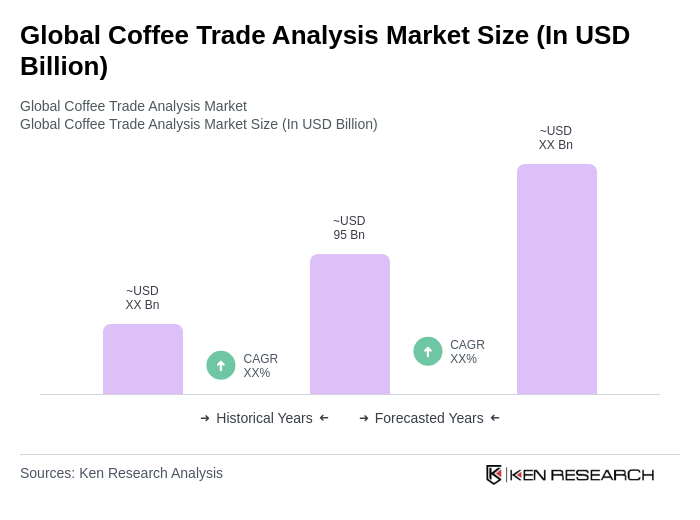
- The Global Coffee Trade Analysis Market is valued at USD 95 billion, based on a five?year historical analysis. Growth is primarily driven by increasing consumer demand for specialty coffee, the rise of coffee culture globally, and the expansion of coffee retail outlets. The market has seen a significant shift towards premium and organic coffee products, reflecting changing consumer preferences and a growing awareness of sustainability. Specialty coffee, premium blends, and convenience-driven formats such as ready-to-drink beverages are increasingly popular, especially among younger consumers. Improvements in brewing technology and the expansion of coffee chains further popularize coffee culture worldwide .
- Countries such as Brazil, Vietnam, and Colombia continue to dominate the coffee trade market due to their large-scale production capabilities and favorable climatic conditions for coffee cultivation. Brazil remains the largest producer, benefiting from established infrastructure and export networks, while Vietnam has rapidly expanded its Robusta coffee production to meet growing global demand .
- The European Union has implemented regulations to promote sustainable coffee sourcing, including mandatory sustainability certifications for coffee imports. These require producers to adhere to environmental and social standards, aiming to enhance transparency in the supply chain and encourage responsible sourcing practices among coffee traders. The regulatory focus on sustainability and traceability is shaping sourcing and trading practices in the region .
Global Coffee Trade Analysis Market Segmentation
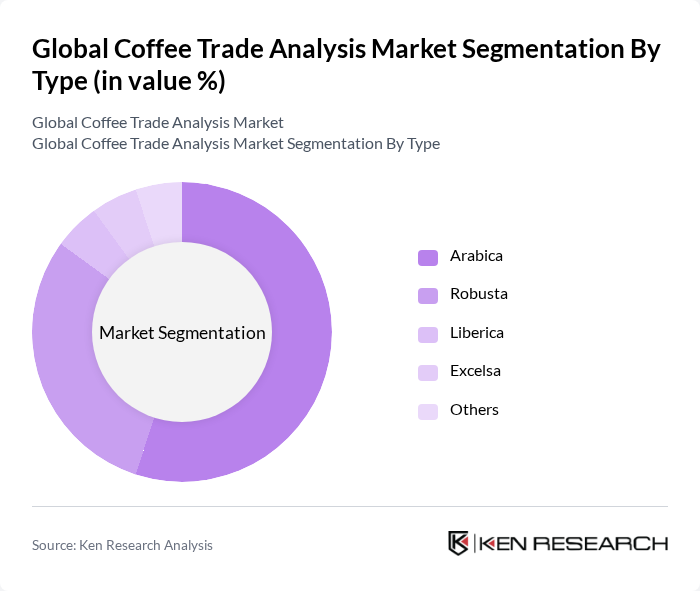
By Type:The coffee market is segmented into Arabica, Robusta, Liberica, Excelsa, and others. Arabica coffee holds the largest share due to its superior flavor profile and lower caffeine content, making it the preferred choice for consumers globally. Robusta, valued for its strong flavor and higher caffeine content, is significant in instant coffee production. The specialty coffee trend has increased interest in Liberica and Excelsa, which offer unique taste experiences. The segmentation aligns with global production and consumption patterns, where Arabica and Robusta dominate, and niche varieties are gaining traction among specialty coffee enthusiasts .
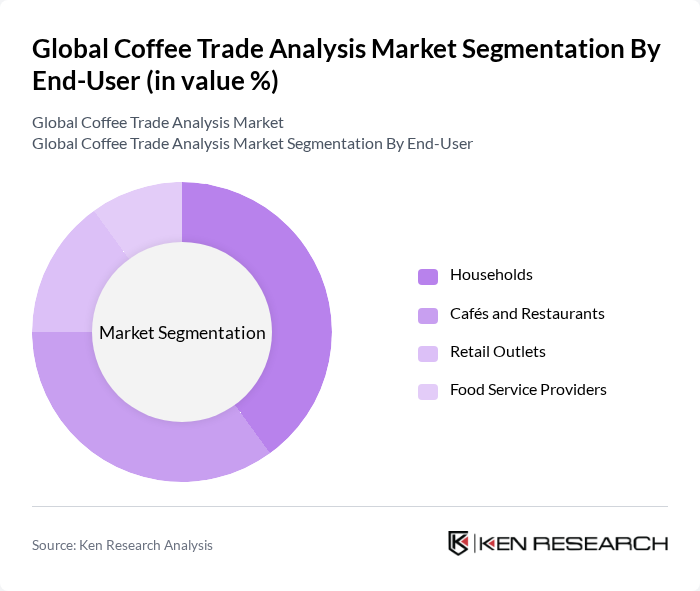
By End-User:The coffee market serves households, cafés and restaurants, retail outlets, and food service providers. Households represent a major segment as home coffee consumption rises, driven by convenience and the proliferation of home brewing equipment. Cafés and restaurants are critical in supporting coffee culture and social experiences. Retail outlets and food service providers are essential for distribution and accessibility, reflecting the market's broad reach across consumer channels. The segmentation mirrors the evolving consumption landscape, where both at-home and out-of-home coffee drinking are significant .
Global Coffee Trade Analysis Market Competitive Landscape
The Global Coffee Trade Analysis Market is characterized by a dynamic mix of regional and international players. Leading participants such as Starbucks Corporation, Nestlé S.A., J.M. Smucker Company, Dunkin' Brands Group, Inc., Keurig Dr Pepper Inc., Luigi Lavazza S.p.A., Illycaffè S.p.A., Peet's Coffee, Inc., Tchibo GmbH, Costa Coffee (The Coca-Cola Company), Blue Bottle Coffee Inc., Tim Hortons Inc. (Restaurant Brands International), Caribou Coffee Company, Inc., Stumptown Coffee Roasters, Coffee Holding Co., Inc., Strauss Group Ltd. (Israel), JDE Peet's N.V., Tata Coffee Limited, Trung Nguyên Group (Vietnam), PT Kapal Api Global (Indonesia) contribute to innovation, geographic expansion, and service delivery in this space.
Global Coffee Trade Analysis Market Industry Analysis
Growth Drivers
- Increasing Global Coffee Consumption:Global coffee consumption reached approximately10.6 million tonsin future, with projections indicating a rise to11 million tonsby future. This growth is driven by an expanding coffee culture, particularly in emerging markets like Asia and Africa, where consumption is expected to increase by2% to 3% annually. The World Bank reports that rising disposable incomes in these regions are significantly contributing to this trend, enhancing demand for coffee products.
- Rising Demand for Specialty Coffee:The specialty coffee segment has seen a remarkable increase, with sales reachingUSD 45 billionin future. This segment is projected to grow as consumers increasingly seek unique flavors and high-quality brews. According to the Specialty Coffee Association, the number of specialty coffee shops has surged by20%in future, reflecting a shift in consumer preferences towards artisanal and ethically sourced coffee, particularly among millennials and Gen Z.
- Expansion of Coffee Retail Chains:Major coffee retail chains, such as Starbucks and Dunkin', have expanded their global footprint, with Starbucks opening over1,000 new storesin future. This expansion is expected to continue, particularly in Asia, where the number of coffee shops is projected to grow by15% annually. The International Coffee Organization notes that this growth is fueled by increasing urbanization and changing lifestyles, driving higher foot traffic and coffee consumption.
Market Challenges
- Fluctuating Coffee Prices:Coffee prices have experienced significant volatility, with the average price per pound fluctuating betweenUSD 1.20 and USD 2.50in future. This instability is largely due to supply chain disruptions and varying crop yields influenced by climate conditions. The International Coffee Organization reported that such price fluctuations can adversely affect both producers and consumers, leading to uncertainty in the market and impacting profitability for coffee businesses.
- Climate Change Impact on Coffee Production:Climate change poses a severe threat to coffee production, with projections indicating that suitable land for coffee cultivation could decrease byup to 50%in future. The World Bank estimates that rising temperatures and changing rainfall patterns could lead to a20% reduction in coffee yieldsin key producing countries like Brazil and Colombia. This challenge necessitates urgent adaptation strategies to ensure sustainable coffee production in the future.
Global Coffee Trade Analysis Market Future Outlook
The future of the coffee trade market appears promising, driven by evolving consumer preferences and technological advancements. As e-commerce continues to grow, online coffee sales are expected to increase significantly, providing new avenues for market penetration. Additionally, innovations in coffee products, such as ready-to-drink options and sustainable packaging, will likely attract environmentally conscious consumers. The focus on ethical sourcing will also shape the market, as consumers increasingly prioritize sustainability in their purchasing decisions.
Market Opportunities
- Growth in E-commerce Coffee Sales:E-commerce coffee sales are projected to reachUSD 10 billionin future, driven by the convenience of online shopping and the rise of subscription services. This trend presents a significant opportunity for coffee brands to reach a broader audience and enhance customer loyalty through personalized offerings and direct-to-consumer models.
- Innovations in Coffee Products:The introduction of innovative coffee products, such as plant-based creamers and cold brew options, is expected to capture the interest of health-conscious consumers. With the market for plant-based products growing at a rate of approximately10% annually, coffee brands that adapt to these trends can tap into new customer segments and increase their market share.
Scope of the Report
| Segment | Sub-Segments |
|---|---|
| By Type | Arabica Robusta Liberica Excelsa Others |
| By End-User | Households Cafés and Restaurants Retail Outlets Food Service Providers |
| By Sales Channel | Online Retail Supermarkets/Hypermarkets Specialty Stores Direct Sales |
| By Packaging Type | Bags Cans Pods Bottles |
| By Roast Level | Light Roast Medium Roast Dark Roast |
| By Flavor Profile | Fruity Nutty Chocolatey Spicy |
| By Region | North America Europe Asia-Pacific Latin America Middle East & Africa |
Key Target Audience
Investors and Venture Capitalist Firms
Government and Regulatory Bodies (e.g., Food and Agriculture Organization, International Coffee Organization)
Manufacturers and Producers
Distributors and Retailers
Exporters and Importers
Logistics and Supply Chain Companies
Industry Associations (e.g., Specialty Coffee Association)
Financial Institutions
Players Mentioned in the Report:
Starbucks Corporation
Nestle S.A.
J.M. Smucker Company
Dunkin' Brands Group, Inc.
Keurig Dr Pepper Inc.
Luigi Lavazza S.p.A.
Illycaffe S.p.A.
Peet's Coffee, Inc.
Tchibo GmbH
Costa Coffee (The Coca-Cola Company)
Blue Bottle Coffee Inc.
Tim Hortons Inc. (Restaurant Brands International)
Caribou Coffee Company, Inc.
Stumptown Coffee Roasters
Coffee Holding Co., Inc.
Strauss Group Ltd. (Israel)
JDE Peet's N.V.
Tata Coffee Limited
Trung Nguyen Group (Vietnam)
PT Kapal Api Global (Indonesia)
Table of Contents
Market Assessment Phase
1. Executive Summary and Approach
2. Global Coffee Trade Analysis Market Overview
2.1 Key Insights and Strategic Recommendations
2.2 Global Coffee Trade Analysis Market Overview
2.3 Definition and Scope
2.4 Evolution of Market Ecosystem
2.5 Timeline of Key Regulatory Milestones
2.6 Value Chain & Stakeholder Mapping
2.7 Business Cycle Analysis
2.8 Policy & Incentive Landscape
3. Global Coffee Trade Analysis Market Analysis
3.1 Growth Drivers
3.1.1 Increasing Global Coffee Consumption
3.1.2 Rising Demand for Specialty Coffee
3.1.3 Expansion of Coffee Retail Chains
3.1.4 Technological Advancements in Coffee Processing
3.2 Market Challenges
3.2.1 Fluctuating Coffee Prices
3.2.2 Climate Change Impact on Coffee Production
3.2.3 Supply Chain Disruptions
3.2.4 Competition from Alternative Beverages
3.3 Market Opportunities
3.3.1 Growth in E-commerce Coffee Sales
3.3.2 Innovations in Coffee Products
3.3.3 Expansion into Emerging Markets
3.3.4 Sustainable Coffee Practices
3.4 Market Trends
3.4.1 Increasing Popularity of Cold Brew Coffee
3.4.2 Rise of Plant-Based Coffee Creamers
3.4.3 Focus on Ethical Sourcing
3.4.4 Growth of Coffee Subscription Services
3.5 Government Regulation
3.5.1 Quality Standards for Coffee Imports
3.5.2 Environmental Regulations on Coffee Farming
3.5.3 Trade Tariffs on Coffee Products
3.5.4 Support for Sustainable Coffee Initiatives
4. SWOT Analysis
5. Stakeholder Analysis
6. Porter's Five Forces Analysis
7. Global Coffee Trade Analysis Market Market Size, 2019-2024
7.1 By Value
7.2 By Volume
7.3 By Average Selling Price
8. Global Coffee Trade Analysis Market Segmentation
8.1 By Type
8.1.1 Arabica
8.1.2 Robusta
8.1.3 Liberica
8.1.4 Excelsa
8.1.5 Others
8.2 By End-User
8.2.1 Households
8.2.2 Cafés and Restaurants
8.2.3 Retail Outlets
8.2.4 Food Service Providers
8.3 By Sales Channel
8.3.1 Online Retail
8.3.2 Supermarkets/Hypermarkets
8.3.3 Specialty Stores
8.3.4 Direct Sales
8.4 By Packaging Type
8.4.1 Bags
8.4.2 Cans
8.4.3 Pods
8.4.4 Bottles
8.5 By Roast Level
8.5.1 Light Roast
8.5.2 Medium Roast
8.5.3 Dark Roast
8.6 By Flavor Profile
8.6.1 Fruity
8.6.2 Nutty
8.6.3 Chocolatey
8.6.4 Spicy
8.7 By Region
8.7.1 North America
8.7.2 Europe
8.7.3 Asia-Pacific
8.7.4 Latin America
8.7.5 Middle East & Africa
9. Global Coffee Trade Analysis Market Competitive Analysis
9.1 Market Share of Key Players
9.2 KPIs for Cross Comparison of Key Players
9.2.1 Company Name
9.2.2 Group Size (Large, Medium, or Small as per industry convention)
9.2.3 Annual Coffee Volume Traded (metric tons)
9.2.4 Revenue Growth Rate (%)
9.2.5 Market Penetration Rate (%)
9.2.6 Customer Retention Rate (%)
9.2.7 Average Selling Price per kg (USD)
9.2.8 Product Diversification Index
9.2.9 Supply Chain Efficiency (Lead Time, Fill Rate)
9.2.10 Brand Recognition Score
9.2.11 Distribution Network Coverage (Countries/Regions)
9.2.12 Share of Specialty vs. Commodity Coffee (%)
9.2.13 Sustainability/Certification Ratio (%)
9.3 SWOT Analysis of Top Players
9.4 Pricing Analysis
9.5 List of Major Companies
9.5.1 Starbucks Corporation
9.5.2 Nestlé S.A.
9.5.3 J.M. Smucker Company
9.5.4 Dunkin' Brands Group, Inc.
9.5.5 Keurig Dr Pepper Inc.
9.5.6 Luigi Lavazza S.p.A.
9.5.7 Illycaffè S.p.A.
9.5.8 Peet's Coffee, Inc.
9.5.9 Tchibo GmbH
9.5.10 Costa Coffee (The Coca-Cola Company)
9.5.11 Blue Bottle Coffee Inc.
9.5.12 Tim Hortons Inc. (Restaurant Brands International)
9.5.13 Caribou Coffee Company, Inc.
9.5.14 Stumptown Coffee Roasters
9.5.15 Coffee Holding Co., Inc.
9.5.16 Strauss Group Ltd. (Israel)
9.5.17 JDE Peet's N.V.
9.5.18 Tata Coffee Limited
9.5.19 Trung Nguyên Group (Vietnam)
9.5.20 PT Kapal Api Global (Indonesia)
10. Global Coffee Trade Analysis Market End-User Analysis
10.1 Procurement Behavior of Key Ministries
10.1.1 Government Contracts for Coffee Supply
10.1.2 Budget Allocations for Coffee Programs
10.1.3 Evaluation Criteria for Coffee Suppliers
10.2 Corporate Spend on Infrastructure & Energy
10.2.1 Investment in Coffee Processing Facilities
10.2.2 Expenditure on Sustainable Practices
10.2.3 Funding for Coffee Research and Development
10.3 Pain Point Analysis by End-User Category
10.3.1 Quality Consistency Issues
10.3.2 Supply Chain Reliability
10.3.3 Pricing Volatility
10.4 User Readiness for Adoption
10.4.1 Awareness of Coffee Varieties
10.4.2 Acceptance of New Coffee Products
10.4.3 Readiness for Online Purchasing
10.5 Post-Deployment ROI and Use Case Expansion
10.5.1 Measurement of Sales Growth
10.5.2 Customer Feedback and Satisfaction
10.5.3 Opportunities for Product Line Expansion
11. Global Coffee Trade Analysis Market Future Size, 2025-2030
11.1 By Value
11.2 By Volume
11.3 By Average Selling Price
Go-To-Market Strategy Phase
1. Whitespace Analysis + Business Model Canvas
1.1 Identification of Market Gaps
1.2 Value Proposition Development
1.3 Revenue Streams Analysis
1.4 Key Partnerships
1.5 Cost Structure Evaluation
1.6 Customer Segmentation
1.7 Channels of Distribution
2. Marketing and Positioning Recommendations
2.1 Branding Strategies
2.2 Product USPs
2.3 Target Audience Identification
2.4 Marketing Channels
2.5 Promotional Activities
3. Distribution Plan
3.1 Urban Retail Strategies
3.2 Rural NGO Tie-ups
3.3 Direct-to-Consumer Approaches
3.4 E-commerce Integration
4. Channel & Pricing Gaps
4.1 Underserved Routes
4.2 Pricing Bands Analysis
4.3 Competitor Pricing Strategies
4.4 Consumer Price Sensitivity
5. Unmet Demand & Latent Needs
5.1 Category Gaps
5.2 Consumer Segments
5.3 Emerging Trends
5.4 Product Development Opportunities
6. Customer Relationship
6.1 Loyalty Programs
6.2 After-sales Service
6.3 Customer Engagement Strategies
6.4 Feedback Mechanisms
7. Value Proposition
7.1 Sustainability Initiatives
7.2 Integrated Supply Chains
7.3 Quality Assurance
7.4 Customer-Centric Innovations
8. Key Activities
8.1 Regulatory Compliance
8.2 Branding Efforts
8.3 Distribution Setup
8.4 Training and Development
9. Entry Strategy Evaluation
9.1 Domestic Market Entry Strategy
9.1.1 Product Mix
9.1.2 Pricing Band
9.1.3 Packaging Considerations
9.2 Export Entry Strategy
9.2.1 Target Countries
9.2.2 Compliance Roadmap
10. Entry Mode Assessment
10.1 Joint Ventures
10.2 Greenfield Investments
10.3 Mergers & Acquisitions
10.4 Distributor Model
11. Capital and Timeline Estimation
11.1 Capital Requirements
11.2 Timelines for Implementation
12. Control vs Risk Trade-Off
12.1 Ownership Considerations
12.2 Partnerships Evaluation
13. Profitability Outlook
13.1 Breakeven Analysis
13.2 Long-term Sustainability
14. Potential Partner List
14.1 Distributors
14.2 Joint Ventures
14.3 Acquisition Targets
15. Execution Roadmap
15.1 Phased Plan for Market Entry
15.1.1 Market Setup
15.1.2 Market Entry
15.1.3 Growth Acceleration
15.1.4 Scale & Stabilize
15.2 Key Activities and Milestones
15.2.1 Milestone Planning
15.2.2 Activity Tracking
Research Methodology
Phase 1: Approach1
Desk Research
- Analysis of global coffee trade statistics from the International Coffee Organization (ICO)
- Review of market reports and white papers from industry associations such as the Specialty Coffee Association
- Examination of trade policies and tariffs affecting coffee imports and exports from government publications
Primary Research
- Interviews with coffee producers and exporters to gather insights on production trends
- Surveys with importers and distributors to understand market dynamics and pricing strategies
- Field interviews with baristas and café owners to assess consumer preferences and trends
Validation & Triangulation
- Cross-validation of data through multiple sources including trade journals and market surveys
- Triangulation of findings from primary interviews with secondary data sources
- Sanity checks conducted through expert panel reviews comprising industry veterans
Phase 2: Market Size Estimation1
Top-down Assessment
- Estimation of total coffee consumption based on global consumption trends and population growth
- Segmentation of market size by coffee type (e.g., Arabica, Robusta) and geographical regions
- Incorporation of emerging market trends such as specialty coffee and sustainable sourcing
Bottom-up Modeling
- Volume estimates derived from production data of major coffee-producing countries
- Revenue calculations based on average selling prices across different coffee segments
- Analysis of supply chain costs from farm to consumer to establish pricing models
Forecasting & Scenario Analysis
- Multi-factor regression analysis incorporating variables such as climate change impact and consumer behavior shifts
- Scenario modeling based on potential changes in trade agreements and tariffs
- Development of baseline, optimistic, and pessimistic forecasts through 2030
Phase 3: CATI Sample Composition1
| Scope Item/Segment | Sample Size | Target Respondent Profiles |
|---|---|---|
| Global Coffee Producers | 100 | Farm Owners, Agricultural Managers |
| Coffee Importers and Distributors | 80 | Import Managers, Supply Chain Directors |
| Retail Coffee Outlets | 60 | Café Owners, Baristas |
| Consumer Preferences in Coffee | 120 | Regular Coffee Drinkers, Specialty Coffee Enthusiasts |
| Market Analysts and Experts | 40 | Industry Analysts, Market Researchers |
Frequently Asked Questions
What is the current value of the Global Coffee Trade Analysis Market?
The Global Coffee Trade Analysis Market is valued at approximately USD 95 billion, reflecting a significant growth driven by increasing consumer demand for specialty coffee and the expansion of coffee retail outlets globally.
Which countries are the largest producers of coffee?
What factors are driving the growth of the coffee market?
How is consumer preference changing in the coffee market?
Other Regional/Country Reports
Indonesia Coffee Trade Analysis Market
Malaysia Coffee Trade Analysis Market
APAC Coffee Trade Analysis Market
SEA Coffee Trade Analysis Market
Why Buy From Us?

What makes us stand out is that our consultants follow Robust, Refine and Result (RRR) methodology. Robust for clear definitions, approaches and sanity checking, Refine for differentiating respondents' facts and opinions, and Result for presenting data with story.

We have set a benchmark in the industry by offering our clients with syndicated and customized market research reports featuring coverage of entire market as well as meticulous research and analyst insights.

While we don't replace traditional research, we flip the method upside down. Our dual approach of Top Bottom & Bottom Top ensures quality deliverable by not just verifying company fundamentals but also looking at the sector and macroeconomic factors.

With one step in the future, our research team constantly tries to show you the bigger picture. We help with some of the tough questions you may encounter along the way: How is the industry positioned? Best marketing channel? KPI's of competitors? By aligning every element, we help maximize success.

Our report gives you instant access to the answers and sources that other companies might choose to hide. We elaborate each steps of research methodology we have used and showcase you the sample size to earn your trust.

If you need any support, we are here! We pride ourselves on universe strength, data quality, and quick, friendly, and professional service.