About the Report
Base Year 2024Global Compound Chocolate Market Overview
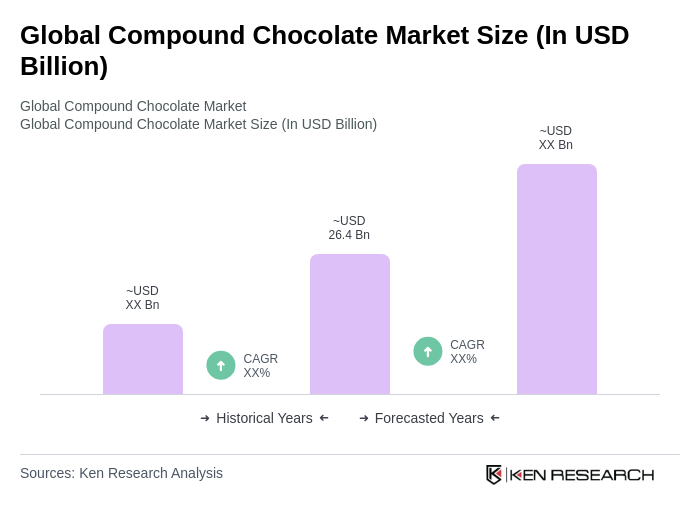
- The Global Compound Chocolate Market is valued at USD 26.4 billion, based on a five-year historical analysis. This growth is primarily driven by the increasing demand for affordable chocolate alternatives, especially in the confectionery and bakery sectors. The rising consumer preference for compound chocolate is attributed to its versatility, cost-effectiveness, and superior heat stability compared to traditional chocolate, which supports market expansion in warmer climates and price-sensitive regions .
- Key players in this market include countries such as the United States, Germany, and China, which dominate due to their robust food processing industries and high consumption rates of chocolate products. The presence of major manufacturers and a well-established distribution network in these regions further enhances their market leadership .
- In 2023, the European Union continued to strengthen regulations aimed at reducing sugar content in food products, including chocolate. These regulations encourage manufacturers to reformulate products to offer lower-sugar, sugar-free, and organic variants, promoting healthier options and driving innovation in the compound chocolate market .
Global Compound Chocolate Market Segmentation
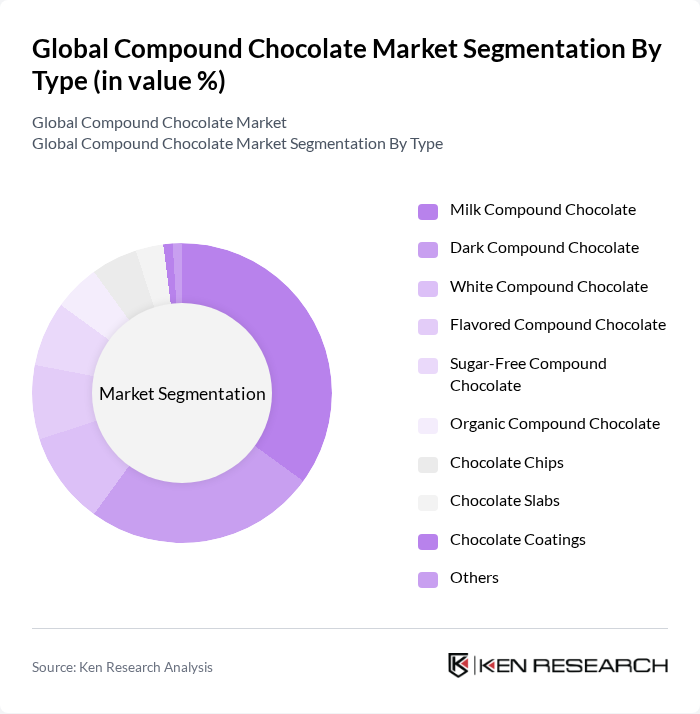
By Type:The compound chocolate market is segmented into Milk Compound Chocolate, Dark Compound Chocolate, White Compound Chocolate, Flavored Compound Chocolate, Sugar-Free Compound Chocolate, Organic Compound Chocolate, Chocolate Chips, Chocolate Slabs, Chocolate Coatings, and Others. Milk Compound Chocolate remains the most popular due to its creamy texture and widespread use in confectionery products. Dark Compound Chocolate is gaining traction as consumers increasingly seek products with perceived health benefits, while Flavored and Organic variants are seeing growth among health-conscious and premium-focused consumers. Sugar-Free Compound Chocolate is expanding as regulatory and consumer trends favor reduced sugar intake .
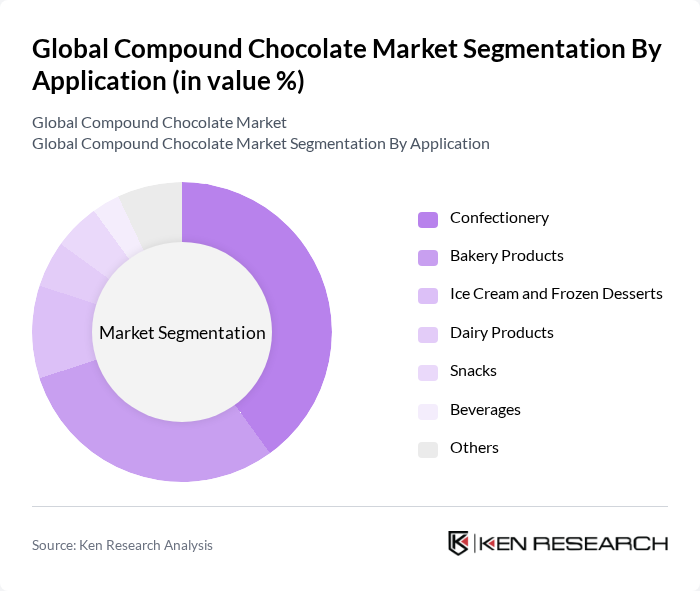
By Application:The compound chocolate market is also segmented by application, including Confectionery, Bakery Products, Ice Cream and Frozen Desserts, Dairy Products, Snacks, Beverages, and Others. The Confectionery segment holds the largest share, driven by high demand for chocolate bars, candies, and sweet treats. Bakery Products are significant due to the widespread use of compound chocolate in cakes, cookies, and pastries. The Ice Cream and Frozen Desserts segment is growing as indulgent dessert trends and technical advantages of compound chocolate (such as heat resistance) support its use in these applications .
Global Compound Chocolate Market Competitive Landscape
The Global Compound Chocolate Market is characterized by a dynamic mix of regional and international players. Leading participants such as Barry Callebaut AG, Cargill, Incorporated, Mondel?z International, Inc., Olam International Limited, Fuji Oil Holdings Inc., The Hershey Company, Nestlé S.A., Mars, Incorporated, Ecom Agroindustrial Corp. Ltd., Puratos Group, Blommer Chocolate Company, AAK AB, Cémoi Chocolatier, Chocoladefabriken Lindt & Sprüngli AG, Guan Chong Berhad (GCB) contribute to innovation, geographic expansion, and service delivery in this space .
Global Compound Chocolate Market Industry Analysis
Growth Drivers
- Increasing Demand for Affordable Chocolate Alternatives:The global compound chocolate market is experiencing a surge in demand, driven by consumers seeking cost-effective alternatives to premium chocolate. In future, the average price of premium chocolate was approximately $4.50 per 100 grams, while compound chocolate was priced around $2.50 per 100 grams. This price difference of $2.00 encourages consumers to opt for compound chocolate, especially in regions where economic conditions are challenging, leading to a projected increase in consumption by 15% in future.
- Rising Health Consciousness Among Consumers:As health awareness grows, consumers are increasingly seeking products that align with healthier lifestyles. In future, the global health food market is expected to reach $1.1 trillion, with a significant portion of this growth attributed to healthier confectionery options. Compound chocolate, often lower in sugar and fat compared to traditional chocolate, is gaining traction. This shift is reflected in a 20% increase in sales of health-oriented compound chocolate products over the past year, indicating a strong trend towards healthier indulgence.
- Expansion of the Confectionery Industry:The global confectionery industry is projected to grow to $250 billion in future, driven by increasing consumer spending on snacks and sweets. This expansion is particularly evident in emerging markets, where urbanization and rising disposable incomes are fueling demand. In regions like Asia-Pacific, the compound chocolate segment is expected to grow by 25% as manufacturers introduce innovative products tailored to local tastes, further solidifying the market's growth trajectory.
Market Challenges
- Fluctuating Raw Material Prices:The compound chocolate industry faces significant challenges due to the volatility of raw material prices, particularly cocoa and sugar. In future, cocoa prices surged by 30% due to supply chain disruptions and adverse weather conditions. This unpredictability can lead to increased production costs, forcing manufacturers to either absorb these costs or pass them on to consumers, potentially impacting sales. The industry must navigate these fluctuations to maintain profitability and market stability.
- Competition from Premium Chocolate Brands:The compound chocolate market is increasingly challenged by the strong presence of premium chocolate brands, which are perceived as higher quality. In future, premium chocolate brands captured 60% of the market share, leaving compound chocolate with a smaller segment. This competition is intensified by the marketing strategies employed by premium brands, which emphasize quality and artisanal production. To counter this, compound chocolate manufacturers must innovate and enhance their product offerings to attract discerning consumers.
Global Compound Chocolate Market Future Outlook
The future of the compound chocolate market appears promising, driven by evolving consumer preferences and innovative product development. As health-conscious trends continue to shape purchasing decisions, manufacturers are likely to focus on creating healthier formulations. Additionally, the rise of e-commerce platforms is expected to facilitate broader market access, allowing consumers to explore diverse product offerings. This shift towards online retail will likely enhance market penetration, particularly in regions with growing internet accessibility and digital payment systems.
Market Opportunities
- Development of Vegan and Organic Options:The increasing demand for vegan and organic products presents a significant opportunity for the compound chocolate market. In future, the organic food market is projected to reach $300 billion, with consumers actively seeking plant-based alternatives. By introducing vegan compound chocolate options, manufacturers can tap into this lucrative segment, potentially increasing their market share by 10% as they cater to health-conscious and environmentally aware consumers.
- Growth in E-commerce Sales Channels:The rapid expansion of e-commerce is transforming the retail landscape, providing a unique opportunity for compound chocolate brands. In future, online sales in the confectionery sector are expected to exceed $50 billion, driven by convenience and a wider product selection. By enhancing their online presence and leveraging digital marketing strategies, companies can significantly boost their sales and reach a broader audience, particularly among younger consumers who prefer online shopping.
Scope of the Report
| Segment | Sub-Segments |
|---|---|
| By Type | Milk Compound Chocolate Dark Compound Chocolate White Compound Chocolate Flavored Compound Chocolate Sugar-Free Compound Chocolate Organic Compound Chocolate Chocolate Chips Chocolate Slabs Chocolate Coatings Others |
| By Application | Confectionery Bakery Products Ice Cream and Frozen Desserts Dairy Products Snacks Beverages Others |
| By End-User | Retail Consumers Food Manufacturers Food Service Providers Industrial Users Others |
| By Distribution Channel | Supermarkets/Hypermarkets Online Retail Specialty Stores Convenience Stores Foodservice & B2B Others |
| By Packaging Type | Bulk Packaging Retail Packaging Eco-Friendly Packaging Flexible Packaging Others |
| By Price Range | Economy Mid-Range Premium |
| By Region | North America (United States, Canada, Mexico) Europe (United Kingdom, Germany, France, Italy, Spain, Russia, Benelux, Nordics, Rest of Europe) Asia-Pacific (China, India, Japan, South Korea, ASEAN, Oceania, Rest of Asia-Pacific) Latin America (Brazil, Argentina, Colombia, Peru, Chile, Rest of Latin America) Middle East & Africa (Turkey, Israel, GCC, North Africa, South Africa, Rest of Middle East & Africa) |
Key Target Audience
Investors and Venture Capitalist Firms
Government and Regulatory Bodies (e.g., Food and Drug Administration, European Food Safety Authority)
Manufacturers and Producers
Distributors and Retailers
Food and Beverage Industry Associations
Packaging Suppliers
Quality Assurance and Testing Laboratories
Logistics and Supply Chain Management Companies
Players Mentioned in the Report:
Barry Callebaut AG
Cargill, Incorporated
Mondelez International, Inc.
Olam International Limited
Fuji Oil Holdings Inc.
The Hershey Company
Nestle S.A.
Mars, Incorporated
Ecom Agroindustrial Corp. Ltd.
Puratos Group
Blommer Chocolate Company
AAK AB
Cemoi Chocolatier
Chocoladefabriken Lindt & Sprungli AG
Guan Chong Berhad (GCB)
Table of Contents
Market Assessment Phase
1. Executive Summary and Approach
2. Global Compound Chocolate Market Overview
2.1 Key Insights and Strategic Recommendations
2.2 Global Compound Chocolate Market Overview
2.3 Definition and Scope
2.4 Evolution of Market Ecosystem
2.5 Timeline of Key Regulatory Milestones
2.6 Value Chain & Stakeholder Mapping
2.7 Business Cycle Analysis
2.8 Policy & Incentive Landscape
3. Global Compound Chocolate Market Analysis
3.1 Growth Drivers
3.1.1 Increasing Demand for Affordable Chocolate Alternatives
3.1.2 Rising Health Consciousness Among Consumers
3.1.3 Expansion of the Confectionery Industry
3.1.4 Innovations in Flavor and Texture
3.2 Market Challenges
3.2.1 Fluctuating Raw Material Prices
3.2.2 Competition from Premium Chocolate Brands
3.2.3 Regulatory Compliance Issues
3.2.4 Consumer Perception of Compound Chocolate
3.3 Market Opportunities
3.3.1 Growth in E-commerce Sales Channels
3.3.2 Development of Vegan and Organic Options
3.3.3 Expansion into Emerging Markets
3.3.4 Collaborations with Food Service Providers
3.4 Market Trends
3.4.1 Increasing Use of Natural Ingredients
3.4.2 Customization and Personalization of Products
3.4.3 Sustainable Packaging Solutions
3.4.4 Growth of Online Retail Platforms
3.5 Government Regulation
3.5.1 Food Safety Standards Compliance
3.5.2 Labeling and Advertising Regulations
3.5.3 Import and Export Tariffs
3.5.4 Environmental Regulations on Packaging
4. SWOT Analysis
5. Stakeholder Analysis
6. Porter's Five Forces Analysis
7. Global Compound Chocolate Market Market Size, 2019-2024
7.1 By Value
7.2 By Volume
7.3 By Average Selling Price
8. Global Compound Chocolate Market Segmentation
8.1 By Type
8.1.1 Milk Compound Chocolate
8.1.2 Dark Compound Chocolate
8.1.3 White Compound Chocolate
8.1.4 Flavored Compound Chocolate
8.1.5 Sugar-Free Compound Chocolate
8.1.6 Organic Compound Chocolate
8.1.7 Chocolate Chips
8.1.8 Chocolate Slabs
8.1.9 Chocolate Coatings
8.1.10 Others
8.2 By Application
8.2.1 Confectionery
8.2.2 Bakery Products
8.2.3 Ice Cream and Frozen Desserts
8.2.4 Dairy Products
8.2.5 Snacks
8.2.6 Beverages
8.2.7 Others
8.3 By End-User
8.3.1 Retail Consumers
8.3.2 Food Manufacturers
8.3.3 Food Service Providers
8.3.4 Industrial Users
8.3.5 Others
8.4 By Distribution Channel
8.4.1 Supermarkets/Hypermarkets
8.4.2 Online Retail
8.4.3 Specialty Stores
8.4.4 Convenience Stores
8.4.5 Foodservice & B2B
8.4.6 Others
8.5 By Packaging Type
8.5.1 Bulk Packaging
8.5.2 Retail Packaging
8.5.3 Eco-Friendly Packaging
8.5.4 Flexible Packaging
8.5.5 Others
8.6 By Price Range
8.6.1 Economy
8.6.2 Mid-Range
8.6.3 Premium
8.7 By Region
8.7.1 North America (United States, Canada, Mexico)
8.7.2 Europe (United Kingdom, Germany, France, Italy, Spain, Russia, Benelux, Nordics, Rest of Europe)
8.7.3 Asia-Pacific (China, India, Japan, South Korea, ASEAN, Oceania, Rest of Asia-Pacific)
8.7.4 Latin America (Brazil, Argentina, Colombia, Peru, Chile, Rest of Latin America)
8.7.5 Middle East & Africa (Turkey, Israel, GCC, North Africa, South Africa, Rest of Middle East & Africa)
9. Global Compound Chocolate Market Competitive Analysis
9.1 Market Share of Key Players
9.2 Cross Comparison of Key Players
9.2.1 Company Name
9.2.2 Group Size (Large, Medium, or Small as per industry convention)
9.2.3 Revenue Growth Rate (CAGR %)
9.2.4 Market Penetration Rate (by region and segment)
9.2.5 Production Capacity (MT/year)
9.2.6 Customer Retention Rate (%)
9.2.7 Pricing Strategy (Value, Premium, Mass Market)
9.2.8 Product Diversification Index (number of SKUs, product forms)
9.2.9 Supply Chain Efficiency (lead time, distribution reach)
9.2.10 Brand Recognition Score (survey-based or market share proxy)
9.2.11 R&D/Innovation Rate (new launches per year, % of revenue spent on R&D)
9.3 SWOT Analysis of Top Players
9.4 Pricing Analysis
9.5 Detailed Profile of Major Companies
9.5.1 Barry Callebaut AG
9.5.2 Cargill, Incorporated
9.5.3 Mondel?z International, Inc.
9.5.4 Olam International Limited
9.5.5 Fuji Oil Holdings Inc.
9.5.6 The Hershey Company
9.5.7 Nestlé S.A.
9.5.8 Mars, Incorporated
9.5.9 Ecom Agroindustrial Corp. Ltd.
9.5.10 Puratos Group
9.5.11 Blommer Chocolate Company
9.5.12 AAK AB
9.5.13 Cémoi Chocolatier
9.5.14 Chocoladefabriken Lindt & Sprüngli AG
9.5.15 Guan Chong Berhad (GCB)
10. Global Compound Chocolate Market End-User Analysis
10.1 Procurement Behavior of Key Ministries
10.1.1 Government Contracts for Food Supplies
10.1.2 Budget Allocations for Confectionery Products
10.1.3 Compliance with Health Standards
10.2 Corporate Spend on Infrastructure & Energy
10.2.1 Investment in Production Facilities
10.2.2 Energy Efficiency Initiatives
10.2.3 Sustainability Projects
10.3 Pain Point Analysis by End-User Category
10.3.1 Quality Assurance Issues
10.3.2 Supply Chain Disruptions
10.3.3 Price Sensitivity
10.4 User Readiness for Adoption
10.4.1 Awareness of Compound Chocolate Benefits
10.4.2 Willingness to Switch from Traditional Chocolate
10.4.3 Availability of Products in Local Markets
10.5 Post-Deployment ROI and Use Case Expansion
10.5.1 Measurement of Sales Growth
10.5.2 Customer Feedback and Satisfaction
10.5.3 Market Expansion Opportunities
11. Global Compound Chocolate Market Future Size, 2025-2030
11.1 By Value
11.2 By Volume
11.3 By Average Selling Price
Go-To-Market Strategy Phase
1. Whitespace Analysis + Business Model Canvas
1.1 Market Gaps Identification
1.2 Value Proposition Development
1.3 Revenue Streams Analysis
1.4 Cost Structure Evaluation
1.5 Key Partnerships Exploration
1.6 Customer Segmentation
1.7 Channels of Distribution
2. Marketing and Positioning Recommendations
2.1 Branding Strategies
2.2 Product USPs
2.3 Target Audience Identification
2.4 Marketing Channels Selection
2.5 Promotional Activities Planning
3. Distribution Plan
3.1 Urban Retail Strategies
3.2 Rural NGO Tie-ups
3.3 Online Distribution Channels
3.4 Logistics and Supply Chain Management
4. Channel & Pricing Gaps
4.1 Underserved Routes
4.2 Pricing Bands Analysis
4.3 Competitor Pricing Strategies
4.4 Consumer Price Sensitivity
5. Unmet Demand & Latent Needs
5.1 Category Gaps Identification
5.2 Consumer Segments Analysis
5.3 Product Development Opportunities
6. Customer Relationship
6.1 Loyalty Programs Design
6.2 After-sales Service Strategies
6.3 Customer Feedback Mechanisms
7. Value Proposition
7.1 Sustainability Initiatives
7.2 Integrated Supply Chains
7.3 Unique Selling Points
8. Key Activities
8.1 Regulatory Compliance
8.2 Branding Initiatives
8.3 Distribution Setup
9. Entry Strategy Evaluation
9.1 Domestic Market Entry Strategy
9.1.1 Product Mix Considerations
9.1.2 Pricing Band Strategy
9.1.3 Packaging Innovations
9.2 Export Entry Strategy
9.2.1 Target Countries Selection
9.2.2 Compliance Roadmap Development
10. Entry Mode Assessment
10.1 Joint Ventures
10.2 Greenfield Investments
10.3 Mergers & Acquisitions
10.4 Distributor Model Evaluation
11. Capital and Timeline Estimation
11.1 Capital Requirements Analysis
11.2 Timelines for Market Entry
12. Control vs Risk Trade-Off
12.1 Ownership vs Partnerships
12.2 Risk Management Strategies
13. Profitability Outlook
13.1 Breakeven Analysis
13.2 Long-term Sustainability Strategies
14. Potential Partner List
14.1 Distributors Identification
14.2 Joint Ventures Opportunities
14.3 Acquisition Targets
15. Execution Roadmap
15.1 Phased Plan for Market Entry
15.1.1 Market Setup
15.1.2 Market Entry
15.1.3 Growth Acceleration
15.1.4 Scale & Stabilize
15.2 Key Activities and Milestones
15.2.1 Milestone Planning
15.2.2 Activity Tracking
Research Methodology
Phase 1: Approach1
Desk Research
- Industry reports from market research firms focusing on the global compound chocolate market
- Trade publications and journals detailing trends in confectionery and chocolate production
- Statistical data from food and beverage regulatory bodies and trade associations
Primary Research
- Interviews with product development managers at leading chocolate manufacturers
- Surveys with retailers and distributors to understand market demand and consumer preferences
- Focus groups with consumers to gather insights on flavor preferences and purchasing behavior
Validation & Triangulation
- Cross-validation of findings through multiple data sources, including sales data and market trends
- Triangulation of insights from primary interviews with secondary research findings
- Sanity checks conducted through expert panel reviews comprising industry veterans
Phase 2: Market Size Estimation1
Top-down Assessment
- Analysis of global chocolate market size and segmentation to estimate the share of compound chocolate
- Evaluation of regional consumption patterns and growth rates in key markets
- Incorporation of macroeconomic factors influencing chocolate consumption, such as GDP growth and disposable income
Bottom-up Modeling
- Estimation of production volumes from major compound chocolate manufacturers
- Cost analysis based on raw material prices and production efficiencies
- Volume x price modeling to derive revenue estimates for different market segments
Forecasting & Scenario Analysis
- Multi-factor regression analysis incorporating consumer trends, health consciousness, and sustainability
- Scenario planning based on potential regulatory changes and market disruptions
- Development of baseline, optimistic, and pessimistic forecasts through 2030
Phase 3: CATI Sample Composition1
| Scope Item/Segment | Sample Size | Target Respondent Profiles |
|---|---|---|
| Retail Chocolate Sales | 120 | Store Managers, Category Buyers |
| Food Service Industry Insights | 90 | Restaurant Owners, Menu Developers |
| Consumer Preferences in Compound Chocolate | 140 | End Consumers, Chocolate Enthusiasts |
| Manufacturing Process Insights | 80 | Production Managers, Quality Control Specialists |
| Distribution Channel Analysis | 100 | Logistics Coordinators, Supply Chain Analysts |
Frequently Asked Questions
What is the current value of the Global Compound Chocolate Market?
The Global Compound Chocolate Market is valued at approximately USD 26.4 billion, reflecting a significant growth trend driven by the demand for affordable chocolate alternatives, particularly in the confectionery and bakery sectors.
What factors are driving the growth of the compound chocolate market?
Which regions are leading in the compound chocolate market?
What types of compound chocolate are available in the market?
Other Regional/Country Reports
Indonesia Compound Chocolate Market
Malaysia Compound Chocolate Market
APAC Compound Chocolate Market
Why Buy From Us?

What makes us stand out is that our consultants follow Robust, Refine and Result (RRR) methodology. Robust for clear definitions, approaches and sanity checking, Refine for differentiating respondents' facts and opinions, and Result for presenting data with story.

We have set a benchmark in the industry by offering our clients with syndicated and customized market research reports featuring coverage of entire market as well as meticulous research and analyst insights.

While we don't replace traditional research, we flip the method upside down. Our dual approach of Top Bottom & Bottom Top ensures quality deliverable by not just verifying company fundamentals but also looking at the sector and macroeconomic factors.

With one step in the future, our research team constantly tries to show you the bigger picture. We help with some of the tough questions you may encounter along the way: How is the industry positioned? Best marketing channel? KPI's of competitors? By aligning every element, we help maximize success.

Our report gives you instant access to the answers and sources that other companies might choose to hide. We elaborate each steps of research methodology we have used and showcase you the sample size to earn your trust.

If you need any support, we are here! We pride ourselves on universe strength, data quality, and quick, friendly, and professional service.