Global Computational Photography Market

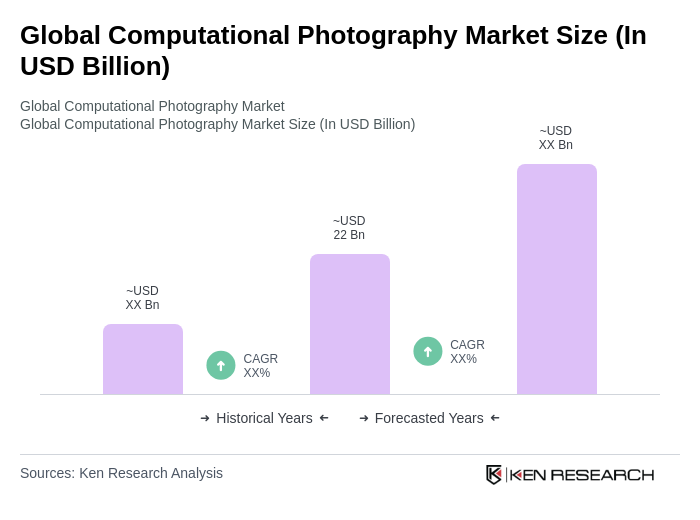
The Global Computational Photography Market, valued at USD 22 Bn, is growing due to advancements in AI-driven imaging and rising social media visual content needs.

Region:Global

Author(s):Geetanshi

Product Code:KRAD0126

Pages:85

Published On:August 2025
About the Report

Base Year 2024

Global Computational Photography Market Overview

  • The Global Computational Photography Market is valued at USD 22 billion, based on a five-year historical analysis. This growth is primarily driven by advancements in imaging technology, rapid integration of artificial intelligence and machine learning in camera systems, increasing demand for high-quality photography in smartphones, and the rising popularity of social media platforms that emphasize visual content. The integration of artificial intelligence in camera systems has significantly enhanced image processing capabilities, enabling features such as real-time image editing, night mode, and portrait effects, further propelling market growth .
  • Key players in this market include the United States, Japan, and Germany, which dominate due to their strong technological infrastructure, significant investments in research and development, and a high concentration of leading camera and semiconductor manufacturers. The presence of major technology companies and a robust consumer electronics market in these countries contribute to their leadership in the computational photography sector .
  • In recent years, the European Union has implemented regulations aimed at enhancing data privacy in computational photography applications. These regulations require companies to obtain explicit consent from users before processing their images, ensuring that consumer rights are protected while using advanced imaging technologies. Compliance with these regulations is crucial for companies operating in the computational photography market .
Global Computational Photography Market Size

Global Computational Photography Market Segmentation

By Product Type:

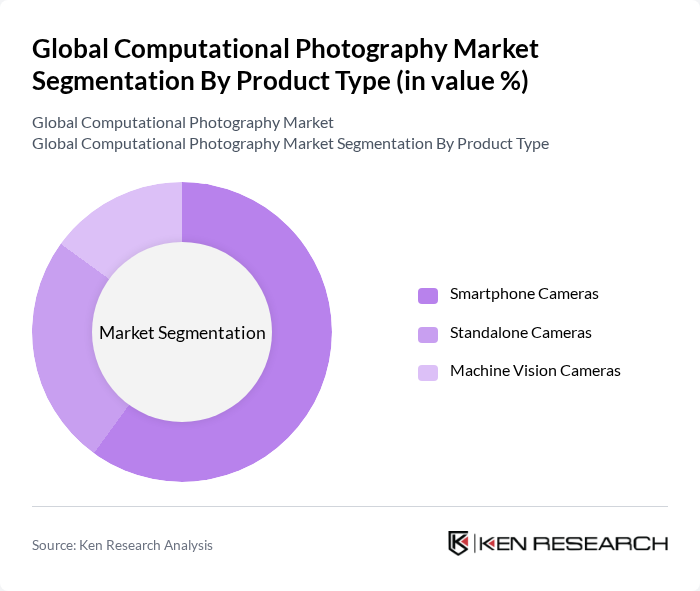
Global Computational Photography Market segmentation by Product Type.

The product type segmentation includes Smartphone Cameras, Standalone Cameras, and Machine Vision Cameras. Among these, Smartphone Cameras dominate the market due to the widespread adoption of smartphones equipped with advanced multi-sensor camera technologies and AI-driven imaging features. The convenience of having a high-quality camera integrated into a mobile device, coupled with the growing trend of social media sharing and real-time image enhancement, drives consumer demand for smartphone cameras. Standalone cameras and machine vision cameras follow, catering to niche markets such as professional photography, security, and industrial automation applications .

By Offering:
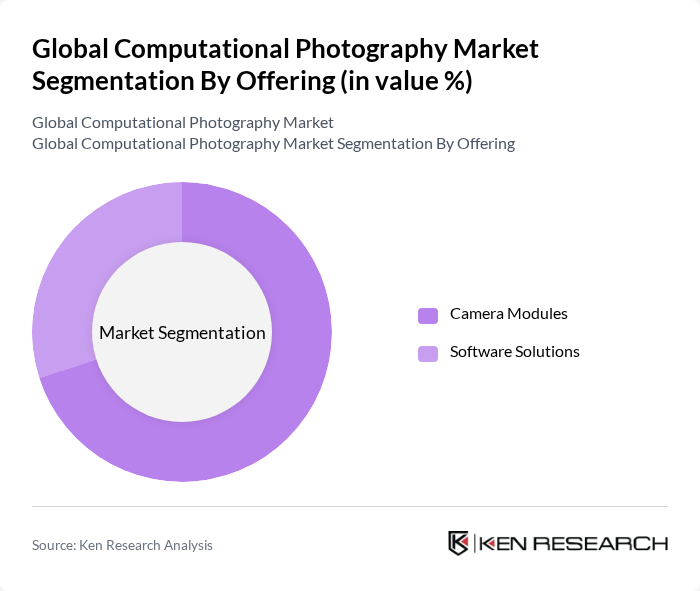
Global Computational Photography Market segmentation by Offering.

This segmentation includes Camera Modules and Software Solutions. Camera Modules are the leading subsegment, driven by the increasing integration of advanced imaging technologies, such as multi-lens arrays and 3D sensors, in consumer electronics. The demand for high-resolution images and enhanced features such as optical zoom, low-light performance, and computational bokeh in smartphones and other devices fuels the growth of camera modules. Software solutions, while essential for image processing, enhancement, and real-time editing, follow as a secondary offering .

Global Computational Photography Market Competitive Landscape

The Global Computational Photography Market is characterized by a dynamic mix of regional and international players. Leading participants such as Apple Inc., Alphabet Inc. (Google), Samsung Electronics Co., Ltd., Sony Group Corporation, Qualcomm Technologies, Inc., Huawei Technologies Co., Ltd., Canon Inc., Nikon Corporation, Adobe Inc., Microsoft Corporation, Fujifilm Holdings Corporation, Panasonic Corporation, GoPro, Inc., DJI Technology Co., Ltd., Light Labs Inc. contribute to innovation, geographic expansion, and service delivery in this space.

Apple Inc.

1976

Cupertino, California, USA

Alphabet Inc. (Google)

1998

Mountain View, California, USA

Samsung Electronics Co., Ltd.

1969

Seoul, South Korea

Sony Group Corporation

1946

Tokyo, Japan

Qualcomm Technologies, Inc.

1985

San Diego, California, USA

Company

Establishment Year

Headquarters

Group Size (Large, Medium, or Small as per industry convention)

Revenue from Computational Photography Segment

R&D Investment in Imaging Technologies

Market Penetration Rate (by device shipments or software installs)

Patent Portfolio Strength (Imaging/AI/Camera IP)

Product Innovation Index (frequency of new feature launches)

Global Computational Photography Market Industry Analysis

Growth Drivers

  • Increasing Demand for High-Quality Imaging:The global demand for high-quality imaging is projected to reach $100 billion by in future, driven by advancements in technology and consumer preferences. As consumers increasingly seek superior image quality for personal and professional use, the market for computational photography is expanding. The rise in online content consumption, with over 5.4 billion internet users globally, further fuels this demand, as high-resolution images are essential for effective digital marketing and social media engagement.
  • Advancements in Smartphone Camera Technology:The smartphone camera market is expected to grow to 1.5 billion units by in future, with computational photography playing a crucial role in enhancing image quality. Innovations such as multi-lens systems and improved sensors are driving this growth. For instance, the introduction of AI-driven features in smartphones has led to a 30% increase in user satisfaction regarding photo quality, indicating a strong consumer preference for devices that leverage computational photography techniques.
  • Rising Popularity of Social Media and Content Creation:The number of social media users is projected to surpass 5.07 billion globally in future, significantly impacting the demand for high-quality images. As content creators and influencers prioritize visually appealing content, the need for advanced photography solutions is increasing. This trend is supported by the fact that posts with high-quality images receive 94% more views, highlighting the importance of computational photography in enhancing user engagement and brand visibility on social platforms.

Market Challenges

  • High Competition Among Key Players:The computational photography market is characterized by intense competition, with major players like Apple, Google, and Samsung investing heavily in R&D. This competitive landscape leads to rapid innovation cycles, making it challenging for smaller companies to keep pace. In future, the market is expected to see over 50 new product launches, intensifying the pressure on existing players to differentiate their offerings and maintain market share.
  • Consumer Privacy Concerns:As computational photography often involves data collection and processing, consumer privacy concerns are a significant challenge. In future, 70% of consumers are expected to express concerns about how their images are used and shared. This apprehension can hinder the adoption of new technologies, as companies must navigate complex regulations and ensure compliance with data protection laws, impacting their ability to innovate and market new solutions effectively.

Global Computational Photography Market Future Outlook

The future of computational photography is poised for significant transformation, driven by technological advancements and evolving consumer preferences. As AI and machine learning continue to enhance image processing capabilities, the integration of these technologies into everyday devices will become more prevalent. Additionally, the growing trend of mobile photography will likely lead to increased demand for innovative solutions that cater to both amateur and professional photographers, ensuring a vibrant and competitive market landscape in the coming years.

Market Opportunities

  • Growth in the E-commerce Sector:The e-commerce market is projected to reach $6.3 trillion by in future, creating substantial opportunities for computational photography. High-quality product images are essential for online sales, driving demand for advanced imaging solutions that enhance visual appeal and customer engagement, ultimately leading to increased conversion rates.
  • Expansion of Augmented Reality Applications:The augmented reality (AR) market is expected to grow to $198 billion by in future, presenting opportunities for computational photography to enhance AR experiences. By integrating high-quality imaging with AR applications, businesses can create immersive experiences that engage users, driving demand for innovative photography solutions that support this technology.

Scope of the Report

SegmentSub-Segments
By Product Type

Smartphone Cameras

Standalone Cameras

Machine Vision Cameras

By Offering

Camera Modules

Software Solutions

By Application

D Imaging

Virtual Reality (VR)

Augmented Reality (AR)

Mixed Reality (MR)

By End-User

Consumer (Smartphones, Tablets)

Professional Photographers

Enterprises (E-commerce, Marketing, Media)

Industrial & Machine Vision

Others

By Region

North America

Latin America

Western Europe

Eastern Europe

Asia-Pacific

Middle East & Africa

Key Target Audience

Investors and Venture Capitalist Firms

Government and Regulatory Bodies (e.g., Federal Communications Commission, National Institute of Standards and Technology)

Manufacturers and Producers of Imaging Devices

Distributors and Retailers of Photography Equipment

Technology Providers and Software Developers

Industry Associations (e.g., Consumer Technology Association, International Imaging Industry Association)

Financial Institutions and Investment Banks

Advertising and Marketing Agencies

Players Mentioned in the Report:

Apple Inc.

Alphabet Inc. (Google)

Samsung Electronics Co., Ltd.

Sony Group Corporation

Qualcomm Technologies, Inc.

Huawei Technologies Co., Ltd.

Canon Inc.

Nikon Corporation

Adobe Inc.

Microsoft Corporation

Fujifilm Holdings Corporation

Panasonic Corporation

GoPro, Inc.

DJI Technology Co., Ltd.

Light Labs Inc.

Table of Contents

Market Assessment Phase

1. Executive Summary and Approach


2. Global Computational Photography Market Overview

2.1 Key Insights and Strategic Recommendations

2.2 Global Computational Photography Market Overview

2.3 Definition and Scope

2.4 Evolution of Market Ecosystem

2.5 Timeline of Key Regulatory Milestones

2.6 Value Chain & Stakeholder Mapping

2.7 Business Cycle Analysis

2.8 Policy & Incentive Landscape


3. Global Computational Photography Market Analysis

3.1 Growth Drivers

3.1.1 Increasing demand for high-quality imaging
3.1.2 Advancements in smartphone camera technology
3.1.3 Rising popularity of social media and content creation
3.1.4 Integration of AI in photography applications

3.2 Market Challenges

3.2.1 High competition among key players
3.2.2 Rapid technological changes
3.2.3 Consumer privacy concerns
3.2.4 High cost of advanced computational photography systems

3.3 Market Opportunities

3.3.1 Growth in the e-commerce sector
3.3.2 Expansion of augmented reality applications
3.3.3 Increasing adoption of drones for photography
3.3.4 Development of new software solutions for image processing

3.4 Market Trends

3.4.1 Shift towards mobile photography
3.4.2 Rise of computational video technology
3.4.3 Growing interest in 3D imaging
3.4.4 Enhanced focus on user-generated content

3.5 Government Regulation

3.5.1 Data protection regulations impacting image sharing
3.5.2 Intellectual property laws for digital content
3.5.3 Standards for image quality and safety
3.5.4 Regulations on drone usage for photography

4. SWOT Analysis


5. Stakeholder Analysis


6. Porter's Five Forces Analysis


7. Global Computational Photography Market Market Size, 2019-2024

7.1 By Value

7.2 By Volume

7.3 By Average Selling Price


8. Global Computational Photography Market Segmentation

8.1 By Product Type

8.1.1 Smartphone Cameras
8.1.2 Standalone Cameras
8.1.3 Machine Vision Cameras

8.2 By Offering

8.2.1 Camera Modules
8.2.2 Software Solutions

8.3 By Application

8.3.1 3D Imaging
8.3.2 Virtual Reality (VR)
8.3.3 Augmented Reality (AR)
8.3.4 Mixed Reality (MR)

8.4 By End-User

8.4.1 Consumer (Smartphones, Tablets)
8.4.2 Professional Photographers
8.4.3 Enterprises (E-commerce, Marketing, Media)
8.4.4 Industrial & Machine Vision
8.4.5 Others

8.5 By Region

8.5.1 North America
8.5.2 Latin America
8.5.3 Western Europe
8.5.4 Eastern Europe
8.5.5 Asia-Pacific
8.5.6 Middle East & Africa

9. Global Computational Photography Market Competitive Analysis

9.1 Market Share of Key Players

9.2 KPIs for Cross Comparison of Key Players

9.2.1 Company Name
9.2.2 Group Size (Large, Medium, or Small as per industry convention)
9.2.3 Revenue from Computational Photography Segment
9.2.4 R&D Investment in Imaging Technologies
9.2.5 Market Penetration Rate (by device shipments or software installs)
9.2.6 Patent Portfolio Strength (Imaging/AI/Camera IP)
9.2.7 Product Innovation Index (frequency of new feature launches)
9.2.8 Strategic Partnerships/Collaborations
9.2.9 Global Distribution Reach
9.2.10 Customer Satisfaction/Net Promoter Score (NPS)

9.3 SWOT Analysis of Top Players

9.4 Pricing Analysis

9.5 Detailed Profile of Major Companies

9.5.1 Apple Inc.
9.5.2 Alphabet Inc. (Google)
9.5.3 Samsung Electronics Co., Ltd.
9.5.4 Sony Group Corporation
9.5.5 Qualcomm Technologies, Inc.
9.5.6 Huawei Technologies Co., Ltd.
9.5.7 Canon Inc.
9.5.8 Nikon Corporation
9.5.9 Adobe Inc.
9.5.10 Microsoft Corporation
9.5.11 Fujifilm Holdings Corporation
9.5.12 Panasonic Corporation
9.5.13 GoPro, Inc.
9.5.14 DJI Technology Co., Ltd.
9.5.15 Light Labs Inc.

10. Global Computational Photography Market End-User Analysis

10.1 Procurement Behavior of Key Ministries

10.1.1 Government contracts for imaging technology
10.1.2 Budget allocation for digital transformation
10.1.3 Collaboration with tech firms for innovation

10.2 Corporate Spend on Infrastructure & Energy

10.2.1 Investment in imaging solutions for marketing
10.2.2 Budget for R&D in photography technology

10.3 Pain Point Analysis by End-User Category

10.3.1 Challenges in integrating new technologies
10.3.2 Need for training and support
10.3.3 Cost concerns for high-end solutions

10.4 User Readiness for Adoption

10.4.1 Awareness of computational photography benefits
10.4.2 Willingness to invest in new technologies

10.5 Post-Deployment ROI and Use Case Expansion

10.5.1 Measurement of performance improvements
10.5.2 Expansion into new markets and applications

11. Global Computational Photography Market Future Size, 2025-2030

11.1 By Value

11.2 By Volume

11.3 By Average Selling Price


Go-To-Market Strategy Phase

1. Whitespace Analysis + Business Model Canvas

1.1 Market Gaps Identification

1.2 Value Proposition Development

1.3 Revenue Streams Analysis

1.4 Customer Segmentation

1.5 Key Partnerships

1.6 Cost Structure

1.7 Channels of Distribution


2. Marketing and Positioning Recommendations

2.1 Branding strategies

2.2 Product USPs


3. Distribution Plan

3.1 Urban retail vs rural NGO tie-ups


4. Channel & Pricing Gaps

4.1 Underserved routes

4.2 Pricing bands


5. Unmet Demand & Latent Needs

5.1 Category gaps

5.2 Consumer segments


6. Customer Relationship

6.1 Loyalty programs

6.2 After-sales service


7. Value Proposition

7.1 Sustainability

7.2 Integrated supply chains


8. Key Activities

8.1 Regulatory compliance

8.2 Branding

8.3 Distribution setup


9. Entry Strategy Evaluation

9.1 Domestic Market Entry Strategy

9.1.1 Product mix
9.1.2 Pricing band
9.1.3 Packaging

9.2 Export Entry Strategy

9.2.1 Target countries
9.2.2 Compliance roadmap

10. Entry Mode Assessment

10.1 JV

10.2 Greenfield

10.3 M&A

10.4 Distributor Model


11. Capital and Timeline Estimation

11.1 Capital requirements

11.2 Timelines


12. Control vs Risk Trade-Off

12.1 Ownership vs Partnerships


13. Profitability Outlook

13.1 Breakeven analysis

13.2 Long-term sustainability


14. Potential Partner List

14.1 Distributors

14.2 JVs

14.3 Acquisition targets


15. Execution Roadmap

15.1 Phased Plan for Market Entry

15.1.1 Market Setup
15.1.2 Market Entry
15.1.3 Growth Acceleration
15.1.4 Scale & Stabilize

15.2 Key Activities and Milestones

15.2.1 Activity Planning
15.2.2 Milestone Tracking

Research Methodology

ApproachModellingSample

Phase 1: Approach1

Desk Research

  • Industry reports from leading market research firms focusing on computational photography trends
  • Academic journals and publications on advancements in imaging technology and computational methods
  • Market analysis from technology blogs and photography forums discussing consumer preferences and innovations

Primary Research

  • Interviews with product managers at leading camera and smartphone manufacturers
  • Surveys with professional photographers and content creators regarding their usage of computational photography tools
  • Focus groups with consumers to understand perceptions and expectations of computational photography features

Validation & Triangulation

  • Cross-validation of findings through multiple data sources, including sales data and user feedback
  • Triangulation of insights from industry experts, market reports, and consumer surveys
  • Sanity checks through expert panel discussions to ensure data accuracy and relevance

Phase 2: Market Size Estimation1

Top-down Assessment

  • Analysis of global smartphone sales data to estimate the penetration of computational photography features
  • Evaluation of the growth of digital camera sales and their integration of computational technologies
  • Incorporation of trends in social media usage and content sharing that drive demand for advanced photography tools

Bottom-up Modeling

  • Estimation of revenue generated from computational photography software and applications
  • Analysis of pricing models for computational photography features in consumer electronics
  • Volume estimates based on user adoption rates and average spending on photography-related products

Forecasting & Scenario Analysis

  • Multi-factor regression analysis incorporating technological advancements and consumer behavior trends
  • Scenario modeling based on potential market disruptions, such as new entrants or regulatory changes
  • Baseline, optimistic, and pessimistic forecasts through 2030 based on varying adoption rates

Phase 3: CATI Sample Composition1

Scope Item/SegmentSample SizeTarget Respondent Profiles
Smartphone Users150General Consumers, Tech Enthusiasts
Professional Photographers100Freelance Photographers, Studio Owners
Camera Manufacturers60Product Managers, Marketing Directors
Software Developers50App Developers, UX/UI Designers
Social Media Influencers40Content Creators, Brand Ambassadors

Frequently Asked Questions

What is the current value of the Global Computational Photography Market?

The Global Computational Photography Market is valued at approximately USD 22 billion, driven by advancements in imaging technology and the integration of artificial intelligence in camera systems, particularly in smartphones and social media applications.

What factors are driving the growth of the Computational Photography Market?

Which regions dominate the Computational Photography Market?

What are the main product types in the Computational Photography Market?

Other Regional/Country Reports

UAE Computational Photography MarketKSA Computational Photography Market

Indonesia Computational Photography Market

Malaysia Computational Photography Market

APAC Computational Photography Market

SEA Computational Photography Market

Why Buy From Us?

Refine Robust Result (RRR) Framework

What makes us stand out is that our consultants follow Robust, Refine and Result (RRR) methodology. Robust for clear definitions, approaches and sanity checking, Refine for differentiating respondents' facts and opinions, and Result for presenting data with story.

Our Reach Is Unmatched

We have set a benchmark in the industry by offering our clients with syndicated and customized market research reports featuring coverage of entire market as well as meticulous research and analyst insights.

Shifting the Research Paradigm

While we don't replace traditional research, we flip the method upside down. Our dual approach of Top Bottom & Bottom Top ensures quality deliverable by not just verifying company fundamentals but also looking at the sector and macroeconomic factors.

More Insights-Better Decisions

With one step in the future, our research team constantly tries to show you the bigger picture. We help with some of the tough questions you may encounter along the way: How is the industry positioned? Best marketing channel? KPI's of competitors? By aligning every element, we help maximize success.

Transparency and Trust

Our report gives you instant access to the answers and sources that other companies might choose to hide. We elaborate each steps of research methodology we have used and showcase you the sample size to earn your trust.

Round the Clock Support

If you need any support, we are here! We pride ourselves on universe strength, data quality, and quick, friendly, and professional service.

Why Clients Choose Us?

400000+
Reports in repository
150+
Consulting projects a year
100+
Analysts
8000+
Client Queries in 2022